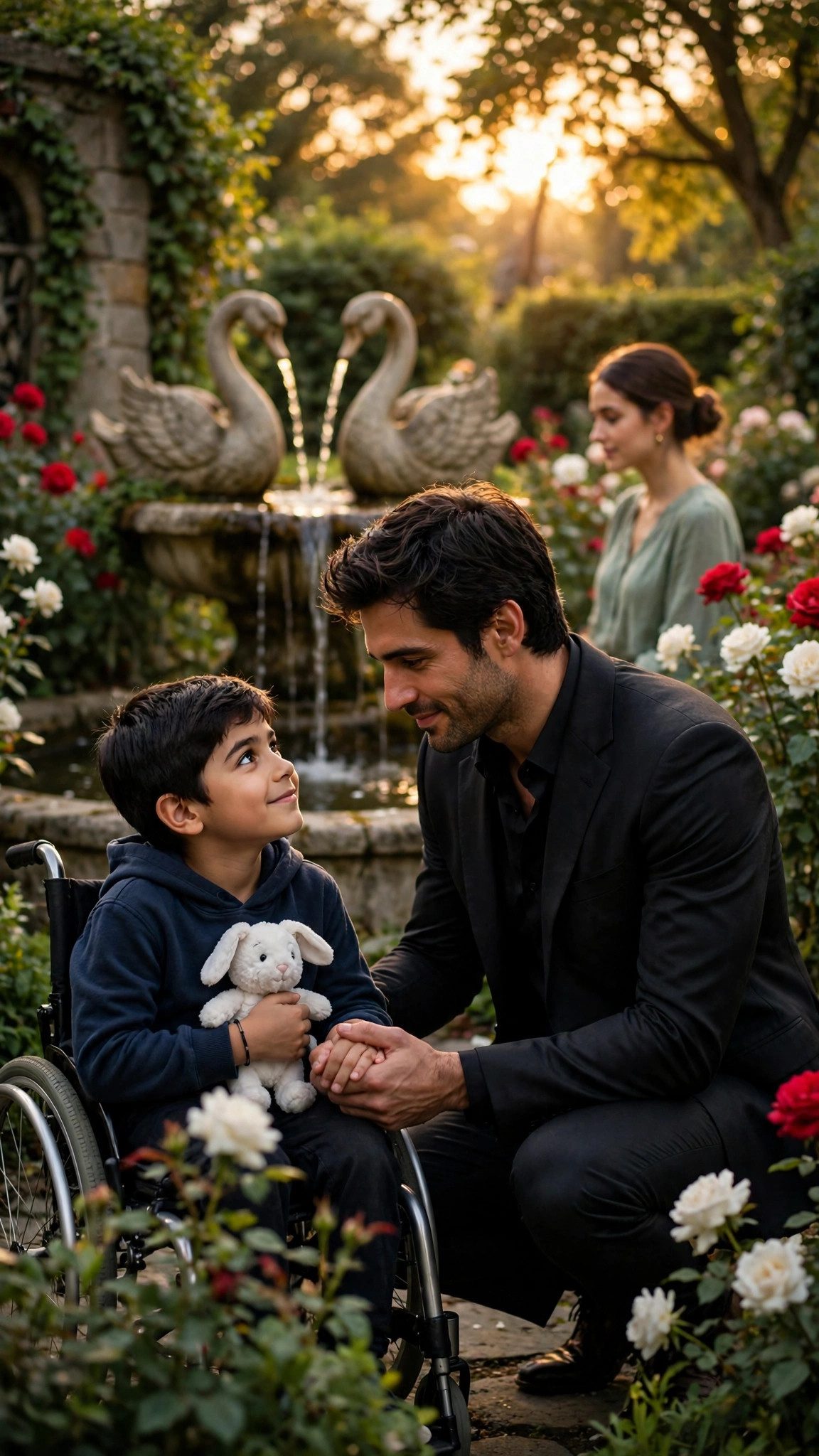
Gabe brought me Clara Hayes's life in a manila folder, and it took me less than five minutes to understand that almost everything in it was a lie.
We sat in my study the morning after I fired her. It was barely seven o'clock. The house was quiet. Matteo was still asleep upstairs, and Rosa was in the kitchen, and the fountain was running in the garden, and the whole world looked ordinary, the way the world always looks ordinary on the morning after something terrible has been confirmed.
Gabe put the folder on my desk and opened it. Inside were photographs, printouts, and a handwritten list of names and dates in Gabe's careful block letters. Gabe had been with me for twenty-three years. He had been my driver when I was twenty-one and stupid, and he had been the man who dragged me out of the burning car on the day my wife died. He did not do sloppy work.
"Her name is not Clara Hayes," Gabe said. "Her real name is Clara Brennan. She was born in Gary, Indiana, thirty-four years ago, not thirty-two. Her mother did not work in cartography. Her mother worked in a diner off the highway and died of an overdose when Clara was sixteen. Her father did not run a business laying cables. Her father was in prison for most of her childhood, for armed robbery, and he died there."
I stared at the folder. "And the references? The families in Winnetka?"
"One of them is real," Gabe said. "She worked for them for six weeks, four years ago. They let her go because the mother caught her going through the father's desk. The other reference is fake. The phone number belongs to a prepaid phone. The woman who answered it and told you what a saint Clara was — that was Clara's friend."
"And Dr. Pierce?" I asked. "He recommended her."
Gabe's face did not change. "Dr. Pierce has a gambling problem, boss. He owes a great deal of money to a great many people. One of the people he owes money to is connected to the Castellano family. I think someone paid off his debt, or part of it, and in return he made a recommendation."
The Castellano family. Salvatore Castellano, who had been trying to take my territory for ten years. Salvatore Castellano, who had smiled at me at Elena's funeral and told me how sorry he was, and whose men had been seen asking questions about my routes and my warehouses in the months before the explosion.
"Keep going," I said.
"Her brother," Gabe said, and he slid a photograph across the desk. It showed a man in his early thirties, thin, with dark hair and a scar that ran from his left eyebrow down to his cheek. "Danny Brennan. He has a record — theft, assault, arson. He did three years in Stateville. He got out eighteen months ago."
"Eighteen months ago," I said. "Four months before the explosion."
"Yes," Gabe said. "And after he got out, he went to work for a man named Eddie Marcone, who runs a garage on the South Side. Marcone does work for the Castellanos. Chop shop, mostly. But he also does other things, for the right price."
I picked up the photograph and looked at it. Danny Brennan. The scar through the eyebrow. I had never seen this man before in my life. But my son had. My son had seen him, on the day his mother died, and he had locked the memory away inside his silence, the way a body locks away a bullet it cannot remove.
"Where is Danny Brennan now?" I asked.
"Gone," Gabe said. "He left Chicago the week after the explosion. No one has seen him since. But I found something else." He slid another paper across the desk. It was a bank statement, or part of one — an account in Clara Brennan's name, at a bank in Milwaukee. "Three deposits," Gabe said. "Fifty thousand dollars, each one, in the three months before she came to work for us. Cash deposits, made in person, in Milwaukee. And one more deposit, two weeks ago. Twenty-five thousand."
"From the Castellanos," I said.
"I can't prove that yet," Gabe said. "But the timing is right. The first deposit came the week Danny Brennan got out of prison. The last one came the week after Matteo drew the woman in the red scarf."
I sat back in my chair and looked out the window at the garden, at the fountain, at the roses, and I felt the cold fury from the night before settle into something harder and clearer. This was not an accident. This was not a bad hire. This was a plan, and it had been running for eighteen months, and my son had been living inside it the whole time.
"Tell me the rest," I said.
Gabe nodded. "The woman in the red scarf," he said. "Matteo's drawing. I think she was at the roadside the day of the van. I think she was there to make sure the men in the van took him. And I think the reason she was hired to take care of him was to make sure he never told anyone what he saw."
"What did he see?" I asked.
"I think he saw Danny Brennan," Gabe said. "I think he saw the man who planted the bomb under your wife's car. He was eight years old, and he was in the back seat, and he saw a man with a scar through his eyebrow crouching beside the car at a red light, and he remembered it, even if he didn't know what it meant. And the Castellanos knew that. They knew that if he ever started talking again, he could describe the bomber. So they sent Clara to keep him quiet. Not to kill him — that would have brought too much attention. Just to keep him afraid. To keep him silent. A little pain, a little fear, every day, just enough to make sure the words never came back."
I thought about Clara's hand in my son's hair. I thought about the rabbit on the floor. I thought about the way Matteo had flinched, every time, for three months, and how I had told myself it was the trauma, the adjustment, the sensory thing. I thought about how close I had come to letting it go on.
"Where is she now?" I asked.
"She left the city last night," Gabe said. "She took a bus to Milwaukee. I have two men watching the house she's staying at. She hasn't left it since she arrived."
"And Danny Brennan?"
"We're looking," Gabe said. "Marcone's garage is being watched. If Danny comes back to Chicago, we'll know."
I stood up and walked to the window. The sun was coming up over the garden, and the light was falling on the fountain, on the water moving over the stone swans, and I thought about Elena, and about the way she used to sit beside that fountain with a book, and about the way she had trusted the world to be kind to her son.
"Here's what we're going to do," I said. "First, I want every piece of paper Clara Brennan ever touched in this house collected and kept. Her contract, her references, everything. Second, I want you to find Danny Brennan. I don't care what it costs. I don't care how long it takes. Find him. Third, I want a message sent to Salvatore Castellano."
"What message?" Gabe asked.
"That I know," I said. "That's all. Just that I know."
Gabe nodded. He understood. In my world, there are messages you send with words, and messages you send with silence, and the most dangerous message of all is the one that says: I know what you did, and I am coming.
But before any of that, there was something else I had to do. Something I had been putting off for fourteen months, because I had not known how to do it, and because I had been afraid of what it would mean.
I had to talk to my son. Not ask him to talk. Not wait for him to talk. I had to tell him the truth.
I went upstairs to his room. He was awake, sitting up in bed, the white rabbit in his arms, staring out the window at the garden. The morning light was coming through the curtains, and his face looked pale and thin, and older than eight.
I sat down on the edge of his bed, the way I had sat the night before, and I took the drawing out of my pocket — the drawing of the road, and the car, and the woman in the red scarf — and I laid it on the blanket between us.
"Matteo," I said, quietly. "I need to tell you something. And I need you to listen, even though it's hard. Can you do that for me?"
He looked at me. His eyes were dark and steady. He nodded, once.
"The woman in the red scarf is gone," I said. "Her name is Clara, and she was not who she said she was. She was working for bad men. The same bad men who hurt your mama. She was supposed to keep you quiet, so you would never tell anyone what you saw. But you did tell me, Matteo. You drew it. You were so brave, and you told me, and now I know."
His eyes filled with tears. His hands tightened on the rabbit.
"I want you to know something," I said. "What happened to your mama was not your fault. What happened to you was not your fault. You did nothing wrong. You were a little boy in the back of a car, and bad men did a bad thing, and none of it — not one piece of it — was because of you."
A tear ran down his cheek. He did not wipe it away.
"And I want you to know something else," I said. "You are safe now. She is gone, and she is never coming back. And I am going to find the men who did this, and I am going to make them answer for it. I promise you that, on your mama's name."
He looked at me for a long moment. Then, slowly, he reached out with one small hand, and he touched the drawing, right where the woman in the red scarf was standing at the edge of the road. And then he turned his hand over, and he pointed at himself, and then he pointed at me, and then he put his hand flat over his heart.
I understood. I am here. You are here. We are still here.
"Yes," I said, and my voice broke, just a little. "We're still here, Matteo. You and me. We're still here."
That afternoon, the van came back.
Gabe was driving Matteo home from physical therapy, the same route they always took, past the park and along the river road, and a black van pulled out of a side street and tried to force their car onto the shoulder. It was the same van, Gabe told me later — the same dent in the rear door, the same cracked taillight. This time, Gabe was ready. He had two of my men in a car behind him, and when the van swerved, the men pulled alongside it and forced it into a parking lot, and they dragged the driver out onto the asphalt.
The driver's name was Tommy Costa. He was twenty-six, and he worked for the Castellanos, and he had a gun under his seat and a photograph of Matteo in his pocket — a photograph taken outside the therapy clinic, the day before.
Gabe brought him to me. Not to the house — never to the house, never where Matteo could hear — but to a warehouse on the South Side, where I kept a room for conversations that could not happen anywhere else. I stood in front of Tommy Costa, and I looked at him, and I asked him one question.
"Who sent you?"
He tried to lie. They always try to lie, at first. But Gabe has a way of asking questions that makes lying feel very expensive, and after a while, Tommy Costa told me the truth.
"Castellano," he said. "Mr. Castellano said the boy had to go. He said the boy saw something, and if he ever started talking, it would be a problem. He said to take him quiet, and bring him to the garage, and someone would take care of it from there."
"Someone who?" I asked.
"I don't know," Tommy said. "I swear, I don't know. I was just the driver."
I believed him. In my world, drivers are rarely told the whole plan. But I had enough. I had the van. I had the photograph. I had the driver's confession. And I had Danny Brennan's name, and Clara Brennan's bank statements, and my son's drawing of a woman in a red scarf.
I called Salvatore Castellano that night. I did not shout. I did not threaten. I simply told him, in a calm voice, that I knew about the bomb, and I knew about the caregiver, and I knew about the van, and that he had until the end of the week to give me Danny Brennan, or I would come and take him myself.
"You don't have proof," Castellano said. His voice was smooth, unbothered, the voice of a man who has spent a lifetime not being caught.
"I have a drawing," I said. "Drawn by an eight-year-old boy who hasn't spoken in fourteen months. A drawing of a woman in a red scarf, standing at the side of the road, watching a van try to take him. A jury would love that drawing, Salvatore. And so would the police. And so would every newspaper in Chicago."
There was a long silence on the other end of the line.
"You have until Friday," I said, and I hung up.
I did not know, then, whether Castellano would give me Danny Brennan, or whether he would try to kill me first, or whether he would do nothing at all and wait to see what I would do. I did not know whether the police would believe a drawing. I did not know whether any of it would be enough.
But I knew one thing. For the first time in fourteen months, I was not waiting anymore. I was moving. And my son, silent in his room upstairs, had given me the first piece of the truth with a red crayon and a shaking hand.
It was time to find the rest of it.