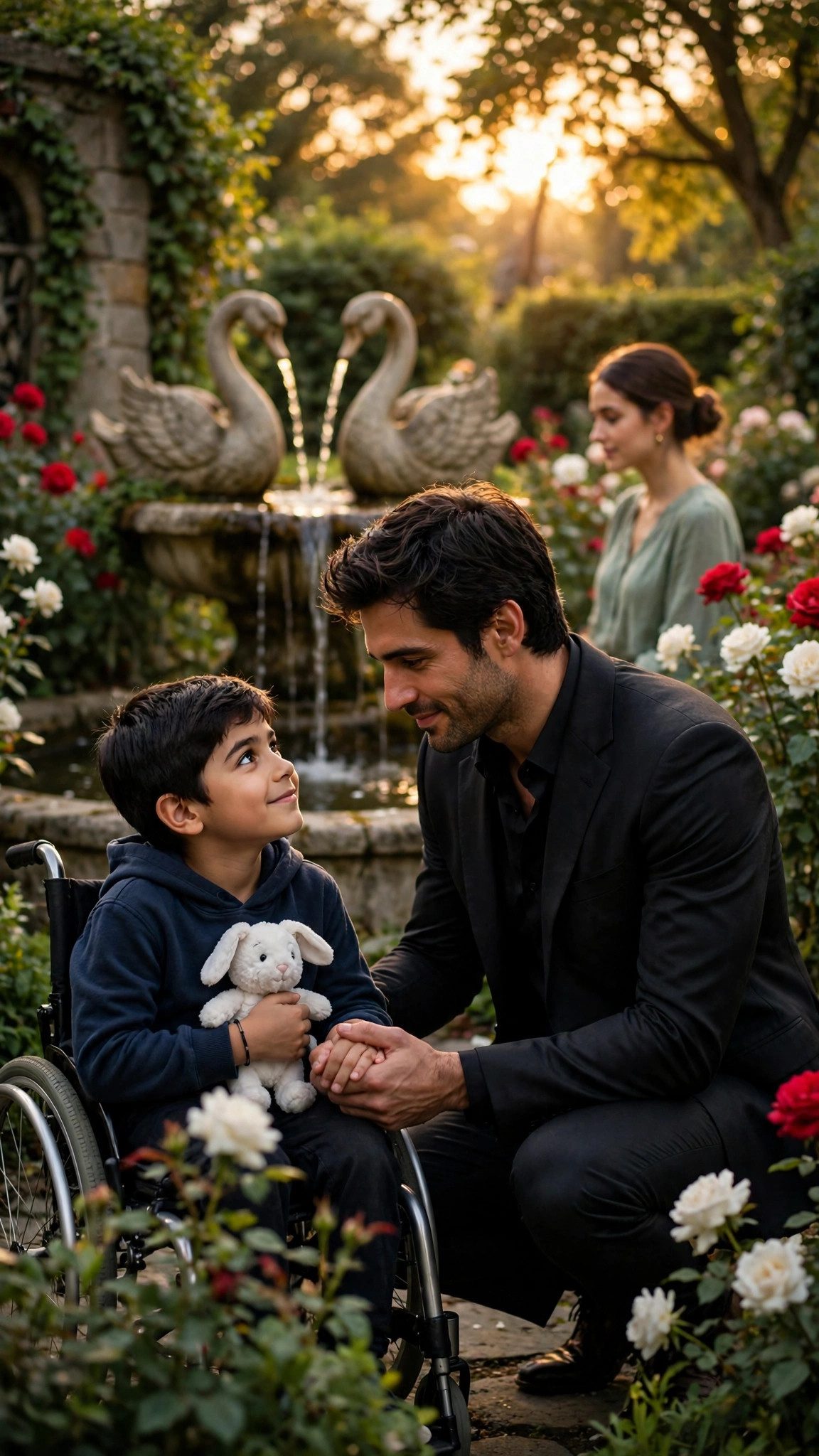
I did not go looking for Lucia Moretti. She came to me, the way the truth comes to you when you have finally stopped running from it.
It was three days after I fired Clara. Matteo was back to eating only when Rosa served him, and he had stopped going to the garden entirely. He sat in his room, in his wheelchair, staring out the window, the white rabbit in his lap, and the house was quiet in the way it had been quiet before Clara came — a waiting quiet, a held-breath quiet.
I was in my study, going over Gabe's reports, when Rosa knocked on the door and said there was a young woman at the gate, asking to see me. She said her name was Lucia Moretti, and she said she had met me at the memorial, and she said she had something to tell me.
I told Rosa to let her in.
Lucia came into the study in the same dark coat she had worn at the memorial, and she stood in front of my desk with her hands folded, and she looked nervous, but she did not look away.
"Mr. Rossi," she said. "I heard what happened. With the caregiver. Rosa told me — I came by yesterday, to leave flowers at the gate, and Rosa told me. I'm sorry. I'm so sorry."
"Thank you," I said. "Why are you here, Lucia?"
She took a breath. "Because I want to help," she said. "I know that sounds strange. You don't know me. But I lost my parents in the same explosion that took your wife, and I have spent fourteen months trying to find a reason to keep going, and I think — I think maybe this is the reason. I used to work as a rehabilitation aide, at a children's hospital downtown. I worked with children who had spinal cord injuries. Children who had stopped speaking. I know what it looks like. I know how long it takes. And I know how to wait."
I looked at her for a long moment. I thought about Dr. Hale's words. I thought about the neighbor's girl who had sat with his son every day after school and never once asked him to answer. I thought about the way Matteo had looked at Lucia at the memorial — the way his eyes had moved, just a little, the way a locked door rattles when someone knocks.
"Why would you want to do this?" I asked. "Why would you want to come into this house, after what happened here?"
"Because someone should have been here for me," she said, and her voice shook, just a little, and she looked down at her hands. "After my parents died, I was alone, and everyone was kind, and everyone brought food, and everyone said all the right things, and then after a month, they all went away, and I was still alone. I don't want Matteo to be alone. I don't want him to sit in a room, waiting for someone to knock. I want to be the person who knocks."
I hired her that afternoon.
Not the way I hired Clara — not on a recommendation, not on a resume, not because she reminded me of anyone. I hired her because she had stood at a memorial in a dark coat with a white rose, and because she had knelt down in front of my son's wheelchair and spoken to him as if he were a person, not a problem, and because when I asked her why, she had told me the truth.
Rosa cried when I told her. She put her arms around Lucia in the kitchen and held her tight, and she said, "Welcome home, sweetheart," and Lucia cried, too, and for the first time in fourteen months, the house did not feel quite so empty.
Lucia started the next morning. She arrived at eight o'clock, the way Clara had, but she did not come in smiling and talking. She came in quietly, and she knocked on Matteo's door, and she waited, and when there was no answer — there was never an answer — she opened the door gently and said, "Good morning, Matteo. It's Lucia. I'm going to sit with you for a while, if that's all right. You don't have to say anything. You don't have to do anything. I'm just going to be here."
And then she sat down in the chair beside his bed, and she opened a book, and she started to read. Not to him, exactly. Just out loud, in a low, easy voice, as if she were reading to herself and he happened to be in the room. She read about a boy who lived in a lighthouse, and a girl who talked to the sea, and after a while, she stopped reading and she started talking — about the weather, about the roses in the garden, about a dog she had seen on the bus that morning — and she never once asked him a question. She never once said, "Can you say something?" She never once looked at him with that waiting, hungry expression that I had worn on my face for fourteen months, the expression that said: please, please, give me a word.
She just kept him company.
On the third day, she brought a sketchbook and a box of crayons, and she set them on the desk beside his bed, and she said, "I like to draw, too. I'm not very good at it, but I like it. If you ever want to draw, the crayons are here. If you don't, that's fine, too."
On the fifth day, Matteo picked up a crayon.
I was standing in the doorway — I had started standing in doorways again, watching, the way I had watched Clara, except this time I was watching for a different reason — and I saw his small hand reach out, slowly, as if the crayon might bite him, and close around the blue one, and he pulled a piece of paper toward him, and he started to draw. It was not a road, or a car, or a woman in a red scarf. It was a fountain. A stone basin with two swans, and water falling over the edge, and roses all around it, red and white, drawn in careful, crooked lines.
Lucia looked at the drawing, and she smiled, and she said, "That's a beautiful fountain, Matteo. Is it the one in the garden?"
He nodded. Once. His eyes were on the paper, but his shoulders had come down, just a little, from where they always lived, up around his ears.
"Would you like to go and see it?" Lucia asked. "The real one? We could go together, if you want. Or we could stay here. It's your choice."
Matteo looked at her for a long moment. Then he looked at the door. Then he looked back at her. And he nodded.
She pushed his wheelchair out of the room and down the hallway and out the back door, into the garden, and I followed at a distance, the way a man follows something he is afraid to believe in. The sun was out. The roses were in bloom — Elena's roses, red and white, the ones she had planted with her own hands. The fountain was running, the water falling over the stone swans, and Lucia pushed Matteo's chair to the edge of the basin, and she sat down on the stone wall beside him, and they sat there together, in the sun, listening to the water.
Matteo reached out with one hand, and he touched the water, just the tips of his fingers, and he pulled his hand back, and he laughed.
It was not a sound. It was not a word. It was a movement — his shoulders shaking, his mouth open, his eyes crinkled at the corners, the silent shape of a laugh. But it was a laugh. The first one I had seen in fourteen months. Lucia laughed, too, out loud, a warm, surprised laugh, and she said, "It's cold, isn't it? I told you it would be cold," and Matteo nodded, and his shoulders shook again, and for a moment, sitting in the sun beside the fountain his mother had loved, my son looked like a child again.
I stood behind the rose bushes, where they could not see me, and I put my hand over my mouth, and I cried. Not the silent, locked-up crying of the months after the explosion. Real crying, with sound, with tears running down my face and into my collar, because for the first time in fourteen months, I had seen my son laugh, and I had seen it happen not because someone had asked him to, or waited for him to, or tried to fix him, but because a young woman who had lost her own parents had sat beside him in the sun and let him be exactly who he was.
After that day, the garden became their place. One afternoon, about a week after the fountain, Lucia arrived carrying a small potted rosebush, white blooms still tight in their buds, soil dark on her hands.
"I brought something," she said to Matteo, holding it up so he could see. "A white rose. Your mama planted red and white roses here, Rosa told me. But I thought the garden could use one more white one. Would you help me plant it?"
Matteo looked at the rosebush, and then at Lucia, and then at the garden, and he nodded. She pushed his chair to a bare patch of earth beside the fountain, where the sun fell strongest in the afternoon, and she knelt down and loosened the soil with a small trowel, and she showed him how to hold the plant steady while she filled the earth around it. His hands were small and careful, and the soil got under his fingernails, and he did not seem to mind. When it was done, he patted the earth flat with the palm of his hand, the way she showed him, and he sat back, and he looked at the little rosebush, and his shoulders came down, and something in his face softened, the way a face softens when it has done something real.
"White roses mean remembrance," Lucia said quietly, sitting back on her heels beside him. "That's what my grandmother used to say. You plant a white rose for someone you love and someone you miss, so that a part of them is always growing."
Matteo reached out and touched one of the closed buds with the tip of his finger, very gently, as if it might break. Then he looked at Lucia, and he pointed at the rosebush, and then he pointed at himself, and then he put his hand flat over his heart.
Lucia's eyes filled with tears. "Yes," she said softly. "For your mama. She would have loved this, Matteo. She would have loved that you planted it yourself."
After that, the white rose became part of their afternoons. Every day, when they came out to the fountain, Matteo would check on it first, leaning forward in his chair to see whether the buds had opened, and Lucia would water it with a small tin can, and they would sit beside it together, and she would read to him, and he would draw, and sometimes she would sing — old songs, lullabies, the kind of songs mothers sing to children when they are small.
Every afternoon, Lucia pushed Matteo's chair out to the fountain, and they sat there together, and she read to him, and he drew, and sometimes she sang — old songs, lullabies, the kind of songs mothers sing to children when they are small. One afternoon, I heard her singing a song I recognized, a song Elena used to sing to Matteo when he was a baby, a song about a river and a boat and a star, and I stood in the doorway of the kitchen, listening, and I felt something inside me loosen, the way a knot loosens when you stop pulling on it.
Matteo started to hum.
It was so quiet, at first, that I thought I was imagining it. A low, tuneless hum, barely louder than breathing, coming from his room one evening while Lucia was reading to him. But then it came again, the next day, and the next, a small, wavering hum, following the shape of the lullaby Lucia had been singing. He was not speaking. He was not even trying to speak. But his voice — the voice I had not heard in fourteen months, the voice I had begun to think I would never hear again — was there, underneath the silence, like water moving under ice.
Dr. Hale came to the house to see him, and he sat with Matteo for an hour, and afterwards he came into my study, and he said, "Something has changed."
"What?" I asked.
"He's not locked anymore," Dr. Hale said. "He's not hiding. He's listening. He's paying attention. Whatever this young woman is doing, keep doing it. Don't change anything. Don't push him. Don't ask him for more. Just let her keep sitting beside him."
"Is he going to talk again?" I asked. It was the question I had asked a hundred times, in a hundred different ways, and I was afraid of the answer, the way you are afraid of an answer you have already heard too many times.
Dr. Hale looked at me, and his old face was kind, and he said, "I don't know, Vincent. I still don't know. But I will tell you this: I have been doing this work for forty years, and I have never seen a child come back from silence without first coming back to the world. And your son is coming back to the world. I can see it in his eyes. He's not gone anymore. He's here. And that is the hardest part. The words, if they come, will come after."
That night, I went out to the garden alone, after Matteo was asleep, and I stood beside the fountain, and I listened to the water falling over the stone swans, and I thought about Elena. I thought about the way she used to sit here with a book, and the way Matteo used to chase butterflies around the rose bushes, and the way the three of us had been a family, once, before the world tore itself in half.
"I'm trying," I said, out loud, to the empty garden. "I'm trying to bring him back, Elena. I don't know if I'm doing it right. But I'm trying."
The fountain kept running. The water kept falling. And for the first time in fourteen months, I did not feel quite so alone in the trying.