Spring came late that year, the way it always comes late in Chicago, as if the city is reluctant to believe in it. But when it came, it came all at once — the sun, the warm wind off the lake, the roses opening in Elena's garden, red and white, all along the paths where Matteo used to chase butterflies before he knew what a wheelchair was.
It had been three weeks since the arrests. Three weeks since Danny Brennan told the police everything, and Clara Brennan was taken away in handcuffs, and Salvatore Castellano's photograph was on the front page of every newspaper in the city. Three weeks since I had told Matteo the truth, and he had written four words on a notepad in large, shaky letters: I SAW THE MAN.
In those three weeks, something had changed in the house. Not all at once. Not dramatically. But quietly, the way spring changes a garden — one bud at a time, until one morning you look out the window and realize that everything is green.
Matteo was drawing every day now. Not just the fountain, not just the roses, but everything — the house, the garden, Rosa in the kitchen, Gabe at the gate, Lucia reading in the chair beside his bed. He drew himself, too, in his wheelchair, with the white rabbit in his lap, and in the drawings, he was always smiling. I kept every one of them in the drawer of my desk, next to the drawing of the woman in the red scarf, because I wanted to remember where we had started, and how far we had come.
He was humming, too. Not just the lullaby, now, but other songs — songs Lucia sang to him, songs Rosa hummed in the kitchen, once, to my amazement, a few bars of a song Elena used to sing in the car, a silly pop song she had loved and I had pretended to hate. He hummed it while he drew, quietly, to himself, and when he caught me listening, he did not stop. He just kept humming, and he smiled, a small, private smile, the way a person smiles when they know a secret and are not quite ready to tell it yet.
Lucia was there every day. She had moved from being a caregiver to being something else, something I did not have a name for yet — a friend, a presence, a part of the house. She ate dinner with us now, at the kitchen table, and Rosa had started setting a place for her without being asked, and Matteo had started saving her the best piece of bread, the way he used to save the best piece for his mother. She never asked him to speak. She never waited for him to speak. She simply sat beside him, and read to him, and talked to him about her day, and let him be exactly who he was, and in return, he gave her something he had given to no one else since the explosion.
His trust.
It was a Sunday morning in late April, warm and bright, the kind of morning Elena had loved best. I was in my study, going over some papers, when Lucia knocked on the door and said, "Vincent, would you come to the garden? Matteo wants to show you something."
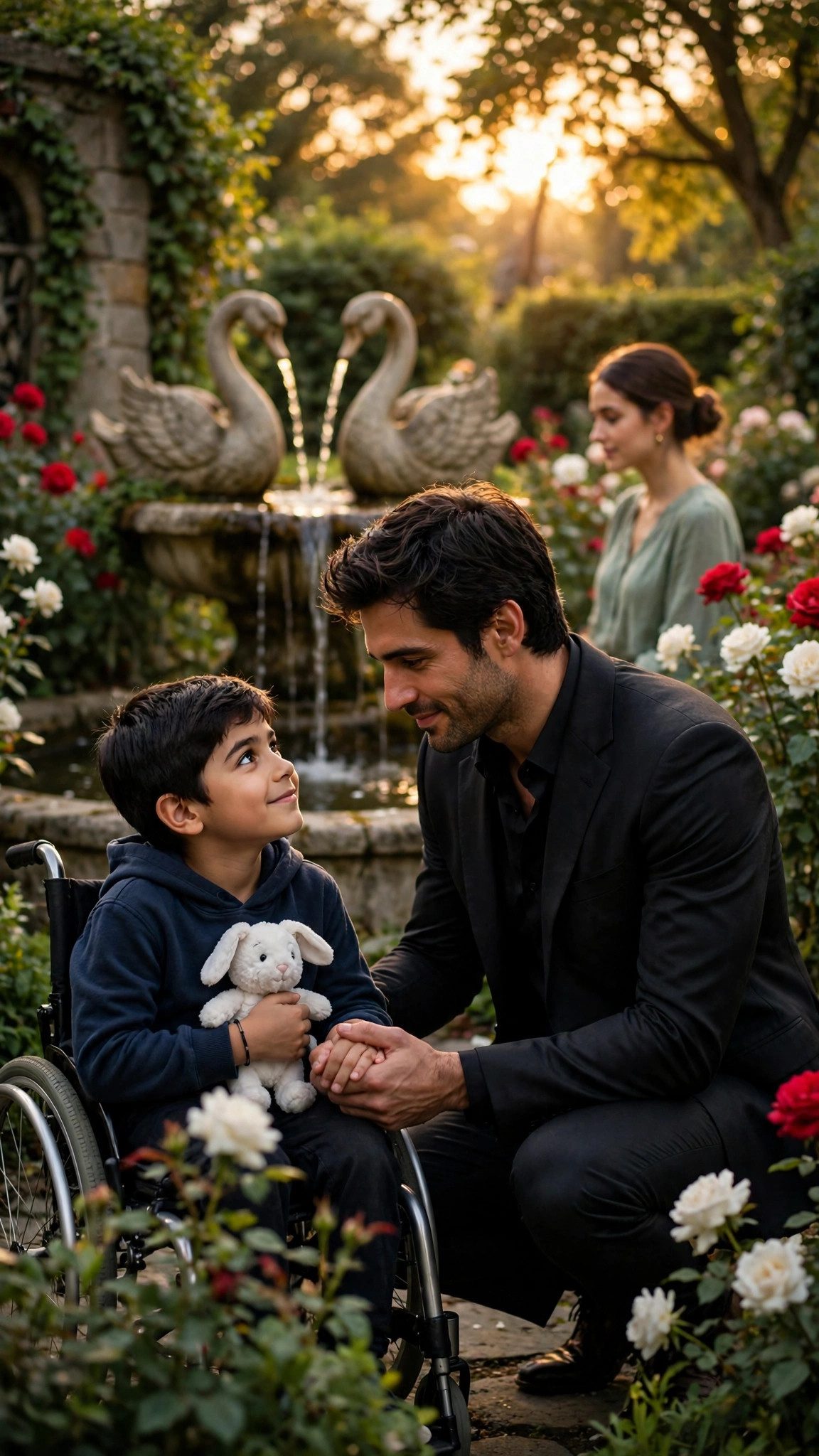
I put down my pen and followed her out the back door, into the sun. The garden was in full bloom. The roses were everywhere, red and white, and the fountain was running, the water falling over the stone swans, and the air smelled like earth and flowers and the lake, miles away.
Matteo was sitting in his wheelchair beside the fountain, in the same place where Lucia had first brought him, on the day he had touched the water and laughed his silent laugh. The white rabbit was in his lap. His sketchbook was open on the stone wall beside him. And he was looking at me, his dark eyes wide and steady, with an expression on his face I had never seen before.
Not fear. Not sadness. Not the flat, waiting look he had worn for fourteen months.
Anticipation. The look of a child who has a secret, and who has finally decided to tell it.
Lucia stood behind his chair, her hands resting lightly on the handles, and she looked at me, and she nodded, once, and she stepped back, giving him space.
I walked toward him, slowly, and I knelt down beside his chair, the way I used to kneel beside his bed when he was small, and I said, "What is it, Matteo? What do you want to show me?"
He looked at me. His mouth moved. His lips shaped a word, the way they had shaped it a hundred times before, in the hospital, in the car, in the dark of his bedroom, when I had asked him and he had tried and nothing had come out.
But this time, something did come out.
It was not loud. It was not clear, not at first. It was a small, rough sound, like a door opening after a long time shut, like a voice remembering how to be a voice.
"Dad."
One word. Three letters. The smallest word in the world, and the biggest.
I stared at him. I could not move. I could not breathe. I could not believe what I had just heard, because for fourteen months I had dreamed of hearing it, and in my dreams it had always sounded exactly like that — small, and rough, and perfect.
"Dad," Matteo said again, a little louder this time, a little clearer, and his eyes filled with tears, and his small hands came out from under the blanket, and he reached for me, and I took him in my arms, wheelchair and all, and I held him, and I cried, and he cried, and the fountain kept running behind us, and the roses kept blooming, and the sun kept shining, as if the whole world had been waiting for this one word, and now that it had come, everything could finally begin again.
"I'm here," I said, and my voice was shaking, and I did not care. "I'm here, Matteo. I'm right here. I've always been here."
He pulled back a little, and he looked at me, and his mouth moved again, and this time the words came faster, tumbling over each other, as if they had been waiting in line for fourteen months and were all trying to get out at once.
"Dad," he said. "Don't go. Stay. Please. Stay."
"I'm not going anywhere," I said. "I'm never going anywhere again. I promise."
He nodded, and then he turned his head, and he looked at Lucia, standing behind his chair with her hands over her mouth and tears running down her face, and he reached out one small hand toward her, and he said, in the same small, rough, perfect voice:
"Stay."
Lucia made a sound — half a laugh, half a sob — and she knelt down beside his chair, and she took his hand, and she said, "I'm staying, Matteo. I'm not going anywhere, either. I'm staying right here."
And that was how it began. Not with a miracle, not with a single moment that fixed everything, but with a word, and then another word, and then another, coming slowly, one at a time, the way water comes back to a fountain after a long winter.
In the weeks that followed, Matteo's words came back the way spring comes back — gradually, and then all at once. First "Dad," and "Stay," and "Lucia," and "Rosa," and "Gabe." Then "hungry," and "tired," and "rabbit," and "fountain." Then whole sentences, short and simple, spoken in a voice that was still rough, still finding its way, but unmistakably his. "I want to go to the garden." "Can Lucia read to me?" "Dad, tell me about Mama."
That last one was the hardest. He asked it one evening, sitting in his bed with the white rabbit in his arms, looking up at me with Elena's dark eyes, and for a moment I did not know what to say. How do you tell an eight-year-old boy about his mother, when the telling means remembering the worst day of your life?
But I had promised myself I would never lie to him again, not even by silence. So I sat down on the edge of his bed, and I told him about Elena. I told him about the way she laughed too loud at dinner parties, and danced barefoot in the kitchen, and put too much garlic in everything she cooked. I told him about the beach in Amalfi, and the fountain she had found at the estate sale, and the roses she had planted with her own hands. I told him about the way she used to sing to him when he was a baby, the song about the river and the boat and the star. And I told him that she loved him more than anything in the world, and that she would be so proud of him — so proud of how brave he had been, and how strong, and how he had never, not once, given up.
"Do you think she can hear me?" Matteo asked, quietly. "If I talk to her?"
"I think she can," I said. "I think she has been listening all along. I think she heard every word you didn't say, and she was waiting, just like I was, for the day you could say them out loud."
He nodded, and he hugged the white rabbit a little tighter, and he said, "Mama, I can talk now," in a small, clear voice, and I had to turn my face away for a moment, because the tears were coming again, and I did not want him to see them, and then I realized that it did not matter if he saw them. Tears count, too. Anna had said that, a lifetime ago, in the hospital. Tears count.
"Tell me one more story about her," Matteo said, settling deeper under his blanket. "The one about how you met."
So I told him, the way I had told him a hundred times before the explosion, and the way I would tell him a hundred times again: about a rainy evening in Rome, and a woman with dark hair laughing at a café table, and a man who walked past and then walked back again, because he could not bear to keep walking. Matteo listened with his eyes half closed, the white rabbit tucked under his chin, and by the time I reached the part where his mother had laughed and said yes to dinner, he was asleep, breathing slow and even, a small smile on his face, dreaming whatever dreams eight-year-old boys dream when the world has finally, finally gone quiet in the right way.
The trials came and went. Danny Brennan was sentenced to twenty-five years. Clara Brennan was sentenced to fifteen. Eddie Marcone was sentenced to thirty. Salvatore Castellano was sentenced to life. The newspapers called it the biggest organized crime case in Chicago in a decade, and for a while, reporters camped outside our gates, and Gabe had to chase them away, and I refused every interview, because none of it mattered to me. What mattered was in the garden, and in the house, and in the small, rough voice of a boy who had found his way back to the world.
Lucia stayed. She did not move into the house, not at first — she had her own small apartment, and her own life, and I did not want to rush anything, not after everything we had been through. But she was there every day, and she ate dinner with us every night, and on Sundays, the three of us went to the garden together, and Matteo would sit beside the fountain, and Lucia would read to him, and I would sit on the stone wall and watch them, and I would think about how strange life was, how it could take everything from you and then, slowly, carefully, give you something back — not the same thing, never the same thing, but something new, something you had not expected, something that was its own kind of gift.
One evening, in late June, when the roses were at their fullest and the air was warm and the fountain was running, Matteo asked me a question.
"Dad," he said. "Is Lucia going to be my new mama?"
I looked at him, and I looked at Lucia, who was sitting beside him with a book in her lap, and I saw the way she was looking at him — not with pity, not with duty, but with love, plain and simple, the way a person looks at someone they have chosen — and I said, "I don't know, Matteo. That's something Lucia and I have to talk about. But I can tell you this: she loves you. And I love you. And whatever happens next, the three of us are going to figure it out together."
"Okay," Matteo said, and he nodded, as if that were a perfectly reasonable answer, and he went back to his drawing, and Lucia reached over and squeezed my hand, and I squeezed hers back, and we sat there in the garden, in the sun, listening to the fountain, and for the first time in fourteen months, the silence in our house was not the silence of a locked door.
It was the silence of a family, sitting together, with nothing left to hide.
That night, after Matteo was asleep, I went out to the garden alone, the way I used to do, and I stood beside the fountain, and I looked up at the stars, and I said, out loud, to the empty air, to Elena, to the woman I had loved and lost and would love for the rest of my life:
"He talks now, Elena. Our boy talks. He says 'Dad,' and he says 'Stay,' and he says your name, and he draws pictures of the fountain, and he laughs, and he is alive, Elena. He is really, truly alive. And I kept my promise. I found out who did this to us. And I brought him home — not the way he was before, because nothing will ever be the way it was before, but home, in the way that matters. He is safe. He is loved. He is heard."
The fountain kept running. The water kept falling over the stone swans. And somewhere upstairs, in a room with a rocket-ship lamp and a white rabbit and a boy who had finally found his voice, the silence that had almost buried us was gone.
And in its place, there was a family.
The End.
THE END