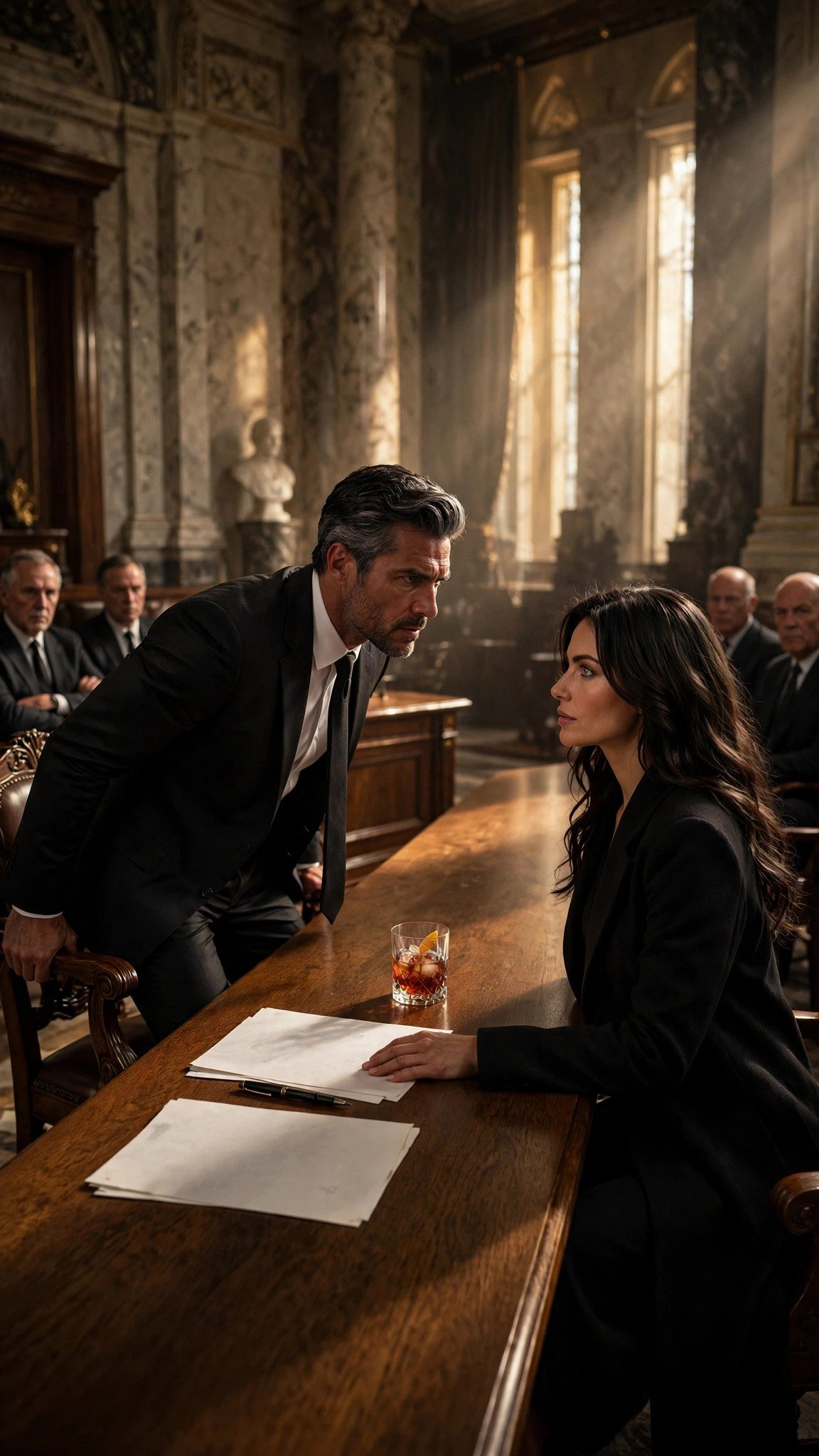
Nothing in my criminal empire had ever frightened me the way my wife did when she walked into that council chamber carrying divorce papers and a secret beneath her black coat.
The chamber doors opened slowly, and every conversation around the oak table died. Capos, attorneys, and men who had ordered killings before breakfast sat straighter as Isabel crossed the marble floor without hesitation. She wore a long black coat, her face calm in a way I found more unsettling than tears. Ten years of marriage stood between us, rotting beneath the silence.
"Isabel," I said.
"Alexander." No affection. No anger. Just our names spoken like the final lines on a gravestone.
Marcus, my consigliere, placed the settlement folder between us. Once we signed, Isabel would surrender every claim to my companies, properties, protection, and family inheritance. She sat opposite me without removing her coat.
"You came prepared," I said.
"I always do."
I studied her over my glass of bourbon. Reading people had kept me alive for years, yet I could not understand the strange steadiness in her eyes.
"You wanted out," I told her. "Here it is."
"No," she replied softly. "You wanted me gone. I simply stopped standing in your way."
The room became painfully still. I looked at the woman across the table and tried to find the girl I had married, and for a moment I could not. What I found instead was a stranger wearing my wife's face, and the stranger was not afraid of me at all. That frightened me more than any rival family ever had, because rivals wanted my money or my territory or my life, and all of those things I knew how to defend. Isabel wanted nothing from me. She had come to sign herself out of my world and walk away clean, and there was no weapon in my arsenal that could stop a woman who wanted nothing.
Marcus cleared his throat and opened the folder. His voice was careful, the voice of a man reading a will at a funeral.
"Upon execution, Mrs. Moretti permanently surrenders all legal, financial, and future claims to the Moretti family, including protection and inheritance."
Future claims. Inheritance. The words struck something deep inside me, something I did not yet have a name for. Isabel moved one hand onto the table, and the fabric of her coat shifted across her body. My eyes dropped for one brief second.
Then I saw it. A curve that had not been there before.
My pulse stopped. Every prayer I had once whispered in darkness, every cruel word I had thrown at her, and every dream I had buried suddenly came together in one impossible truth.
"Take off the coat," I ordered.
Marcus stared at me. "Alexander—"
Isabel's expression remained perfectly calm. "Excuse me?"
My hand tightened around the unsigned divorce papers as I slowly rose from my chair. "I said take off the coat."
Eleven years earlier, I had met her at a charity gala in Manhattan, and I had not believed in love at first sight until she turned around with a glass of champagne in her hand and laughed at something the man beside her had said. She was twenty-four years old, a curator at a small gallery in Chelsea, and she wore a green dress that matched her eyes. I was thirty-one, already running my father's business in all but name, already a man other men lowered their voices for. I had walked across that ballroom with the confidence of a man who had never been refused anything, and I had asked her to dance, and she had looked at me for a long moment and said, "I don't dance with men who look at me like I'm a property listing."
I laughed. Nobody had spoken to me that way in years. I asked her name, and she told me it was Isabel Marchetti, and when I asked what she did, she told me she spent her days convincing rich people to buy paintings they did not understand, which was, she said, probably not so different from what I did. I should have walked away. Instead I asked her to dinner, and she said yes, and then she spent the entire evening arguing with me about art and power and whether a man could be good if his hands were not clean. I had never met anyone like her. I married her fourteen months later, in a small church in Savannah, because her mother had been from Savannah and Isabel had wanted the wedding where her mother's people were buried. My father, Vittorio, had wanted a cathedral in Manhattan with five hundred guests and every capo in the city in attendance. I chose the small church. It was the first time I had ever chosen Isabel over my father, and for a while I believed it would not be the last.
Our first apartment was above a bakery in Chelsea, two rooms and a kitchen so small that Isabel could touch both walls if she stretched her arms out. She loved it. She painted the walls herself, a pale yellow she said reminded her of Savannah mornings, and she hung her mother's watercolors in the hallway, and on Sunday mornings she made coffee so strong it could strip paint and read the newspaper aloud to me in different voices, doing impressions of politicians she despised. I would sit at the table in my shirtsleeves and watch her, and I would think that this was what other men meant when they talked about peace, and that I had somehow stolen it for myself.
She wore her mother's necklace every day then, a thin gold chain with a small oval locket that held a photograph of her mother as a young woman in Savannah, standing under an oak tree with her hair loose around her shoulders. Isabel told me her mother had given it to her on her eighteenth birthday, with the words, "Wear it when you need to remember who you are." After her mother died, Isabel never took it off. Not in the shower. Not at night. It was the one thing she owned that had nothing to do with me, and I understood, even then, that it mattered to her in a way my gifts never would.
The gallery gave her a show of her own in our second year of marriage. She curated it herself — young painters, unknown names, canvases full of color and anger and hope — and on the opening night the little room in Chelsea was so crowded that people spilled out onto the sidewalk with glasses of cheap wine. I stood in the corner in a suit that cost more than every painting on the walls combined, and I watched her move through the crowd, touching elbows, remembering names, making a nervous young artist laugh until he forgot to be afraid. A collector offered to buy three pieces on the spot. Isabel sold him one, and told him the other two were not for sale at any price, because the artist needed to know his work had a home that was not a vault. The collector laughed and bought the one, and Isabel came to find me afterward with champagne on her breath and paint on her cuff, and she said, "Did you see that? Did you see what we did tonight?" And I said, "You did it. I just stood in the corner." And she said, "You were here. That counts." It counted. God, it counted. I did not know then how much I would miss being counted.
We were happy. I want that written down plainly, because everything that came after makes it easy to believe we were not. We were happy in the ordinary way, the way that does not make a good story but makes a good life. She taught me to cook one dish — a shrimp pasta her mother had made in Savannah — and I burned it three times before I got it right, and she ate every failed attempt without complaint and told me each one was better than the last, which was a lie, and I knew it was a lie, and I loved her for it. On our third anniversary, I gave her a painting, a small seascape by an artist she admired, and she cried, and she hung it in our bedroom where the morning light would hit it first. On our fifth, she gave me a watch, and I have worn it every day since, even now, even in this chamber, even while I sit across from her and try to find the words that will undo what I have done.
The first years were good. They were better than good. Isabel turned our penthouse into a home, filling it with paintings and books and the smell of coffee in the mornings. She kept her gallery job, and in the evenings she would come home and tell me about difficult clients and impossible artists, and I would tell her nothing about my days, and she would pretend not to notice the shape of what I did not say. She knew what I was. She had known from the beginning. She had married me anyway, and for a long time I believed that was enough, that love could be a wall between my world and hers.
Then my father began to talk about an heir.
Vittorio Moretti had built the family from nothing, and he believed with the certainty of a religious man that a family without a son was a family already dying. He said it at Sunday dinners. He said it at christenings of other men's children. He said it to Isabel directly, with a smile that did not reach his eyes, asking when we would give him a grandson to carry the name. At first Isabel laughed it off. Then she stopped laughing. Then she began to try.
We tried for two years. Doctors, clinics, charts, temperatures, appointments that I attended in a suit with my phone buzzing in my pocket, specialists who used words like "unexplained" and "patience" while my father's voice got louder in my head. Every month that passed without news, I felt the bloodline narrowing, and I began to hear my father's words in my own voice. A man in my position can survive enemies and betrayal, I told myself, but he cannot survive being the end of his bloodline. I said it to Isabel once, in anger, and I watched her face change, and I told myself she would forgive me because she always forgave me.
The night everything broke, rain hammered the windows of our Manhattan penthouse while Isabel stood barefoot near the fireplace, clutching a folder of fertility treatments. She had asked me to keep trying, but my father's obsession had already poisoned everything between us.
"A man in my position can survive enemies and betrayal," I said. "But he cannot survive being the end of his bloodline."
Isabel stared at me as though I had struck her. "So I'm only the woman who failed to give you a son?"
Pride answered before love could stop it. "You're the woman who cannot give me one."
She went completely pale. "If I had already given you a child," she asked, "would you still speak to me this way?"
I said nothing. There was nothing to say that would not make it worse, and so I said the worst thing of all, which was nothing. She looked at me for a long moment, and I saw something close behind her eyes, and then she turned and walked out of the room. By sunrise, she was gone.
For months, Isabel disappeared from every place my name could easily reach. She rented a quiet townhouse in Savannah under her maiden name, refused my money, ignored every call, and rebuilt her life with a precision that slowly drove me mad. My men could not find her. My father's men could not find her. Marcus told me to let her go, and I told Marcus to keep looking, and the penthouse grew emptier every week, and the paintings she had chosen began to look like evidence in a room where a crime had been committed.
What I did not know was that shortly after leaving, she had walked into a private clinic because of nausea, dizziness, and exhaustion. A doctor reviewed her medical history twice before delivering the impossible news. She was pregnant. The child I had destroyed our marriage trying to secure had already been growing inside her.
Isabel told no one in my family. She refused to let our baby become leverage, succession, or proof of my bloodline. For six months, she attended appointments alone, bought blankets in quiet colors, and built a life far beyond my reach.
And now she sat across from me while Marcus read the final clause aloud, and her coat shifted, and I saw the curve, and my whole world tilted on its axis.
"Alexander," Marcus said again, more sharply. "Sit down."
I did not sit down. I looked at Isabel, and she looked back at me, and in her green eyes I saw six months of mornings I had not been part of, six months of appointments I had not driven her to, six months of a life growing inside her that I had nearly thrown away with my own hands.
"Is that what I think it is?" I asked, and my voice did not sound like my own.
Isabel's hand rested flat against the table, steady as stone. "That depends," she said, "on what you think it is."
Around the table, the men had gone very still. These were men who had survived indictments and ambushes and betrayals, men who could smell a shift in power the way animals smell a storm, and every one of them was watching me now, waiting to see what the head of the Moretti family would do when the ground moved under his feet. I could feel their eyes on my face. I could feel Marcus holding his breath beside me. And I could feel, underneath it all, the one thing I had not felt in six months — not anger, not pride, not the cold arithmetic of the family business, but something raw and unguarded and almost like hope, rising in my chest before I could stop it.