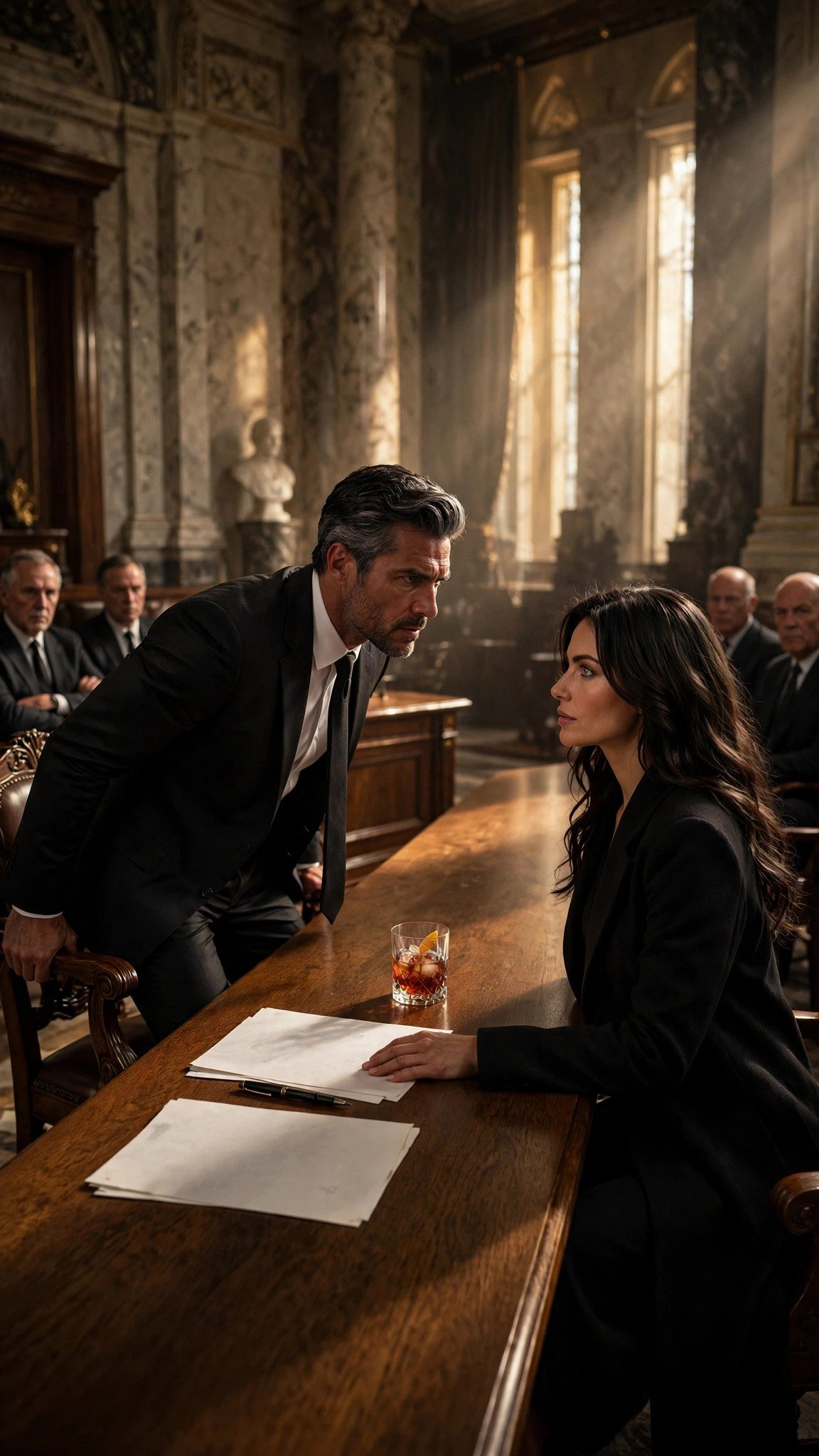
Marcus told me on a Thursday, in my office, with the door closed and the blinds drawn, in the voice he uses when the news is bad enough to require a drink first.
"Your father found her," he said. "Savannah. A townhouse. He's been there. Delgado filed the report three days ago."
I stared at him. "And you are telling me this now?"
"I am telling you now because Delgado's report had a second page, and I only got the second page this morning." Marcus set his glass down. "Alexander. She is pregnant. Six months, by Delgado's estimate. The child is yours."
The room tilted. I remember the exact shape of the moment: the bourbon glass on my desk, the late light coming through the blinds in bars, Marcus's face, very still, watching me the way you watch a man who has just been told his house is on fire. Six months. She had been pregnant when she left. She had been pregnant on the night of the fight. She had been pregnant when she asked me the question I could not answer. The child I had destroyed our marriage trying to secure had been growing inside her all along, and I had spent six months searching for a woman who was carrying my son or my daughter in a townhouse in Savannah while I sat in Manhattan feeling sorry for myself.
"Where exactly?" I asked.
Marcus gave me the address. He gave me Delgado's photographs. I looked at them for a long time — Isabel on a quiet street with groceries, Isabel in a square under the oaks, Isabel with her hand pressed to the small of her back — and I felt something crack open in my chest that had been sealed shut for six months.
"Does my father know?" I asked.
"He knows. He went there himself. He offered her the family. She refused him."
"Of course she refused him," I said, and I almost laughed. "She refused me. Why would she accept him?"
Marcus leaned forward. "There is more. Delgado says another crew has been asking questions in Savannah. Not ours. Not your father's. Men asking about a pregnant woman from New York. Alexander — I think Ferraro knows."
Carlo Ferraro. The name landed like a stone in still water. Ferraro had been circling my territory for two years, probing, testing, waiting for a weakness. A pregnant wife, alone in Savannah, was not a weakness. It was a wound, and Ferraro had a nose for wounds.
I flew to Savannah that night. I did not tell my father. I did not tell the council. I took two men I trusted — Tony, my driver, and Sal, who had been with me since I was twenty — and I rented a room in a small hotel across the street from a bookshop called The Paper Lantern, and I waited.
I saw her the next morning. She came out of the townhouse with a canvas bag over her shoulder, her hair loose, her dress loose too, but not loose enough. I saw the curve beneath it, and I had to grip the windowsill to stay upright, because there it was, the thing I had wanted for so long that I had stopped believing in it, walking down a Savannah street in the morning sun with a canvas bag full of books. She looked well. She looked rested. She looked, impossibly, like a woman who had found a way to be happy without me, and the sight of it hurt more than any betrayal ever had, because betrayal I understood. Her happiness without me was a language I did not speak.
I followed her that day, at a distance, the way Delgado had followed her, the way a man follows something precious he is afraid to touch. She went to the bookshop. She shelved novels. She recommended poetry to a tourist. She ate lunch on a bench in a square, under the oaks, with her hand resting on her belly. She bought peaches from a market stall and laughed at something the vendor said. And all day, I watched from doorways and corners, a ghost in my own wife's life, and I did not approach her, because I did not know what I would say. I am sorry is four syllables. It is not enough. It will never be enough. But it was all I had, and I could not bring myself to spend it on a sidewalk where she might look at me and say the words I deserved to hear: too late.
On the third day, I went to see my father. I flew back to New York, walked into his house in Brooklyn without calling first, and found him in his study with a glass of wine and a newspaper, as if nothing had happened.
"You went to Savannah," I said.
"I went to see my grandchild's mother," he said, not looking up. "Someone had to. You were too busy feeling sorry for yourself."
"She is not your grandchild's mother. She is my wife. And the child is not the family's property. The child is hers, and mine, and that is where it ends."
He set the newspaper down then, slowly, and looked at me, and I saw in his face the same expression I had seen a hundred times — the don weighing a disobedient son. "You would throw away the bloodline for a woman who left you?"
"I threw away the woman for the bloodline," I said. "I will not make the same mistake twice. Stay away from her, Father. Stay away from Savannah. If anything happens to her, if one hair on her head is harmed because of this family, I will hold you responsible, and you know what that means."
We looked at each other for a long moment, father and son, two men who had loved each other once and had spent years learning how not to. Then he picked up his newspaper again, and he said, very quietly, "Ferraro knows, Alexander. His men were asking in Savannah before Delgado ever got there. Whatever you are going to do, do it quickly."
I flew back to Savannah that night. I rented the room across from the bookshop again. I watched her come out of the townhouse in the morning, and I watched her walk to work, and I watched the street the way I used to watch the docks when a shipment was coming in — every face, every car, every man standing too long in one place. On the fourth evening, a photograph was slipped under Isabel's door. I know, because Rosa called the police, and the police called no one, and Marcus's man in the Savannah department told Marcus, and Marcus told me. The photograph showed Isabel's townhouse, taken from across the street, in the morning light. On the back, in block capitals, someone had written: PRETTY HOUSE. BE A SHAME IF SOMETHING HAPPENED TO THE MOTHER.
I did not sleep that night. I sat in the dark hotel room with the lights off and my gun on the table beside me, watching the street below, and I made myself a promise. I had failed Isabel as a husband. I had failed her as a partner. I had failed her on the night of the fight, and in the months after, and in every way a man can fail a woman he loves. But I would not fail her as a protector. Not now. Not while there was still breath in my body and a child growing inside her who had never asked to be born into any of this.
I would stay in Savannah. I would watch from afar. And when they came for her — because they would come, Ferraro's men always came — I would be standing between them and my family. For the first time in ten years, I knew exactly what I was supposed to do, and it had nothing to do with the bloodline, and everything to do with the woman across the street who had survived me.
—
My first night in Savannah, I sat in the dark hotel room with the lights off and my gun on the table beside me, and I thought about my father teaching me to watch a street. I was fourteen years old, and he had taken me to a corner in Brooklyn at two in the morning, and he had said, "Watch. Don't look. Watch. Looking is what tourists do. Watching is what men do." He taught me to count the cars, to note the faces, to feel the rhythm of a street the way you feel the rhythm of a song. He taught me that a man standing too long in one place is either lost or dangerous, and that the difference matters less than you think. I sat in that dark hotel room and I watched the street below the way he had taught me, and I thought about how everything he had ever taught me had been about protecting what was mine, and how I had spent ten years using those lessons to protect everything except the one person who mattered.
Marcus called me at midnight. "Talk to me," he said.
"She's here. She's safe. For now."
"And you?"
"I am sitting in a hotel room across the street from a bookshop, watching my wife live a life without me. I am fine, Marcus. I am exactly where I deserve to be."
He was quiet for a moment. "Alexander. There is something you should know. About your father."
"What about him?"
"After your mother died — after Elena Moretti passed, when you were nineteen — your father changed. You remember how he was before. He laughed. He took you fishing. He was a hard man, but he was a whole man. After she died, he became a man with a single idea, and the idea was the bloodline. I think he believed that if the name survived, some part of her survived too. I think he has spent twenty-three years trying to keep your mother alive by making sure there is always another Moretti. That is not an excuse. It is an explanation. And I thought you should have it before you go to war with him."
I sat with that for a long time after Marcus hung up. My mother. I had not thought about her in years, not really — she was a photograph on a mantel, a voice I could barely remember, a woman who had died of an illness no doctor could name when I was nineteen and too young to understand what losing her would do to my father. Vittorio had never remarried. He had never even looked at another woman. He had poured everything he had into the family, into the name, into me, and when I failed to produce a son, he had heard it as a second death — the death of the bloodline, the death of the last thing that connected him to her. I hated what he had done to my marriage. But for the first time, I understood why he had done it, and understanding did not forgive him, but it changed the shape of my anger. I was no longer angry at a tyrant. I was angry at a grieving old man who had mistaken a grandson for a resurrection.
The next morning, I nearly approached her. She was at the market, buying peaches from a vendor with a white beard and a straw hat, and she laughed at something he said, and the sound of it stopped me in my tracks on the other side of the square. I had not heard her laugh in six months. I had forgotten what it sounded like, and hearing it again was like hearing a song I had loved and lost. I stood there, fifty feet away, with my hands in my pockets, and I watched her choose each peach carefully, turning it over, pressing it gently, the way she used to choose paintings — with patience, with attention, with love. And I thought about walking across that square and saying her name, and I thought about what she would do if I did. She would go still. She would look at me. And then she would do whatever she had decided to do in the months she had spent building a life without me, and I was afraid — more afraid than I had ever been in my life — that what she had decided was that I was finished.
I did not cross the square. I waited until she left, and then I went to the same vendor and bought peaches I did not want, and the vendor looked at me and said, "Your wife has good taste. She comes every Thursday. Always the same stall." I paid him and I walked away with a bag of peaches, and I sat on a bench under the oaks and ate one, and it was the best thing I had tasted in six months, because it was the closest I had come to her.
When I confronted my father in Brooklyn, I carried that peach vendor's words with me. I carried Marcus's story about my mother. I carried six months of empty rooms and unanswered phones. And when Vittorio looked at me across his study and asked if I would throw away the bloodline for a woman who left me, I did not answer with anger. I answered with the truth.
"My mother died when I was nineteen," I said. "You spent twenty-three years trying to bring her back by building an heir. It did not work, Father. She is gone. And Isabel is not gone. She is in Savannah, carrying my child, and she is alive, and she is the only family I have left that is still breathing. I will not lose her the way you lost Mother. I will not stand in a room full of men and watch the woman I love walk away because I was too proud to say I was wrong. Stay away from her. That is not a request. That is the last thing I will ever ask you for."
He looked at me for a long time, and I saw something in his face I had never seen before — not anger, not calculation, but a crack, thin as a hairline in old porcelain, and behind it, for one second, grief. Then he picked up his newspaper, and he told me Ferraro knew, and I flew back to Savannah, and I sat in the dark hotel room with the lights off, and I watched the street, and I waited for them to come.