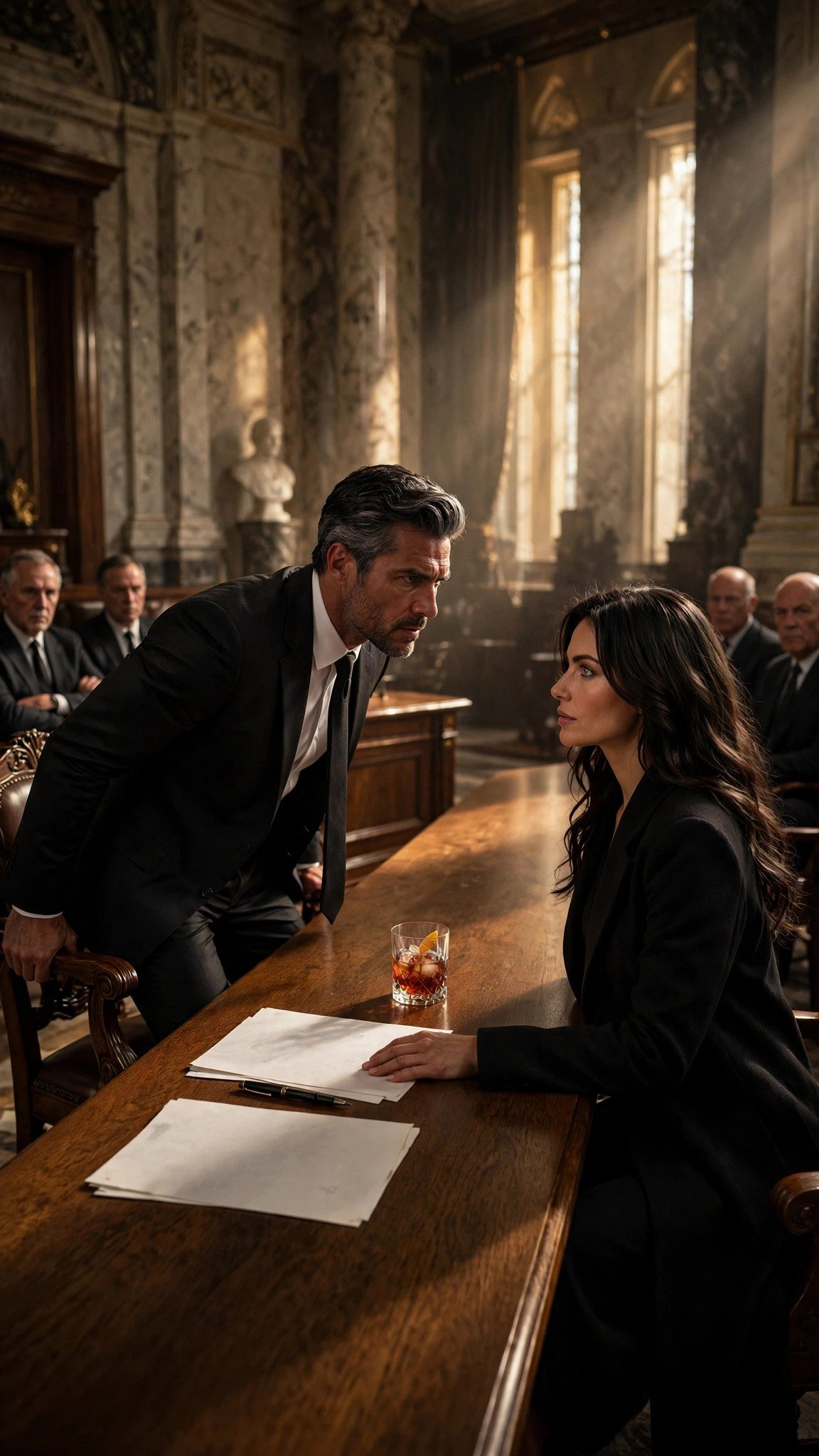
She told me about Savannah later, in pieces, in the hospital, in the dark hours when there was nothing left to do but tell the truth. I am writing down what she told me, because those six months belong to her, and I was not there, and the only way I can carry them is in her words.
She drove south in the rain, the same rain that had been falling on the penthouse windows when she left, and she did not stop until the highway signs began to say Savannah. She rented a townhouse on a quiet street under her maiden name, Isabel Marchetti, and she paid six months in advance with money she had saved in an account I never knew about — money from her gallery salary, set aside a little at a time over ten years, her own private independence. She told me she had started the account in our second year of marriage, not because she planned to leave, but because her mother had once told her that every woman should have a door of her own, even inside a happy house. I did not know whether to be proud of her or ashamed of myself. I was both.
Her mother's sister, Rosa, lived twenty minutes away in a house full of cats and cookbooks, and Isabel went to see her on the third day. Rosa took one look at her niece's face and did not ask a single question. She made coffee, she put a plate of biscuits on the table, and she said, "Your room is the blue one. It always was." Isabel cried then, for the first time since she left Manhattan, and Rosa held her and said nothing at all, which was exactly right.
The nausea started in the second week. Isabel told herself it was grief, or the drive, or the biscuits. By the third week, she was dizzy standing up, exhausted by noon, sick every morning at the same hour, and Rosa drove her to a private clinic on the edge of town without a word of discussion. Dr. Amara Okafor reviewed her medical history twice before she said anything. She looked at the fertility treatments, the charts, the years of negative tests, and then she looked at Isabel, and she said, "I want you to hear me carefully. You are pregnant. About five weeks. And given everything in this file, I would call that nothing short of remarkable."
Isabel sat very still. She told me later that she did not cry, and did not laugh, and did not feel joy, not at first. What she felt was a strange, vertiginous clarity, as if the whole world had tilted and settled into a new shape. The child I had destroyed our marriage trying to secure had already been growing inside her when I said the words that drove her away. She had been pregnant on the night of the fight. She had been pregnant when she asked me if I would still speak to her that way if she had already given me a child. She had been pregnant, and neither of us had known, and I had answered her question with silence.
She made her decision in that clinic, sitting on the paper-covered examination table with her coat folded in her lap. She would tell no one in my family. Not Marcus. Not Vittorio. Least of all me. The baby would not become leverage, or succession, or proof of my bloodline. The baby would be hers, and hers alone, until she decided otherwise. She asked Dr. Okafor to keep the records under her maiden name. She paid cash. She walked out of the clinic into the Savannah sun and bought a small white blanket from a shop on the corner, and she held it against her chest all the way home, and that night she slept with it folded beside her pillow like a promise.
For six months, she built a life. She took a part-time job at a bookshop called The Paper Lantern, shelving novels and recommending poetry to tourists, and the owner, an old woman named Mrs. Delacroix, never asked why a Manhattan gallery curator was shelving paperbacks in Savannah. She attended her appointments alone, carrying her own folder the way she had once carried the fertility folder, except this time the folder was full of good news. She bought blankets in quiet colors — cream, sage, soft gray — and a crib she assembled herself with Rosa holding the instructions and arguing about every screw. She walked in the squares in the evenings, under the oaks, with her hand resting lightly on the place where her child was growing, and she learned the shape of a life that did not need my name to be complete.
She was careful. She used cash. She never called anyone from our old life. She thought she was invisible. She was wrong.
My father had never stopped looking. Vittorio Moretti does not lose things; he misplaces them temporarily and then retrieves them. He hired a private investigator named Ray Delgado, a retired detective with a quiet voice and patient methods, and Delgado did what my men could not do, because my men looked for Isabel Moretti, the wife of a don, and Delgado looked for a woman who had once been a girl from Savannah. He found Rosa first. He watched the house for three days. On the fourth day, he followed Rosa to a townhouse on a quiet street, and he watched a woman with long dark wavy hair carry groceries up the steps, and he watched her pause halfway up with one hand pressed to the small of her back, the way pregnant women do, and he wrote it all down in a report, and he sent the report to my father.
Vittorio flew to Savannah the following week. He did not tell me. He did not tell Marcus. He walked up to Isabel's door in the middle of a Tuesday afternoon and knocked, and when she opened it, he stood there in his dark suit with his white hair combed back, and he looked at her the way he had looked at her at a hundred Sunday dinners, as if she were a problem he had already decided how to solve.
"Hello, Isabel," he said.
She did not invite him in. She stood in the doorway with her hand on the frame, and Rosa appeared behind her in the hallway, wiping her hands on a dish towel, and Vittorio's eyes went from Isabel's face to the curve beneath her loose dress, and something in his expression changed. I know that expression. I have seen it on his face my whole life. It is the expression of a man who has just found something he thought he had lost.
"So it is true," he said. "You are carrying my grandson."
"My child," Isabel said. Her voice was steady. She told me she had practiced that steadiness for weeks, saying it to the mirror, saying it to the oak trees in the squares, saying it until it felt like armor. "My child. Not yours. Not Alexander's. Mine."
Vittorio smiled, the smile that does not reach his eyes. "A Moretti child belongs to the family, Isabel. That is not a threat. It is a fact, like the weather. You can come home now. We will take care of everything. The doctors, the house, the money. All you have to do is come home."
"I am home," she said.
He looked at her for a long moment, and then he looked past her, into the little townhouse with its books and its blankets and its life that had no room in it for him, and he said, very quietly, "The family does not lose its blood, Isabel. Remember that."
Then he left. Rosa locked the door behind him and bolted it, and she stood beside Isabel in the hallway, and the two women did not speak for a long time. That night, Isabel lay in the blue room with her hand on her belly, and she felt it for the first time — not a kick, not yet, but a flutter, light as a moth against a window — and she whispered into the dark, "I will keep you safe. Whatever it takes. I will keep you safe."
—
The first ultrasound came in the fourth month, on a Tuesday morning when the light in Savannah was the color of honey. Dr. Okafor dimmed the room and moved the wand, and then the screen filled with a shape Isabel had seen a hundred times in other women's photographs and never once in her own life — a small, curled figure, impossibly real, with a heartbeat flickering like a candle in wind. The sound filled the room, fast and steady, and Isabel put her hand over her mouth, because she had not expected the sound. She had expected a picture. She had not expected a drum.
"There," Dr. Okafor said softly. "That is your baby. That is a strong heart."
Isabel lay there in the dim room with the gel cold on her skin and the heartbeat filling her ears, and she thought about all the months of charts and temperatures and negative tests, all the mornings she had woken up and drawn a line through another hope, and she thought about the night of the fight, when she had asked Alexander a question and he had answered with silence. She had been pregnant then. The heartbeat on this screen had already been beating, small and stubborn, while she stood barefoot by the fire and he told her she could not give him a son. The baby had heard it all. The baby had stayed anyway.
She did not know the sex yet, and she did not want to know. In her head, she had begun to call the baby her little oak, after the trees in the squares, because oaks in Savannah grow slowly and live for centuries, and they bend in storms instead of breaking. It was a private name, a secret between her and the fluttering heartbeat, and she carried it with her everywhere she went, the way she used to carry her mother's locket.
Rosa knew, of course. Rosa knew everything, the way aunts do. One evening in the kitchen, while Isabel was washing dishes and Rosa was drying them, Rosa said, very casually, "Your mother left your father once, you know. Before you were born. Packed a bag, took the bus to Savannah, stayed three weeks. He came after her. He stood on this very porch and told her he would change. She let him come home, and he did change, for a while. Then he didn't. But she never regretted leaving, not once. She said those three weeks were the first time she had ever belonged entirely to herself."
Isabel stopped washing. "Why didn't you ever tell me that?"
"Because you never needed to know it before," Rosa said, and she took the plate from Isabel's hands and dried it, and she did not say anything else, and she did not need to. Isabel understood. Leaving was not a failure. Leaving was something the women in her family did when the men they loved forgot how to love them back. It was not an ending. It was a door.
At the bookshop, Mrs. Delacroix began to save the poetry for her. "For you, dear," the old woman would say, sliding a slim volume across the counter. "This one is about a woman who walks away from a king." Isabel would smile and take the book home and read it in the blue room with her hand on her belly, and some nights she would read a line aloud to the little oak, her voice low and steady, and she would think about Alexander in Manhattan, in the penthouse full of paintings she had chosen, and she would wonder if he ever stood in the doorway of the empty bedroom and understood what he had done. She did not hope for it. Hope was a luxury she could not afford. But sometimes, in the quiet hours, she wondered anyway, and then she would press her hand a little more firmly against her belly and remind herself that wondering was not the same as waiting. She was not waiting. She was building. There was a difference, and the difference was everything.
By the sixth month, the little oak was kicking in earnest, and Isabel had learned to read the kicks the way she used to read paintings — a flurry meant excitement, a slow roll meant contentment, a sharp jab meant the baby objected to something, usually Rosa's cooking. She bought a crib and assembled it herself, with Rosa holding the instructions upside down and arguing about every screw, and when it was finished, they stood back and looked at it, and Rosa said, "Well. It's crooked, but it's ours." And Isabel laughed until she cried, and Rosa held her, and the crib stood in the corner of the blue room, crooked and waiting, like a promise that had not yet learned how to stand up straight.
At her six-month appointment, Dr. Okafor measured and listened and smiled, and then she said the words Isabel had been quietly waiting to hear. "Everything looks perfect. Strong heartbeat, good growth, right on schedule. Your due date is the middle of December." Isabel did the arithmetic in her head before she could stop herself, counting backward through the weeks, and the numbers landed exactly where she had feared and hoped they would land. The baby had been conceived in the last good week before the fight — the week of their anniversary, when Alexander had given her the painting and she had given him the watch, and they had been happy in the ordinary way, the way that does not make a good story but makes a good life. She sat in the car afterward with her hands on the steering wheel and her forehead pressed against it, and she thought about that week, and about the man who had given her a painting and then, a few weeks later, told her she could not give him a son. The baby had been there through all of it. The baby had been listening. And the baby had stayed.