The morning my car died, the sky over Chicago was the colour of wet concrete, and I remember thinking — I remember this so clearly, the way you remember the last ordinary thought before everything changes — that I should have worn my heavier coat.
The meeting was downtown, at a law firm that handled the Kane family's property filings, and I was supposed to present a summary of the logistics audit. I had the folder under my arm. I had my sensible shoes on. I had apologized to the bus driver for taking too long to find my fare card, because that is what I did. I apologized for existing, quietly, in advance, so that nobody would have to be bothered by me.
My car coughed once at the light on Division Street. It coughed twice. Then it died, steam curling up from under the hood, and I sat there for a moment with my hands on the wheel, listening to the horns behind me, thinking about how much a tow truck would cost and whether my mother would say "I told you to get that car checked" in exactly the voice I was already hearing in my head.
Eddie pulled up beside me before I had even unbuckled my seatbelt. Eddie, the driver, who had been waiting by the elevator with an umbrella that wasn't needed, who had started appearing in my life the way good things appear when someone has quietly arranged them.
"Miss Bennett," he said, rolling down the window. "Get in. The convoy's leaving in ten minutes, and Mr. Kane's drivers don't wait for anyone."
I got in. I thanked him. I apologized for the trouble. And as the car pulled into traffic, I looked out at the city going past and thought about how strange it was that my life, which had always been so small and so quiet, had somehow ended up inside a convoy of black SUVs.
The convoy was four cars that morning. Eddie drove the last one, and I sat in the back seat with my folder on my lap, watching the city slide past. In the car ahead of us, in the middle of the formation, rode Eli — six months old, wrapped in a blue blanket, with Grace the nurse beside him and a guard named Tommy in the front seat. Gabriel was not with us. He was already downtown, in a meeting I didn't know about, with men I had never met, about things I was never told.
We turned onto Lower Wacker Drive, and that was when I noticed it.
The GPS on Eddie's dashboard flickered. The map froze. The little blue arrow that showed where we were stopped moving, and then the screen went black, and Eddie said, very quietly, "That's not right."
Before I could ask what he meant, the SUVs came.
They came from both sides, fully loaded, black, no plates I could see — three of them, boxing us in so tightly that Eddie couldn't move forward or back. The lead car braked hard. The car behind us pulled up so close I could see the driver through the rear window, his face blank, his hands steady on the wheel. And then the doors opened, and men came out, and the tunnel filled with the sound of gunfire.
It was louder than I thought gunfire would be. In movies, it sounds clean, like a door slamming. In a concrete tunnel, it sounds like the whole world is breaking apart at once — the crack of it bouncing off the walls, the echo chasing itself, the car rocking with every shot. Eddie shouted something I couldn't hear. He reached for his radio. He reached for his gun. And then the back door of our car was torn open, and hands grabbed me, and I was pulled out into the cold air of the tunnel, my folder scattering across the concrete, my sensible shoes slipping on the wet ground.
I screamed. I am not proud of it. I screamed, and someone hit me — a backhand across the face that snapped my head to the side and filled my mouth with the taste of blood — and then I heard Eli crying.
Not the soft, sleepy cry of a baby waking up. A terrified, wrenching cry, the kind that comes from deep in the chest, the kind that says the world has turned upside down and nothing is safe anymore. I heard it from the middle car, and I turned toward it, and I saw a man in a black jacket reaching into the back seat, and I saw Grace the nurse trying to hold on, and I saw Tommy the guard on the ground, not moving, and I understood, all at once, that they were taking the baby.
I ran. I don't remember deciding to run. My body decided for me. I ran toward the middle car with my hands out, and I grabbed at the man's arm, and I shouted, "No! No, you can't have him, he's just a baby, please, please —" and someone caught me from behind, and an arm went around my throat, and the world went narrow and dark around the edges.
"Take her too," a voice said. It was calm. Bored, almost. The voice of a man who had done this before and was already thinking about lunch. "She saw the cars. She saw our faces. Take her."
They took us to an abandoned shipping warehouse near Hammond. I know that now because Mason told me later, and because I saw the signs on the drive, half-read through a blindfold they tied too loosely. At the time, all I knew was the smell — oil and rust and cold concrete — and the sound of Eli screaming, and the sound of my own breathing, too fast, too loud, in a room that was too dark to see.
They zip-tied my hands behind my back and sat me on the floor. Eli was in a car seat they had taken from the car, set down on a metal table a few feet away, crying so hard his whole body shook. A man stood over him — young, nervous, with a scar through his eyebrow — and he kept looking at the door, and at his watch, and at Eli, and finally he said, "Shut him up. Somebody shut him up, I can't think with that noise."
"Then you shut him up," another voice said from the dark. Older. Tired. "You wanted this job, Danny. You do it."
Danny — the young one with the scar — stepped toward the car seat. His hand was shaking. He reached out, and I saw what he was about to do — I saw his hand going toward Eli's face, to cover his mouth, to make the crying stop — and something in me broke open.
I have never been brave. I have never been strong. I am a woman who apologizes when someone else bumps into her. But in that warehouse, with a stranger's hand reaching for a six-month-old baby, I understood something I had never understood before: bravery is not the absence of fear. Bravery is what happens when the fear is still there, and you do it anyway, because the alternative is worse.
"They are not taking this baby," I said. I said it out loud, to the dark, to the men, to myself. "Not while I'm alive."
The zip ties were loose. That was the first gift. Whoever had tied them had been in a hurry, or careless, or simply didn't think a woman in a cardigan could be a problem. I worked one hand free, slowly, while Danny argued with the older man about who was going to shut the baby up. I worked it free the way I worked everything — quietly, patiently, without anyone noticing.
When the guard stepped inside — a big man, bored, carrying a bottle of water, not expecting anything — I hit him with a fire extinguisher.
I had never hit anyone in my life. I had never even raised my voice at anyone, not really. But I had spent two years reading invoices, and I knew how to find the weak point in a system, and a man who isn't expecting to be hit is a system with a weak point. The extinguisher was heavy. It was red. It was sitting by the door, exactly where safety regulations said it should be, and I swung it with both hands, and I hit him hard, in the temple, and he went down without a sound.
I didn't stop to see if he was breathing. I didn't have time. I stole his key card from his belt. I grabbed Eli out of the car seat — he was so small, so light, so warm, his whole body shaking against my chest — and I ran.
The service corridor was long and dark and smelled of damp concrete. Alarms screamed behind me. I could hear men shouting, boots on metal stairs, a voice yelling, "She's got the kid! She's got the kid!" I ran with Eli held tight against me, one shoe gone, my coat torn, my face burning where they had hit me, and I ran until I found the maintenance drainage — a low concrete channel running along the side of the building, half full of cold water, dark enough to hide in.
I slid into it. I held Eli against my chest and covered his head with my coat, and I whispered, "Shh, shh, it's all right, I've got you, I've got you," and he cried, and cried, and cried, and I cried with him, silently, because I was afraid that if I made a sound, they would hear us.
We stayed there until I heard the helicopter.
It came low over the warehouse, its searchlight sweeping across the roof, and I heard men shouting a name — a name I didn't know then, a name that would change everything.
"Asher! Asher, where are you?"
They were looking for a man named Asher.
I waited until the helicopter moved away. I waited until the shouting faded. Then I climbed out of the drainage, soaked and shaking, and I ran for the nearest exit, and I found a local surveillance camera mounted on the wall by the door — a small, blinking eye — and I looked straight into it, because I wanted someone, anyone, to know we were alive.
Before I climbed out, though, there was a moment in the drainage I have never forgotten, and I think about it still, on quiet nights, when the house is asleep and the rain is falling on the windows.
Eli had stopped crying.
It didn't happen all at once. It happened the way a storm passes — slowly, then suddenly, the rain thinning, the wind dropping, the world going quiet in a way that feels almost impossible after so much noise. One minute he was screaming against my chest, his whole body rigid with fear, and the next he was hiccupping, and the next he was still, his cheek pressed against my collarbone, his breathing slowing into the soft, uneven rhythm of a baby who has cried himself out.
I held him tighter. I pressed my lips to the top of his head, to the soft, fine hair that smelled like baby soap even after everything, and I whispered, "That's it. That's it. You're safe. I've got you."
And he believed me. A six-month-old baby, who had been stolen from his car seat and carried into a warehouse by strangers, believed a woman he had met only a handful of times when she told him he was safe. His tiny fingers found my coat collar and curled into it, holding on the way a drowning person holds on to a rope. And I understood, in that cold concrete channel with water soaking through my clothes, that trust is not something you earn with words. It is something you earn by staying. By not letting go. By being there when the shouting stops.
I thought about Gabriel then. I thought about him sitting in his office downtown, not knowing, or knowing and tearing the city apart looking for us. I thought about the way he had looked at me in the elevator, when he said my reports were the only ones he read all the way through. I thought about Rosa, and the nursery, and the chipped mug with one sugar. I thought about my mother, in Evanston, who would be sitting at her piano right now, not knowing her daughter was hiding in a drainage ditch with a baby that wasn't hers, bleeding from a cut on her face, holding on to a child with everything she had.
I thought about all of that, and I thought about how small my life had been — the bus, the invoices, the cardigans, the apologies — and how, in the space of one morning, it had become the only thing standing between a baby and men who wanted to use him. And I thought: if I die here, in this ditch, at least I will have died for something that mattered. At least no one will ever be able to say that Claire Bennett was only good at adding things up.
Then I heard the helicopter move away, and I heard the shouting fade, and I knew it was time to move. I climbed out of the drainage, my legs shaking so badly I almost fell, and I ran for the nearest exit with Eli held against my chest, and I did not stop running until I saw the camera blinking on the wall, and I looked into it, and I thought: find us. Please. Find us.
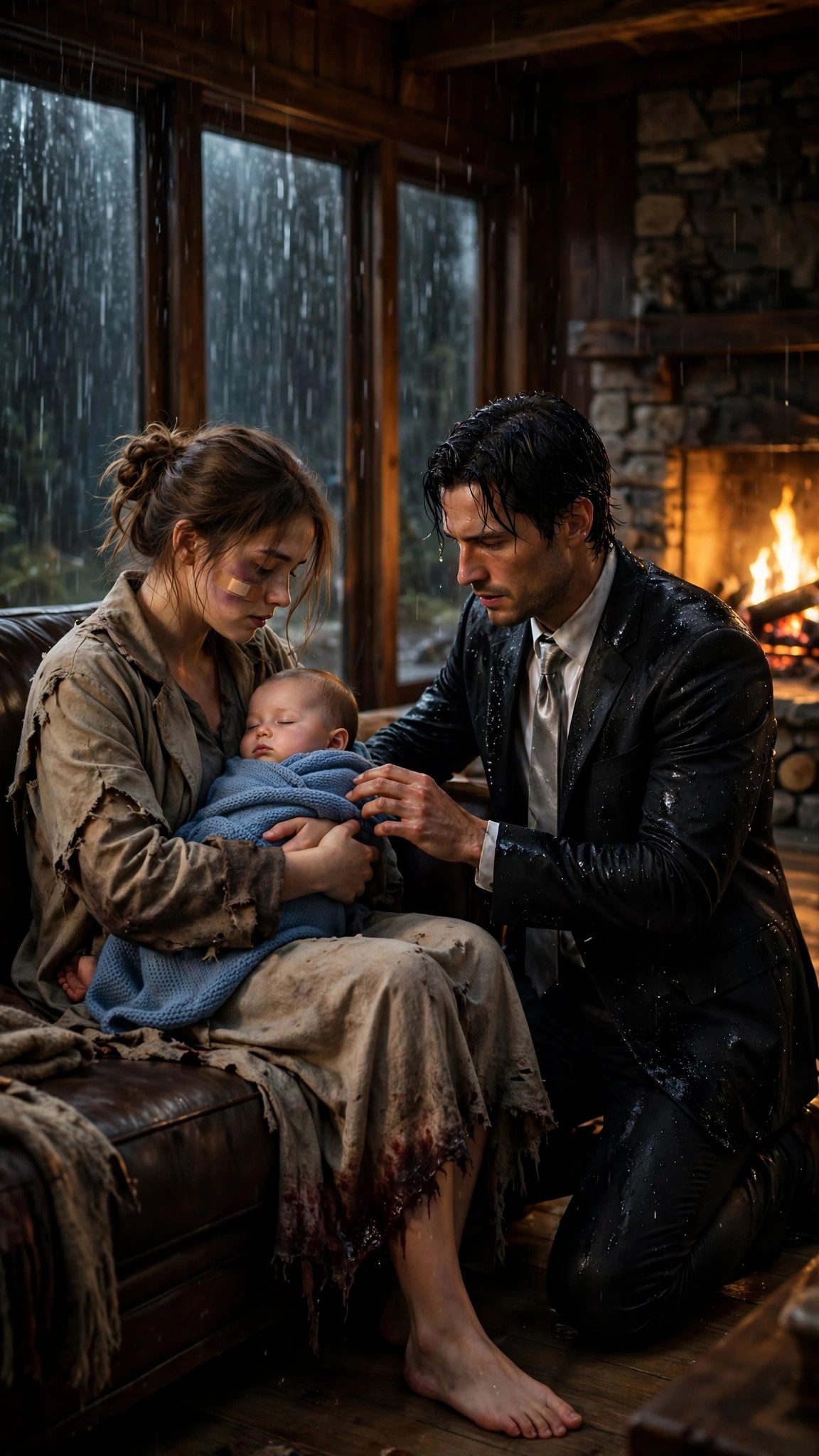
The drive to the Lincoln Park safe house took twenty-eight miles. I don't remember most of it. I remember the cold. I remember Eli's tiny fingers curled into my coat collar, as if he was afraid I'd disappear next. I remember the rain starting, and the windshield wipers of a stolen car I barely knew how to drive, and the voice in my head saying, over and over, "Keep going. Keep going. Keep going."
When I finally reached the safe house, my body gave out. I made it through the door. I made it to the sofa. And then the world went soft and warm and far away, and the last thing I heard was Mason's voice, whispering, "Don't wake her."
And then Gabriel's voice, low and lethal, asking, "What did you say?"
And then silence. And then a finger, gentle as a question, touching Eli's cheek.
And then nothing at all.