I woke to warmth.
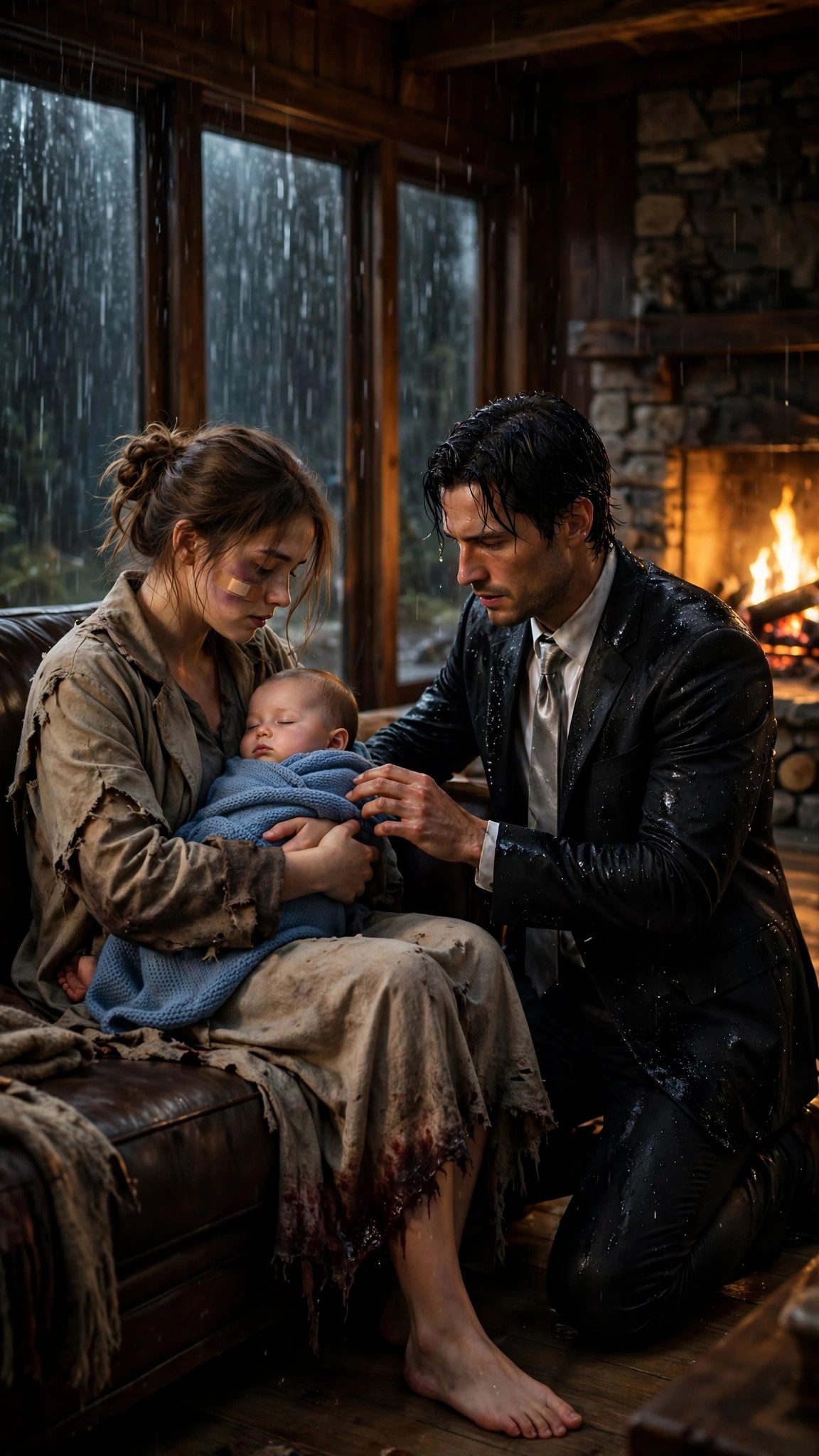
That was the first thing. Warmth, after hours of cold water and cold concrete and cold fear. Warmth from a blanket I didn't remember anyone putting over me. Warmth from a fire I could hear crackling somewhere nearby. Warmth from a small, solid weight against my chest — Eli, still asleep, still holding on to my coat collar with one tiny fist, as if he had decided that I was his now and nobody was going to argue with him about it.
Rain was pounding against the windows. I could hear it, steady and hard, the kind of rain that makes you glad to be inside. Somewhere in the room, a man whispered, "Don't wake her."
Another voice answered, low and lethal. "What did you say?"
Even half-conscious, I knew that voice. Gabriel.
His security captain, Mason, didn't back down. "I said don't wake her, boss. Doctor says she's been through enough today."
Footsteps came closer. Then silence. I didn't open my eyes, but I felt someone kneel beside the sofa. A finger touched Eli's cheek. For one strange second, the room seemed to stop breathing.
I knew Gabriel's older brother and sister-in-law had died eleven months earlier. Eli was all Gabriel had left. His brother had never gotten a chance to see his nephew. Tonight, someone had gotten through Gabriel's security, slipped past his drivers, and taken his nephew. And I had brought him back.
Mason's voice came quietly from across the room. "She drove twenty-eight miles like that."
Gabriel said nothing. Then I heard him ask, almost too softly to recognize, "With those injuries?"
My eyelids fluttered open. Gabriel Kane was on one knee beside me, soaked from the storm, his black hair dripping rain onto his silver tie. But he wasn't looking at Eli anymore. He was looking at me. And the expression on the face of Chicago's most dangerous man made my heart stop.
It wasn't anger. I had expected anger — the cold, quiet kind, the kind that makes a room go silent. It wasn't grief, either, though I could see the grief underneath, the way you can see the foundation of a house underneath the floorboards. It was something I had never seen on his face before, and I didn't have a word for it until much later.
It was wonder.
He looked at me the way a man looks at something he thought he had lost forever and has just found in the last place he thought to look. He looked at me the way he had looked at my folder in his office, that first day — like I was the first honest thing he had seen in years.
"You're awake," he said. His voice was rough, like he hadn't used it in hours.
"I'm awake," I said. My own voice sounded strange to me — hoarse, small, like it belonged to someone else. "Is Eli all right?"
"He's fine," Gabriel said. "He's been asleep for two hours. He hasn't let go of your coat once. The doctor says he's unharmed. Scared. Hungry. But unharmed." He paused. "You, on the other hand —"
"I'm fine," I said, automatically. It was what I always said. I was always fine. I was fine when my car broke down. I was fine when the tunnel filled with gunfire. I was fine when a man hit me in the face and zip-tied my hands and locked me in a warehouse.
"You are not fine," Gabriel said. "You have a concussion. You have three broken ribs. Your left wrist is sprained. Your face —" He stopped. His hand moved, almost without him meaning it to, toward my cheek, and then stopped in the air, as if he wasn't sure he was allowed to touch me. "Your face is going to need stitches. The doctor is on her way back with supplies. She said you need rest. She said you need to stay here, where it's safe."
"Where is here?" I asked.
"My house," he said. "The Lincoln Park house. The safe house. It's the same thing, tonight. Nobody gets in here without going through Mason, and nobody goes through Mason."
I looked around for the first time. The room was large and warm, with dark wood and soft lamps and a fire burning in a stone fireplace. Rain ran down the tall windows. There were books on the shelves, and a piano in the corner — a real piano, not the small upright my mother taught on — and photographs on the mantelpiece. I could see one of them from where I lay: a young man with Gabriel's face and a different smile, his arm around a woman with dark hair, both of them laughing at something outside the frame. Daniel and Anna. I knew without asking.
"How long was I asleep?" I asked.
"Four hours," Mason said from across the room. He was standing by the door, arms crossed, watching the windows the way a man watches for something that might come through them. "You got here at just past midnight. It's almost four in the morning now."
"Four hours," I repeated. "And Eli —"
"Hasn't cried once since you got here," Mason said. "He woke up once, about an hour ago, and looked around, and saw you, and went back to sleep. Like that was all he needed to know."
I looked down at Eli. He was still asleep, his cheek against my collarbone, his fist still curled in my coat. My coat — the beige coat, torn and bloodied, the hem stiff with dried blood. Someone had tried to take it off me while I was asleep, and Eli hadn't let them. Or I hadn't let them. I wasn't sure which.
"Tell me what happened," Gabriel said. He said it quietly, but it wasn't a request. "From the beginning. All of it."
So I told him. I told him about the car breaking down, and Eddie, and the convoy, and the GPS going dark on Lower Wacker. I told him about the SUVs boxing us in, and the gunfire, and Tommy on the ground, and Grace trying to hold on. I told him about the warehouse in Hammond, and the zip ties, and Danny with the scar through his eyebrow, and the older man who told him to shut the baby up. I told him about the fire extinguisher, and the key card, and the service corridor, and the drainage, and the helicopter, and the name they were shouting.
"Asher," I said. "They were looking for a man named Asher."
Gabriel went very still. It was the stillness I had seen in his office, on the day I brought him the memo about Marcus Webb — the stillness of a man who has just heard something he already knew and hoped he was wrong about.
"Did you see his face?" Gabriel asked. "Asher. Did you see him?"
"No," I said. "I only heard the name. The men in the warehouse were working for him, I think. They kept looking at the door, waiting for someone. Waiting for him."
Gabriel stood up. He walked to the window and stood there for a long time, looking out at the rain, his hands behind his back, his shoulders rigid. When he turned around, his face was calm again — the surgeon's calm, the general's calm — but his eyes were different. They were the eyes of a man who had just made a decision.
"Mason," he said. "Find Marcus Webb. Bring him to me. Not to the office. Here. Tonight."
Mason nodded and left the room without a word.
Gabriel came back to the sofa. He knelt beside me again, and this time he didn't stop his hand. He reached out, very gently, and touched the edge of the bandage on my cheek — the bandage someone had put there while I was asleep, clean and white against the bruising.
"You saved my nephew's life," he said. "Do you understand that? You saved the only family I have left in this world. There is nothing I can say to you that is big enough for that. So I won't try. I'll just tell you this instead." He looked at me, and for the first time since I had met him, Gabriel Kane looked like a man who was afraid. "You are not leaving this house until I know who did this and why. Not because I don't trust you. Because I don't trust the world outside that door. Do you understand?"
I understood. I understood that the most feared man in Chicago was asking my permission to protect me, and that he was terrified I would say no.
"I understand," I said.
"Good," he said. He stood up. He looked down at Eli, still asleep on my chest, and something in his face softened, the way a wall softens when the sun hits it after a long winter. "Sleep now. I'll be right here."
And he was. He sat in the chair across from the sofa, in his wet suit, with his tie loosened and his hair still dripping, and he watched us — me and Eli, asleep under a blanket in his safe house, while the rain pounded against the windows and the city outside went on with its business, not knowing that the most dangerous man in Chicago had just found the one thing he couldn't buy, couldn't threaten, and couldn't live without.
A woman who had brought his family home.
The doctor came back an hour later. Her name was Hannah Reyes, and she was small and brisk and unimpressed by everything, including Gabriel Kane, which I liked immediately. She stitched my cheek with six neat stitches, taped my ribs, splinted my wrist, and told me I was lucky in the flat, factual voice of a woman who has told a hundred people they were lucky and meant it every time.
"Lucky," she said, "is a woman who gets hit in the face and walks away with a concussion instead of a fractured skull. Lucky is a woman who drives twenty-eight miles with three broken ribs and doesn't pass out at the wheel. You are very lucky, Miss Bennett. Don't waste it."
"I won't," I said.
She looked at Gabriel, who was standing in the doorway with his arms crossed, and she said, "She needs rest. Real rest. Not the kind where she wakes up every hour to check on the baby. The kind where she actually sleeps. If you want her to heal, you need to let her heal."
"I'll take care of it," Gabriel said.
Dr. Reyes looked at him for a long moment, and then she smiled — a small, tired smile, the smile of a woman who has seen men like Gabriel Kane before and knows exactly what they are. "I believe you will," she said. And then she left, and the house went quiet, and the rain kept falling, and I slept.
I slept for ten hours. I slept the way you sleep when you have been holding your breath for a very long time and someone has finally told you that you can breathe now. When I woke up, the sun was coming through the tall windows, and Eli was gone from my chest, and for one terrible second I thought it had all been a dream — the tunnel, the warehouse, the drainage, all of it — until I heard a small, happy sound from across the room, and I turned my head, and I saw Gabriel Kane sitting on the floor in his shirtsleeves, holding his nephew up in the air, making a face so ridiculous that Eli was laughing, and laughing, and laughing, and I understood that I had not dreamed any of it.
Before Dr. Reyes came back, there was a moment — I don't know how long it lasted, an hour, maybe less — when the house was quiet and Gabriel was sitting in the chair across from me, and the rain was falling, and I was half-asleep and half-awake, and he started talking.
He didn't talk the way people talk when they want you to listen. He talked the way people talk when they have been carrying something alone for so long that they have forgotten what it sounds like to say it out loud.
"Daniel was the good one," he said. His voice was low, and he was looking at the fire, not at me. "Everyone always said that. Daniel was the good one, and I was the one who did what had to be done. He married Anna because he loved her. He left the family business because he wanted a normal life. He was going to tell me at the dinner — that night, the night of the crash — that Anna was pregnant. She had it planned. A little box, with a tiny pair of shoes inside. She was going to open it at dessert, and Daniel was going to laugh, and I was going to pretend to be surprised, and then we were all going to be happy."
He stopped. The fire crackled. The rain kept falling.
"They never made it to dessert," he said. "The brakes failed on the Kennedy. That's what the report said. Brakes fail. It happens. But brakes don't fail on a car that was serviced the week before, by a mechanic Daniel trusted with his life. Brakes don't fail on a dry road, in the rain, at exactly the wrong curve. I knew it then, and I know it now. Someone killed my brother. Someone killed my sister-in-law. And someone left their baby alive, because a baby is worth more than a body. A baby is leverage. A baby is a weapon you can hold against a man until he gives you whatever you want."
He looked at me then, and his eyes were wet — not crying, not quite, but wet, the way a man's eyes get when he is holding something back with everything he has.
"For eleven months, I have been waiting for them to come for Eli," he said. "I have moved him between houses. I have changed his guards. I have doubled the convoy. And tonight, they came anyway. They got through everything. They took him. And the only reason he is alive right now — the only reason I have anything left in this world — is because a woman I barely know, a woman who apologizes when someone bumps into her, decided that they were not taking this baby."
He stood up. He walked to the sofa. He knelt beside me, and he took my hand — my good hand, the one that wasn't splinted — and he held it the way you hold something fragile, the way you hold something you are afraid of breaking.
"I don't know how to thank you," he said. "I don't know the words. Men like me don't learn those words. But I know this: you are not a guest in this house, Claire. You are not an employee anymore. You are family. My family. And I protect my family."
I didn't say anything. I couldn't. My throat was closed, and my eyes were burning, and all I could do was hold his hand back, and think about how strange it was that the most feared man in Chicago was kneeling beside a sofa in the middle of the night, holding the hand of an accountant, and telling her she was family.
It was real. All of it was real. And I was home — not my home, not yet, but a home, a place where the most feared man in Chicago sat on the floor and made faces at a baby, and the rain had stopped, and the sun was coming through the windows, and for the first time in my life, I didn't want to apologize for being there.