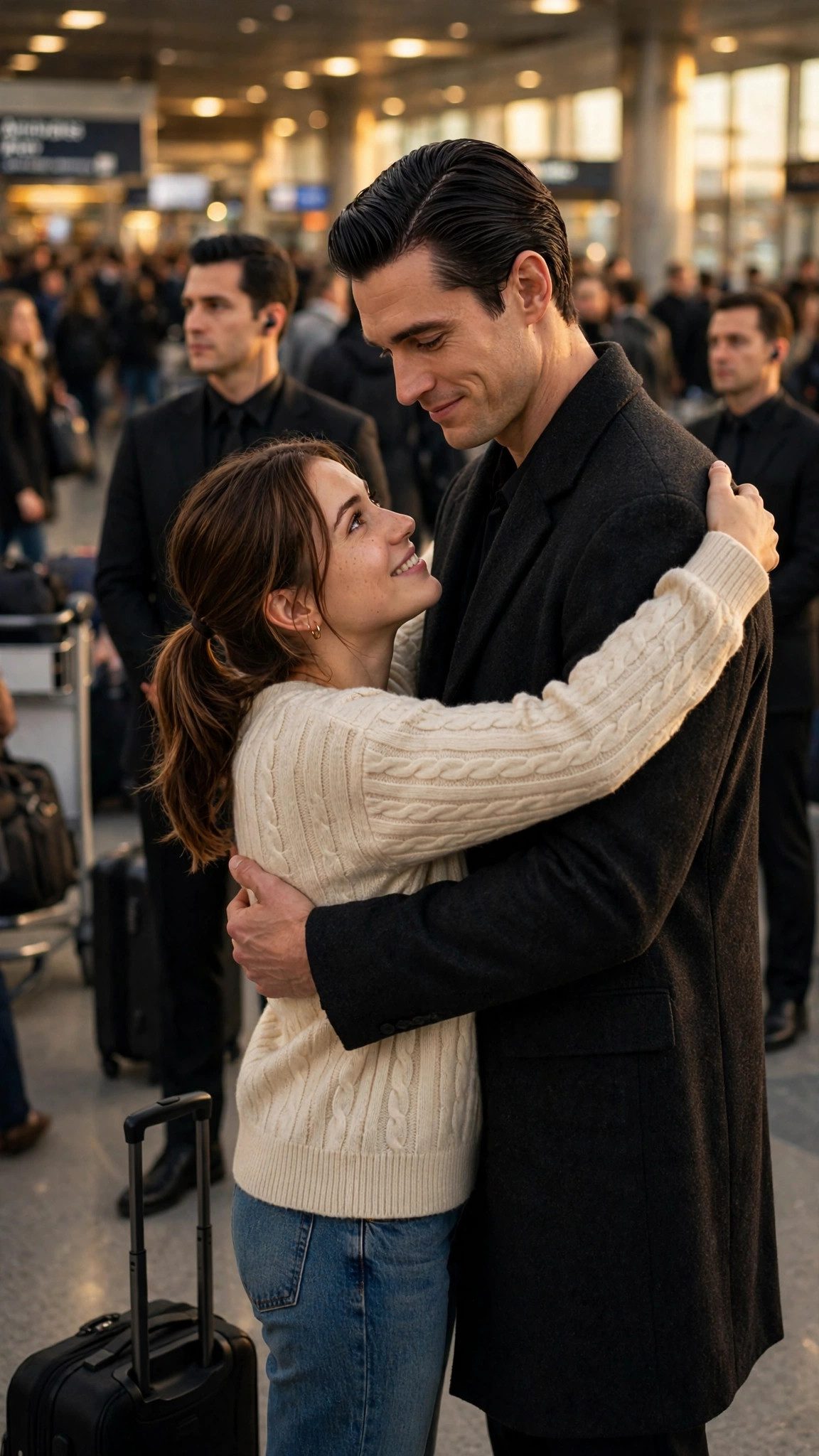
The most humiliating mistake of my life happened in the middle of a crowded Chicago airport, when I threw my arms around a complete stranger and whispered, "I missed you so much."
Seconds later, the man holding me steadily said calmly, "I'm going to take a wild guess and say we've never met," and that was when I realized I had just hugged one of the most feared mafia bosses in the city.
My arms were still wrapped around his broad chest beneath a charcoal wool coat. He smelled faintly of cedar, rain, and the kind of expensive cologne my brother Luke would never waste money on. Then I looked up. That was not my brother. The stranger was taller than Luke, sharper around the jaw, and much too calm for a man who had just been tackled by an emotional twenty-nine-year-old woman in the arrivals terminal.
His dark hair was neatly swept back, while gray eyes studied me with quiet amusement. Two men in black suits stood several feet behind him. One of them had already slipped a hand inside his jacket.
"Oh my God." I stumbled backward, caught my heel on my suitcase, and nearly crashed onto the floor. The stranger grabbed my elbow before I fell, steadying me with almost effortless control.
"I'm so sorry," I gasped. "I thought you were my brother."
"That makes this slightly less concerning."
"I haven't seen him in eight months."
"I know. You were screaming it at me."
"I wasn't screaming, just getting it straight."
"You were embarrassing everyone in the terminal, yet I found it adorable."
"I never expected that."
Then someone shouted from behind me, "Hannah!" The voice was unmistakable. Luke! When I turned, I found him standing there with his arms open and a wide grin on his face. He was wearing the same wool coat as the man I had just hugged.
"You bought the same coat!" I cried.
"I thought you would never come home. I bought it for luck."
"No wonder this makes sense." I couldn't stop laughing, and I wrapped my arms around Luke in a quick, tight hug. Luke pointed at the stranger and said, "Wait, why are you hugging the guy I told you to pick me up?"
He pointed at the stranger and said, "Hannah, this is Ethan Caldwell."
"You know Ethan Caldwell?" He nodded. Everyone in Chicago had heard rumors about him. Clubs, gambling rooms, shipping companies, private security firms, and who knew what else. Ethan Caldwell was one of the most feared men in the city.
I swallowed hard. "Actually, I was wondering if I could move to Wisconsin before airport security found that recording."
Ethan finally laughed. He looked at me and said, "Don't worry, Hannah. You're quite entertaining."
"Your brother knows more about you than I do, but you're the one yelling at me. I could really make something happen with you."
"Thank you for saving my day," I said.
"You're welcome," he said. "You're welcome."
I checked my watch. It's Luke's watch. Luke said with a grin on his face, "You're only saying that because you weren't the one shouting 'I missed you' into a stranger's chest at the airport."
I had to laugh despite my embarrassment. Three months later, I would remember that moment and wonder if fate had been laughing at me from the very beginning. Because I had no idea that there was an invisible thread that connected me to Ethan Caldwell. And I would discover that Ethan Caldwell's organization was connected to the worst thing that had ever happened to my brother.
But that afternoon, all I knew was that my face was burning, my brother was laughing at me, and the most feared man in Chicago was looking at me like I was the most interesting thing he had seen all year.
"Come on," Luke said, throwing an arm around my shoulders. "Let me buy you a coffee before you die of shame. Mr. Caldwell, I'm sorry about my sister. She's normally less of a public hazard."
"Don't apologize on my behalf," I said, elbowing him. "I can apologize for myself. I'm very good at it. I practice constantly."
"I noticed," Ethan said. His gray eyes were still on me, and there was something in them I couldn't read — amusement, yes, but something underneath it, something careful. "You hug strangers often?"
"Only the dangerous-looking ones," I said. "It's a hobby. Very exclusive."
One of the men in black suits made a sound that might have been a laugh being strangled. Ethan's mouth twitched.
"Luke," he said, turning to my brother, "walk with me. We have the Meridian schedule to discuss before the board call." He looked back at me. "Miss Reed. Try not to hug anyone else on your way out."
"I'll do my best," I said. "No promises."
He walked away with Luke, and I stood there in the middle of the arrivals terminal with my suitcase and my burning face, watching the two men in charcoal wool coats disappear into the crowd — one of them my brother, the other the man whose name made bartenders lower their voices all over this city.
My phone buzzed. Priya, my best friend and fellow barista, had texted: *How's the reunion? Did you cry?*
I typed back: *I hugged the wrong man. He might be a mafia boss. I have to go to work now.*
Three dots. Then: *WHAT.*
By four o'clock, I was back behind the counter at Gatehouse Coffee near Terminal C when my manager slid a note toward me. He sat at table twelve with a ticket open. His coat was gone, his tie loosened, and one arm rested casually across the chair beside him. His two bodyguards, who had been keeping watch on the arrivals hall, were now sitting near the doors.
It was him.
Ethan Caldwell, sitting in my coffee shop, at table twelve, like a man who had all the time in the world and had decided to spend it watching me steam milk.
"Do mafia bosses really have this much free time?" I asked when I placed the coffee on his table.
"You're probably worried after all this time," Ethan said, "but I haven't been able to resolve your situation."
"You're doing quite well," I said.
"Hannah… who told you what I am?" He was watching, and at that point, no one could beat him. I had tried to avoid him for some time, and it was only fair. And I might not be prepared for something like that.
I set the cup down with more force than I meant to. Coffee sloshed over the rim.
"Everyone," I said. "Everyone in Chicago knows who you are, Mr. Caldwell. Your name is a rumor and a warning at the same time. My brother works for your shipping company, in case you forgot, and even the baristas at Gatehouse know not to ask questions about Meridian Freight."
"And yet you asked me one anyway," he said. "About my free time."
"That wasn't a question about your business," I said. "That was a question about your manners. You have a board call, a company, an empire, and you're sitting at table twelve watching me make lattes."
"I'm waiting," he said.
"For what?"
"For you to stop being afraid of me."
I stared at him. "I'm not afraid of you."
"You've been holding that cup with both hands for thirty seconds," he said mildly. "Your knuckles are white."
I looked down. He was right. I set the cup on the table and wiped my hands on my apron, furious at myself.
"I hugged you by accident," I said. "That's the whole story. There is no more story. I mistook you for my brother because of a coat, and now I would like to go back to my life, which is small and ordinary and does not involve men with bodyguards."
"Your life," Ethan said, "is not as small as you think. And your brother is not as ordinary as you think."
Something in his voice made the hairs on the back of my neck stand up. "What does that mean?"
"It means," he said, picking up his coffee, "that Luke came home for a reason, Hannah. And it wasn't to see you."
The cup was halfway to his mouth when he paused and looked at me over the rim, and in that moment, with the afternoon light coming through the terminal windows and the smell of coffee and jet fuel in the air, I understood something with a terrible, cold clarity: the man I had hugged by accident was not an accident at all. He had been waiting at that gate for my brother. And whatever Luke had come home to do, Ethan Caldwell was standing right in the middle of it.
"Ask him," Ethan said quietly. "Ask your brother why he really came home. And when he won't tell you — because he won't, not at first — come back to table twelve and ask me."
He stood, straightened his cuffs, and left a twenty on the table for a four-dollar coffee.
"Mr. Caldwell," I called after him, before I could stop myself. "Why are you telling me this?"
He turned at the door. The two men in black suits fell in behind him like shadows.
"Because," he said, "three hours ago you threw your arms around a stranger and told him you'd missed him. And I haven't been able to stop thinking about the fact that nobody has ever done that to me before."
Then he was gone, and I was standing at table twelve with a cold cup of coffee and a twenty-dollar bill and the certain, sinking feeling that my small ordinary life had just ended.
Priya found me twenty minutes later, still standing at table twelve, holding the twenty-dollar bill like it was evidence in a trial.
"Hannah," she said, "you have been staring at that table for twenty minutes. Carlos is about to send someone to check your pulse."
I folded the bill and put it in my apron pocket. "I hugged a mafia boss today."
"I'm sorry, what?"
"At the airport. I thought he was Luke. Same coat. I threw my arms around him and said I missed him so much, and he just stood there, very calm, while his bodyguard reached inside his jacket."
Priya's eyes went wide. "Hannah. Hannah, no."
"And then Luke showed up, and it turned out Luke knows him, and the man came here at four o'clock and sat at table twelve and told me to ask Luke why he really came home."
Priya took the twenty out of my pocket, looked at it, and handed it back. "Keep it," she said. "You're going to need therapy money."
That night I walked home to my apartment in Logan Square in the rain, and I thought about Luke. Eight months. Eight months of phone calls that got shorter and shorter, of him saying the routes were long and the signal was bad, of me pretending not to notice that my brother had stopped laughing the way he used to.
Luke had always been the loud one. When we were kids in Madison, he was the one who climbed the water tower on a dare and the one who taught me to ride a bike by pushing me down the hill and shouting that falling was just flying with a bad ending. Our mother died when I was sixteen — a sudden aneurysm, no warning, gone between breakfast and lunch — and Luke, who was twenty-one and barely an adult himself, had held our family together with sheer stubbornness while our father fell apart. Dad taught high school history in Madison until he retired. He still called every Sunday and asked if I was eating properly, as if I were still sixteen and he could fix things with a casserole.
Luke left Chicago eight months ago for long-haul routes out of Milwaukee. Or so he said. He had a new job, he said, good money, and he would be home for Christmas, and then he wasn't home for Christmas, and then he was home for Easter for exactly one day, and then he was gone again.
What I did not know then — what I would not understand until much later — was that Luke had not been driving freight for eight months. He had been driving toward a dead man.
Three years ago, Luke's best friend Marcus Doyle was killed on I-90 near Rockford. Marcus was twenty-nine, a co-driver with Luke at Meridian Freight, a man who laughed too loud and collected terrible jokes and had once driven three hundred miles out of his way to bring me soup when I had the flu in college. The official story was a hijacking gone wrong: armed men stopped the truck, Marcus resisted, Marcus died. The police investigated for two weeks and then the file went quiet. No arrests. No answers. The company paid for the funeral and sent flowers, and Luke carried the coffin, and that was the end of it.
Except it wasn't the end of it for Luke. Because Marcus had called him the night before he died, and Luke had never told anyone what Marcus said on that call. I knew only that my brother stopped sleeping properly after that, and that he started keeping a locked box under his bed, and that whenever Meridian Freight came up on the news, he went very still, the way a man goes still when he is listening for a sound in the dark.
I let myself into my apartment, kicked off my wet shoes, and called him.
"Hey," Luke said. He sounded tired. "You survived your shift?"
"Luke," I said. "Why did you really come home?"
A pause. A long one. In the background I could hear traffic and a television turned low.
"Hannah," he said at last, "don't."
"Don't what? Don't ask? Ethan Caldwell sat in my coffee shop today and told me to ask you. So I'm asking."
"Ethan said that to you?" His voice changed — sharper, alert. "What else did he say?"
"He said you didn't come home to see me. He said you came home for a reason."
Another pause. Then, quietly: "He's right. But it's not your business, Hannah. It's not your fight."
"It became my fight the second I hugged him in front of half of O'Hare," I said. "Luke, please. Whatever this is — tell me."
"I can't," he said. "Not yet. Not until I know who's listening. Just… stay away from Ethan Caldwell. I mean it. He's not a man you have coffee with, Hannah. He's not a story you tell Priya. Stay away from him."
He hung up before I could answer. I sat on my couch in the dark with my phone in my hand, listening to the rain against the windows, and I thought about the man at table twelve, and the way he had said my name like it mattered, and the way he had told me to come back and ask him when Luke wouldn't tell me.
I had spent my whole life being the sensible one. The one who made coffee and paid rent and did not hug strangers in airports. But my brother was lying to me, and a dead man named Marcus Doyle was standing somewhere in the middle of it, and the most feared man in Chicago had just invited me back to his table.
I was not going to stay away. I knew it even then. I just didn't know yet what it would cost.