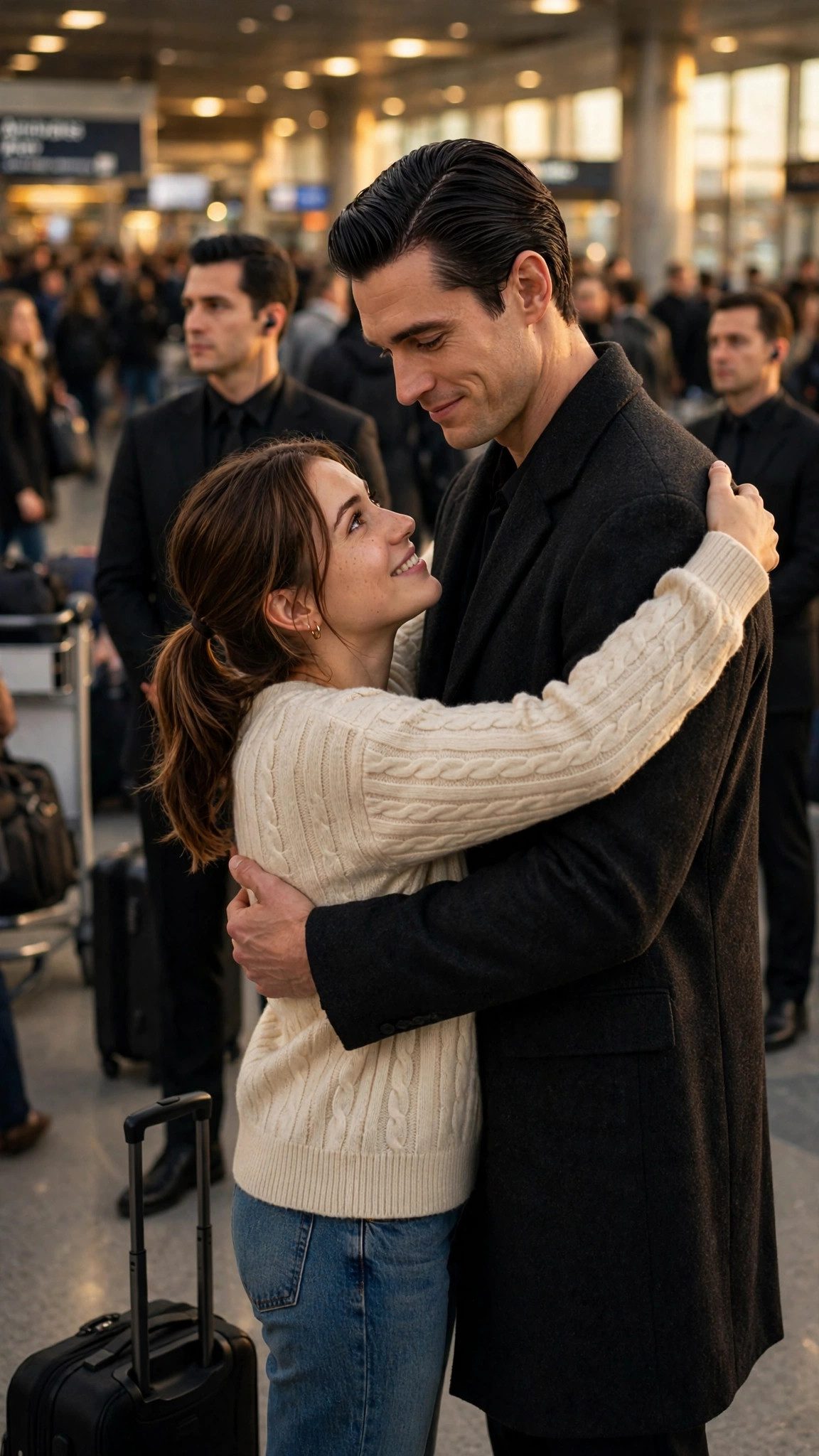
My life before the hug was small, and I liked it small.
I woke up at five-thirty every morning in my one-bedroom apartment on Milwaukee Avenue in Logan Square, where the radiator clanked like a tambourine and the upstairs neighbor practiced the violin at hours that suggested he hated me personally. I made coffee in a chipped blue mug, I walked the twelve blocks to O'Hare in the dark with my apron folded in my bag, and by six-fifteen I was behind the counter at Gatehouse Coffee near Terminal C, steaming milk and learning the regulars by their orders instead of their names.
The pilot who always ordered a double espresso and called me "kid." The flight attendant with the red scarf who tipped in exact change and never smiled before her first sip. The nervous father flying to see his daughter for the first time, who asked me three times if the coffee would keep him awake for a six-hour flight. I liked them. I liked knowing what people needed before they said it. I liked the hiss of the steamer and the smell of the beans and the way the whole terminal smelled like jet fuel and possibility in the early morning, before the crowds arrived.
My manager, Carlos Alvarez, was fifty-two and had run Gatehouse for eleven years. He had a mustache like a retired general and a soft spot for stray animals and new employees, and he had hired me four years ago when I walked in with a resume that said "college degree in art history, no relevant experience" and asked if he needed anyone who could learn fast and never call in sick.
"You'll do," he had said, looking at me over his glasses. "But the apron is non-negotiable."
Priya Sharma was my best friend and the only other barista on the morning shift. She was twenty-seven, quick with a joke and quicker with a latte, and she had a theory that every man in the airport was either running toward something or running away from it, and that you could tell which one by how they held their coffee cup. "Two hands, running away," she would say. "One hand, running toward. No cup at all — mafia."
She said that last one as a joke. I wish I had remembered it as a warning.
My father called every Sunday from Madison. He was seventy-one now, retired from teaching high school history, living alone in the house where Luke and I grew up, where our mother's garden still grew wild along the back fence because neither of us had the heart to tame it. "Are you eating properly?" he would ask, every single Sunday, as if I were still sixteen. "Are you sleeping? Is Luke behaving himself?"
"Luke is fine, Dad," I would say, which was what I always said, because what else was there to say? Luke was three states away and getting farther, and I didn't know how to tell our father that his son had stopped laughing.
Luke had always been the loud one. When we were kids, he climbed the water tower on a dare and got grounded for a month and did it again the next summer because, he said, the view was worth it. He taught me to ride a bike by pushing me down the hill behind our house and shouting that falling was just flying with a bad ending. When our mother died — a sudden aneurysm, no warning, gone between breakfast and lunch when I was sixteen — Luke was twenty-one and barely an adult himself, and he held our family together with sheer stubbornness while our father fell apart in slow motion.
After Mom died, Luke became the person who fixed things. The leaking faucet. The broken fence. My college applications. My heart, the one time a boy in Madison broke it and Luke drove four hours to sit on my dorm-room floor and eat an entire pizza with me in silence. That was Luke. He didn't talk about feelings. He showed up.
So when Luke stopped showing up, I noticed. Everyone noticed. Dad noticed and pretended not to. I noticed and pretended I was fine with it.
It started three years ago, with Marcus Doyle.
Marcus was Luke's best friend since they were both nineteen and working the loading docks together, two kids with more muscle than sense and a shared love of terrible jokes. Marcus was the kind of man who laughed too loud in quiet rooms and collected bottle caps and once drove three hundred miles out of his way to bring me soup when I had the flu in college. He was Luke's co-driver at Meridian Freight, the shipping company that moved everything from electronics to restaurant supplies across the Midwest. They drove together for years. They were supposed to drive together forever, or at least until one of them got smart enough to quit.
Three years ago, on a wet October night on I-90 near Rockford, Marcus was killed. The official story was a hijacking gone wrong: armed men stopped the truck, Marcus resisted, Marcus died. The police investigated for two weeks. The file went quiet. No arrests. No answers. Meridian Freight paid for the funeral and sent flowers, and Luke carried the coffin with five other men, and I stood in the rain at the cemetery in my black dress and watched my brother put his best friend into the ground.
After that, Luke changed. He stopped sleeping properly. He started keeping a locked box under his bed. He stopped laughing the way he used to — the big, stupid, whole-body laugh that had been his signature since he was a kid. He went very still whenever Meridian Freight came up on the news, the way a man goes still when he is listening for a sound in the dark.
And then, eight months ago, he left. Long-haul routes out of Milwaukee, he said. Good money. He would be home for Christmas. He wasn't home for Christmas. He was home for Easter for exactly one day, and then he was gone again, and his phone calls got shorter and shorter, and the signal was always bad, and I pretended not to notice that my brother had become a stranger who called once a week to say he was fine.
I told myself he was grieving. I told myself grief made people strange. I told myself that Marcus's death had broken something in him and that time would fix it, the way time was supposed to fix everything.
I was wrong about all of it.
The morning after the hug, I woke up at five-thirty and went to work like nothing had happened, because that is what I did. I made coffee. I steamed milk. I smiled at the pilot and the flight attendant with the red scarf. And at ten o'clock, when the morning rush thinned, Priya leaned across the counter and said, "Okay. Tell me everything. Start from the coat."
So I told her. I told her about the charcoal wool coat and the gray eyes and the cedar smell and the bodyguard with his hand inside his jacket. I told her about Luke showing up in the same coat, laughing, and about Ethan Caldwell sitting at table twelve at four o'clock with his tie loosened and a ticket open in front of him.
"A ticket?" Priya said. "What kind of ticket?"
"I don't know. A train ticket? A plane ticket? It was open on the table, and I didn't look at it properly because I was too busy trying not to spill coffee on a mafia boss."
"Hannah," Priya said slowly, "do you know what people say about Ethan Caldwell?"
"Everyone says things about Ethan Caldwell," I said. "That's the problem. Nobody says anything specific. They just lower their voices."
"My cousin works at a club downtown," Priya said. "The Meridian Club, on Rush Street. She says Caldwell owns it, and she says he comes in twice a month, always at midnight, always alone except for the two men in suits, and he sits in the back and watches the room like he's counting something. She says he never drinks. She says he tips a hundred dollars and leaves before one."
"That's very specific," I said.
"That's the thing," Priya said. "Nobody knows anything specific about what he does. They only know what he owns. Clubs, gambling rooms, shipping companies, private security firms. And Meridian Freight — your brother's company."
"Luke's company," I repeated, and the words sat strangely in my mouth, because Luke had never once, in all the years he drove for Meridian, mentioned Ethan Caldwell's name. Not once. And now Ethan Caldwell was sitting at table twelve in my coffee shop, and Luke was working for him, and my brother had come home for a reason that wasn't me.
At noon, Carlos slid a note across the counter toward me. It was folded in half, and my name was written on the outside in a hand I didn't recognize — neat, slanted, expensive-looking.
I opened it. There were only two lines.
*Table twelve. Four o'clock. Come alone.*
*— E.C.*
Priya read it over my shoulder and whistled. "Well," she said. "I guess you're not done hugging strangers after all."
I folded the note and put it in my apron pocket, next to the twenty-dollar bill, and I went back to making coffee with hands that would not stop shaking. Because whatever Ethan Caldwell wanted from me at four o'clock, I already knew one thing for certain: I was going to be there.
My brother was lying to me. A dead man named Marcus Doyle was standing somewhere in the middle of it. And the most feared man in Chicago had just written me a note in handwriting that looked like it belonged on a wedding invitation.
I had spent my whole life being the sensible one. But sensible had never gotten me any answers. And I was done waiting for answers to come to me.
That evening, after my shift, I did something I had never done before. I went to Luke's apartment without calling first.
He lived in a third-floor walk-up in Wicker Park, a place with peeling paint and a radiator that worked too well and a view of an alley that he insisted had character. I had a key — he'd given it to me years ago, "for emergencies," and I had never used it. I stood outside his door for a full minute with the key in my hand, feeling like a burglar in my own brother's life, and then I unlocked the door and went in.
The apartment was clean in the way that a place is clean when nobody really lives in it. The bed was made with military corners. The kitchen counter was empty except for a coffee maker and a single chipped mug. But the desk in the corner — the desk was a different story.
The desk was covered in paper. A Meridian Freight manifest, folded open to a page with a route circled in red pen: I-90, Rockford, October 14th. A photograph of Marcus Doyle, laughing, holding a fish he had clearly just caught, his arm around Luke's shoulders. A notebook, open to a page of dates and times and license plate numbers written in Luke's cramped handwriting. And a newspaper clipping, yellowed at the edges, about a hijacking on I-90 three years ago. Someone had underlined one sentence in red: *Police have no suspects at this time.*
Under the desk, on the floor, was the locked box. Black metal, the size of a shoebox, with a combination lock I had seen a hundred times and never once asked about. I knelt down and touched it. It was cold. It felt like a secret with weight.
I did not open it. I wanted to — God, I wanted to — but I didn't, because whatever was inside that box was my brother's, and if he had wanted me to know, he would have told me. Instead I stood up and looked at the photograph of Marcus again, at his big stupid grin, and I thought about the way Luke had gone still at the airport when Ethan said his name, and I understood something I should have understood three years ago: my brother had never believed the official story about Marcus's death. Not for a single day.
The door opened behind me. I spun around, my heart hammering, and there was Luke, standing in the doorway with a bag of groceries in one hand and his keys in the other, staring at me like I was the intruder I suddenly felt like.
"Hannah," he said. His voice was flat. "What are you doing here?"
"I came to see you," I said. "You're my brother. I don't need a reason."
"You used the key." He set the groceries down slowly, carefully, the way a man sets down something breakable. "I've never seen you use the key."
"I've never needed it before." I pointed at the desk. "Luke. What is all this?"
"Work," he said.
"That's not work. That's an investigation. That's three years of dates and license plates and a locked box under your desk. Luke, what happened to Marcus?"
He went very still. The same stillness I had seen at the airport, the same stillness I had seen every time Meridian Freight came up on the news. For a moment I thought he was going to lie to me again, the way he had been lying to me for eight months, and then something in his face cracked — just a little, just enough for me to see the grief underneath, raw and unhealed, like a wound that had never been allowed to close.
"Marcus called me the night before he died," Luke said quietly. "He said the manifest was wrong. He said the truck was carrying something it wasn't supposed to be carrying, and he said if anything happened to him, I should look at Meridian Freight. Not at the hijackers. At Meridian."
"And then he died," I said.
"And then he died," Luke said. "And the police file went quiet, and the company sent flowers, and everyone moved on except me."
"Luke." I took a step toward him. "Did you come back to Chicago to find out who killed Marcus?"
He looked at me for a long time. Then he nodded, once, the smallest nod in the world.
"And Ethan Caldwell?" I asked. "Where does he fit in?"
Luke's jaw tightened. "Ethan Caldwell owns Meridian Freight. He owns the company that put Marcus on that road. So either he ordered it, or he didn't know. And I intend to find out which one."
"By working for him?" I said. "Luke, that's insane. You're driving his trucks. You're in his building. If he did order it—"
"Then I'll know," Luke said. "And if he didn't, I'll know that too. But I can't find out from Milwaukee, Hannah. I had to come home. I had to get close."
"Close to a man who has bodyguards," I said. "Close to a man who could—"
"Don't," Luke said. "Don't say it. I know what he is. I know what he could do. But Marcus was my best friend, and somebody buried the truth about his death, and I'm not going to spend the rest of my life wondering who."
He walked past me to the desk and closed the notebook. He folded the manifest. He picked up the photograph of Marcus and looked at it for a moment, and his face did something I had never seen it do before — it crumpled, just for a second, before he smoothed it out again.
"Go home, Hannah," he said gently. "Please. Stay out of this. Stay away from Ethan Caldwell. I mean it this time."
I went home. But I did not stay away. I couldn't. Because now I knew the truth — or part of it — and the part I knew was this: my brother was walking into the lion's den with nothing but a notebook and a dead friend's name, and the lion had just invited me to his table at four o'clock.
And I was going to be there.