We moved back into the house on Linden Lane on a Saturday in June, three months after my mother died, and the day was so beautiful it felt like the world was apologizing.
The sun was shining. The garden my mother had planted forty years ago was in full bloom — roses along the fence, lavender by the front steps, the old oak tree in the backyard spreading its branches over the lawn like a blessing. Jason ran from room to room, shouting, opening every door, touching every wall, as if he needed to make sure it was all still there, as if he needed to prove to himself that home was still home.
I stood in the kitchen, at my father's oak table, and I put my hands flat on the wood, and I closed my eyes, and I listened. The refrigerator hummed. The clock ticked in the hallway. A bird sang outside the window. And underneath it all, underneath the ordinary sounds of an ordinary house, I could hear my father's voice, from thirty years ago, standing on an empty lot on Linden Lane with me on his shoulders.
"One day this will be yours, Clara-bear. Nobody can ever take that away from you."
Nobody had. Not Marc. Not Falco. Not a developer from out of state. Not a forged signature. The house was mine. It was Jason's. It was ours, the way my father had always intended.
Alexander came that afternoon, carrying a paper bag from the bakery and a toolbox — my father's toolbox, the one Marc had packed into a cardboard box and left on the porch, the one my father had left to Marc in his will "because a man should have something useful in his hands." Alexander had gotten it back. I never asked him how. I did not need to ask.
"I thought you might want this," he said, setting the toolbox down on the kitchen table. "It belongs here. It belongs in this house."
I opened the toolbox. Inside were my father's tools, arranged the way he always arranged them — the hammer on top, the screwdrivers in a row, the measuring tape coiled neatly, the level with the little bubble in the glass. They smelled of sawdust and oil and my father's hands. I ran my fingers over the hammer, and I thought about all the things that hammer had built — this house, that table, the window seat, the banister, my whole childhood — and I started to cry.
Not the hard, gasping crying of grief. The soft, quiet crying of a woman who has finally come home.
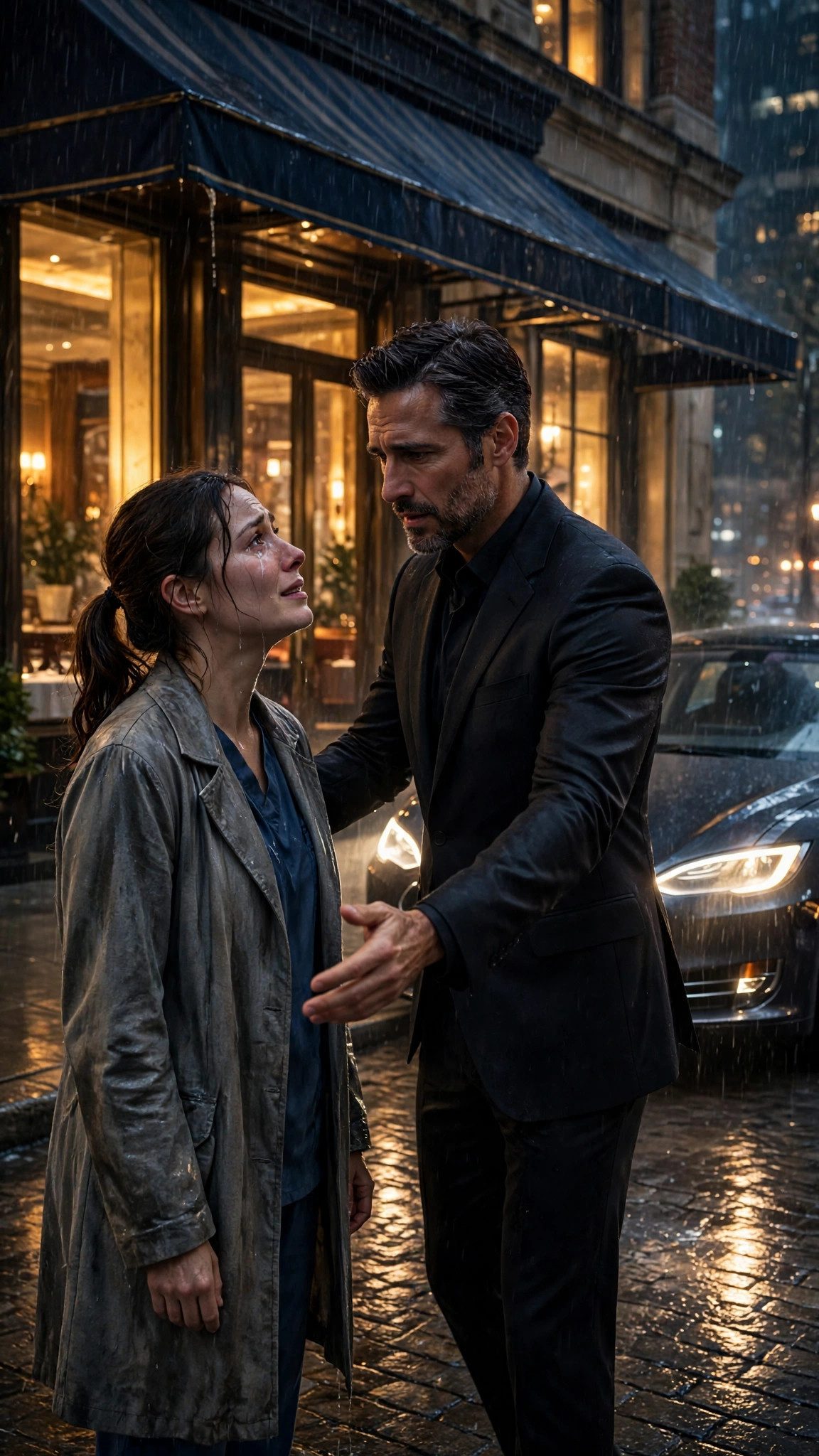
Alexander did not say anything. He did not try to fix it. He just stood beside me, in my father's kitchen, with his hands in his pockets, and he waited, the way he had waited twelve years to keep a promise, the way he had waited in the rain outside a restaurant for me to decide.
When I stopped crying, I wiped my eyes with the back of my hand, and I said, "The porch needs fixing. The boards on the north side are loose. My father was going to fix them the spring he died, and he never got to it."
Alexander looked at the porch through the kitchen window. "Then we'll fix it," he said. "Together. This weekend. I'll bring the wood. You bring the lemonade. Jason can hand us the nails."
And that was how it started. Not with a grand gesture. Not with a declaration. With a porch. With loose boards and lemonade and a seven-year-old boy handing nails to a mafia boss like it was the most normal thing in the world.
We fixed the porch that weekend. It took two days. Alexander worked the way my father had worked — slowly, carefully, measuring twice and cutting once, sanding every board smooth, because he said a little boy would be running his bare feet across that porch for the next twenty years and he did not want him to ever get a splinter. I watched him work, and I thought about my father, and I thought about the way some men build things with their hands because they love the people who will live in them, and I thought about how rare that is, and how lucky I was to have known two such men in my life.
After the porch, we fixed the fence. After the fence, we painted the kitchen — a soft yellow, the color my mother had always wanted but never got around to choosing. After the kitchen, we planted a garden together, Jason and Alexander and me, kneeling in the dirt in the backyard, putting tomato plants in the ground the way my mother used to, and Jason got mud all over his face, and Alexander laughed, and I laughed, and for the first time in a very long time, the house on Linden Lane sounded like a home again.
It was not fast. It was not easy. There were days when I woke up and the grief hit me fresh, like a wave, and I would stand in my mother's bedroom and look at her empty closet and feel the loss all over again. There were nights when Jason cried for his grandmother, and I held him, and I told him what my mother had told me: that she loved him first, before anybody, and that love does not end just because a person is gone.
And there were days when I looked at Alexander — this man with his black suits and his black cars and his quiet power — and I wondered what I was doing, letting a mafia boss into my son's life, into my father's house, into my heart. I wondered if my father would approve. I wondered if my mother would approve. I wondered if I was making a terrible mistake.
But then I would watch him with Jason — teaching him to hammer a nail straight, showing him how to tell oak from pine by the smell of the sawdust, sitting on the porch steps on summer evenings watching the fireflies — and I would see my father in him. Not the power. Not the money. Not the name that made people afraid. The patience. The steadiness. The way he kept his word.
My father had seen it twelve years ago, in a hospital hallway at four in the morning. He had looked at a dangerous man and seen a good one. And he had been right.
In September, on the first cool evening of the fall, Alexander asked me to walk with him in the garden. Jason was inside, doing his homework at the kitchen table — my father's table, where my family had eaten a thousand dinners — and the sun was setting, and the roses were still blooming along the fence, and the air smelled like rain and woodsmoke.
We walked to the old oak tree in the backyard, the one my father had planted the year I was born, and Alexander stopped, and he turned to me, and he took my hands in his, and he said, "Clara Bennett. I have been waiting twelve years to ask you something. And I have been waiting three months to ask it properly. So here it is."
He reached into his pocket and took out a small box. Inside was a ring — not a big ring, not a flashy ring, but a simple gold band with a single small diamond, the kind of ring a carpenter's daughter would wear.
"Your father asked me to watch over you," Alexander said. "I did. I will. For as long as you will let me. But I don't want to watch over you from a distance anymore, Clara. I want to stand beside you. In this house. At this table. For the rest of our lives. If you'll have me."
I looked at the ring. I looked at the oak tree. I looked at the house my father had built with his own hands, with its backwards R above the front door and its window seat and its oak table and its porch that Alexander and I had fixed together, board by board.
And I thought about my mother, who had loved this family first, before anybody. And I thought about my father, who had built this house for me and told me nobody could ever take it away. And I thought about Jason, doing his homework at the kitchen table, waiting for me to come back inside.
"Yes," I said. "Yes, Alexander. Yes."
He put the ring on my finger. It fit perfectly. Of course it fit perfectly. Alexander Moretti did not do anything halfway.
We were married the following spring, in the garden behind the house on Linden Lane, under the old oak tree my father had planted the year I was born. It was a small wedding. Rosa was there. Mr. Doyle was there. Mr. Hart was there. Enzo Moretti was there — thirty-one years old now, healthy and strong, with a wife and a baby daughter of his own — and he hugged me so hard I could barely breathe, and he said, "You saved my life, Clara. And now you're my sister. I couldn't be happier."
Jason was the ring bearer. He carried the rings down the garden path in his navy suit — the suit my mother had bought him for Christmas, the one he had worn to her funeral, now a little too small in the shoulders — and he was so serious about it, so careful, that everyone laughed, and then everyone cried, because it was the most beautiful thing any of us had ever seen.
Alexander and I said our vows under the oak tree, and when the minister asked if anyone objected, nobody did, because there was nothing to object to. There was only a house, and a garden, and a family, and a promise kept.
After the wedding, we had dinner at my father's oak table — all of us, crowded around it, passing dishes, laughing, talking over each other, the way families do — and Jason stood up on his chair and raised his glass of apple juice and said, in his clear, serious, seven-year-old voice, "To Grandma. And to Grandpa. Thank you for building this house. Thank you for our family."
And we all raised our glasses. And we all cried. And we all laughed. And the house on Linden Lane, the house my father had built with his own hands, plank by plank, board by board, held us all, the way it had always held us, the way it always would.
Because a house is not just walls and a roof. A house is a promise. My father made that promise to me when I was four years old, standing on an empty lot with me on his shoulders. He kept it in his will. My mother kept it with her love. Alexander Moretti kept it with his word.
And now, on quiet evenings, when the sun is setting and the fireflies are out and Jason is doing his homework at the kitchen table and Alexander is on the porch fixing something that does not really need fixing, I sit on the porch steps and I touch the backwards R above the front door, and I think about my father, and my mother, and everything they gave me.
They gave me a house. They gave me a family. They gave me a promise.
And nobody — not a husband, not a loan shark, not a forged signature, not all the money in Miami — nobody could ever take that away from me.
Because the house her father built was never just a house.
It was home. And it always will be.
Our first Christmas in the house as a family was the best Christmas I have ever had, and I have had a lot of Christmases in that house.
Alexander bought a tree so tall we had to cut six inches off the top to fit it under the ceiling, and Jason decorated it with ornaments my mother had collected over forty years — glass birds, wooden stars, a little angel with a chipped wing that my mother had loved more than any of them. Enzo and his wife came with their baby daughter, and Rosa came with her husband, and Mr. Doyle came with a bottle of wine older than Jason, and we all crowded around my father's oak table for dinner, and the house was so full of voices and laughter that I thought the walls might burst.
After dinner, Alexander disappeared for a few minutes, and when he came back, he was carrying a small wooden box. He set it down in front of Jason, and Jason opened it, and inside was a child's toolbox — small, perfect, made of oak, with a tiny hammer and a tiny screwdriver and a tiny measuring tape, all arranged the way my father used to arrange his tools.
"I made it myself," Alexander said. "In your grandpa's workshop. Well — in the garage, with your grandpa's tools. It took me three weeks. I wanted it to be right."
Jason stared at the toolbox for a long time. Then he looked up at Alexander with wide eyes, and he said, "Is this mine? Really mine?"
"It's yours," Alexander said. "A man should have something useful in his hands. That's what your grandpa used to say. And one day, when you're older, you're going to build things with those tools. Maybe you'll build a house. Maybe you'll fix a porch. Maybe you'll do something I can't even imagine yet. But whatever you build, you'll build it with your grandpa's tools, and his hands will be in yours."
Jason hugged the toolbox to his chest like it was made of gold. And then he hugged Alexander, hard, around the neck, and Alexander closed his eyes, and for a moment the most feared man in Chicago looked like the happiest man in the world.
On Christmas morning, before Jason woke up, Alexander and I drove to the cemetery where my parents are buried, side by side under the old oak tree, and we stood there in the cold, holding hands, with our breath fogging in the air.
"Mom," I said quietly. "Dad. I want you to know — the house is safe. Jason is safe. I'm safe. And I'm happy. I know you worried about me. I know you wanted me to be strong. I am strong. But I'm not alone anymore. Alexander is here. He keeps his promises. Just like you said he would, Dad. Just like you knew he would, twelve years ago, in that hospital hallway."
The wind moved through the oak tree above us. A bird sang, even though it was winter. And I swear, I swear on everything I have ever loved, that in that moment I felt my mother's hand on my shoulder, and my father's voice in my ear, saying what he used to say to me every night when he tucked me into bed.
"Goodnight, Clara-bear. Sleep tight. The house will keep you safe. And so will I."
I cried a little. Alexander held me. And then we drove home, to the house on Linden Lane, to the tree with the glass birds and the wooden stars, to Jason and his little oak toolbox, to Christmas morning and pancakes and the rest of our lives.
That is the end of my story. Or maybe it is the beginning.
The End.
THE END