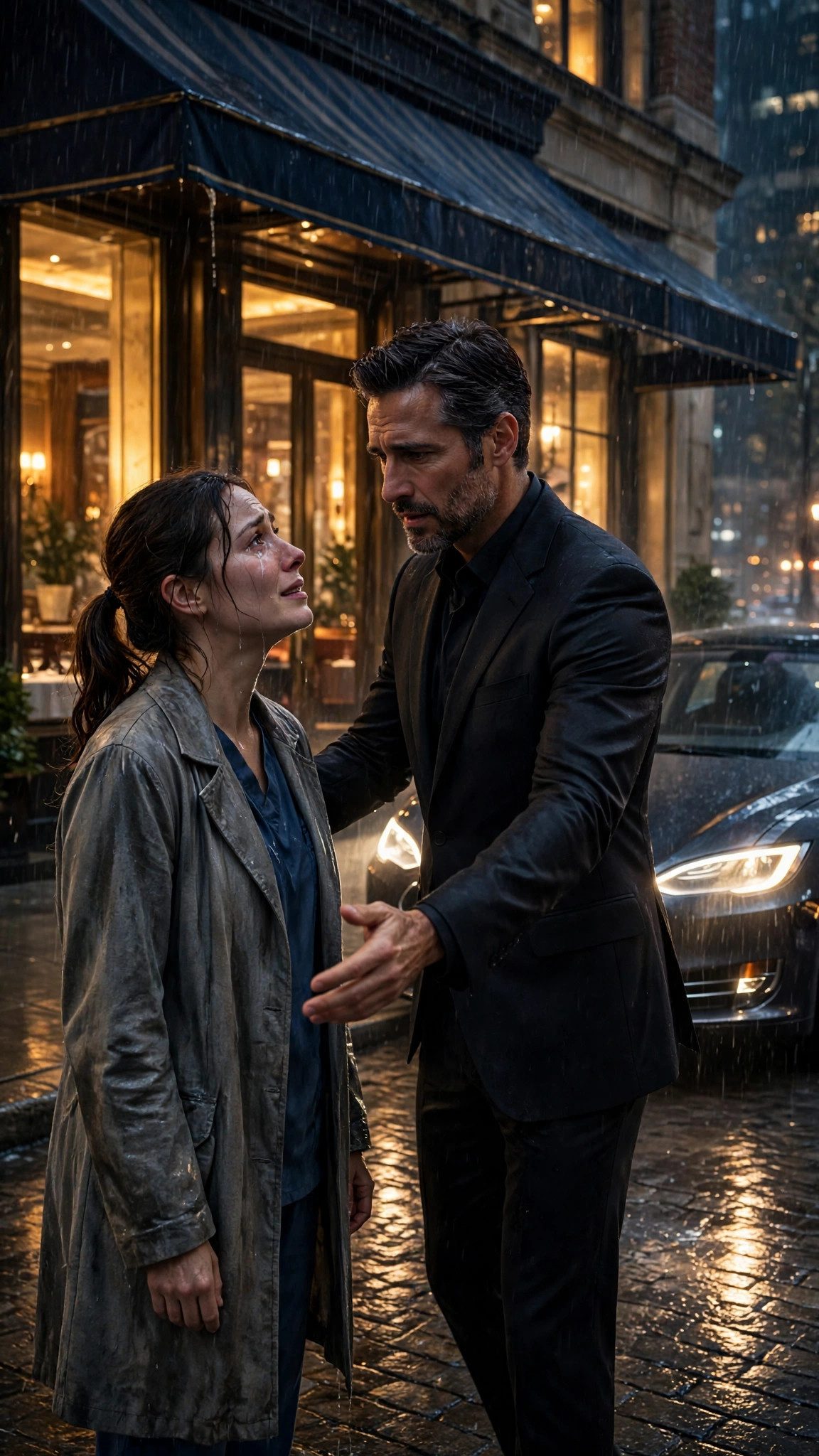
I did not sleep well the night before the meeting at Mr. Hart's office, despite what I had told myself about sleeping through the night. I lay awake until three in the morning, staring at the ceiling of a strange apartment, listening to the radiator clank and to Jason breathing softly in the next room, and I thought about everything that had happened in the three weeks since my mother died.
Three weeks. It felt like three years. It felt like a lifetime. In three weeks, I had buried my mother, discovered my husband's betrayal, found out about a secret girlfriend and a forged signature and a gambling debt that could have cost me my father's house, moved my son to a strange apartment in a strange city, and met a mafia boss in the rain who had promised my father he would protect me.
And tomorrow morning, at ten o'clock, it was all supposed to end. With papers. With signatures. With a man I had loved for eleven years signing away his claim to my life.
I was afraid it would not work. I was afraid Marc would refuse. I was afraid he would find some new lie, some new scheme, some new way to hurt us. I was afraid that even Alexander Moretti, with all his power and all his promises, could not make a desperate man do the right thing.
I should not have been afraid. But fear is a habit, and I had been practicing it for eleven years.
At eight o'clock the next morning, while I was making Jason's breakfast, my phone rang. It was the school secretary. Her voice was tight and high, the way people's voices get when they are trying very hard to stay calm.
"Mrs. Bennett," she said. "Mr. Johnson is here. He's trying to pick up Jason. He says there's been a change in the custody arrangement. He says you agreed."
My hands went cold. "Did you let him take Jason?" I asked.
"No," she said. "I told him I needed to call you first. He's in the office right now. He's very angry, Mrs. Bennett. He's saying — he's saying that if you don't come and get Jason yourself, he's going to take him, and there's nothing anyone can do about it."
"Keep Jason in his classroom," I said. My voice sounded steady. I was proud of how steady it sounded. "Do not let Mr. Johnson near him. Do not let him out of that classroom. I'm coming right now. And call the police if he tries to leave with him."
I called Alexander. I did not think. I just called. The number was on the white card I had kept in my jewelry box for twelve years, the card I had finally taken out the night I met him in the rain. He answered on the second ring.
"Clara," he said. "What is it?"
"Marc is at Jason's school," I said. "He's trying to take him."
"I'll be there in ten minutes," Alexander said. "Don't go alone. Wait for me. Clara — do you hear me? Wait for me."
I waited three minutes. Three minutes, standing in my kitchen with the phone in my hand and my heart pounding in my chest, thinking about my seven-year-old son sitting in his classroom while his father waited in the office down the hall, and then I could not wait anymore.
I drove to the school. I ran a red light. I do not recommend running red lights, and I have never done it before or since, but that morning I ran a red light on Green Bay Road because my son was in a building with a man I no longer trusted, and nothing else mattered.
When I got to the school, Alexander was already there. He was standing in the parking lot, leaning against the black Tesla, talking quietly on his phone, calm as still water. Behind him, parked in a neat row along the curb, were three black cars I had never seen before, and standing beside them were six men in dark suits, standing the way Alexander's men always stood — still, quiet, patient, like trees.
"Clara," Alexander said, putting his phone away. "Stay calm. Jason is safe. He's in his classroom with his teacher. The secretary did exactly what you told her to do. Marc is in the office. He is not going anywhere."
"How do you know all that?" I asked.
"Because I called the school the moment you called me," Alexander said. "And because my men have been watching this school since the day you moved to Evanston. Your father asked me to watch over you, Clara. That includes Jason. Especially Jason."
I stared at him. "You've had men watching my son's school?"
"Since the day you moved," Alexander said. "Quietly. From a distance. They never approached him. They never spoke to him. They just watched. To make sure no one ever tried to take him. To make sure nothing like this morning ever happened."
I should have been angry. A part of me was angry — the part of me that believed a mother should be the one to protect her child, that no one else should have to do it for her. But a bigger part of me, the part that had been afraid for three weeks, the part that had lain awake listening to Jason breathe, felt something else.
Relief. Enormous, overwhelming relief. Because for three weeks I had been the only person standing between my son and a man who would forge a signature and sell a house and lie to a grieving widow, and now, standing in a school parking lot in the rain, I was not the only person anymore.
"Thank you," I said.
Alexander nodded. He held out his hand. "Come on," he said. "Let's go get your son. And then let's go deal with your husband. Together."
We walked into the school together. The secretary saw us coming and her face went pale, and then she saw me, and her face relaxed, and she said, "Mrs. Bennett, thank God. He's in the office. Mr. Hart is already here."
Mr. Hart. The thin, precise lawyer with the glasses and the soft voice. He was standing in the hallway outside the office, holding a leather folder, looking as calm as if he were waiting for a bus.
"Mrs. Bennett," he said. "Mr. Moretti. Your husband is inside. He is upset. I have explained the situation to him. I have explained the documents. I have explained the debt. He is… considering his options."
"Let me talk to him," I said.
Alexander put a hand on my arm. Gently. "Clara," he said. "Let me come with you."
I nodded. We walked into the office together.
Marc was standing by the window, his back to the door, his hands in his pockets. When he heard us come in, he turned around, and his face was a map of everything he had become — angry, afraid, desperate, cornered. He looked at Alexander, and his face went white.
"You," Marc said. "You're the one who bought my debt."
"I am," Alexander said calmly. "And you are the one who tried to take a seven-year-old boy from his school without his mother's permission. So I think we both know why we're here."
Marc looked at me. "Clara," he said, and his voice was different now — not angry, not calculating, but pleading, the voice of a man who has finally run out of lies. "Clara, please. I know I've made mistakes. I know I've hurt you. But Jason is my son too. You can't keep him from me."
"I'm not keeping him from you," I said. "I'm keeping him safe from you. There's a difference, Marc. You tried to steal his grandfather's house. You forged my signature. You lied to me for two years about a woman in Miami. You gambled away a hundred and eighty thousand dollars. And this morning you came to his school and tried to take him without telling me. That is not a father. That is a man who is desperate and dangerous."
"I'm desperate because I owe money!" Marc shouted. "I'm desperate because Falco was going to kill me! You don't understand what it's like, Clara. You don't understand what it's like to owe a man like that!"
"I understand," I said, very quietly, "that you chose to gamble instead of coming to me. I understand that you chose a woman in Miami instead of your family. I understand that you chose to forge my name instead of asking me for help. Those were your choices, Marc. Not mine. Not Jason's. Yours."
Mr. Hart stepped forward then, and he opened his leather folder, and he set three documents on the desk, one by one, in a neat row. The divorce settlement. The quitclaim deed. The restraining order.
"Mr. Johnson," Mr. Hart said, in that soft voice of his, "these are your options. You sign these documents, and your debt to Mr. Moretti is forgiven in full. You walk away, free and clear, with no criminal charges for the forgery, no lawsuit, no police report. You will have supervised visitation with your son, once a month, at a location of Mrs. Bennett's choosing, for as long as Mrs. Bennett believes it is in Jason's best interest. Or you do not sign, and you owe Mr. Moretti a hundred and eighty thousand dollars, and Mrs. Bennett files criminal charges for forgery, and the police report about this morning's incident at the school becomes part of the public record. Those are your options. There are no other options."
Marc stared at the documents for a long time. I watched his face, and I saw the calculation happen — the same cold, fast calculation I had seen at my father's kitchen table the night of my mother's funeral — only this time, the numbers did not add up in his favor. This time, there was no way out except through.
"And Abi?" Marc asked finally, his voice barely above a whisper. "What about Abi?"
Alexander spoke then, and his voice was not unkind. It was simply honest, the way honest men speak to other men when there is nothing left to pretend about.
"Miss Torres left for Miami three days ago," Alexander said. "On her own. She took the money she had saved and she went without you. She called your phone twice yesterday. You did not answer. She has not called since."
Marc closed his eyes. For a moment, he looked like a man who had lost everything — because he had. Not because I had taken it from him. Because he had given it away, piece by piece, choice by choice, for two years, until there was nothing left.
He picked up the pen. His hand was shaking. He signed the divorce settlement. He signed the quitclaim deed. He signed the restraining order. Three signatures, quick and shaky, and then he set the pen down, and he looked at me, and he said the last honest thing he ever said to me.
"I'm sorry, Clara. I really am sorry. I don't expect you to forgive me. I just wanted you to know."
I looked at him. I thought about eleven years of marriage. I thought about the man who had brought me coffee in bed on Sunday mornings. I thought about the man who had held my hand in the delivery room. I thought about the man who had stood at my mother's funeral and thought about real estate.
"I forgive you, Marc," I said. And I meant it. Not because he deserved it. But because I deserved to be free of him. "I forgive you. But I will never trust you again. And Jason will decide for himself, when he's older, what kind of father you were. That is not my decision to make. It is his."
Marc nodded. He walked out of the office without another word. He did not look at Alexander. He did not look at Mr. Hart. He walked past the secretary, past the black cars in the parking lot, past the six men in dark suits standing like trees, and he got into his car, and he drove away.
I never saw him again.
After he left, I went to Jason's classroom. His teacher opened the door, and Jason saw me, and his whole face lit up, and he ran to me and threw his arms around my waist, and he said, "Mommy! You're here! Are we going home now?"
I picked him up — he is getting too big to pick up, but I picked him up anyway — and I held him tight, and I said, "Yes, baby. We're going home."
Alexander was standing in the doorway, watching us, and Jason looked over my shoulder at him, and he said, "Mommy, who's that man?"
"That's Alexander," I said. "He's a friend of Grandpa's. A very old friend."
Jason studied Alexander for a moment with those big serious eyes of his. Then he said, "Does he like cannoli?"
Alexander laughed. It was a real laugh, deep and surprised, the laugh of a man who had not laughed in a long time. "I love cannoli," he said.
"Good," Jason said solemnly. "Because Grandma used to say that a man who doesn't like cannoli can't be trusted."
"Your grandma was a very wise woman," Alexander said.
And Jason, my seven-year-old son, who had held his grandmother's hand while she died, who had told her it was okay to go, looked at Alexander Moretti — one of Chicago's most powerful mafia bosses, a man feared by people who knew exactly what his name meant — and he smiled, and he said, "Okay. Then I trust you."
That was the moment I knew. Not the moment I fell in love with him — that came later, slowly, the way real love comes, like a house being built board by board. But the moment I knew that my father had been right. The moment I knew that the man in the hospital hallway twelve years ago had kept his word, and would keep it, for as long as I needed him to.
My father had asked him to watch over us. And he had. And he would.
The rest was up to me.