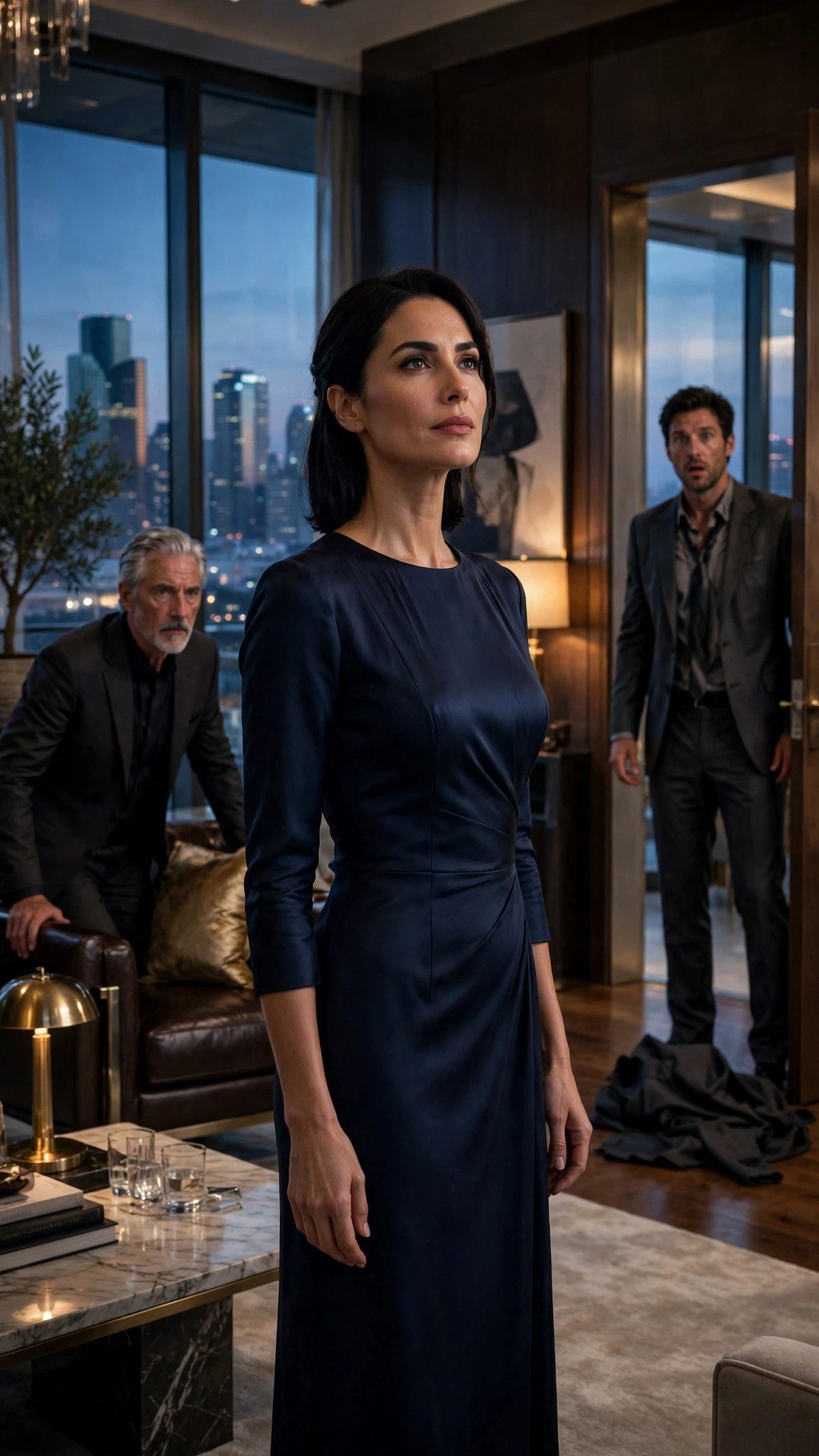
The divorce was finalized on a clear morning in March, six months after the night Helena was arrested.
I stood in the courthouse in a navy suit I had bought for myself, with my own money, from an account that only I could access, and I listened to the judge read the terms. The house was mine to sell, and I had already sold it. The money was mine to keep. My name was mine to keep, too. Lauren Ellis Morgan. I had kept my father's name in the middle of it all along, and now I understood why my father had insisted on that, all those years ago, when I was a girl who thought a name was just a name.
Luke sat across the room from me, in a gray suit, with his lawyer beside him. He did not contest anything. He did not ask for the house. He did not ask for the money. He signed every paper the judge put in front of him, and when it was over, he stood up, and he walked across the room, and he held out his hand to me.
"Thank you," he said. "For telling me the truth. For giving me my father back. I know I don't deserve it. I know I hurt you in ways I can never undo. But thank you."
I shook his hand. It was a strange thing to do, shaking hands with the man I had married at twenty-two, the man I had loved and lost and finally set free. But it felt right. It felt like the end of something, and the beginning of something else.
"Take care of yourself, Luke," I said. "And take care of your father. He's been waiting a long time."
"I will," Luke said. "I see him every Sunday now. We have dinner. He tells me stories about when I was a boy. He tells me about the bicycle. He tells me about the letters. I'm learning who he is. And I'm learning who I am, without my mother telling me."
He paused, and he looked at me, and for a moment, he looked like the young man I had danced with at the charity gala, all those years ago, before the lies and the late nights and the gold hoops on my nightstand.
"I hope you find someone who loves you the way you deserve to be loved," he said.
"I already found her," I said, and I smiled. "Me."
Helena's trial lasted four months. The evidence was overwhelming: the immunity agreement with her signature, the bank statements, the mechanic's notebook, Frank Calloway's testimony, Luke's testimony, and the photographs she had taken of Jennifer, which the FBI found in a safe in her bedroom, along with a second set of photographs she had taken of me, over the years, in my own apartment, through my own windows. She had been documenting all of us, for years, building files on the people she claimed to love, the way a general builds files on an enemy.
The jury took three days to find her guilty on every count: murder, conspiracy, money laundering, obstruction of justice. The judge sentenced her to life in prison without the possibility of parole.
She did not look at me when the sentence was read. She looked at the floor. And I thought, as I sat in that courtroom, that Helena Cross had spent her whole life making sure that no one could ever look down on her, and in the end, she had built a life that left her with nowhere to look but down.
I did not go to see her in prison. I did not write to her. I did not forgive her. Forgiveness is a gift, and it is mine to give or not to give, and I chose not to give it to the woman who killed my father. That is my right. My father taught me that a record is a kind of power, and my record of Helena Cross is complete, and it is closed.
Jennifer and I rebuilt our relationship slowly, the way you rebuild a house after a fire: one room at a time, carefully, with new materials, and with the understanding that some things can never be exactly the same as they were before.
She apologized to me a hundred times, in a hundred different ways, and I told her, every time, that I heard her, and that I was trying, and that trying was enough for now. She moved into a small apartment of her own, and she started seeing a therapist, and she got a job at a gallery downtown, and she began to build a life that belonged to her, not to Luke, not to Helena, not to anyone else.
One Sunday afternoon, six months after the divorce, Jennifer came to my new apartment for dinner. I had moved into a bright, airy place in the Heights, with a garden full of roses and a study where I kept my father's file and my leather notebook, side by side, on a shelf where I could see them every day.
We cooked together, the way we used to when we were girls, and we laughed about the time Jennifer burned the Thanksgiving turkey and blamed it on the dog, and for a few hours, it felt like we were sisters again, not strangers who had hurt each other.
"Lauren," Jennifer said, as we washed the dishes, "do you ever miss him? Luke, I mean. Do you ever miss what you had?"
I thought about it for a long moment. I thought about the charity gala, and the dance, and the white dress, and the twelve years of Sunday dinners and late nights and insults counted in a leather notebook.
"I miss the idea of him," I said. "I miss the man I thought I married. But that man never really existed. The real Luke was always his mother's son, until the day he chose to be his father's son instead. And I am proud of him for that. But I don't miss being married to him. I don't miss being quiet. I don't miss being counted."
Jennifer nodded. She dried a plate and set it down.
"I'm glad you found your voice," she said. "I always knew it was in there."
Damian became a part of our lives in a way I had never expected. He came to Sunday dinners, not Helena's Sunday dinners, with their dark wood and their silver and their rules, but my Sunday dinners, in my bright apartment, with food we cooked ourselves and laughter that belonged to us.
He told us stories about his life before prison, about the man he had been and the man he was trying to become. He told us about the security firm he had built, and the companies he helped protect, and the young men he mentored, men who had grown up the way Luke had grown up, without fathers, and who needed someone to tell them that a man's past does not have to be his future.
He never tried to be my father. He knew better than that. My father was Daniel Ellis, and no one could replace him. But Damian became something else: a friend, an ally, a man who had stood beside me when I needed him, and who had kept his word.
One evening, as we sat on my balcony watching the sun go down over Houston, Damian said to me, "Your father would be proud of you, Lauren. He told me once, in prison, that his daughter was the bravest person he knew. He said you had his stubbornness and your mother's kindness, and that one day, when it mattered, you would use both. He was right."
I thought about my father that night, sitting in his study, reading his newspaper, doing all the voices, making me laugh until my stomach hurt. I thought about the file folder he had left me, and the photograph, and the page of handwriting that said: "Do not trust Helena. She killed a man once to protect a lie, and she will do it again."
My father had been right about everything. He had been right about Helena. He had been right about Luke. He had been right about me.
On the anniversary of my father's death, I went to the cemetery alone, early in the morning, before anyone else was there. I brought white roses — his favorite — and I set them on the stone, and I sat on the grass beside him, the way I used to sit beside his desk when I was a little girl, and I told him everything.
I told him about the file, and the immunity agreement, and the mechanic's notebook. I told him about Damian Cross, and the fourteen letters, and the photograph of the boy on the bicycle. I told him about Helena's arrest, and the trial, and the sentence. I told him about the divorce, and the gallery I was planning, and Jennifer, and Luke, and the Sunday dinners that belonged to us now.
"It's done, Dad," I said. "She's in prison. Luke knows the truth. Your name is clear. And I kept my own name on my own accounts, just like you told me to. I did what you asked. I came to the study first. And then I finished what you started."
The wind moved through the oak trees above the cemetery, and the roses nodded on the stone, and for a moment, I could almost hear my father's voice, doing all the characters from the newspaper, making me laugh until my stomach hurt.
I stayed there for an hour. And when I left, I did not cry. I felt something better than tears. I felt peace.
That same week, Luke called me with news that made me laugh out loud for the first time in months.
"Damian found the bicycle," he said. "The one from the photograph. It was in my mother's garage, under a tarp, behind boxes of Christmas decorations. She kept it all these years. She never threw it away. Damian and I spent the whole weekend rebuilding it. New tires. New chain. New paint. It's red now. The same red it was when I was nine."
"Are you going to ride it?" I asked.
"I'm going to give it to a boy at the community center," Luke said. "A nine-year-old boy whose father is in prison. Damian runs a mentoring program there now. He says every boy deserves a bicycle, and a father who shows up. I think he's right."
I thought about that for a long time after we hung up. Helena had kept the bicycle, hidden under a tarp, for thirty years. She had kept the thing that proved her son had once been happy, and she had hidden it away, the way she had hidden the letters, the way she had hidden the truth. And now Luke and Damian had pulled it out of the dark, and rebuilt it, and given it to a boy who needed it.
That was what redemption looked like. Not a grand gesture. Not a speech. A bicycle, rebuilt by a father and a son, given to a child who needed to know that someone would show up for him.
A year after the divorce, I did something I had dreamed about since I was a girl, something I had put aside when I married Luke and became a wife and a hostess and a quiet girl at the end of a long table.
I opened my own gallery.
It was a small space in the Heights, with white walls and tall windows and a garden out back, and I filled it with art by women who had been overlooked, women who had been told they were too thin or too ordinary or too quiet, women who had stories to tell and no one to listen.
The opening night was packed. Frank Calloway came, with Biscuit, who was not allowed inside but who sat by the door like a guardian. Jennifer came, and she cried when she saw her name on the wall as the gallery's first featured artist, because she had painted a series of portraits of our father, from memory, and they were beautiful. Luke came, with Damian, and they stood in the corner, two men who looked so much alike it made my chest ache, and they applauded when I cut the ribbon.
And at the end of the night, when the last guest had gone and the gallery was quiet, I stood alone in the middle of the room, surrounded by art made by women who had refused to be erased, and I thought about the leather notebook, and the 237 insults, and the gold hoops, and the file folder, and the man in the armchair at 4:48 in the morning.
I thought about everything I had lost, and everything I had found, and I understood something my father had tried to teach me a long time ago, on the night Luke proposed, when he told me to keep my own name on my own accounts.
A name is not just a name. A name is a record. A name is a kind of power. A name is the proof that you existed, and that you mattered, and that no one, not a husband, not a mother-in-law, not a whole city full of whispers, could erase you.
My name is Lauren Ellis Morgan.
I am thirty-five years old, and I am free.
In the gallery's first month, a woman came in, a stranger, and she stood in front of Jennifer's portraits of our father for a long time, and then she found me in the back room, and she said, "My mother-in-law told me I was too ordinary for her son, too. I stayed quiet for eleven years. Your gallery made me feel like I wasn't alone." She bought nothing. She just thanked me, and left, and I stood there for a long time afterward, thinking about all the women who keep count in silence, and about what happens when one of them finally decides to speak.
And the man who never knew his father finally knows him. And the woman who was never acknowledged finally acknowledges herself.
The End.
THE END