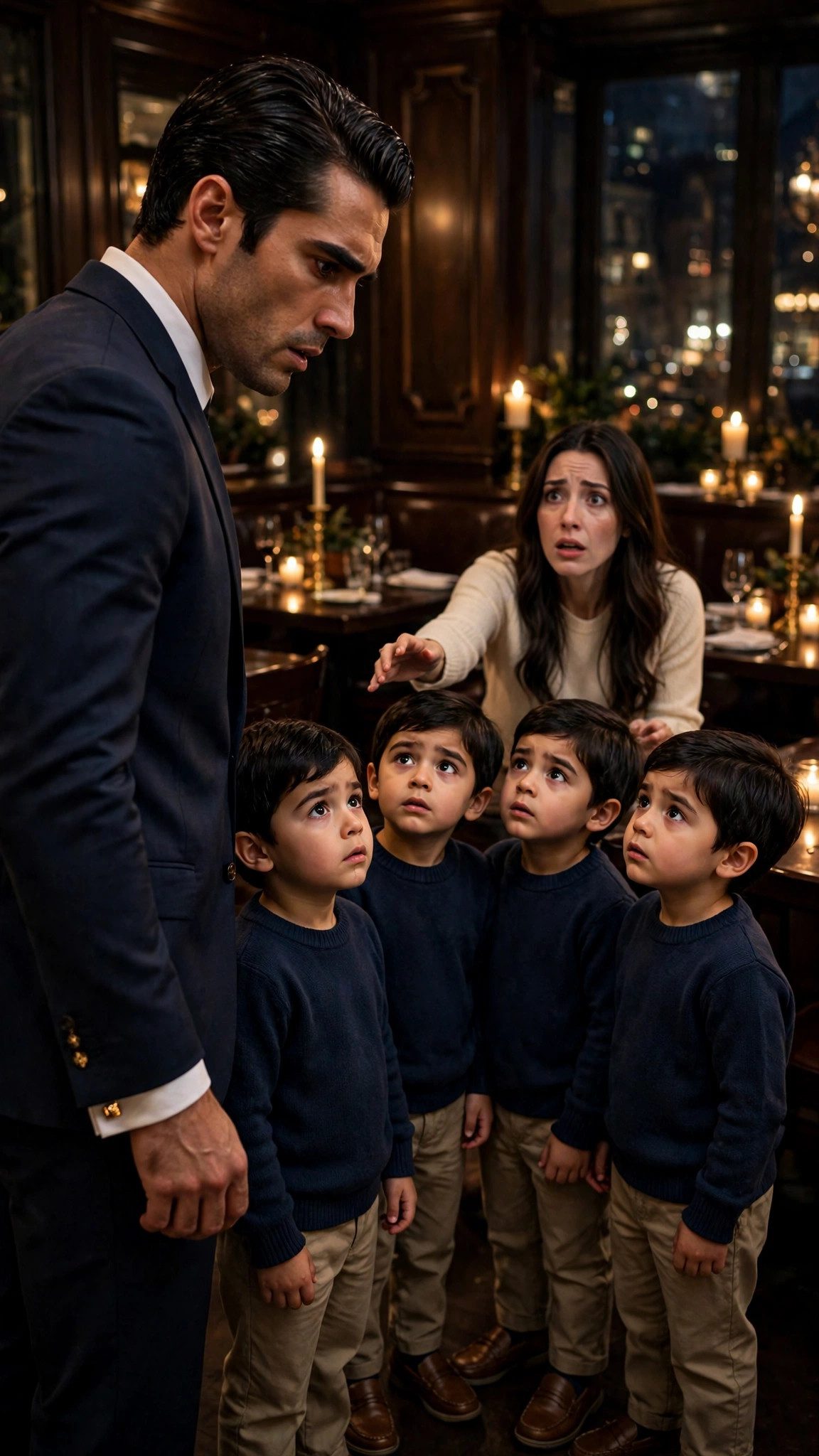
Hours before I was supposed to propose to another woman, four six-year-old boys walked into a restaurant bathroom looking so much like me that I forgot how to breathe. Then I heard their mother calling from outside the door, and I recognized the voice of the only woman I had ever truly loved. Suddenly, the diamond ring in my pocket felt completely meaningless.
My name is Dominic Moretti.
At thirty-seven, people in Boston knew better than to ask exactly how I made my money. My family owned restaurants, real estate, shipping interests, private clubs, and enough influence that the Moretti name could open doors most people never even knew existed.
That night, though, even I was following someone else's plan.
At 7:30, I was supposed to propose to Sloane Barrett beneath the glass roof of my family's private conservatory overlooking the Charles River. My navy suit had been tailored on Newbury Street. My grandfather's cuff links were fastened at my wrists. A diamond ring sat inside my jacket.
Everything was perfect.
Except I didn't love her.
Sloane was beautiful, intelligent, polished, and came from exactly the kind of powerful family mine wanted connected to ours. Everyone kept calling the match perfect. I knew what they really meant.
Useful.
When my driver called to say he was running late, I found myself with almost an hour to kill. So I stopped at an upscale restaurant in Back Bay. I went into the men's room to wash my hands and straighten my tie.
That was when I saw them.
Four little boys stood beside the sinks. Matching navy sweaters. Khaki pants. Dark hair. One of them pushed his hair back, tilted his head slightly, and reached his left hand behind his neck. The other three copied him.
My heart stopped.
I had made that exact gesture since I was a child.
Then the first boy turned toward me. I felt the floor disappear beneath my feet. His eyes. His mouth. The stubborn little crease between his eyebrows. It was like looking at an old photograph of myself.
Then the others turned too.
Four faces.
Four copies of mine.
I had sat across from armed men and watched them threaten my life without blinking. But those boys terrified me.
"How old are you?" I finally managed to ask.
One smiled.
"Six."
Six.
That number hit me harder than any bullet ever could. Because six years earlier, there had been someone. A woman I loved enough to imagine leaving this life behind. The only woman I had ever pictured growing old with. And the woman I had lost.
My hand moved automatically toward the ring inside my jacket.
Then I heard footsteps outside.
A woman's voice called for the boys.
Everything inside me froze.
I knew that voice.
Six years had passed, but I would have recognized it in any room, in any city, after any amount of time.
The boys ran toward the doorway.
I stayed beside the mirror, unable to move.
Tonight, all of Boston expected Dominic Moretti to announce an engagement that would strengthen two powerful families.
But none of that mattered anymore.
Because the woman I had loved six years ago was standing just outside that door.
And four six-year-old boys wearing my childhood face were running straight toward her.
I did not follow them right away. I stood at the sink with my hands braced on the cold marble and stared at my own face in the mirror, and for the first time in my adult life I did not recognize the man looking back at me. The suit was right. The tie was right. The cuff links my grandfather had worn on his own wedding day were right. But the man wearing them looked like a stranger who had been sleepwalking through someone else's life for six years.
Six years. I did the arithmetic the way a man counts the years of a prison sentence. Six years ago, Isabella Fontaine had vanished from my life between one Friday and the next, and I had spent every year since telling myself that she had simply chosen to leave. That she had woken up one morning, looked at what I was, and decided she wanted no part of it.
I had told myself that story so many times that I had almost started to believe it.
But four six-year-old boys had just walked into a bathroom wearing my face, and the arithmetic did not lie. Six years ago, Isabella had left Boston. Six years ago, four boys had been conceived. And no story I had ever told myself could make those two facts sit comfortably side by side.
My phone buzzed in my pocket. Sloane. Probably checking that I was on my way, that the string quartet was in place, that the photographer was hiding behind the right palm tree. I let it buzz. Then it buzzed again, and I took the phone out and looked at the screen, and I felt something cold and unfamiliar settle in my chest. It was not fear. I knew fear. Fear was a man pointing a gun at you across a table. This was something worse. This was the feeling of a man realizing that every choice he had made for six years had been built on a lie.
I put the phone back in my pocket without answering.
Outside the bathroom, the restaurant hummed with Friday-night money: low laughter, clinking glass, a piano playing something soft in the corner. I walked out slowly, the way a man walks when he is afraid of what he will find at the end of the hallway, and I stopped at the edge of the dining room.
There she was.
Isabella Fontaine was standing by a corner table with her back half-turned to me, herding four small boys into their chairs with the practiced hands of a woman who had done it a thousand times. Her hair was longer than I remembered, dark brown and pulled back in a low ponytail, and she was wearing a simple cream sweater and jeans in a room full of silk and diamonds, and she looked more beautiful than every polished woman in that restaurant combined.
One of the boys said something, and she laughed, and the sound of it hit me so hard I had to grip the back of a chair to stay upright. It was the same laugh. Six years, and it was the same laugh, and it belonged to the only three months of my life when I had ever been happy.
"Mama, can I have the bread?" one of the boys asked, and she reached for the basket without looking, the way mothers do, and said, "Matteo, wait for everyone, please," and the name landed in my chest like a fist.
Matteo. My grandfather's name. The name I had once told her, lying in her narrow bed in the North End with the window open to the summer night, that I would give my first son.
She had remembered.
Or she had never needed to remember, because the name had never been mine to give away. It had been waiting for him all along.
I must have made a sound, because she looked up. And for one long second, the whole restaurant went silent in my head. The piano stopped. The glasses stopped. The entire city of Boston stopped, and there was only her face, and the way the color drained out of it when she saw me.
"Dominic," she said. It was barely a whisper, but I heard it across the room as clearly as I had heard her voice outside the bathroom door.
The boys turned in their chairs to look at me. Four pairs of dark eyes. Four small faces with my cheekbones, my mouth, my stubborn crease between the eyebrows. The smallest of them, the one with a scrape on his knee, waved at me with the open, fearless friendliness of a child who has never been taught that strangers can be dangerous.
"Hi," he said. "You're tall."
"Luca," Isabella said quickly, too quickly, her voice tight. "Sit down, sweetheart. Eat your bread."
But Luca kept looking at me, and then the others were looking at me too, and I realized with a strange, floating clarity that they were studying me the way children study a puzzle they almost recognize. One of them tilted his head, exactly the way I tilt mine. Another reached his left hand behind his neck.
Isabella stood up. She came toward me fast, too fast, and she stopped a foot away from me with her hands clenched at her sides, and when she spoke, her voice was low and shaking and furious in a way I had never heard from her before.
"You need to leave," she said. "Right now. Walk out that door and do not come back to this table."
"Isabella," I said, and her name felt strange and perfect in my mouth after six years of not saying it. "Isabella, please. Just tell me—"
"There is nothing to tell you," she said. "You are a stranger. These are my children. You will not frighten them."
"I'm not trying to frighten anyone," I said. "I just need to know—"
"You need to know nothing," she said, and her eyes were bright with tears she refused to let fall. "You made your choice six years ago, Dominic. You chose your family. You chose your name. You chose all of this." She gestured at the room, at the suit, at me. "So go back to it. Go propose to your perfect fiancée under your perfect glass roof. Leave us alone."
The words hit me like a physical blow, because they were the words I had rehearsed in my own head a thousand times, the story I had told myself about why she left. She was throwing my own lie back at me, and hearing it from her mouth, I understood for the first time that she believed it too. She believed I had chosen. She believed I had let her go.
"That is not what happened," I said quietly.
"Then what happened?" she demanded. "Because I waited, Dominic. I waited three weeks. I called. I went to your building. Your doorman told me you were in New York. Your office told me you were in New York. Your father told me—" She stopped. Her mouth closed. Her face went very still, the way a person's face goes when they have almost said something they swore never to say.
"My father told you what?" I asked.
"Nothing," she said. "Go away, Dominic."
"No," I said. "Not this time. Not again. Six years ago I let you walk away because I thought you wanted to go. I am not making that mistake twice."
Behind her, the four boys had gone quiet. They were watching us with the wide, watchful eyes of children who understand far more than adults give them credit for. The oldest-looking one, the one who had smiled at me in the bathroom, slid off his chair and came to stand beside his mother, and he took her hand, and he looked up at me with open curiosity.
"Are you the man from the bathroom?" he asked.
"Matteo," Isabella said softly. "Go back to your seat."
"But Mama, he looks like us," Matteo said, and the innocence of it nearly broke me in half. "He looks like all of us."
I crouched down slowly, the way you approach a nervous animal, until I was at his eye level. The suit protested. I did not care.
"What's your name?" I asked him, although I already knew.
"Matteo," he said. "Matteo Fontaine. I'm six. These are my brothers. Luca, Enzo, and Nico. We're quadruplets. That means there are four of us. We were all born on the same day."
"That's very impressive," I said, and my voice sounded rough to my own ears. "Four brothers. You must look after each other."
"We do," Matteo said seriously. "Mama says we're a team."
I looked up at Isabella. Her face was white. Her hand was shaking where it held Matteo's.
"They're mine," I said. It was not a question. I had known it from the first second in the bathroom, from the first tilt of a small head, from the first hand reaching behind a small neck. But saying it aloud made it real in a way that knowing never had. "Isabella. They're mine. Aren't they?"
She did not answer. She looked at me, and in her eyes I saw six years of nights alone with four crying babies, six years of working double shifts, six years of carrying a secret so heavy it had bent her spine. And I saw something else too, something that made my chest tighten with a fury I had never felt toward anyone in my life. I saw fear. Not fear of me. Fear of what my world would do to her children if it ever found them.
"Please," she whispered. "Please don't do this here. Not in front of them."
I stood up. I took a card from my jacket, my personal card, the one with only my private number on it, and I held it out to her. She stared at it as if it might bite her.
"I am not proposing to Sloane Barrett tonight," I said, and I meant it with every part of me. The ring in my pocket suddenly weighed nothing at all. "I am going to walk out of this restaurant, and I am going to call off an engagement in front of two powerful families, and then I am going to find out what really happened six years ago. And Isabella—" I put the card down on the nearest empty table, where she could take it or leave it. "When you are ready to tell me the truth, call me. I will come. Wherever you are. Whenever it is. I swear it on my mother's grave."
She said nothing. She gathered her boys with shaking hands, and she walked them out of the restaurant into the Boston night, and I watched the door close behind them, and I stood alone in a room full of people who had no idea that the entire course of my life had just changed.
My phone buzzed again. Sloane. Then my father. Then Sloane again.
I took the phone out, and I looked at the ring box in my other hand, and I thought about the glass roof and the string quartet and the photographer behind the palm tree, and I thought about four small faces with my cheekbones, and I made the easiest decision I had made in six years.
I called my driver.
"Rocco," I said. "Change of plan. I'm not going to the conservatory tonight."
There was a pause on the other end of the line. Rocco had driven for my family for twenty years. He had seen everything. He had never once questioned an order.
"Where are we going, boss?" he asked.
"Home," I said. "And then, Rocco, I need you to find someone for me. A woman named Isabella Fontaine. I need to know where she lives, where she works, and who has been watching her. And Rocco—" I looked at the empty table where she had sat, at the bread basket with four small rolls missing. "Do it quietly. No one can know. Not my father. Not Sloane. No one."
"Understood," Rocco said.
I walked out of the restaurant into the cold Boston air, and the diamond ring sat in my pocket like a stone from someone else's life. Somewhere across the city, beneath a glass roof overlooking the Charles River, Sloane Barrett was waiting for a proposal that would never come.
And somewhere in the dark, four six-year-old boys were going home with their mother, wearing my face, carrying my name in their blood, and I had six years to make up for.
I had no idea yet what Sloane had done, or what my father had done, or how deep the lie went. I only knew one thing, and I knew it the way a man knows the ground is solid under his feet.
I was not going to lose them twice.