I did not go to the conservatory that night. I went home, to my penthouse above the city, and I sat in the dark with the ring box open on the table in front of me, and I looked at the diamond the way a man looks at a stranger's photograph. It was a beautiful stone. Three carats, flawless, set in platinum. Sloane had picked it out herself, of course. She had sent me the link with a note that said, "This one. Don't get the other one." I had bought it without thinking, the way I did everything in those days: without thinking.
Rocco called at eight o'clock. "Boss," he said, "Mrs. Barrett is asking where you are. The quartet has played the same song three times. Your father is asking questions."
"Tell them I'm not coming," I said.
There was a long silence on the other end of the line. Rocco had driven for my family for twenty years. He had seen my father humiliate grown men for lesser insults than standing up a Barrett. He knew what this would cost.
"Boss," he said carefully, "are you sure?"
"I've never been more sure of anything," I said. "And Rocco, I need you to do something for me. I need you to find a woman named Isabella Fontaine. She works at Boston Children's Hospital. She lives somewhere in the South End, with four little boys. I need her address. I need to know everything about where she's been for the last six years. And I need to know who has been watching her."
"Watching her?" Rocco asked.
"Someone has been watching her," I said. "I can feel it. Six years, Rocco. She hid for six years, and the moment she comes back to Boston, my father finds out? No. Someone knew she was here. Someone has been keeping track of her. Find out who."
"Understood," Rocco said. "And Sloane?"
"Sloane can wait," I said. "Everyone can wait."
I hung up, and I sat in the dark for a long time, and I thought about the woman in the cream sweater and the four boys in matching navy sweaters, and I thought about the note she had left on her kitchen counter six years ago, and I thought about the way her face had gone white when she saw me in that restaurant.
She had not left me. I understood that now, the way you understand something that has been true all along and you were simply too blind or too cowardly to see it. Isabella Fontaine had never once, in all the time I knew her, done something cruel. She had stitched my knuckles and made me terrible coffee and told me to come back whole. A woman like that does not vanish in the night without a reason. A woman like that is driven away.
And the only person in the world with both the motive and the power to drive her away was sitting in my father's house, or standing under a glass roof waiting for a proposal, and I intended to find out which one it was.
My phone rang again. Sloane. I answered it this time, because there are some conversations a man cannot avoid, and I would rather have it over the phone than face to face.
"Dominic," she said, and her voice was cool and controlled, the way it always was when she was furious and determined not to show it. "Where are you? Your father is here. My parents are here. The photographer has been hiding behind a palm tree for forty minutes."
"I'm not coming, Sloane," I said.
There was a silence. Then, very quietly, she said, "What did you just say?"
"I'm not coming," I said again. "I'm not proposing tonight. I'm not proposing ever. It's over."
"Dominic, you can't be serious," she said, and for the first time I heard something crack in her perfect composure. "Do you have any idea what you're doing? Do you have any idea what this will do to both our families? My father has already told the board. Your father has already told the families. This isn't a dinner reservation you can cancel, Dominic. This is an alliance."
"Then the alliance is cancelled," I said.
"Why?" she demanded. "Give me one reason. One honest reason."
I almost told her. I almost said the words: because I found the woman I actually loved, and she has four sons who look like me. But something stopped me. It was instinct, the same instinct that had kept me alive in rooms full of armed men. Sloane Barrett was not a woman to hand information to in anger. She was a woman to watch, carefully, until I understood exactly what she knew and exactly what she had done.
"Because I don't love you," I said instead. It was true enough. "And I'm not going to marry a woman I don't love to make our fathers happy."
"You don't love anyone," she said coldly. "That's the problem with you, Dominic. You're incapable of it. You were incapable of it six years ago, and you're incapable of it now."
The words should have hurt. Six years ago, they would have. But standing in my dark penthouse with the ring box open in front of me, I heard something in her voice that I had never noticed before: not pain, not heartbreak, but calculation. She was not a woman losing the man she loved. She was a woman losing a merger.
"Goodbye, Sloane," I said, and I hung up.
Rocco called back an hour later. "I found her," he said. "Isabella Fontaine, thirty-one, pediatric nurse at Boston Children's. She lives on a quiet street in the South End with her four boys and her mother, Rosa. The boys are in kindergarten at a public school two blocks away. And boss—" He paused. "There's something else. There's a man. A private investigator named Ray Doyle. He's been following her for two years. Photographs, license plates, school schedules. He reports to someone. I don't know who yet, but I'm going to find out."
"Two years," I said. "Someone has been watching my sons for two years."
"Your sons," Rocco repeated quietly. "You know for certain?"
"I know," I said. "But I want the test anyway. For them. For the record. For the day someone asks."
"I'll set it up," Rocco said. "Discreet. A lab in Cambridge. Results in twenty-four hours."
"Thank you," I said. "And Rocco, one more thing. I need you to look into Sloane Barrett. Not her family. Her. Her money. Her phone records. Who she talks to when she thinks no one is listening. I have a feeling she's been busy."
"I'll start tonight," Rocco said.
I did not sleep that night. I stood at the window of my penthouse and looked out over the city, and I thought about four little boys asleep in a small apartment in the South End, and I thought about the woman who had raised them alone for six years while I sat in rooms full of powerful men telling myself that she had chosen to leave me.
My father came to my penthouse the next morning, before I was even dressed. He did not knock. He never knocked. He walked in with two of his men behind him, and he stood in the middle of my living room, and he looked at the ring box still sitting open on the table, and his face went dark.
"Do you have any idea what you have done?" he asked. His voice was low and cold, the voice he used in rooms where decisions were made that could not be unmade. "The Barretts have already called me three times. Sloane's father is threatening to pull his money out of the shipping company. Do you understand what that means?"
"I understand," I said. "I understand that I was about to marry a woman I don't love to protect a shipping company. And I understand that I'm not going to do it."
"You're being a child," my father said. "A sentimental child. Love doesn't keep a family alive, Dominic. Alliances do. Money does. Power does."
"Then why did you marry my mother?" I asked.
The question stopped him cold. He stared at me, and for a moment the cold mask slipped, and I saw something raw underneath it.
"Your mother," he said slowly, "was the only mistake I ever made that I didn't regret. And I spent forty years making sure no one could ever use her against me. That is the price, Dominic. That is what it costs."
"And was it worth it?" I asked. "Was it worth it, keeping her at arm's length for forty years so no one could touch her?"
My father did not answer. He looked at the ring box on the table, and he looked at me, and I saw something in his eyes that I had never seen before: not anger, but fear. The fear of an old man who has just realized that the thing he spent his life building might have been built on a mistake.
"Something happened six years ago," I said quietly. "Something to do with a woman named Isabella Fontaine. And I think you know what it was."
His face went very still. He picked up his coat. He walked to the door. And without turning around, he said, "Be careful, Dominic. There are things in this family you don't want to dig up."
Then he was gone, and I stood alone in my penthouse, and I understood, with a clarity that frightened me, that my father had just confirmed everything I suspected without saying a single word.
That afternoon, I did something I had never done before: I went to a toy store. I stood in the aisle for twenty minutes, feeling like an idiot in a suit that cost more than most people's cars, staring at a wall of trucks and trains and blocks. I had four sons. I had four sons I had never met, and I did not know what a six-year-old boy liked, and I did not know what their favorite colors were, and I did not know if they liked trucks or trains or dinosaurs. So I bought four identical red trucks, because red was the only color I was sure about, and I had Rocco deliver them to Isabella's building with a note that said only, "From someone who is glad you exist."
Rocco called me an hour later. "She knows it was you," he said. "She took one look at the note and said, 'He always did have terrible handwriting.' Then she let the boys open them. Boss, you should have heard them. Four little boys, all shouting at once. It was the loudest thing I've heard in years."
"Did she say anything else?" I asked.
"She said to tell you that Matteo named his truck Lightning, Luca named his Thunder, Enzo named his Red, and Nico named his Truck," Rocco said, and I could hear the smile in his voice. "She said Nico is very literal."
I sat in my office for a long time after that call, thinking about four red trucks and four small boys with names like a thunderstorm, and I thought about the fact that I had missed six years of birthdays and scraped knees and lost teeth, and I thought about how much time I had left to make up for, and whether it would ever be enough.
It would have to be. It was all I had.
In the morning, I drove to the South End myself. I did not bring Rocco. I did not bring anyone. I parked across the street from a small brick building with window boxes full of geraniums, and I sat in the car for twenty minutes, watching the door, trying to find the courage to walk up the steps.
What if she slammed the door in my face? What if the boys were frightened of me? What if six years was too long, and the woman I had loved was gone, replaced by a stranger who hated me?
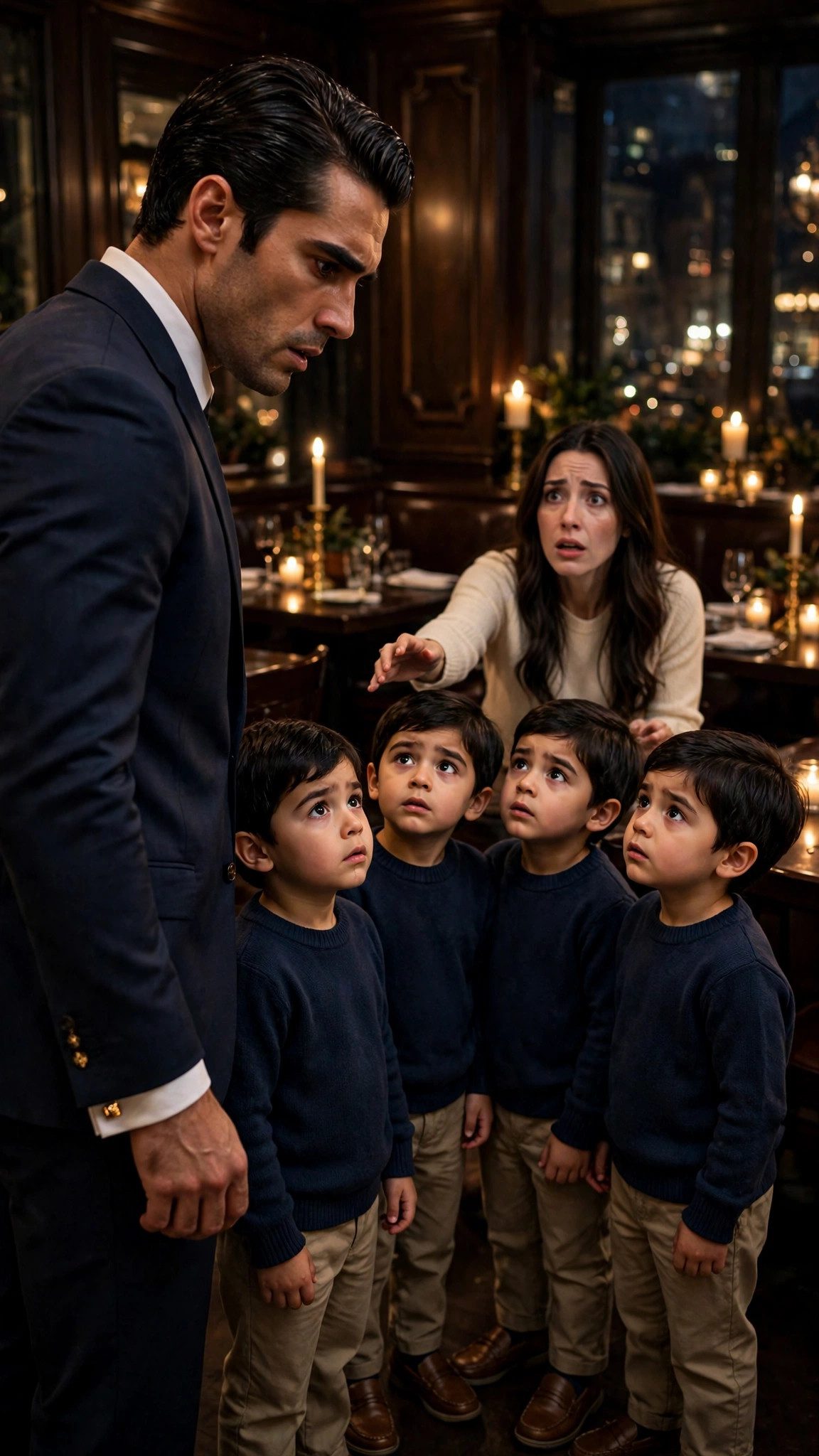
Then the door opened, and Isabella came out with the four boys, and all four of them were wearing their matching navy sweaters, and she was carrying a bag of groceries in one hand and holding Nico's hand with the other, and Luca was telling a story with his hands, and Enzo was laughing, and Matteo was walking a half-step behind his mother, the way the oldest child always does, watching everything.
I got out of the car before I could talk myself out of it.
"Isabella," I called.
She turned. The boys turned. Four pairs of dark eyes fixed on me, and for a moment nobody moved, and then Matteo said, "It's the tall man from the restaurant," and Luca said, "Hi, tall man," and Nico hid behind his mother's leg, and Enzo waved.
Isabella looked at me for a long moment. Then she said, very quietly, "The boys have a doctor's appointment in an hour. You can walk with us to the corner. That's all I can give you right now."
It was more than I deserved. I walked beside her, and the boys ran ahead to the corner and back, and she told me, in short, careful sentences, about the last six years. About Providence. About the clinic. About the night she found out she was carrying four babies, and the doctor who told her she would need to be very brave. About the apartment above the laundromat. About her mother's heart, and the specialist in Boston, and the job at Children's.
She did not tell me about Frankie Lombardo. She did not tell me about the envelope, or the note, or the threat. Not yet. But she told me enough, and when we reached the corner, she stopped and looked at me, and her eyes were full of six years of exhaustion and pride and a grief so old it had become part of her.
"They're yours," she said finally. It was the first time she had said it aloud. "All four of them. I never told them about you, because I didn't know how. But they're yours, Dominic. Matteo, Luca, Enzo, and Nico Moretti. They have your face. They have your temper. Matteo hums when he's nervous, did you know that? He hums the same song you used to hum when you were waiting for your coffee. I don't know how he knows it. He just does."
I crouched down at the corner, in my suit, on a sidewalk in the South End, and I looked at four small faces, and I said, "Hi. I'm Dominic. I'm your dad."
Luca grinned. "We know," he said. "You look like us."
Nico peeked out from behind his mother's leg. "Are you going to stay?" he asked.
It was the smallest question in the world, and it was the biggest question anyone had ever asked me.
"Yes," I said. "I'm going to stay."
And for the first time in six years, I meant something completely.