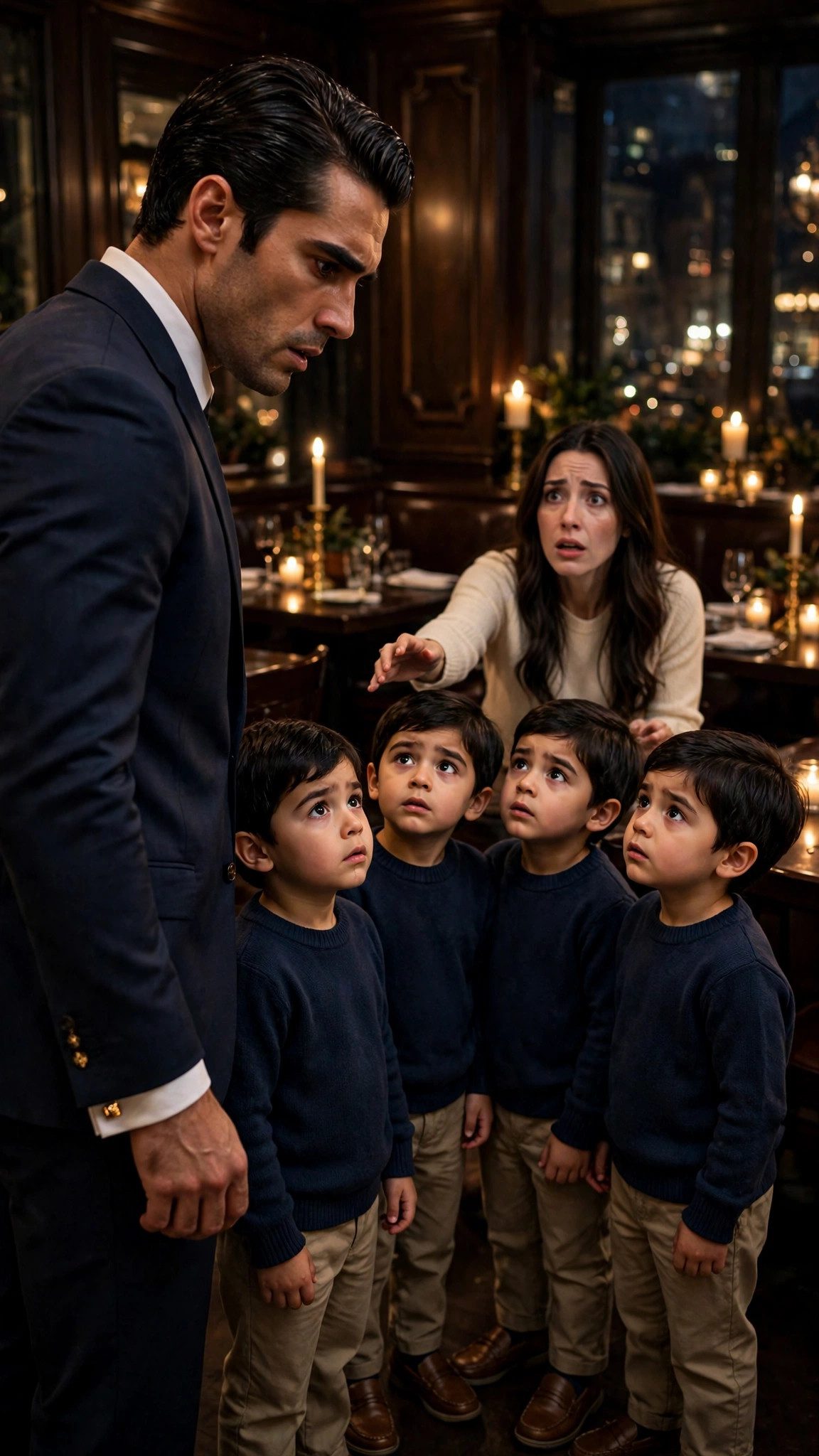
Isabella Fontaine had never been afraid of hard work. She had been afraid of many things in her life — her mother's heart stopping in the middle of the night, the rent coming due before her paycheck cleared, the sound of her own phone ringing with bad news — but hard work had never frightened her. Hard work was the one thing she could control.
The morning Vittorio Moretti's men came to her apartment, she learned that there were things in this world that hard work could not fix.
It was a Thursday, early November, cold enough that the radiators in her building had started to clank. She had just come home from a night shift at the hospital, exhausted, her scrubs smelling of antiseptic and her feet aching in her shoes. She was standing in her small kitchen, making tea, when the knock came at the door.
Three knocks. Slow. Patient. The kind of knock that does not ask permission.
She opened the door, and a man she had never seen before stood in the hallway. He was in his sixties, silver-haired, wearing an expensive coat, and he smiled at her the way a priest smiles at a sinner: with pity, and with absolute certainty.
"Miss Fontaine," he said. "My name is Frankie Lombardo. I work for the Moretti family. May I come in?"
She should have said no. She should have slammed the door and called the police. But her mother lived two streets away, alone, with a heart that could stop at any moment, and the man in the hallway knew it. She could see it in his eyes. He knew everything about her, and he wanted her to know that he knew.
"Say what you came to say," she said, not opening the door any wider.
He nodded, as if he had expected exactly that answer.
"Mr. Moretti is very fond of his son," he said. "And Mr. Moretti is very fond of you, in his way. But Dominic is the head of this family now, and a man in his position cannot have a weakness. You understand me. You are a weakness."
"I am not a weakness," Isabella said. "I am a nurse."
"You are a woman he loves," Frankie said gently. "And in our world, that is the same thing. Men who want to hurt Dominic will not come for him. They will come for you. And when they do, they will not be polite. They will not knock."
Isabella's hands were shaking. She hid them behind her back.
"What do you want?" she asked.
"I want you to leave Boston," Frankie said. "Tonight. Quietly. No goodbye. No phone call. No letter he can follow. You will go somewhere no one in this city can find you, and you will stay there, and you will never contact Dominic Moretti again."
"And if I refuse?" she asked, and her voice came out smaller than she wanted it to.
Frankie sighed, and for a moment he looked almost human. "Then I will have to tell Mr. Moretti that you refused. And Mr. Moretti is an old man, Miss Fontaine, and old men in his position do not like to be refused. Your mother is on a waiting list for a heart specialist at Mass General. A very long list. Mr. Moretti can move her to the top of that list tonight. Or he can make sure she never reaches the top of it at all."
The words landed like a weight on her chest. Her mother. Rosa. Sixty-one years old, with a heart that the doctors said would need surgery within the year, and a waiting list that stretched for months, and a daughter who had spent her whole life trying to keep her alive.
"You're threatening my mother," Isabella whispered.
"I am explaining your choices," Frankie said. "Leave tonight, and your mother's surgery is paid for, in full, by a private foundation. No waiting list. The best surgeon in Boston. She will live to see her grandchildren. Stay, and—" He spread his hands. "I cannot promise anything."
Isabella stared at him. She thought about Dominic, asleep in his penthouse across the city, a man who had never once raised his voice to her, who had fixed her dripping faucet and learned to cook her mother's pasta. She thought about the ring she had seen him looking at in a shop window on Newbury Street, the simple gold band he thought she hadn't noticed. She thought about the life they had been building, box by box, in her third-floor walk-up.
And she thought about her mother, alone in her apartment two streets away, with a heart like a clock running down.
"How do I know you'll keep your word?" she asked.
"Because Mr. Moretti always keeps his word," Frankie said. "That is why he is still alive at seventy-one. You have his word, Miss Fontaine. Your mother will be taken care of. But you must go tonight, and you must never come back. If Dominic ever finds you, the arrangement ends. Do you understand?"
She understood. She understood perfectly. She was being bought, and the price was her mother's life, and there was no version of this story in which she got to keep both the man she loved and the mother who had raised her.
"There is one more thing," Frankie said, and he reached into his coat and took out an envelope. "This is for you. For the journey. There is enough here to start over somewhere new. Do not be proud, Miss Fontaine. Take it. You will need it."
She took the envelope with numb fingers. Inside, she would later find five thousand dollars in cash, and a single sheet of paper with a handwritten note on it. The handwriting was not Frankie's. It was a woman's handwriting, elegant and looping, and the note said only this:
"Leave tonight and never come back. He was never yours. — S."
She did not know who S. was. Not then. She folded the note and put it in her purse, and she did not understand why the handwriting frightened her more than Frankie's threats. Perhaps some part of her already knew. Perhaps some part of her had already seen that elegant looping handwriting somewhere before, on a place card at a charity dinner, on a thank-you note sent to the clinic, on the arm of a beautiful blonde woman who had been circling Dominic Moretti for years.
She packed one suitcase. She wrote the note to Dominic — the shortest note she had ever written, the hardest thing she had ever done — and she left it on the kitchen counter. She went to her mother's apartment, and she held Rosa in her arms, and she told her mother that she had to go away for a while for work, and that everything was going to be all right, and that the surgery would be paid for, and her mother cried, and Isabella cried, and neither of them said what they both knew: that this was not a choice. It was a ransom.
By midnight, she was on a bus to Providence, Rhode Island, with one suitcase, five thousand dollars, a note in a stranger's handwriting, and a secret she did not yet know she was carrying.
Her first week in Providence, she lived in a motel room with a buzzing neon sign outside the window and a lock on the door that did not quite catch. The landlady, a stout Irish woman named Mrs. Agnes O'Connor, took one look at her on the first morning — young, exhausted, carrying one suitcase and crying quietly into her coffee — and decided, without asking a single question, that Isabella was hers to look after.
"You eat," Mrs. O'Connor said, putting a plate of toast and eggs in front of her. "Whatever it is, you eat first. Tears on an empty stomach never fixed anything."
Isabella ate. She told Mrs. O'Connor nothing, and Mrs. O'Connor asked nothing, and that was the beginning of the first real friendship Isabella had made in years. In the evenings, Mrs. O'Connor would knock on her door with tea and sit on the edge of the bed and talk about her own life: a husband dead twenty years, a daughter in California, a motel that had been her whole world since she was thirty. She never asked Isabella what she was running from. She only said, once, "Whatever his name is, love, he isn't worth your health. Eat. Sleep. The rest will sort itself out."
By the second week, Isabella had found work at a free clinic in Providence, three mornings a week, enough to pay for the motel room and a little food. The clinic director, a tired, kind man named Dr. Patel, hired her on the spot when she told him she was a nurse.
"We need hands," he said. "We always need hands. You can start tomorrow."
She started tomorrow. She worked mornings, and in the afternoons she walked the streets of Providence, learning the city the way she had once learned the North End: which bakery sold day-old bread for half price, which laundromat had the cheapest machines, which park had benches where she could sit and breathe. She wrote letters she never sent. She wrote one to Dominic, six pages long, telling him everything: about Frankie, about the envelope, about her mother, about the note in the looping handwriting. She read it twice, and then she tore it into small pieces and dropped it into the motel trash can, because Frankie's voice was still in her head, saying, "If Dominic ever finds you, the arrangement ends," and she believed him. She believed that a letter would be the thing that killed her mother.
She found out three weeks later, in a bathroom in a cheap motel room in Providence, staring at a pregnancy test with shaking hands. She sat on the edge of the bathtub for an hour, and she cried, and then she laughed, and then she cried again, because the universe had a sense of humor so dark it bordered on cruelty. She had left Dominic Moretti to protect the people she loved. And she was carrying his child.
Or rather, as the doctor told her at her first ultrasound, his children. Four of them.
"Quadruplets," the doctor said, showing her the screen, four tiny heartbeats flickering like candles in the dark. "Miss Fontaine, this is a high-risk pregnancy. You will need bed rest. You will need help. You will need family."
"I don't have family here," Isabella said.
"Then you will need to be very brave," the doctor said.
She was brave. She was brave in the way that only a woman with no other choice can be brave. She found a job at a clinic in Providence, working mornings until her belly grew too large for the chairs. She moved into a small apartment above a laundromat. She saved every dollar. She read every book about multiple births she could find at the library. And on a snowy night in May, she gave birth to four boys in a hospital room full of nurses and monitors and fear, and when they placed the first one in her arms, she looked at his dark hair and his stubborn little crease between his eyebrows, and she whispered, "Matteo," because it was the name Dominic had once told her he would give his first son, and she had never forgotten it.
Matteo. Luca. Enzo. Nico. Four boys, four heartbeats, four copies of the man she had loved and lost. They were born small and loud and furious at the world, and she loved them with a ferocity that frightened her sometimes. She worked double shifts at the hospital. She learned to cook with one baby on her hip and another in a sling. She taught them to say "team" before they could say "Mama," because a team was what they were, and a team was what they would need to be.
She never told them about their father. When they asked, and they did ask, she told them that their father was a good man who lived far away, and that one day, when they were older, she would tell them the whole story. It was not a lie. It was a delay. She told herself that she would know when the time was right.
The time was never right. There was always a reason to wait. They were too young. They were too happy. Boston was too far away and too dangerous. And underneath all the reasons was the real one, the one she never said aloud: she was afraid. She was afraid that if Dominic ever found them, his world would swallow them whole, the way it had swallowed her. She was afraid that four small boys with his face would become targets the moment his enemies learned they existed.
So she hid them. She hid them in plain sight, in Providence, in a life so ordinary that no one would ever think to look twice. And for six years, it worked.
Until her mother's heart began to fail again.
Rosa Fontaine needed a specialist, and the only specialist who could help her was in Boston, at Mass General. Isabella had no choice. Two months ago, she packed up her life in Providence, took a nursing job at Boston Children's Hospital, and moved her four boys into a small apartment in the South End, three miles from the Moretti penthouse and a world away from everything Dominic represented.
She told herself it was temporary. She told herself that Boston was a big city, and that Dominic Moretti moved in circles so far above hers that they would never cross. She told herself that she could keep her boys safe if she was careful, if she kept her head down, if she never went to the restaurants where his kind of people ate.
She had been careful for six years. She had been careful every single day.
She had never once imagined that the danger would find them in a restaurant bathroom on a Friday night, in the form of four little boys and a man who had never stopped looking for her.