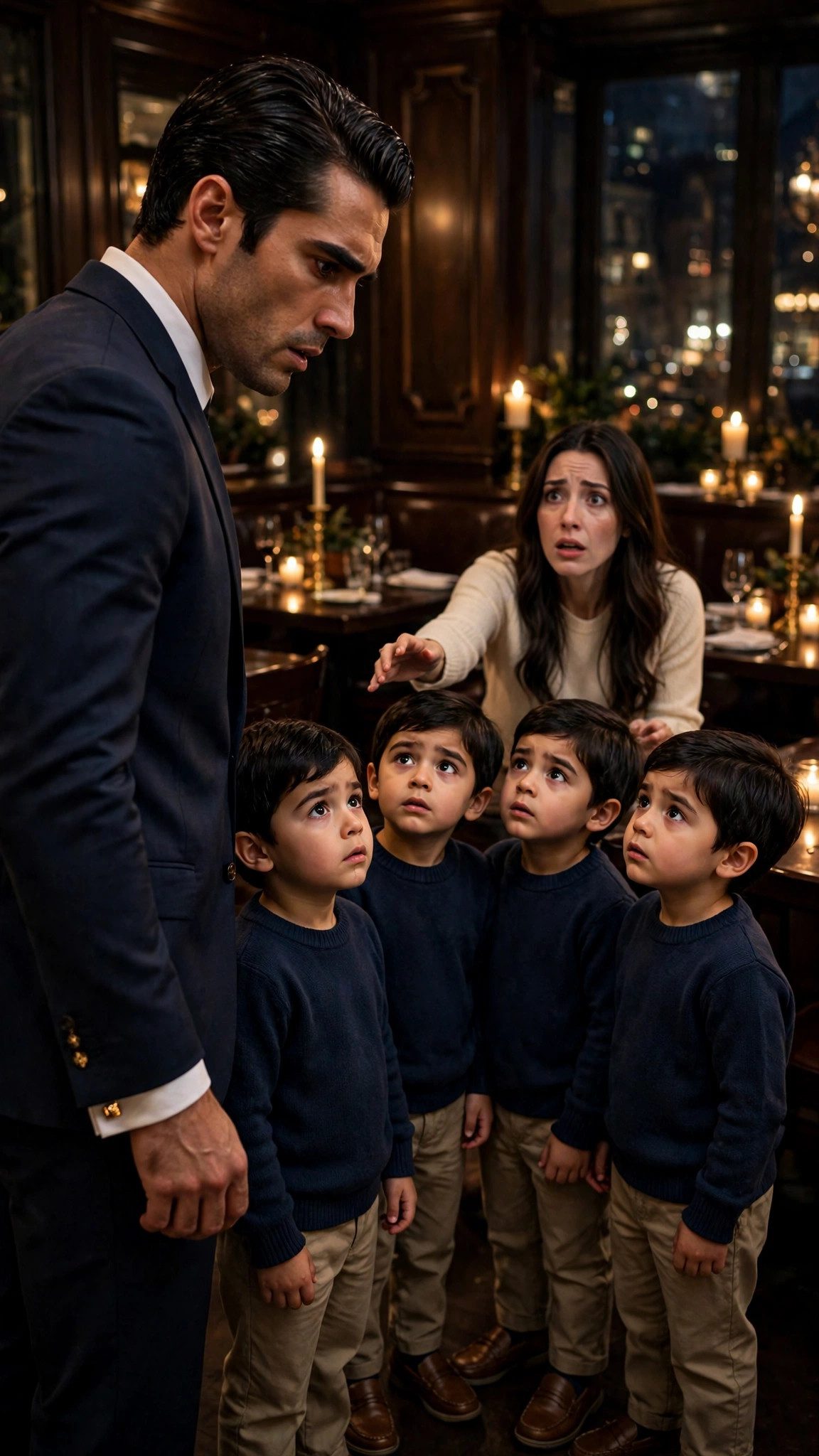
The night Sloane Barrett was exposed under the glass roof, Vincent Castellano made his move.
I should have expected it. A man like Castellano does not watch his investment collapse and do nothing. For two years, he had been funding the Barrett family through shell companies, keeping them afloat while they sank deeper into debt. The marriage between me and Sloane was supposed to be his way in: a Moretti wife with a Barrett name, a seat at my table, access to my shipping routes, and a family too compromised to fight back. When Isabella walked into that conservatory with four little boys, she did not just expose my fiancée. She exposed his entire plan. And men like Vincent Castellano do not forgive that.
The call came at two in the morning. Rocco's voice was tight and low.
"Boss," he said. "A van was spotted near the boys' school. Two men. They were asking the crossing guard about dismissal times. I have men on the building now, but you need to know: this is real. They're going to try to take one of them. Maybe all of them. Castellano wants leverage, and he knows exactly where your leverage sleeps."
I was on my feet before he finished speaking. I drove to the South End myself, through empty streets, with my heart hammering against my ribs. Isabella's building was dark. Her windows were dark. I parked across the street and called her, and she answered on the second ring, her voice thick with sleep.
"Dominic? What's wrong?"
"Nothing's wrong," I said. "But I need you to listen to me very carefully. Lock your door. Lock the boys' bedroom door. Don't open it for anyone but me or Rocco. My men are outside your building right now, and they will be there all night. In the morning, the boys are not going to school. Do you understand?"
There was a pause. Then she said, in a voice that was steady in the way only a mother's voice can be steady when she is terrified, "He's coming for them, isn't he?"
"Yes," I said. "But he's not going to get them. I swear it, Isabella. Not while I'm breathing."
"I believe you," she said. "That's the terrible thing. I believe you."
I stayed outside her building until dawn, watching the street, watching the shadows, watching for a van that never came. In the morning, Rocco arrived with coffee and a plan.
"We take them somewhere safe," he said. "My cousin has a house on the Cape. Quiet. Gated. No one knows about it. We move Isabella, her mother, and the boys there today. You stay here and deal with Castellano."
"No," I said. "I go with them. Castellano wants me to choose between my family and my business. I've already chosen. My business can wait."
Rocco looked at me for a long moment. Then he nodded, slowly, the way a man nods when he has just watched his boss become someone else.
"All right, boss," he said. "Then we do it your way. But Castellano won't wait. He's going to come at you through the business. The docks. The trucks. He's going to make it expensive."
"Let him," I said. "Money I can make back. My sons I can't."
We moved them that afternoon. Isabella packed four small suitcases while the boys ran around the apartment, excited about an adventure, oblivious to the danger. Rosa Fontaine sat in her chair by the window, her hand pressed to her chest, watching her daughter with eyes full of fear and pride.
"Mama," Isabella said gently, kneeling beside her. "We're going to the Cape for a little while. Just until things are safe. The air will be good for you there."
Rosa took her daughter's hand. "I am not afraid, my love," she said. "I have been afraid for six years. I am tired of being afraid. Whatever comes, we face it together now. As a family."
The drive to the Cape took two hours. The boys sang songs in the back seat, all four of them, off-key and out of time with each other, and Isabella laughed, and I drove, and for two hours the world was just a car full of noise and sunlight and the smell of the sea coming through the open windows. It was the happiest two hours of my life.
The house on the Cape was small and weathered and perfect: a gray-shingled cottage with a view of the water, a yard full of wild grass, and a porch where Rosa could sit and watch the boats. The boys exploded out of the car and ran for the beach, and Isabella called after them to stay where she could see them, and I stood on the porch with Rocco and watched them go.
"They're good boys," Rocco said quietly. "You did well, boss. All those years, you thought you'd lost everything. Turns out you had four of everything."
"They're not mine to take credit for," I said. "She raised them. She did all of it alone. I just showed up at the end."
"Showing up is the hardest part," Rocco said. "Most men never do."
The next morning, the boys woke up before dawn and pressed their faces to the windows, and when they saw the ocean, they went wild. They had never seen the ocean before. They had seen it in books, and on television, but they had never stood on a beach and felt the wind coming off the water, and they ran down to the sand in their pajamas, all four of them, shouting, and Isabella ran after them in her robe, laughing, and I followed with a bag of towels, and Rosa followed with a thermos of coffee, and for the first time in days, nobody was afraid.
I taught Matteo to skip stones. He was terrible at it at first — every stone sank with a sad little plop — but he kept trying, his tongue stuck out in concentration, his small arm winding up the way mine used to wind up when I was his age. On the seventeenth try, the stone skipped twice, and Matteo shouted so loudly that a seagull took off in alarm, and Luca demanded a turn, and Enzo wanted to collect shells, and Nico wanted to dig a hole to China.
"You're doing it wrong," Luca told Matteo, with the absolute confidence of a six-year-old. "You have to throw it like this." He threw his stone. It sank immediately.
"You're doing it wrong too," Matteo said.
"I'm doing it differently," Luca said. "That's not the same as wrong."
Isabella sat on a blanket with her mother, watching them, and she looked more peaceful than I had ever seen her. The wind pulled at her hair. The sun was warm on her face. She looked like a woman who had finally, after six years of running, found a place to stand still.
"We could stay here," she said quietly, when I sat down beside her. "Not forever. Just for a while. Until it's safe. The boys love it here. My mother loves it here. I love it here."
"We can stay as long as you want," I said. "The house is ours for as long as we need it. But Isabella, I don't want to hide anymore. Not you. Not them. Not us. I spent six years living in the dark because I thought that's what my life was. I'm done with the dark."
She looked at me, and she nodded, slowly, and she took my hand, and we sat there on the blanket while four small boys tried to dig a hole to China and argued about the correct way to skip a stone.
That afternoon, Rocco called from Boston. His voice was calm, but I could hear the tension underneath it.
"Boss, the federal agents want Doyle's records," he said. "All of them. They're building a case, and Doyle is the key. They want to talk to you, too. About Castellano. About the shell companies. About everything."
"Tell them I'll talk," I said. "Tell them I'll tell them everything I know. But Rocco, I need something from you first. I need to know my boys are safe. I need to know that no one can get to this house."
"No one can get to this house," Rocco said. "I have four men on the road, two on the beach, and one on the roof of the bait shop with binoculars. The only way anyone gets to those boys is over my dead body, and I don't plan on dying this week."
"Good," I said. "Keep it that way."
That night, after the boys were asleep in a row of small beds like peas in a pod, Isabella and I sat on the porch with two cups of tea, and she told me about the note. She told me about Frankie Lombardo, and the envelope, and the threat to her mother, and the handwriting she had never forgotten. She told me about the bus to Providence, and the motel room, and the four heartbeats on the ultrasound screen. She told me about the nights when all four babies cried at once and she sat on the floor of her apartment and cried with them, because she was twenty-five years old and alone and she had no idea how she was going to do it.
"But I did it," she said. "I did it because they needed me to. And I would do it again. Every single day of it. Even the worst days. Because they were worth it."
"I know," I said. "I can see it. In every part of them."
She looked at me then, really looked at me, and I saw the question in her eyes before she asked it.
"Dominic," she said. "What happens now? With Castellano. With your father. With all of it."
"Now," I said, "we end it. All of it. My father has already agreed to cooperate with the federal agents. He's giving them everything: the ledgers, the routes, the names. He's seventy-one years old, Isabella. He's going to spend the rest of his life making this right. And Castellano—" I paused. "Castellano made a mistake. He tried to take my sons. Men in my world understand one thing, and it's this: you can steal money, you can steal territory, you can even steal a man's name. But you do not touch his children. When you do, every rule stops applying."
I did not sleep that night either. I sat in the living room of the Cape house with the lights off, watching the dark road through the window, listening to the house breathe around me. Twice I got up and walked down the hallway to check on the boys, and twice I stood in the doorway of their room, watching four small chests rise and fall in the moonlight, and I thought about how fragile they looked, and how fiercely I would fight for them. Isabella found me there on the second trip, standing barefoot in the hallway, and she did not say anything. She just took my hand, and we stood there together in the dark, listening to our sons sleep, and it was enough.
The next morning, Rocco's men found the van. It was parked three blocks from the boys' school, with two of Castellano's men inside and a bag full of rope and tape in the back. They were arrested before they could move. Within a week, Ray Doyle's testimony and the payment records led federal agents to Castellano's entire operation: the shell companies, the bribes, the shipments. Vincent Castellano was arrested on a Tuesday morning, in his own office, in front of his own lawyers, and the photograph of him being led out in handcuffs was on the front page of every newspaper in Boston by noon.
Sloane Barrett was arrested the same week, charged with conspiracy and fraud. Her father resigned from his company in disgrace. The Barrett family, which had once been one of the most powerful names in Boston, collapsed in a matter of days, the way a house collapses when you pull out the one beam that was holding up the roof.
I did not attend her trial. I did not need to. I had seen everything I needed to see in the conservatory, in the moment her smile finally broke. I felt no triumph. I felt only a vast, quiet relief, as if a weight I had been carrying for six years had finally been set down.
My father came to the Cape on a Sunday, a week after the arrests. He stood on the porch in his old coat, looking smaller than I had ever seen him, and he asked if he could meet his grandsons. Isabella brought the boys out, one by one, and my father knelt down in the grass — my father, Vittorio Moretti, who had never knelt for any man — and he looked at four small faces with his own cheekbones, and he wept.
"I am so sorry," he said to Isabella. "I did a terrible thing to you. I told myself it was for the family. But a family that begins with a threat is not a family. It is a prison. Forgive me, if you can. If you cannot, I understand."
Isabella was quiet for a long time. Then she put her hand on his shoulder, and she said, "You can start by being their grandfather. That's all they need from you. The rest, we'll figure out as we go."
Matteo tugged on my father's sleeve. "Are you our nonno?" he asked.
My father looked at him, and his face broke into a smile so wide and so young that for a moment I saw the man he had been before the weight of the family had bent him.
"Yes," he said. "I am your nonno. And you four are going to be the death of me, I can already tell."
"Good," Luca said seriously. "Nonnos are supposed to be fun."
And that was how Vittorio Moretti, the most feared man in Boston for forty years, spent his first afternoon as a grandfather: on his knees in the grass on Cape Cod, building a sandcastle with four six-year-old boys who had his cheekbones and his stubbornness and absolutely no fear of him at all.