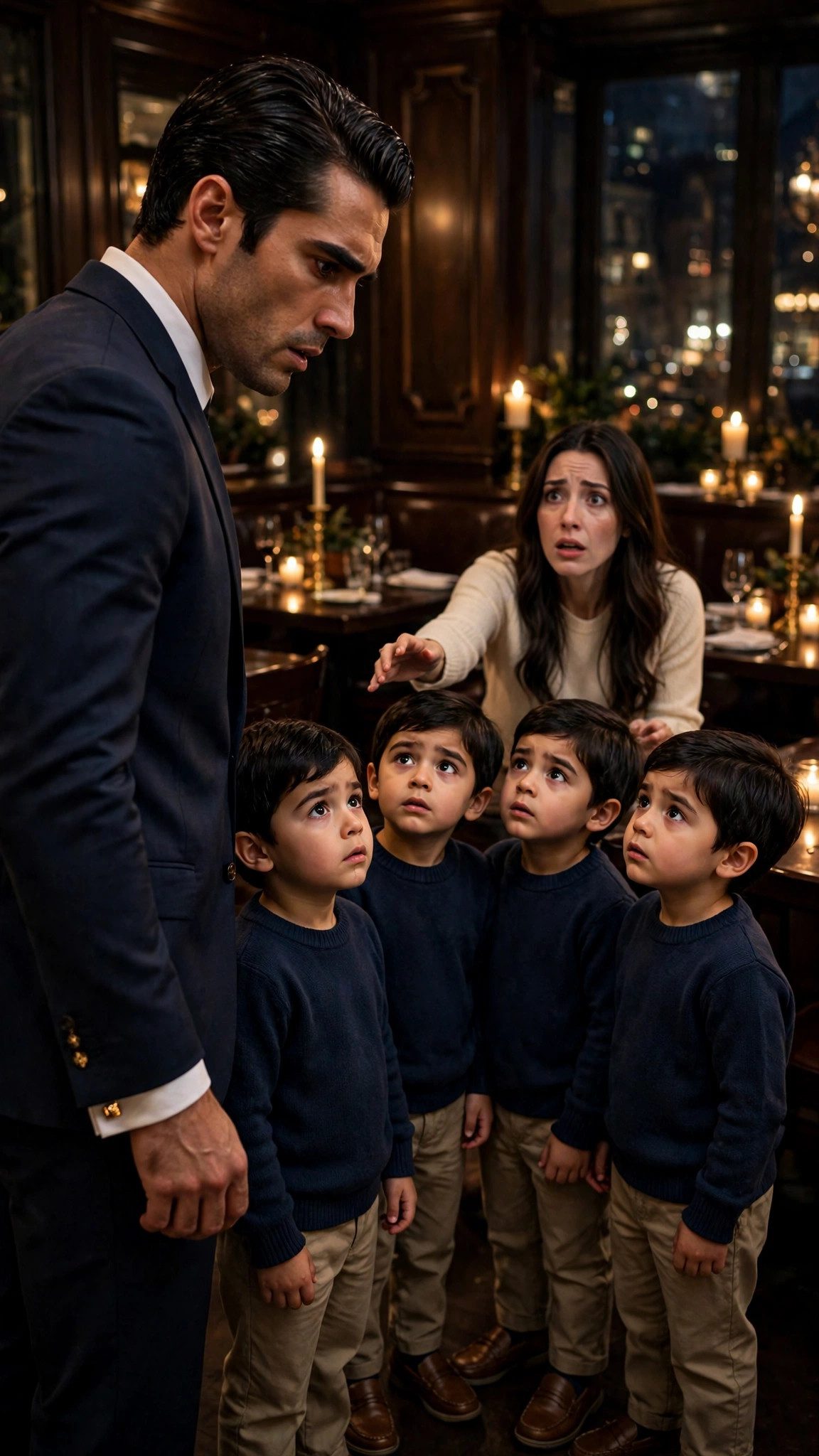
I proposed to Isabella Fontaine on a Tuesday evening in October, in the small Back Bay restaurant where I had first seen my sons, at the exact table where she had sat with them that night. I did not rent the conservatory. I did not hire a string quartet. I did not hide a photographer behind a palm tree. I asked Rocco to reserve the corner table, and I asked the chef to make the same bread the boys had eaten that night, and I asked Isabella to meet me there at seven o'clock, and I told her to bring the boys.
She came in wearing a simple green dress, and her hair was down, and the boys came in wearing their matching navy sweaters, and they climbed into their chairs with the confidence of children who now owned every room they walked into, and Matteo said, "This is where Dad saw us first," and Luca said, "In the bathroom," and Enzo said, "That's disgusting," and Nico said, "I like the bread here," and Isabella laughed, and I thought: this. This is what a life is supposed to feel like.
I waited until dessert. Then I stood up, and I took a small velvet box from my pocket, and I knelt down beside her chair, and four small faces turned to watch me with wide eyes.
"Isabella," I said, "six years ago, I let you walk away because I thought you wanted to go. I was wrong. I was wrong about everything. I was wrong about why you left, and I was wrong about what I had to do to get you back, and I was wrong to think that a life without you was a life at all."
I opened the box. Inside was my grandmother's ring: a simple gold band with a single small diamond, the ring my grandfather had given her when they had nothing but a restaurant and a dream. It was the ring I had meant to give Isabella six years ago, the ring I had hidden in my desk drawer and practiced words for in the mirror.
"I bought a different ring once," I said. "A big one. An expensive one. For a woman I didn't love, under a glass roof, in front of two families. I threw it into the Charles River last week. It sank like a stone, and I have never felt lighter. This is the ring that matters. This is the ring I wanted to give you the first time. Will you marry me, Isabella? Will you let me be their father, and your husband, and the man who comes home to you every night for the rest of his life?"
She looked at me, and her eyes were full of tears, and she opened her mouth, and before she could answer, Matteo stood up on his chair and said, very loudly, "Say yes, Mama. Say yes or we'll never stop asking."
"Matteo," Isabella said, laughing through her tears. "Sit down."
"No," Luca said. "He's right. Say yes, Mama."
"Say yes," Enzo chanted, banging his spoon on the table. "Say yes, say yes, say yes."
Nico, the smallest, climbed down from his chair and came to stand beside me, and he put his hand on my shoulder, and he said, very seriously, "Dad, if she says no, can I have the ring?"
The whole restaurant laughed. Isabella laughed. I laughed, kneeling there on the floor of a Back Bay restaurant with a ring in my hand and four boys chanting at me and the woman I loved crying into her napkin.
"Yes," Isabella said. "Yes, Dominic. Yes."
I slid my grandmother's ring onto her finger, and it fit perfectly, as if it had been waiting six years to be there, and the boys cheered, and the waiters applauded, and the piano player in the corner started playing something soft and sweet, and Isabella pulled me up and kissed me, and for the first time in my life, I understood what my grandfather must have felt when he gave that ring to my grandmother: that a man can own restaurants and real estate and shipping lines and still own nothing at all, until he owns a moment like this.
We were married three months later, in January, beneath the glass roof of the conservatory overlooking the Charles River. The same glass roof. The same stars. But this time, there was no string quartet playing the same song three times. This time, there was a small band, and my father gave a speech that made half the room cry, and Rosa Fontaine danced with her grandsons, and the four boys wore matching suits and carried the rings down the aisle in a velvet box, and when Isabella walked toward me in a simple white dress with her hair down and her mother's smile on her face, I thought my heart would stop.
"I do," she said, and the words were the simplest words in the world, and they were the truest words I had ever heard.
After the ceremony, my father took me aside. He put his hand on my shoulder, and he looked at me the way he had looked at me when I was a boy, before the family and the weight and all of it.
"Your grandfather told me something on his wedding day," he said. "He said, a man doesn't know who he is until he knows who he would give everything up for. I spent forty years thinking the answer was the family. I was wrong. The answer is the person sitting across the table from you at breakfast. I hope you never forget that."
"I won't," I said. "I never will again."
The wedding preparations took three months, and they were, in their own way, as chaotic as everything else in our lives. Isabella refused a wedding planner. "I have planned my own life for six years," she said. "I think I can plan one wedding." She chose a simple white dress, and Rosa cried when she tried it on, and the boys insisted on being involved in every single decision, which meant that the flowers were chosen by a committee of four six-year-olds who voted, democratically, for sunflowers, because sunflowers were "the happiest."
The rehearsal was a disaster. Matteo walked too fast. Luca walked too slow. Enzo forgot the ring box. Nico refused to walk at all, because, in his words, "walking is boring." Isabella laughed until she cried, and my father laughed until he cried, and Rocco, who had been assigned to keep the boys in line, gave up after ten minutes and sat down with a glass of whiskey and said, "Boss, I've guarded shipments, I've guarded witnesses, I've guarded your father. I have never guarded anything as difficult as these four."
On the wedding day itself, everything went perfectly, which surprised no one more than me. The boys walked down the aisle in their matching suits, slow and solemn, carrying the velvet box between them like it was the crown jewels. Matteo carried it. Luca steadied it. Enzo watched it. Nico narrated the entire procession to the guests in a stage whisper: "Here comes the ring. Here comes the ring. It's very important. Don't touch it."
For our honeymoon, we went back to the Cape house for a week, just the two of us, while Rosa and Rocco held the fort in Boston with the boys. It was the first week in six years that Isabella had not woken up to four small voices calling her name, and on the first morning she wandered around the cottage looking lost.
"I don't know what to do with myself," she said, standing in the kitchen in her bare feet. "I keep listening for them."
"They're fine," I said. "Rosa sent a photograph. They're building a fort out of couch cushions. Rocco is trapped inside it."
She laughed, and then she was quiet, and she looked out at the ocean, and she said, "Do you ever think about what would have happened if you hadn't stopped at that restaurant that night? If your driver hadn't been late? If the boys hadn't gone into that bathroom?"
"Every day," I said. "And every day, I'm grateful for a late driver and a bathroom and four little boys who needed to wash their hands."
She came and stood beside me, and she put her head on my shoulder, and we watched the boats for a while without talking, and it was the most peaceful morning of my life.
On our first anniversary, we went back to the small Back Bay restaurant, to the exact table where it had all begun. The boys were seven by then, and they insisted on sitting at the same table, and Matteo, who was now the self-appointed historian of the family, told the waiter, very seriously, "This is where our dad saw us first. In the bathroom. It was disgusting. But it was also the best day ever."
The waiter, who had no idea what he was talking about, nodded politely and brought more bread.
Isabella raised her glass, and she looked at me, and she said, "To late drivers, and restaurant bathrooms, and four little boys in matching sweaters."
"To the woman who exposed my fiancée," I said, raising my glass, "and saved my life."
We moved into a house in the South End, not far from Isabella's old apartment, with a yard big enough for four boys and a garden where Rosa grew tomatoes in the summer. My father came for Sunday dinner every week, and he taught the boys to play cards, badly, and they taught him to play video games, worse, and he pretended to be terrible at both so they could win. Rocco became their favorite person in the world, after their mother, because he taught them to drive the car in the driveway and let them sit on his shoulders at the parade.
Isabella went back to work at Boston Children's Hospital, three days a week, because she loved it and because she refused to be a woman who gave up her life for a man's name. I restructured the family businesses, all of them, into the light: the restaurants, the real estate, the shipping company, all of it legitimate, all of it clean. It took two years, and it cost a fortune, and my father helped me every step of the way, because he had finally understood what I had understood in a restaurant bathroom on a Friday night: that a name is only worth something if the people who carry it are proud to carry it.
The boys grew. Matteo grew tall and serious, the leader, the one who looked after the others. Luca grew loud and fearless, the one who talked to strangers and made friends everywhere he went. Enzo grew thoughtful and quiet, the one who read books under the table and asked questions no one could answer. Nico grew small and fierce, the one who hid behind his mother's leg and then came out swinging.
They started first grade, and then second, and they learned to ride bicycles in the yard, and they fought over the last piece of bread at dinner, and they told their teachers that their father was a businessman and their mother was a nurse, and that they had a nonno who used to be scary but was now mostly funny.
And every night, before bed, Isabella read them a story, and I sat on the floor with my back against the wall, and I listened, and I thought about how close I had come to losing all of it. How close I had come to standing under a glass roof and proposing to the wrong woman, and going home to the wrong life, and never knowing that four little boys with my face were eating bread three miles away.
The boys started second grade that autumn, and I volunteered to coach their soccer team, which was a decision I regretted exactly once, when Luca scored an own goal and then celebrated it, and Matteo gave a halftime speech about teamwork that moved two of the parents to tears, and Enzo spent the entire game collecting interesting rocks from the edge of the field, and Nico refused to leave the goal because, in his words, "someone has to guard it." We lost every game that season. It was the best autumn of my life.
On the boys' seventh birthday, we had a party in the backyard. My father brought a cake the size of a table. Rosa brought her famous tomato sauce. Rocco brought fireworks, which Isabella immediately confiscated. The boys ran around the yard in their matching navy sweaters — they insisted on matching, always matching, as if the world might forget they were a team — and when it was time for the candles, Matteo stood up on a chair and said, "Make a wish, Dad. You have to make a wish too."
I closed my eyes. I thought about a free clinic in the North End, and a nurse with ink on her fingers, and a note on a kitchen counter, and a bus to Providence, and four heartbeats on an ultrasound screen. I thought about a bathroom in Back Bay, and four small faces, and a voice I would have recognized in any room, in any city, after any amount of time.
I opened my eyes. Isabella was looking at me, and the boys were looking at me, and my father was looking at me, and Rosa was looking at me, and the candles were burning down, and the whole world was waiting.
"I already got my wish," I said.
And I blew out the candles with my four sons, and my wife laughed, and the smoke curled up into the October sky, and somewhere across the city, beneath a glass roof overlooking the Charles River, a diamond ring lay at the bottom of the river where I had thrown it, forgotten and meaningless, exactly where it belonged.
The End.
THE END