The palace Alexander built for me stood on the lake, behind iron gates, at the end of a driveway lined with trees that had been planted fully grown, as if even the garden had not been allowed to take its time. It had marble floors and a staircase that curved like a river and a bedroom with windows that looked out over the water, and a kitchen bigger than the whole first floor of my parents' house. There were more rooms than people. There were rooms I never entered in twelve years.
He promised me a life of luxury, and he kept that promise the way he kept all his promises — exactly, and without warmth. I had clothes I had never asked for, jewelry I never wore, a car I never drove. I had a housekeeper named Rosa who had worked for the Moretti family for thirty years and who looked at me with a mixture of pity and respect, as if I were a guest who had stayed too long and could not leave.
My wedding night, Alexander came to my room — the room that was mine alone, because we had never shared a bedroom, not once — and stood in the doorway for a long time, looking at me the way he had looked at our living room that Tuesday in June. Like a man inspecting a property.
"I will not force myself on you," he said. "I am not that kind of man. This marriage is a matter of honor, Emma. Your father saved my life. I will protect you and provide for you. That is the arrangement."
"An arrangement," I repeated.
"Yes," he said. "And I expect you to honor it. You will attend the events I require you to attend. You will be polite to my associates. You will not embarrass me. In return, you will want for nothing."
He left, and closed the door softly behind him, and I sat on the edge of the bed in my white nightdress and listened to his footsteps going down the marble stairs, and I understood, finally, what my mother had been crying about.
I was not a wife. I was a receipt, framed and hung on the wall of a palace.
The first year was the hardest, because I still believed it might become something else. I still believed that a man who had sworn an oath on his mother's grave might one day look at me and see a woman instead of a debt. I cooked dinners he never ate. I waited up for him on nights he never came home. I learned the names of his associates and their wives, and I smiled at galas, and I wore the dresses he bought me, and I told myself that this was what marriage was — patience, and silence, and waiting.
But Alexander did not come home. He came to the house, the way a man comes to an office — to sleep, to change his suit, to take a phone call in his study behind a closed door. He was polite to me, always polite, in the way powerful men are polite to people who cannot hurt them. He asked about my day. He never listened to the answer.
I found work, because I needed something that was mine. I took a job at a small accounting firm downtown — not a Moretti company, not a company that owed him anything — and I worked there three days a week, balancing books for bakeries and flower shops and a dance studio run by a woman named Mrs. Okafor who made the best lemon cake I had ever tasted. My colleagues did not know who my husband was, or if they did, they were kind enough not to mention it. For three days a week, I was Emma Hayes again — a woman who was good with numbers, who drank too much coffee, who laughed at jokes about tax season.
Alexander did not object to the job. He did not object to anything I did, as long as I did not embarrass him. I think he preferred it when I was out of the house. A receipt is easier to live with when it is not sitting across the table from you.
In the third year of our marriage, my mother died. A stroke, sudden, in her sleep, in the small brick house where I had grown up. She was sixty-one. At her funeral, Alexander stood beside me in a black suit, and he held my hand during the service, and for one moment — one brief, stupid moment — I thought he might be human after all. Then, in the car on the way home, he said, "Your father will be taken care of. The pension continues. You have my word."
That was all he said. That was the whole of his comfort.
My father came to live with me after that, in a small apartment I rented for him near the lake, paid for from my own salary, because I did not want him living in Alexander's palace, and I did not want Alexander to own him the way he owned me. My father visited the house sometimes, on Sundays, and he would sit in the garden and look at the lake, and he would say, "Your mother would have liked this garden, Emma." And I would say, "She would have liked the garden, Papa. She would not have liked the price."
He never answered that. He only patted my hand, the way he had always done, and changed the subject.
In the fifth year, Vivian Cross arrived.
She was twenty-three years old, blonde, beautiful in the sharp, polished way of women who have learned that beauty is a tool and have decided to use it well. She had a degree from a good university and a smile that made men forget what they were saying. Alexander hired her as his personal assistant, and within a month, she was traveling with him everywhere — to New York, to Miami, to Las Vegas, to meetings I was never invited to and dinners I never attended.
I noticed, the way wives notice, in small pieces. A perfume on his jacket that was not mine. A second glass of wine at a dinner where I had not been present. A photograph in a magazine — Alexander at a charity event in Miami, and a blonde woman in a red dress standing just behind him, her hand on his arm, smiling at the camera as if she belonged there.
I said nothing. I had learned, over five years, that saying nothing was the safest thing a wife of Alexander Moretti could do. I told myself she was only an assistant. I told myself that powerful men have assistants, and assistants travel, and there was nothing more to it than that.
But I watched, and I remembered. And in the seventh year of our marriage, on my birthday, Alexander did not come home at all. He was on a private island with Vivian Cross and a group of women in dresses that cost more than my father's car, celebrating — I learned later, from a photograph in a magazine left open on Rosa's kitchen table — not my birthday, but hers. Vivian's birthday. He had flown a dozen people to an island for her birthday, and he had forgotten mine entirely.
I sat alone that night in the palace on the lake, in a dress I had bought for a dinner that never happened, and I ate a piece of cake by myself in the kitchen, and I thought about my mother, standing alone in our kitchen, crying the whole evening. I thought about my father, in his small apartment, pressing his hand to his chest when he was tired. I thought about the bullet, eighteen years ago, and the promise, and the debt, and the price.
And I thought: I have paid this debt for seven years. How much longer?
I did not have an answer. I did not have an answer for five more years.
In the ninth year, my father's heart began to fail in earnest. The doctors said the scar tissue from the bullet had been weakening the muscle for years, and now it was giving out. He tired after walking across a room. He slept most of the day. He was admitted to the hospital for the first time, and then the second, and then the third, and each time he came home a little weaker, a little smaller, a little more afraid.
Alexander paid for the best doctors. I will give him that. He paid for a private room, for specialists, for medicine that cost more than my yearly salary. He paid, and he never once came to see my father. Not once in twelve years did Alexander Moretti visit the man who had saved his life in a hospital bed. He sent money. He sent flowers, once, through Rosa. He never came himself.
I think that is the thing I cannot forgive. Not the island. Not the assistant. Not the twenty-five dollars. The fact that he never once sat beside my father's bed and said thank you.
In the twelfth year, my father was admitted to the intensive care unit at St. Mary's Hospital, and the doctors told me, gently, that his heart was failing, and that this time, he might not come home. I stayed at the hospital for three days and three nights, sleeping in a chair beside his bed, holding his hand, watching the machines breathe for him.
On the third day, I called Alexander. I had not spoken to him in four days. I told him my father was dying, and I asked him — I asked him, quietly, in the corridor outside the ICU — if he knew where his assistant was, and why she had needed to travel with him to a private island for her birthday.
He was silent for a long moment. Then he said, "Emma, you are embarrassing yourself. And you are embarrassing me."
And he hung up.
An hour later, my phone buzzed. A bank notification. A transfer, from Alexander Moretti, to my account.
Twenty-five dollars.
The message attached to it read: "For nourishment."
I stood in the corridor outside the ICU, with the smell of disinfectant in my nose and the sound of my father's ventilator sighing behind the glass, and I read that message twice, and I understood, finally and completely, what I was worth to Alexander Moretti.
Twenty-five dollars. The price of a sandwich and a coffee.
And I understood something else, too. I understood that I had been silent for twelve years, and that my silence had cost me everything — my youth, my choices, my father's pride, my mother's tears. I had been silent because I thought silence was the price of the debt. But the debt was my father's, not mine. My father had paid it with his body, eighteen years ago, on a rainy street in Chicago. I owed Alexander Moretti nothing.
Nothing at all.
I went back into my father's room, and I held his hand, and I whispered to him, "Papa, I'm going to be all right. I promise you. I'm going to be all right."
He died two days later, at four in the morning, while I was asleep in the chair beside his bed. The nurse woke me gently and told me he had gone peacefully, in his sleep, and that he had not been in pain. I held his hand for a long time after that, until it was cold, and then I stood up, and I washed my face, and I went home to the palace on the lake, and I began to plan.
Because Alexander Moretti had made a mistake. He had sent me twenty-five dollars, and he had shown me exactly what he thought I was worth. And a woman who knows what she is worth to her husband — and knows that it is not enough — is a woman who has nothing left to lose.
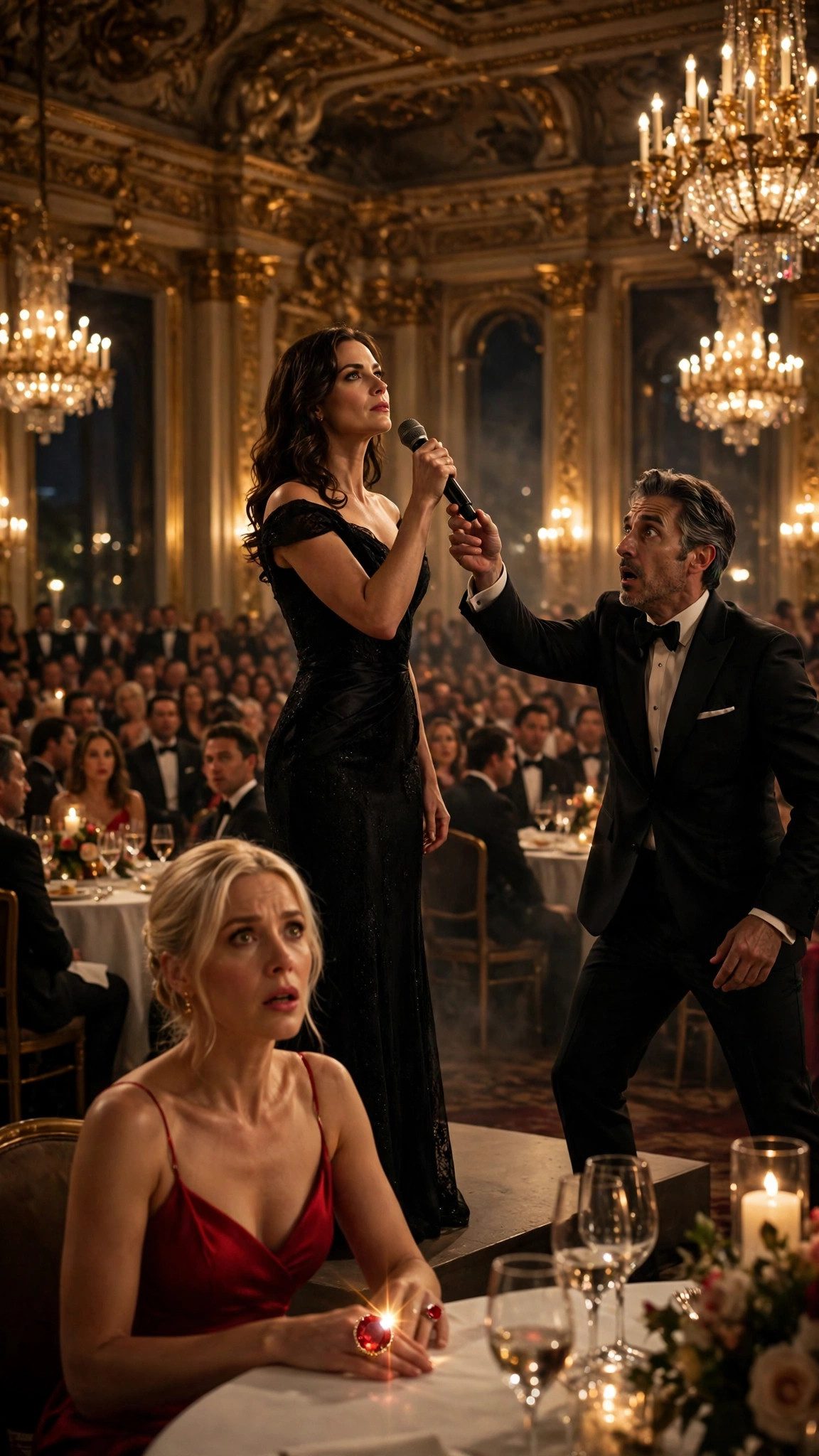
Four days after my father died, Alexander Moretti held his company gala, in a ballroom full of hundreds of people, with chandeliers and white tablecloths and cameras. And he had no idea what was coming.
Neither did I, entirely. I only knew that I would not be silent anymore.
I had met Vivian Cross only once before that night — at a charity gala two years earlier, a glittering event for a children's hospital, where I had worn a blue dress and smiled until my face hurt. She had come up to me at the bar, holding a glass of champagne, and she had said, in a voice as smooth as silk, "Mrs. Moretti, I am such an admirer of yours. Alexander speaks of you so highly."
I had looked at her — young, blonde, beautiful, her hand resting lightly on the bar, a diamond bracelet catching the light — and I had said, "Thank you, Miss Cross. I hope you enjoy working for my husband."
"Oh, I do," she had said, smiling. "He is a wonderful man to work for. So — attentive."
She had let the word hang in the air between us, just long enough for me to hear what she meant by it, and then she had drifted away, into the crowd, toward Alexander, toward the center of the room, toward the place where I was supposed to stand.
Later that night, Rosa had found me in the ladies' room, staring at myself in the mirror, and she had said, very quietly, "Mrs. Moretti, be careful of that one. She has the eyes of a woman who is counting what other people own."
I had laughed it off. I had told myself Rosa was old-fashioned, that she saw danger everywhere. But I remembered her words, and I watched, and over the next two years, I watched Vivian Cross move through my husband's life the way a tide moves through a house — slowly, quietly, and then all at once, everything is underwater.
I watched her at the office Christmas party, laughing at Alexander's jokes a little too long. I watched her in the photographs from Miami, standing a little too close. I watched her hand, in every photograph, resting a little too easily on his arm.
And I said nothing. For two years, I said nothing. Because I had learned, over twelve years, that saying nothing was the safest thing a wife of Alexander Moretti could do.
But I am not silent anymore.