The day my father died, the rain came back to Chicago.
It rained the way it had rained eighteen years ago, on the night of the bullet — cold, steady, indifferent rain that washed the streets clean and made the lake look grey and endless. I stood at the window of my father's small apartment, looking out at the rain, and I thought about how much of my life had been measured in rain. The night he was shot. The day Alexander came to our house. The day of my wedding. The day of my mother's funeral. And now this day, the day I would bury my father, with rain on the roof and rain on the windows, as if the sky itself were grieving for a man who had never been anyone important.
My father was a driver. He was not a soldier. He was not an executive, not a bodyguard, not anyone important. But he had been important to me. He had been the man who taught me to ride a bicycle, who helped me with my geometry homework even though he did not understand it, who pressed his hand to his chest when he was tired and smiled anyway, who walked me down the aisle with a shaking hand and whispered, "Forgive me."
I forgave him. I forgave him on the day he died, standing in the ICU with his hand cold in mine. I forgave him for the debt, for the promise, for the marriage. He had done what he thought was right. He had done what a man who owes his life does — he had given what he could, and what he could give was me, and he had spent eighteen years regretting it.
The funeral was small. My father had never been a man for crowds. Mrs. Okafor came, from the dance studio, with a lemon cake. Rosa came, from the palace, and stood at the back of the church with her hands folded. My colleagues from the accounting firm came, kind and awkward, not knowing what to say. Alexander did not come. He sent flowers — white lilies, expensive, impersonal — and a card that read, in his assistant's handwriting, "With sympathy, Alexander Moretti."
I stood at my father's grave and I thought about the twenty-five dollars.
I had not spent it. It sat in my bank account, untouched, a small, humiliating monument to twelve years of marriage. I had looked at the balance on my phone a dozen times since the transfer, and each time, I had felt the same thing — not anger, not at first, but a kind of cold clarity, as if someone had wiped a fogged window clean and I could finally see the room I had been living in.
On the morning of the funeral, I went to the bank. I do not know why I did it — perhaps I needed to hold the thing in my hands, to make it real, to prove to myself that it had actually happened. I stood in line at the counter, among ordinary people depositing paychecks and withdrawing cash for groceries, and when my turn came, I asked the teller for twenty-five dollars, in a single bill, from my own account. She counted it out without looking at me, the way tellers do, and she handed me a crisp twenty-five-dollar bill, and I put it in an envelope, and I put the envelope in my purse, next to my father's letter.
The teller smiled at me, a polite, professional smile, and said, "Have a nice day."
I almost laughed. A nice day. My father was dead. My husband had sent me twenty-five dollars for nourishment. And a stranger at a bank wished me a nice day. I thanked her anyway, because kindness is kindness, even when it is wasted, and I walked out into the rain, with the envelope in my purse, and I thought: this bill is going to be the most expensive twenty-five dollars Alexander Moretti ever spent. Not because of what it cost him. Because of what it is going to cost him.
Twenty-five dollars. For nourishment. As if I were a stray dog he had found on the street. As if my father's dying had been an inconvenience, and the money was meant to keep me quiet while he enjoyed his island.
On the third day after the funeral, I did something I had never done before. I went through my husband's study.
Alexander was in New York — or so Rosa told me — and the house was empty except for Rosa and the silence. I went into his study, the room behind the closed door, the room I had never been invited into, and I opened the drawers of his desk, one by one, looking for — I did not know what. Proof. Evidence. Something that would explain the last twelve years.
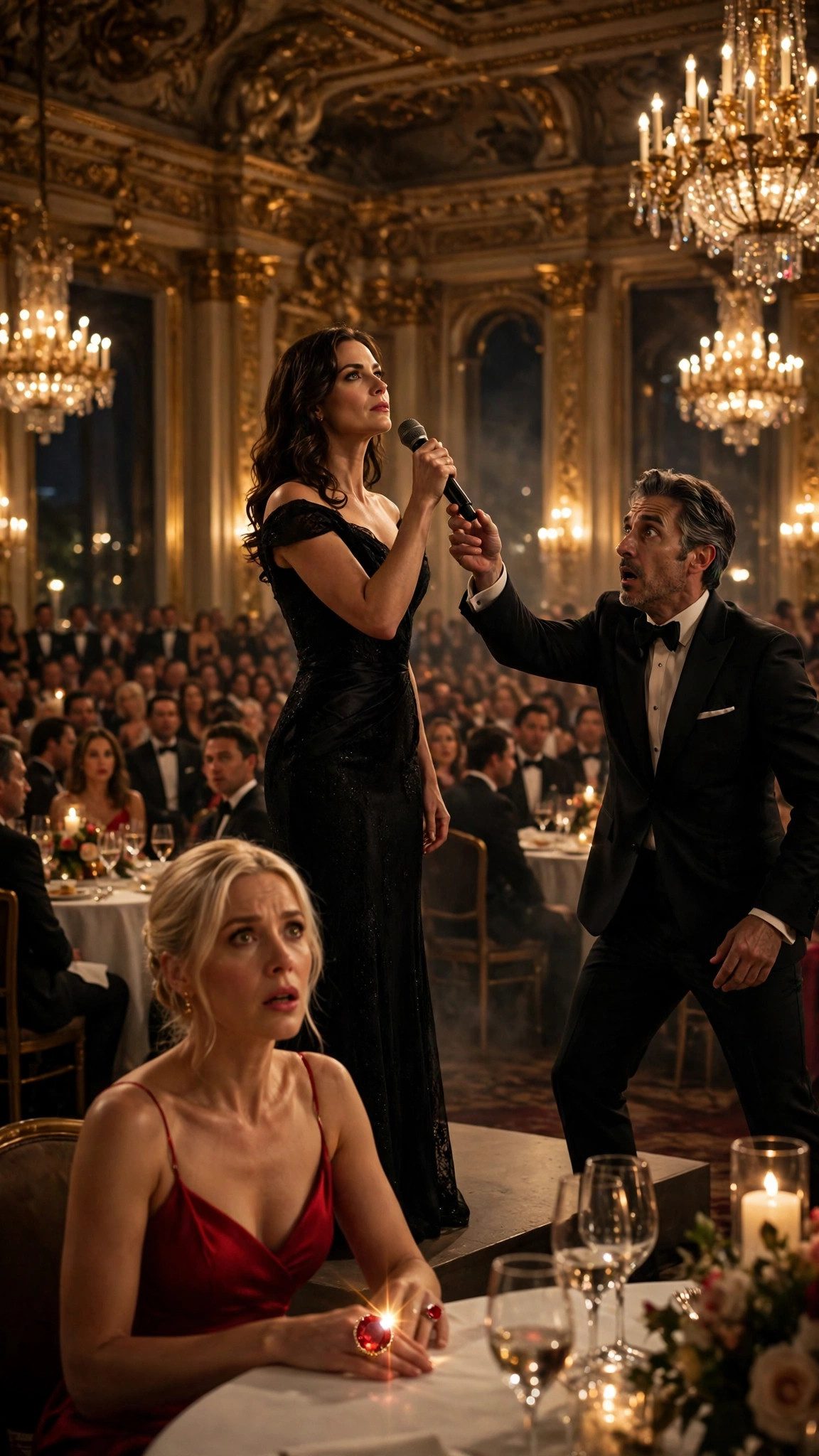
I found photographs. Dozens of them, in a drawer, in envelopes marked with dates. Alexander and Vivian, in Miami, in Las Vegas, on a yacht, on a private island. Vivian in a red dress, Vivian in a white dress, Vivian laughing, Vivian with her hand on Alexander's arm. And in every photograph, on Vivian's left hand, a ruby ring.
I knew that ring. I had seen it once, years ago, in a photograph on Alexander's desk — a photograph of his mother, a stern, beautiful woman in a black dress, wearing a ruby ring on her left hand. I had asked him about it once, in the early years, and he had said, "That ring belongs to the wife of the head of this family. It has been passed from mother to wife for four generations. My mother wore it. One day, my wife will wear it."
One day, my wife will wear it.
I was his wife. I had never worn it. I had never even seen it, except in that photograph. And now it was on the hand of his assistant, in photograph after photograph, catching the light, red as blood, red as a warning.
I sat at his desk for a long time, with the photographs spread out in front of me, and I felt something inside me go very still and very cold. It was not jealousy. Jealousy would have been simpler. It was something older and deeper than jealousy. It was the understanding that Alexander had not merely been unfaithful to me. He had replaced me. He had given another woman the ring that belonged to his wife, the ring that said to everyone in his world: this is the woman who stands beside me. This is the woman who matters.
And he had sent me twenty-five dollars.
I put the photographs back in the drawer, exactly as I had found them, and I closed it, and I went to my room, and I took out my black dress — the one I had worn to my mother's funeral, the one I had worn to every gala where I had smiled and been polite — and I hung it on the door, ready.
Because the gala was in four days. The company gala, the biggest event of Alexander's year, with hundreds of guests, and cameras, and the press, and all of his associates and their wives, and Vivian Cross in the front row in a red dress.
And I had something to say.
I spent the next three days preparing, the way I had once prepared for exams — quietly, carefully, without telling anyone. I went to the bank and I withdrew the twenty-five dollars in cash, a single crisp bill, and I put it in an envelope. I went to my father's apartment and I packed his things — his shirts, his books, his old driver's cap, the shoebox under his bed where he kept his letters and his papers — and I brought them home to the palace, to my room, where Alexander would never look.
And on the morning of the fourth day, I found something in that shoebox that changed everything.
It was a letter, folded and refolded so many times that the creases were soft and worn. It was written in Alexander Moretti's own hand, eighteen years ago, on the day after my father was shot. It was addressed to my father, and it was witnessed by a man named Frank DeLuca — the consigliere, the old guard, the one man in Alexander's world whose word was law.
The letter said: "Robert Hayes saved my life. I owe him a debt that cannot be measured in money. I swear, on my mother's grave and before God, that his daughter will live a life of honor and protection, and that no harm will come to her through me or mine. If I break this oath, let the family judge me."
I read it three times. And then I sat on the floor of my room, surrounded by my father's things, and I cried for the first time since he had died — not from grief, but from something like relief. Because I finally had, in my hands, the proof that Alexander had not merely been a bad husband. He had broken an oath. He had sworn, before God and before the family, to protect me — and he had spent twelve years doing the opposite.
He had given my ring to another woman. He had sent me twenty-five dollars while my father died. He had threatened me in front of hundreds of people — or he was about to.
And I had, in my hands, the paper that could end him.
I folded the letter carefully and put it in my purse, next to the envelope with the twenty-five dollars. And I put on my black dress, and I did my hair, and I looked at myself in the mirror, and I saw a woman I had not seen in twelve years.
I saw Emma Hayes. I saw a woman who was done being silent.
The gala was that night. And Alexander Moretti had no idea what was coming.
But before the gala, there were the three days in the intensive care unit — three days that felt like three years, three days that I will remember for the rest of my life, in every detail, because grief has a way of carving ordinary moments into stone.
The ICU at St. Mary's was on the sixth floor. The corridor was long and pale, with linoleum floors that squeaked under your shoes, and a nurses' station in the middle where the nurses spoke in low voices and drank coffee from paper cups. My father's room was at the end of the corridor, behind a glass wall, and inside it, the machines breathed for him — a ventilator, sighing in and out, in and out, and a monitor that beeped, steady and green, and an IV bag that dripped, drip by drip, into his arm.
There was a nurse named Angela. She was in her fifties, with grey hair pulled back and kind eyes, and she had worked in the ICU for twenty years, and she knew things that doctors did not know — like how to tell when a family needed to be left alone, and when they needed someone to sit with them. She brought me coffee, and she brought me a blanket for the chair, and she said, "Talk to him, honey. Even if he can't answer. They hear more than we think."
So I talked to him. I sat beside his bed, holding his hand — his hand thin and cold, the veins standing out like blue rivers under the skin — and I talked to him about ordinary things. I told him about Mrs. Okafor's lemon cake. I told him about the accounting firm, about the bakery whose books I had balanced that week, about the dance studio and the little girls in their pink leotards. I told him about the weather, about the rain, about the traffic on the lake road. I told him everything and nothing, because Angela said he could hear me, and I wanted him to hear something kind.
On the second day, the doctor came — a young man named Dr. Patel, with tired eyes and a gentle voice — and he took me into the corridor, and he said, "Mrs. Moretti, I need to be honest with you. Your father's heart is failing. The scar tissue from the old injury has been weakening the muscle for years, and now it is giving out. We are doing everything we can. But you should prepare yourself."
"Prepare myself for what?" I asked, though I knew.
"For the possibility," he said, "that he will not come home this time."
I nodded. I thanked him. I went back into the room, and I held my father's hand, and I did not cry, because I had learned, over twelve years, that tears in the Moretti house were a currency no one accepted, and because I did not want my father's last days to be spent watching his daughter cry.
On the third day, in the afternoon, my father opened his eyes.
It was only for a moment — a brief, flickering moment of lucidity, the kind the nurses said sometimes happens, a last rally before the end. His eyes found mine, and they were clear, clearer than they had been in weeks, and he squeezed my hand — weakly, so weakly, but I felt it — and he whispered, so softly I had to lean close to hear him, "Emma. My Emma. You are not a debt. You never were. Remember that."
Those were the last words he ever spoke to me.
I held his hand, and I whispered back, "I remember, Papa. I remember. I love you."
He closed his eyes, and he did not open them again.
He died two days later, at four in the morning, while I was asleep in the chair beside his bed. The nurse — Angela, kind Angela — woke me gently, and she told me he had gone peacefully, in his sleep, and that he had not been in pain. I held his hand for a long time after that, until it was cold, and then I stood up, and I washed my face, and I went home to the palace on the lake.
And I carried his last words with me, the way I carried the letter, the way I carried the twenty-five dollars. "You are not a debt. You never were."
My father had paid the debt with his body, eighteen years ago, on a rainy street in Chicago. I owed Alexander Moretti nothing. And now, finally, I believed it.