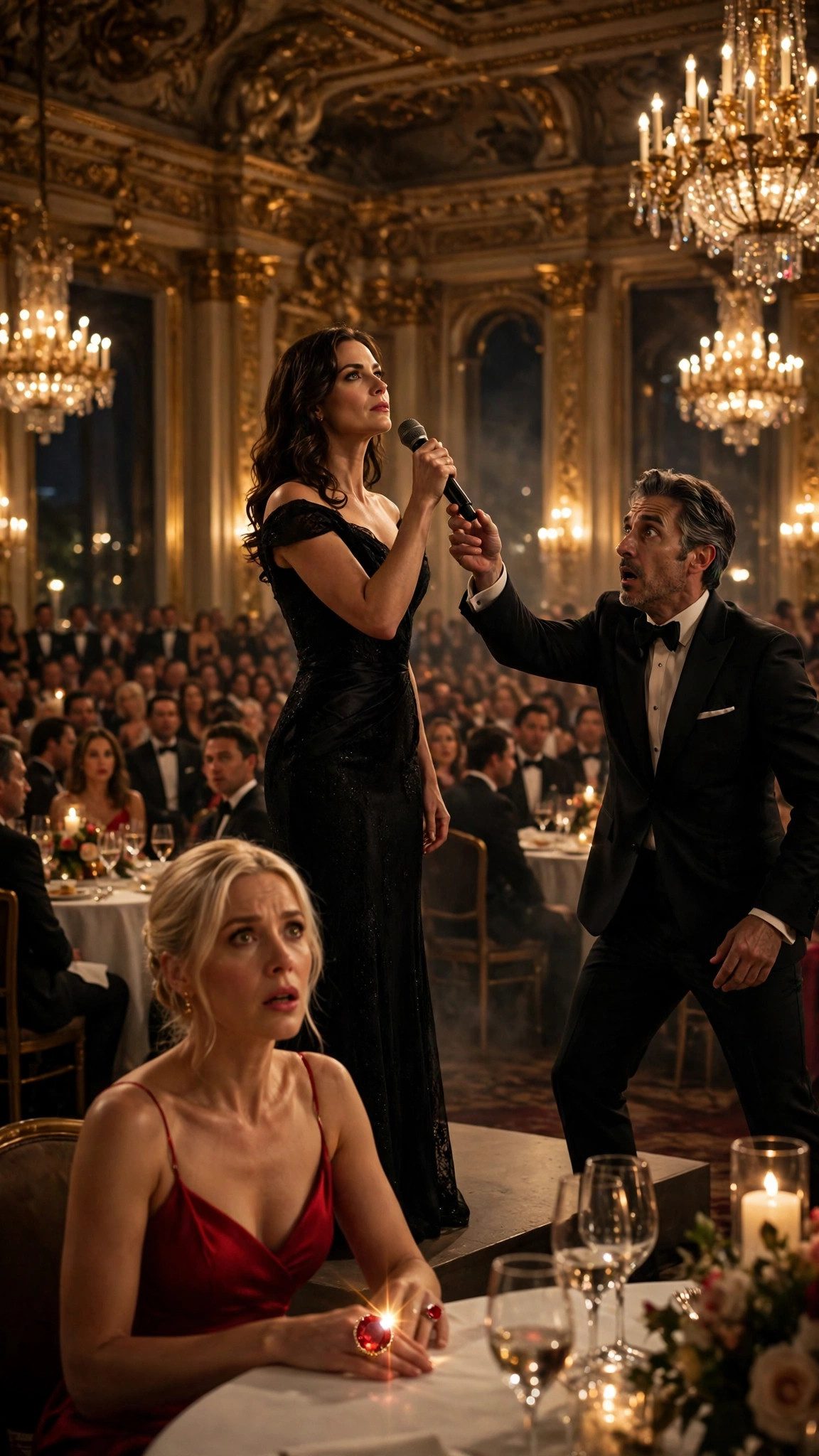
I did not go back to the palace that night.
I went to my father's apartment — the small apartment near the lake, paid for from my own salary, the apartment where he had lived his last years among his books and his shirts and his old driver's cap. I sat on his bed, in the dark, and I listened to the rain on the windows, and I waited for the shaking to stop.
It took a long time. My hands shook for hours. My whole body shook, as if the twelve years of silence had been stored in my muscles and were finally coming out. I thought about the ballroom, about the cameras, about Frank DeLuca standing up, about Vivian's white face, about Alexander reaching for the microphone. I thought about the twenty-five dollars, sitting on the stage, under the chandeliers, for three hundred people to see.
I did not regret it. Not for one moment. But I was afraid — afraid of what Alexander would do, afraid of what the family would do, afraid of what came next. I had spent twelve years being afraid of Alexander Moretti, and one night of courage did not erase twelve years of fear.
In the morning, when the shaking had finally stopped, I went through my father's shoebox — really going through it, for the first time, not just looking for the letter, but looking at everything he had kept, everything he had thought worth saving.
There was his old driver's cap, the one he had worn for twenty years, the brim soft with wear. There was a photograph of him as a young man, standing beside a car, smiling, his arm around my mother, both of them laughing at something the camera had not caught. There were letters — dozens of them, in my mother's handwriting, from the early years of their marriage, when my father had worked long hours and my mother had written to him on scraps of paper left on the kitchen table: "Dinner is in the oven. I love you. Come home safe."
There were the pension letters from Alexander — formal, typed, signed, each one the same: the amount, the date, the words "in recognition of your service." No warmth. No gratitude. Just numbers, the way Alexander measured everything.
And there was a small notebook, bound in leather, with my father's handwriting on the first page: "For Emma, when I am gone."
Inside it, he had written down the things he wanted me to know. The name of the street where he had been shot. The name of the hospital where he had woken up. The name of the surgeon who had saved him. The date of my mother's birthday, and the date of their wedding anniversary, and the recipe for my mother's soup — the soup I had brought him in a bowl with both hands, when I was fourteen.
And on the last page, he had written: "Emma, if you are reading this, then I am gone, and you are on your own, and I am sorry. I am sorry for the debt. I am sorry for the marriage. I am sorry that I gave you to a man who did not deserve you. I did it because I thought I owed him my life, and I thought a life was worth a daughter. I was wrong. A daughter is worth more than a life. You are worth more than my life, more than his life, more than all the money in Chicago. Do not let anyone tell you otherwise. Not Alexander. Not anyone. You are my daughter, and you are free."
I sat on the floor of my father's apartment, with the notebook in my lap, and I cried — not the quiet tears of a wife who has learned to be silent, but the deep, shaking sobs of a daughter who has finally heard her father say the words she needed to hear.
I was still sitting there, with the notebook in my lap, when Rosa called. Her voice was low and careful, the way it always was when she was telling me something she was not supposed to tell me.
"Mrs. Moretti," she said, "you should know. Mr. DeLuca came to the house last night, after the gala. He stayed for two hours. He was very angry. And this morning, Mr. Moretti's office called, and they said the assistant — Miss Cross — has been asked to clear her desk."
I closed my eyes. "Thank you, Rosa."
"There is something else," Rosa said. "Mr. DeLuca asked for your telephone number. He said he would like to speak with you. He said — " She paused. "He said your father was a good man, and the family remembers."
I gave her permission to give him my number. An hour later, Frank DeLuca called.
"Mrs. Moretti," he said, in his old, gravelly voice. "I would like to meet you. There is a café on the lake, the one with the blue awning. Come at noon. Come alone."
I went. I wore a grey coat, and I carried my purse, and in my purse was my father's letter — Alexander's letter, written in his own hand, witnessed by Frank DeLuca himself, eighteen years ago — and my father's notebook.
Frank was already there when I arrived, sitting at a table by the window, a cup of black coffee in front of him, untouched. He was seventy-two years old, with white hair and hands that had the tremor of age, but his eyes were sharp, and they did not leave my face.
"Sit down, Emma," he said. "I knew your father. I was there, the night he was shot. I drove behind Alexander's car that night. I saw what he did. He was a brave man, your father. A good man."
"Thank you," I said.
"Last night," Frank said, "you said something in that ballroom that cannot be unsaid. You said Alexander broke an oath. You said it in front of the family. Do you understand what that means?"
"I understand," I said. "I understand that an oath, once broken in front of the family, must be answered."
Frank nodded slowly. "You are your father's daughter," he said. "He had the same courage. He put his body in front of a bullet without thinking. You put your reputation in front of three hundred people without thinking."
He leaned forward. "Tell me about the ring."
So I told him. I told him about the photographs, about the island, about the ring in every picture, about the promise Alexander had made to me on our wedding day — or rather, the promise he had never made, because he had never given me the ring that belonged to his wife. I told him about the twenty-five dollars. I told him about the hospital, and the funeral, and the lilies.
And then I took my father's letter out of my purse, and I put it on the table between us, and I watched Frank DeLuca's face as he read it.
He read it twice. His hands trembled — not with age, but with anger. When he looked up, his eyes were wet.
"I witnessed this," he said, very quietly. "I was there. I signed it. I have not thought about this letter in eighteen years. I thought Alexander had honored it. I thought — " He stopped. "I thought he had married you out of gratitude. I did not know he had made you a receipt."
"He married me to pay a debt," I said. "And then he spent twelve years making sure I knew what I had cost him."
Frank folded the letter carefully and gave it back to me. "Keep this safe," he said. "It is the most valuable thing you own."
Then I took out the notebook, and I opened it to the last page, and I showed him what my father had written. He read it, slowly, and when he looked up, his eyes were wet again, and he said, "Your father was a better man than any of us, Emma. He knew what he had done, and he spent eighteen years trying to make it right, in the only way he knew how — by loving you, and by telling you the truth, even if he could only tell it after he was gone."
And then Frank told me his own story — the story of the night my father was shot, from the other side of the street.
"I was driving behind Alexander's car that night," he said. "I was his consigliere even then, and I followed him everywhere, because that was my job. I saw the gunman step out from between the cars. I saw your father throw his door open. I saw him put his body between the gunman and the back seat. And I saw Alexander drive away — with your father bleeding in the back seat — while I stayed behind, with my own gun in my hand, and I faced the gunman down in the rain."
He paused, and he looked out the window at the lake, and he said, "I have killed men, Emma. I will not lie to you about that. I have done things in this life that I am not proud of. But your father — your father was the bravest man I ever saw, because he had no gun, and no training, and no reason to die for a man he drove for wages, and he did it anyway. He did it because it was his job to get his passenger home safe. And I have spent eighteen years trying to live up to that."
He turned back to me. "That is why I am here, Emma. That is why I will stand beside you tomorrow night, in front of the family. Because your father saved Alexander's life, and Alexander owes him, and Alexander owes you, and the family will hear it — from me, and from you, and from that letter, if it comes to that."
"And now," Frank said, "I need to tell you something. Something you do not know."
He told me about Vivian Cross.
Vivian had not come to Alexander by accident. She had been placed there — by Vincent Castellano, the head of the rival family, the man who had ordered the shooting eighteen years ago, the man whose gunman had put a bullet in my father's chest. Castellano had spent years looking for a way inside Alexander's house, and he had found it in a beautiful, ambitious young woman who wanted power more than she wanted love.
Vivian had been feeding Castellano information for two years — schedules, routes, names, numbers. She had leaked the island photographs herself, to humiliate me, to make me look like a fool, to push me toward a public scene that would weaken Alexander. And she had worn the ruby ring — Alexander had given it to her, yes, but she had asked for it, and she had worn it to send a message to Castellano's people: I am the new power in this house. I am the one who matters.
"She was using him," Frank said. "And he was too blind — or too proud — to see it. But last night, after you left, Alexander's own men searched her office. They found a second phone. They found the messages to Castellano. They found everything."
I sat very still. "What happens to her now?"
"She is gone," Frank said. "Cast out. She will never work in this city again. Alexander did that himself, this morning, before I arrived. He did it because he finally saw what she was."
He looked at me for a long moment. "And now, Emma, I must ask you something. What do you want?"
It was the first time in twelve years that anyone had asked me what I wanted.
I thought about it. I thought about my father, and my mother, and the bullet, and the debt, and the palace, and the twenty-five dollars, and the ring. I thought about the woman I had been at twenty, standing in a living room in jeans and a sweater, listening to a powerful man decide her future. I thought about the woman I was now, thirty-two years old, sitting in a café on the lake with a letter in her purse and nothing left to lose.
"I want my father's name honored," I said. "I want the family to know what he did, and what it cost him. I want Alexander to stand before the family and admit that he broke his oath. And I want — " I stopped. I took a breath. "I want to choose. For the first time in my life, I want to choose what happens to me."
Frank nodded. "Then that is what will happen," he said. "The family will meet tomorrow night. Alexander will be there. And you will be there, Emma. Not as his wife. As Robert Hayes's daughter. As a woman the family owes a debt to."
He stood up, and he put his hand on my shoulder, gently, the way my father used to do. "Your father would be proud of you," he said. "He saved a man's life with his body. You saved your own life with your voice. That is the same courage."
He left, and I sat at the table by the window for a long time, looking out at the lake, with my father's letter and my father's notebook in my purse and the rain coming down outside, and I thought about what it meant to choose.
When I finally stood up to leave, the waitress — a young woman, no older than I had been when Alexander came to our house — came to clear the table, and she looked at me, and she said, "Are you all right, ma'am? You have been sitting here a long time."
I smiled at her. "I am all right," I said. "I have just been learning how to choose."
She nodded, as if she understood, though she could not have understood, and she said, "Good. Choosing is the hardest part. My grandmother always said that. Choosing, and then living with the choice."
I walked home from the café, through the rain, without calling a car, without hurrying. I walked past the shops and the restaurants, past ordinary people living ordinary lives, and I thought about my father, and my mother, and the bullet, and the debt, and the ring, and the letter, and the notebook, and the twenty-five dollars. I thought about all of it, and I felt something I had not felt in twelve years.
I felt like myself.
Tomorrow night, the family would meet. Alexander would be there. And for the first time in twelve years, I would walk into a room full of powerful men not as a receipt, not as a debt, not as a wife — but as Emma Hayes, a woman who had finally learned the price of her own silence.
And stopped paying it.