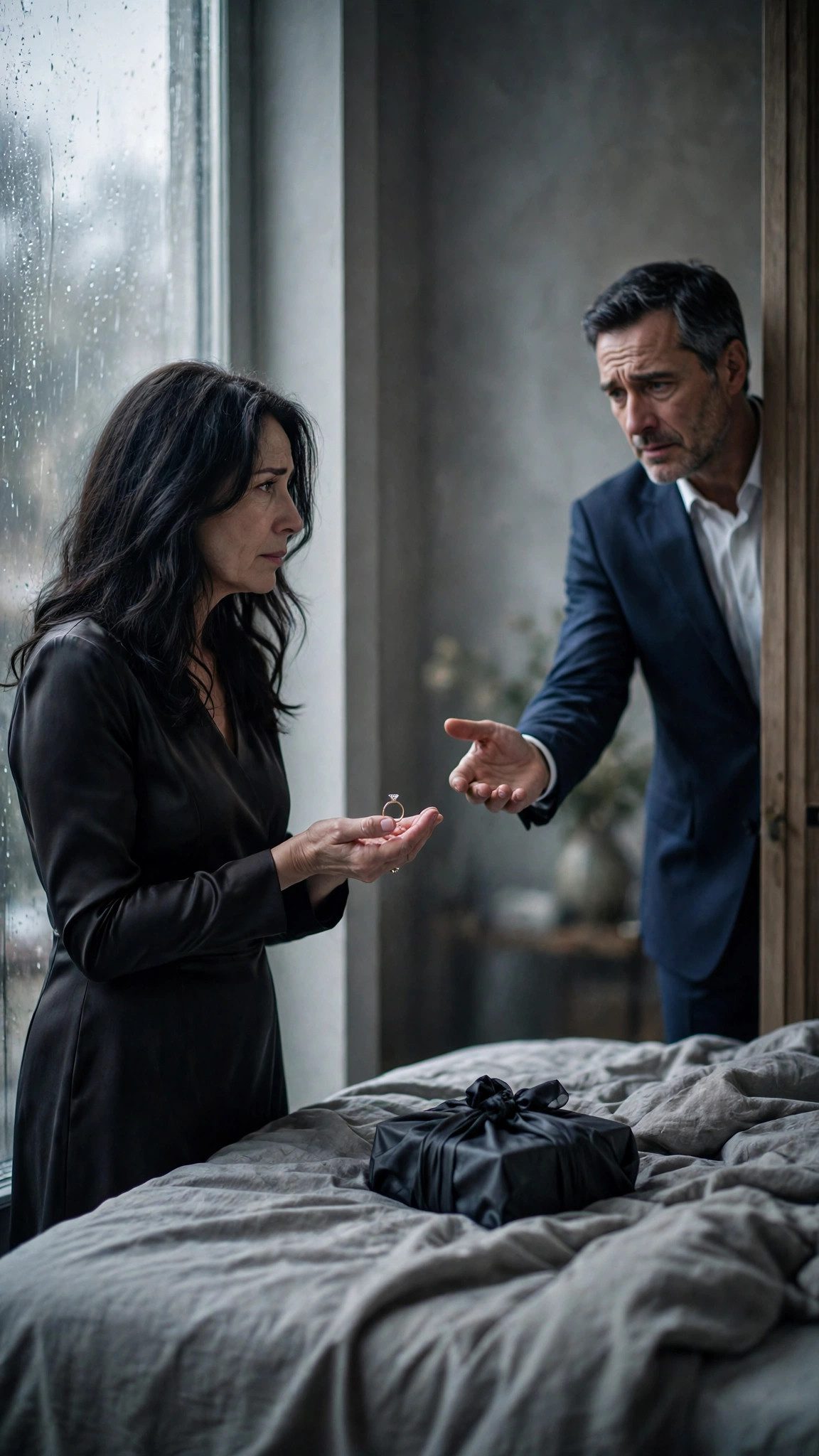
The morning of my forty-eighth birthday arrived gray and slow, the kind of morning that made the whole city look like it was holding its breath. I woke alone in the bedroom of the house I had shared for four years with Declan Mercer, and for a moment I lay still and listened to the rain against the glass, and I told myself that forty-eight was not old, that I was a doctor, that my hands had held life and death at the same time and had not shaken, and that whatever this year brought I could survive it.
Then the door opened, and Declan walked in unannounced.
He did not knock. He never knocked in our own house. He stood in the doorway in his pressed navy suit, tall and still, the way he stood when he was about to deliver news that would ruin someone, and he looked at me with a calm that frightened me more than anger ever could.
"Family comes first," he said.
I sat up slowly. The sheets were cold against my skin. "What does that mean?"
"I am sorry," he said.
Those were the only two sentences he gave me before the world came apart, and I remember thinking, with the strange clarity that comes in the seconds before a disaster, that he looked almost sad. Not cruel. Not triumphant. Sad, the way a man looks when he has already decided to lose everything and has come only to say goodbye.
"Declan," I said. "Talk to me. Whatever it is, talk to me."
He crossed the room and stopped at the foot of the bed, and he did not touch me, and that was how I knew. Declan Mercer touched me every morning. He held my hand in bed. He whispered my name in the dark. He had done it for four years, and the morning he stopped was the morning I understood that my marriage was already over and I was only now being told.
"Victoria is pregnant," he said simply.
The words were so sharp that I felt no pain at first, only something rising in my throat, something hot and formless, like smoke.
"The baby is mine," he said.
I turned away from him. I looked at the rain on the window and at my own reflection in the glass, and I did not recognize the woman staring back at me. She had dark circles under her eyes that were different than usual, and her dark hair was loose around her shoulders, and she looked like a woman who had just been told that the last four years of her life had been a rehearsal for someone else's family.
"It was never about love," Declan said, and his voice was steady, and that steadiness was the worst part of it, because it meant he had rehearsed this too. "It was about bloodlines. The family needed an heir. A voice. An heir for our future. And that was a promise I should never have broken in the first place."
"In the first place," I repeated. My voice sounded like it belonged to someone else. "What promise, Declan? What promise did you make, and to whom?"
He did not answer that. Not then. He reached into the inside pocket of his suit jacket, and he took out a small parcel wrapped in dark silk, and he set it on the bed between us with the care of a man handling something sacred, and my heart stopped, because I knew that silk. I had seen it once before, on the morning of my wedding day, when he had wrapped my grandmother's diamond ring in it and locked it away.
"Sarah," he said quietly. "I am sorry I failed you."
I unwrapped the silk with hands that did not shake, because my hands never shook, not even now, and there it was. My grandmother's diamond ring. The same one she had given me before she died. The same one that had survived all kinds of hardship, survived the war, survived the invasion, survived the crossing of an ocean in a coat pocket sewn shut by a woman who had nothing left but that ring and her name. It was a symbol of protection, and love, and family history. It was also, I realized as I held it, a symbol of everything my life had become after marrying him. It would never be mine. Not really. Not while I was his wife.
I held the ring in my palm, and it seemed to grow heavier with each second. The warmth of the gold pressed against my skin, and in that moment I learned something new about my marriage. The damage of the past four years had reached its final stage. I was married to a man who loved me and, at the same time, owned the entire city, and those two facts had finally collided, and I was the one standing in the wreckage.
"Take it back," I said. "I do not want it like this."
"Sarah."
"Take it back," I said again, and my voice broke, and I hated that it broke, because I was a doctor, and doctors did not break, and I had spent four years not breaking. "You took it from me on our wedding day, Declan. You said I would never need it again. You said what was yours was mine. And now you are giving it back to me like a settlement. Like I am a debt you are paying off."
He flinched. It was the first real movement I had seen from him since he walked in, and it told me more than his words had. Declan Mercer did not flinch. Not for the city, not for his enemies, not for anyone. He flinched for me.
The silence pressed against my shoulders, and I knew the right thing to do. I knew I should stand up, and pack a bag, and walk out of that house with my head high, and never look back. I had done it before, in smaller ways. I had walked out of rooms. I had walked out of hospitals. I had walked away from men who thought my silence was agreement. I knew how to leave.
Until Declan appeared at the door and said one sentence that stopped me cold.
"Sarah," he said, "I need to tell you why everything I did was for you."
I stared at him. "For me? You got your assistant pregnant for me?"
"And you need to understand why I left you in Boston."
Boston. The word landed between us like a stone dropped into still water, and the ripples went outward through four years of my life, touching everything. The winter in Boston. The six months he had left me there alone, telling me it was business, telling me it was temporary, telling me not to worry. I had never forgiven him for Boston. I had never even told him I had not forgiven him. I had simply carried it, the way you carry a stone in your shoe, until you forget it is there and then one day you realize your foot has been bleeding for years.
"Then tell me," I said. "Tell me everything. No more half answers. No more lies. I have believed every word you have ever said to me, Declan. I believed you when you said Victoria was just your assistant. I believed you when you said her life was complicated and secretive and shy. I believed you when you said she was a valued person who really cared about us. I believed all of it, and I was wrong about all of it, so now you will tell me the truth, all of it, and you will not stop until I tell you to stop."
He nodded slowly, and he sat down in the chair by the window, the chair where he used to sit and watch me sleep, and he began to speak, and what he told me was worse than anything I had imagined, and also, in a way I did not expect, it was the first honest thing he had said to me in years.
He told me about the money. How he had moved cash offshore, how he had purchased the trucking companies, how he had rebuilt the debt in the city, piece by piece, until the Mercer family no longer owed anyone anything. He showed me a ledger, a real ledger, bound in black leather, filled with debts and private flights and meetings that politicians pretended never happened. The names on that ledger terrified me. My family. My friends. My partners. My old colleagues. Everyone I had ever loved was written in that book, not because Declan had threatened them, but because he had protected them, quietly, for years, paying debts and burying threats before they ever reached my door.
And then he told me about his brother.
Marcus Mercer was Declan's younger brother, and I knew him. I had known him since the night he was carried into my emergency room with a bullet in his chest, seven years ago, when I was still a young attending and he was a man I had never met. I had held his life in my hands that night. I had felt his cool skin under my fingers, and I had watched his family cry while I told them there was nothing left to do, and then I had done it anyway. I had saved him. And Declan had never forgotten it.
His brother had been the target of all that anger, Declan said, as he lost his head. His decisions were completely wrong, and I realized that my use was partly due to my work as a doctor. The men who had shot Marcus had meant to shoot Declan. The war that followed had nearly burned the city down. And Declan had walked away from the city afterward, with a blank look on his face, because he had understood, finally, what his power cost the people he loved.
"I have spent four years trying to build a way out," he said. "A way for us to leave all of it behind. The ledger is the way out. The trucking companies, the offshore accounts, the debts I have collected — all of it is leverage. I was going to use it to walk away. I was going to give the family to Marcus and take you somewhere no one knows our name."
"Then why Victoria?" I asked. "Why a baby? Why an heir?"
"Because the council found out," he said. "My uncle Aldo found out I was planning to leave. And the old law says a boss without an heir cannot leave. A boss without an heir is a dead boss. If I walked away without an heir, Castellano would have come for everything. For the family. For Marcus. For you."
"So you gave them an heir."
"I gave them a child," he said, and his voice broke at last, and the break in it was the most human sound I had ever heard from him. "I gave them a child so they would let me keep you alive. That was the price, Sarah. You, or the child. I chose you. I have always chosen you. Even when it looked like I was choosing something else."
I sat on the edge of the bed with my grandmother's ring in my palm, and I looked at the man I had married, and I understood, for the first time in four years, that I did not know him at all, and that I had never known him, and that everything I thought I knew about my marriage was only the surface of something much deeper and much darker.
And I understood something else, too. Something that frightened me more than the betrayal.
I believed him.
I believed him, and I hated that I believed him, and I knew that believing him was going to change everything, because if he was telling the truth, then the enemy was not Declan Mercer. The enemy was the family itself. The enemy was the old law. The enemy was the council, and my uncle-in-law Aldo, and Vincent Castellano, who had been waiting for years for exactly this moment.
I closed my fingers around the ring.
"Start from the beginning," I said. "From the fundraiser. From the night I met you. Tell me all of it, and do not leave anything out. Not Boston. Not the baby. Not the ledger. All of it."
Declan Mercer looked at me for a long moment, and then he nodded, and he began.
My name is Sarah Hamilton. I met Declan Mercer when I was hardly twenty-two. He was thirty-five, dressed in a pressed navy suit and built like a man who had never known a single doubt. We met at a hospital fundraiser, and his charm and confidence in the way he listened made it impossible for me to say no to dinner.
That is where this story really begins. Not on my forty-eighth birthday. Not in the bedroom with the ring in my hand. It begins twenty-six years ago, in a ballroom full of people raising money for a children's ward, with a man in a navy suit who listened to me the way no one had ever listened to me before, and with a decision I made that night that changed the entire course of my life.
I did not know then what I know now. I did not know that the man who listened so carefully was the most feared man in the city. I did not know that the ring my grandmother gave me would one day be taken from my finger on my wedding day and locked away in dark silk. I did not know that I would lose a child, and lose a winter in Boston, and lose the woman I used to be.
But I am a doctor. My hands have held life and death at the same time. I know how to stay calm when the world collapses. And on the morning of my forty-eighth birthday, with my grandmother's ring heavy in my palm and my husband's confession still hanging in the air, I made a decision.
I was not going to walk away. Not yet. Not until I knew the whole truth. And then, whatever the truth was, I was going to decide for myself what happened next.
This is that truth.