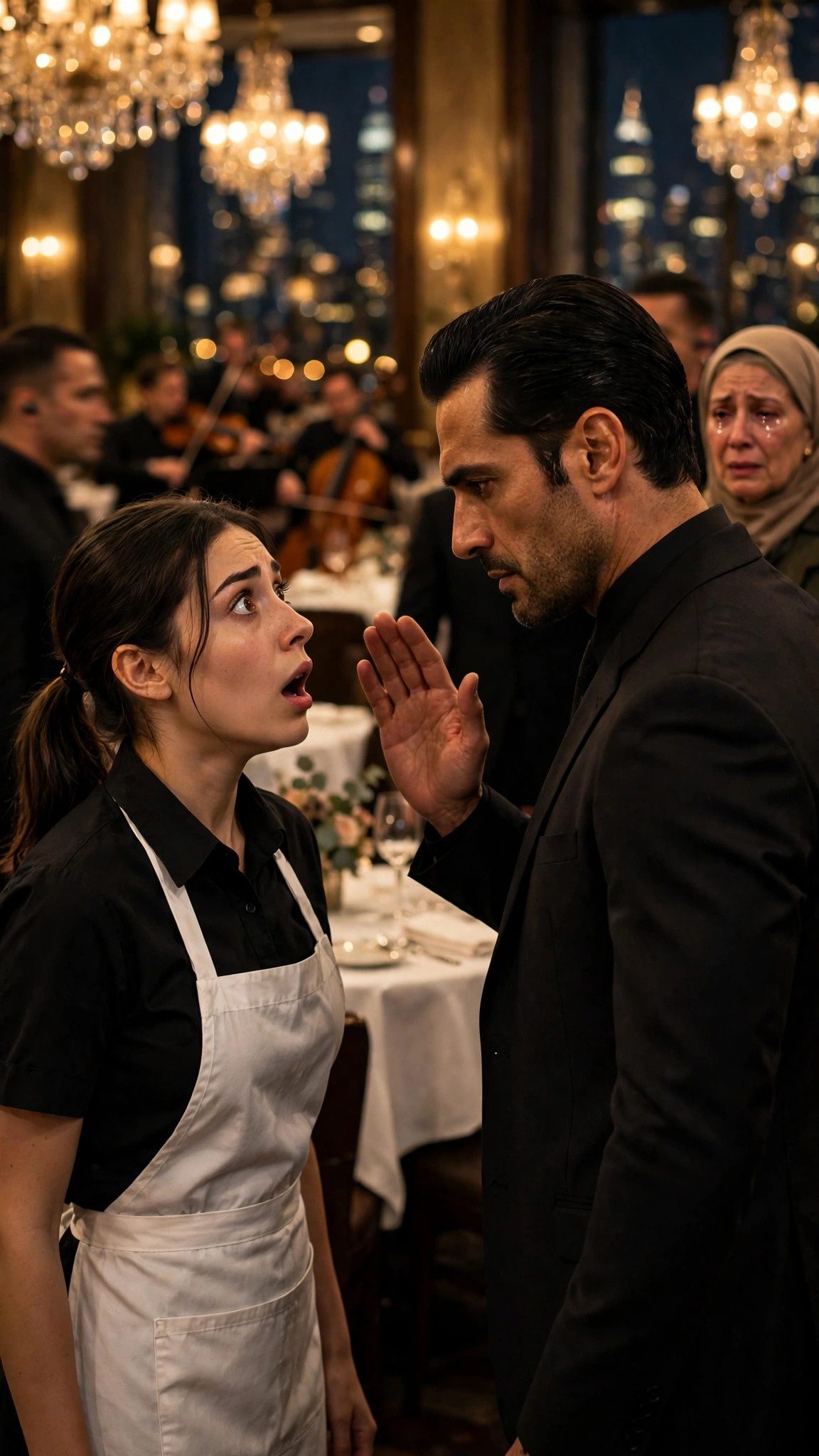
The most feared Arab mafia boss in New York was leaving my restaurant when I spoke one sentence in Arabic, and in the next minute his driver turned the limousine around.
His name was Kareem Rahal, and he had spent one full hour sitting at the table next to the main window of the Bellweather Room, saying nothing at all, watching me the way a man watches a painting he is trying to decide whether he has seen before. He drank vanilla-scented tea. He did not touch the food. The string quartet played in the lobby, and the whole room glowed with warm evening light, and every other table in the restaurant laughed and talked and clinked their glasses, and Kareem Rahal sat in the middle of all of it like a cold, beautiful statue, and looked at me.
I was twenty-eight years old, and I had worked at the Bellweather Room on Manhattan's Fifth Avenue for two years, and I had learned how to carry three plates on one arm and how to smile when a guest snapped his fingers at me and how to pretend I did not hear the things rich men said about waitresses when they thought we were furniture. I had not learned how to stand still while the most dangerous man in the city studied my face for an hour.
Then an old woman in a head-cover walked toward me across the dining room, and she hugged me as if she had known me all my life, and she whispered, "You look like him."
And then she whispered something else, in Arabic, so quietly that only I could hear it: "Who is the mother of the child?"
I did not understand the question. I did not understand why my hands were shaking. I did not understand why my throat closed up and why, without deciding to do it, without even knowing what the words meant, I found myself mouthing the words that even his bodyguards followed.
"Ya habibi, la tuqatiluh. Ya habibi, ruuh ahlaykum."
Kareem was already leaving. He was closing his jacket, turning toward the door, and his bodyguards were moving with him like a tide going out. But he stopped. He stopped in the middle of the dining room, with his back to me, and the whole restaurant seemed to hold its breath, and then the words came back to me, the way they always came back to me when I was frightened, in my mother's voice, from a room I had not seen in nineteen years.
"Life's gifts are often cloaked in its toughest lessons," he said, without turning around.
And then, outside on Fifth Avenue, the driver turned the limousine around.
I heard it before I saw it, the long black car swinging back toward the curb in a slow, deliberate arc, and the doorman's face going pale, and the quartet faltering on a note, and then Kareem Rahal was walking back toward me through the dining room, and his bodyguards were parting before him like water, and he stood directly in front of me, close enough that I could smell the vanilla on his breath, and he whispered, "Who told you to say that?"
"No one did," I whispered back.
He looked at me for a long time. His eyes were dark, and there was something in them I had never seen in a man's eyes before, not anger and not hunger, but something older and more broken than either of those things, like a door opening in a house that had been locked for years.
"Then the three of us need to talk," he said. "Grandma, baby, and me."
And then his advisor, a man named Nabil, turned toward me and placed a hand on my shoulder, gently, the way you would touch something precious and easily broken, and said, "Amina is your grandmother now."
I was stunned. I did not have words to answer anything. I stood there in my black waitress uniform with a tray still balanced on my hand, and the whole shining restaurant spun slowly around me, and all I could think was that it had been a secret meeting my grandmother had arranged, and nobody had ever spoken of its existence before, and somehow, without anyone telling me, I had walked straight into the middle of it.
My name is Nia Brooks. I was twenty-eight years old, and until that night I believed I was nobody. I believed I was a waitress with dark hair and a soft, nervous voice and a pair of shoes that pinched my feet by the end of every shift, and a mother who had died when I was nine, and a father who had loved her so much that he never really came back from losing her, and a life that was small and ordinary and entirely mine.
I had been wrong about every part of that except the shoes.
Two years earlier, I had walked into the Bellweather Room with a borrowed blazer and a resume that had three restaurants on it and a smile I had practiced in the mirror of a subway station bathroom, and the manager, a man named Marcus Hale, had looked me up and down and said, "Black uniform, no jewelry, no talking back to the guests, and you keep your tips in the envelope at the end of the night." I had nodded, because I needed the job, and because the Bellweather Room was the kind of restaurant where a waitress could make enough in tips to pay rent and buy groceries and still have something left over, and I had not known then what I learned in my first month, which was that the envelope at the end of the night was always lighter than it should have been.
The smallest tip request would literally make me smile. A dollar, a coin, a folded bill pressed into my palm with a whispered thank you, and I would smile like someone had handed me a gift, because to me it was a gift. But I never saw my tips leave the restaurant. The money went into the envelope, and the envelope went into Marcus Hale's office, and what came back to me at the end of the week was never what I had earned. I counted. I always counted. I kept a little notebook in my apron pocket, and I wrote down every table, every bill, every tip, in tiny careful numbers, and at the end of every week the numbers did not match. Somebody was taking from me, a little at a time, week after week, and I did not know who, and I did not know how to stop it, and I was too afraid of losing the job to ask.
That was my life. I served food to people who owned buildings, and I went home to a fourth-floor walk-up in Queens with a radiator that clanged all winter, and I ate dinner standing up at my kitchen counter, and I fell asleep to the sound of traffic on the street below, and I dreamed sometimes of my mother singing to me in a language I did not understand, in a voice I could still hear perfectly even though I had not heard it in nineteen years.
My mother had been Layla. That was all my father ever told me about her, really. Layla, who had dark hair like mine and a laugh like a bell, and who had died when I was nine years old, of an illness my father never named, in a hospital room with white walls and a window that looked out over a parking lot. He never talked about her family. He never talked about where she came from. When I asked, when I was small, he would go quiet and look out the window, and after a while he would say, "She loved you more than anything in the world, Nia. That is the only thing about her you need to know."
But there was one thing he could not hide from me, because it was in my own mouth. When I was frightened, when I was small and the dark pressed in around my bed, my mother used to whisper words to me in a language I did not know, and the words stayed with me, locked somewhere deep in my chest, even after I forgot everything else about her. "Ya habibi, la tuqatiluh. Ya habibi, ruuh ahlaykum." I did not know what they meant. I did not know they were Arabic. I only knew that they were the sound of safety, the sound of my mother's arms around me, the sound of a door closing against the dark.
I had not spoken them aloud in years. Not until the night Kareem Rahal walked into the Bellweather Room.
He came in at seven o'clock, with Nabil beside him and four bodyguards behind him, and the whole restaurant seemed to rearrange itself around him the way water rearranges itself around a stone. The hostess went pale. Marcus Hale came out of his office so fast he nearly tripped over his own feet. The best table in the house, the one next to the main window, was cleared and set within minutes, and the quartet in the lobby began to play something slower and more careful, as if the music itself knew who had just walked in.
I was assigned to serve them their food. Me. Nia Brooks, the waitress with the soft nervous voice, the one who counted her tips in a little notebook. I carried the tray across the dining room with my hands steady and my heart hammering against my ribs, and I set down the tea, vanilla-scented, the way he liked it, and I said, "Welcome to the Bellweather Room, sir," and he looked up at me, and I felt something cold run down the back of my neck, because his eyes did not move over me the way a man's eyes usually moved over a waitress. They stayed on my face. They studied my face. They studied it the way you study a photograph of someone you have lost.
For one hour, he was dead silent. He sipped his tea. He did not touch the food. The orchestra played. The evening was perfect, a string quartet performing in the lobby, the warm light falling across the white tablecloths, the whole room golden and shining, and I moved between the tables with my tray, and every time I passed his table I could feel his eyes on me, and every time I felt them I told myself I was imagining it, because why would the head of the Rahal family, the most feared Arab mafia boss in New York, spend an hour staring at a waitress?
But he did. And when the evening ended, when the last dessert plate had been cleared and the quartet had packed away their instruments and the lights in the dining room had begun to dim, he stood up, and he closed his jacket, and he turned toward the door, and I thought, that is the end of it. I thought he would walk out into the night and I would never see him again, and I would go back to counting my tips in my little notebook, and the whole strange hour would become a story I told myself on lonely nights.
And then the old woman in the head-cover walked toward me, and hugged me, and whispered, "You look like him."
I did not know who "him" was. I did not know who she was. But her arms around me felt like my mother's arms, and her voice sounded like a song I had heard once, a long time ago, in a room with white walls and a window that looked out over a parking lot, and before I could stop myself, before I could even think, the words came out of my mouth.
"Ya habibi, la tuqatiluh. Ya habibi, ruuh ahlaykum."
The limousine turned around. Kareem Rahal walked back through his parting bodyguards. He stood in front of me and whispered, "Who told you to say that?"
"No one did," I whispered.
And that was the moment my life stopped being small and ordinary and entirely mine. That was the moment I learned that my mother had a family, and that the family had been looking for me, and that the sentence I had carried in my chest for nineteen years was not a lullaby at all.
The whole restaurant was watching us. I could feel it without looking, the way you can feel a hundred pairs of eyes on the back of your neck. The quartet had stopped in the middle of a phrase, the cellist's bow frozen above the strings, and a waiter near the bar had dropped a spoon, and it rang against the marble floor like a bell, and nobody bent down to pick it up. Marcus Hale stood by the kitchen door with his clipboard pressed against his chest like a shield, and his face had gone the color of spoiled milk, and Rosa, who had worked at the Bellweather Room for eleven years and had seen everything, was standing by table nine with her mouth open, her tray tilted so far to one side that the glasses on it were sliding toward the edge.
And Kareem Rahal stood in front of me, close enough that I could see the faint scar above his left eyebrow, close enough that I could smell the vanilla on his breath, and his dark eyes were fixed on my face, and there was no anger in them, no threat, no hunger, only a question so large it seemed to fill the whole shining room. He was waiting. The most feared man in New York was waiting for an answer from a waitress, and the waitress did not have one, because she did not understand the question, and she did not understand the words that had come out of her own mouth, and she did not understand why the old woman's arms around her had felt like coming home.
I thought of my mother then, the way I always thought of her when I was frightened, not her face, which I could barely remember, but her voice, low and warm, whispering words I did not understand into the dark of my childhood bedroom. I thought of the hospital room with the white walls, and the machines breathing for her, and my father's hands shaking as he held hers. I thought of the little wooden box at the back of his closet, locked, waiting. And I thought, for the first time in my life, that perhaps the box was not the only thing my father had kept from me, and that perhaps my mother had left me more than a few words in a language I did not know. Perhaps she had left me a whole world, and I had been living outside its gates for twenty-eight years, counting my tips in a little notebook, believing I was nobody.
It was a key.