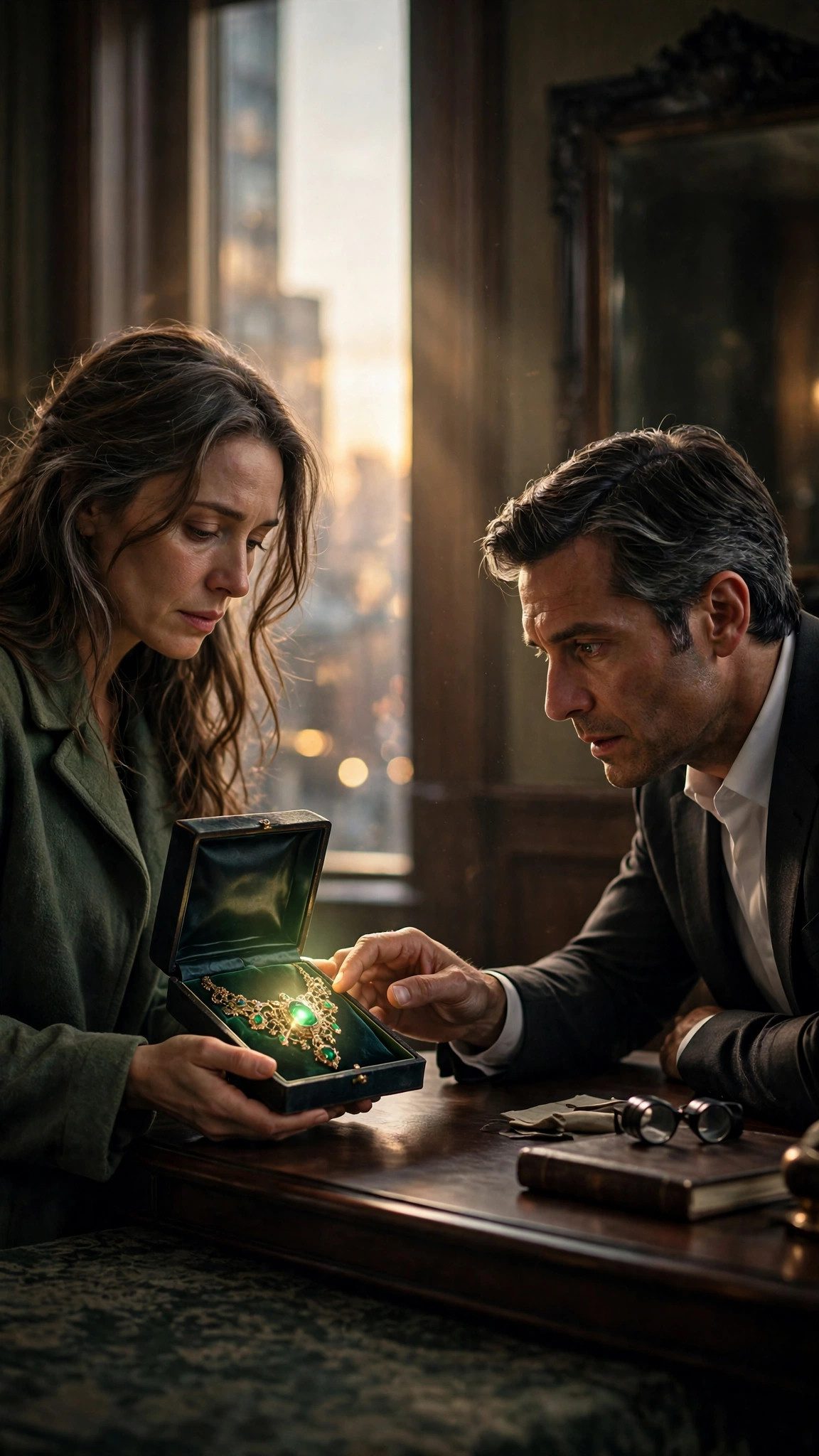
The morning after the hospital, Vincent Castellano's world came apart the way a poorly built wall comes apart — all at once, and then in pieces, and then in dust.
Marcus had spent the night doing what Marcus did best: quietly, thoroughly, and without mercy. By eight o'clock, three of Castellano's creditors had called in their loans. By nine, the firm that had examined the forged documents had sent its report to two newspapers and one federal investigator. By ten, Bianca Castellano had left her husband's house with two suitcases and her mother's jewelry, telling her lawyer that she had never known about the forgeries, and that she had never wanted the necklace, and that she was tired of being married to a man who stole from widows.
By noon, Castellano was gone from the city. He left no forwarding address. The men who had once feared him began to forget his name within a week, the way the city always forgets men who build their power on other people's fear.
Nathaniel did not celebrate. He had spent too many years watching men fall to take pleasure in another man's ruin. He simply called Marcus and said, "Make sure he stays gone," and then he went to the hospital, where Margaret Ellis was sitting up in bed for the first time in weeks, eating soup that Valerie had made at home and carried to the hospital in a thermos.
"Your mother's chemotherapy is working," the doctor told Valerie that afternoon, his voice careful and hopeful in the way doctors' voices are when they have good news they are afraid to promise. "The tumor is shrinking. It is early, and there are no guarantees, but she is responding better than we expected. If this continues, she could have years — good years."
Valerie cried then, quietly, into her mother's shoulder, and Margaret stroked her daughter's hair the way she had stroked it when Valerie was small, and whispered, "You see, my girl? You see what happens when you don't give up?"
Nathaniel stood in the doorway, watching them, and he felt something in his chest that he had not felt in twelve years — not power, and not triumph, but peace. The simple, ordinary peace of a room where the people you love are alive and together.
Over the following weeks, he courted Valerie the way a man courts a woman he has already lost once and will not lose again: slowly, honestly, and without games. He did not send flowers by the dozen or cars with drivers. He brought soup to the hospital. He fixed the leaking faucet in her kitchen — this time with his own tools, which he had finally learned to use. He sat with Margaret in the afternoons and listened to her stories about the laundry, and Rose, and the neighborhood as it had been forty years ago. He took Valerie to the park on Sundays, and they walked the way they had walked twelve years ago, past the bakery and the parking lot, and this time he did not look over his shoulder.
He told her everything. He told her about his father, and the office on the top floor, and the choice that had not been a choice. He told her about the twelve years, and the empire, and the empty rooms, and the nights he had driven past her building and sat in his car, unable to go in. He told her about the men he had hurt, and the things he had done, and the slow, painful work of dismantling it all — the gambling rooms closed, the debts forgiven, the men given honest work or honest farewells.
Valerie listened to all of it, and when he finished, she was quiet for a long time. Then she said, "My grandmother used to say that a man is not the worst thing he has done. A man is the best thing he is willing to do next. What are you willing to do next, Nathaniel?"
"I am willing to be the man you deserved twelve years ago," he said. "For as long as you will let me."
It was Margaret who asked the question, one afternoon in late spring, when the chemotherapy was done and her hair was growing back in soft grey curls and she was strong enough to sit in the garden behind Valerie's small house.
"When are you going to marry my daughter, Nathaniel?" she said, in the blunt, practical voice of a woman who has survived cancer and has no time left for games. "She has waited twelve years for you once already. Do not make her wait another twelve."
Nathaniel laughed — a real laugh, the first Valerie had heard from him since the clinic — and he went down on one knee in the garden, in the dirt, in his dark suit, and he took Valerie's hand, and he said, "Valerie Bennett, I left you once without a goodbye, and I have spent twelve years trying to earn the right to say hello again. Will you marry me? Not because I need a wife, and not because my family demands it, but because I love you, and because I want to spend the rest of my life making up for the twelve years I stole from us."
Valerie looked at him — at the man in the dirt, in the dark suit, with grey at his temples and his heart in his eyes — and she thought about her grandmother, and the letter in the velvet box, and the words Rose had written: "Do not let the world be too small for you."
"Yes," she said. "Yes, Nathaniel. Yes."
They were married in the garden behind the small house, on a warm evening in June, with Margaret in the front row in a yellow dress, her hair growing back, her eyes bright. Marcus stood as Nathaniel's best man, and he cried — openly, unashamedly, the way only a man who has waited twenty-eight years to keep a promise can cry. The nurse Angela from St. Mary's came, and the neighbors, and the women from the care home where Valerie had worked, and the whole small, ordinary, beautiful world that Valerie had built out of nothing.
Valerie wore a simple white dress, and her long brown hair loose around her shoulders, and around her neck, for the first time in her life, she wore her grandmother's necklace — the 1921 emerald and gold necklace, the emeralds catching the evening light like green fire.
When Nathaniel saw her, he forgot how to breathe — the same way he had forgotten how to breathe in the appraisal room, behind the one-way glass, the first time he saw her after twelve years. Only this time, she was not selling the jewel. She was wearing it. And she was walking toward him, with a full heart, the way her grandmother had always known she would.
After the ceremony, Margaret took Valerie aside, and she pressed something into her daughter's hand. It was a small, worn photograph, black and white, of a young woman with dark hair and a laughing mouth, standing beside a young man with kind eyes.
"Your grandmother and Elias," Margaret said softly. "Rose kept it hidden her whole life. She gave it to me before she died, and told me to give it to you when the time was right. The time is right now, my girl. Look at them. Look how happy they were, even though the world was too small for them. Your grandmother used to say that love doesn't die when the world says no. It waits. It waits for someone brave enough to say yes."
Valerie looked at the photograph for a long time, and then she tucked it into the velvet box with the necklace, where it belonged — with the letter, and the will, and the promise that had waited ninety years to be kept.
That night, after the guests had gone and the garden was quiet, Nathaniel and Valerie sat together on the porch, and he held her hand, and they looked up at the stars.
"Do you regret it?" Valerie asked softly. "The twelve years? The empire? All of it?"
Nathaniel thought about his father, and the office on the top floor, and the cage he had lived in for twelve years, calling it power. He thought about the clinic, and the parking lot at midnight, and the woman who had laughed when she stalled a car. He thought about the necklace, and the letter, and the photograph of two young people who had loved each other in a world too small for them.
"I regret the twelve years I lost with you," he said. "But I do not regret this — sitting here, with you, wearing your grandmother's jewel, with your mother alive in the next room. Elias and Rose waited ninety years for someone to finish their story. We finished it, Valerie. You and I. We made the world big enough."
Valerie leaned her head against his shoulder, and the emeralds at her throat caught the porch light, and the green coat — Thomas's coat, faded now, hanging in the closet inside — waited patiently for winter, for the woman who would wear it again, not out of need, but out of love for the man who had given it to her.
At the wedding, when the time came for the vows, Nathaniel did not read from a card. He stood in the garden, in the evening light, with Valerie's hands in his, and he spoke the way he had spoken in the hospital room — quietly, and without hiding.
"Valerie," he said, "twelve years ago, I stood in your doorway and I lied to you. I told you I would come back tomorrow, and I did not come back. I have spent twelve years trying to earn the right to stand in front of you and tell you the truth. The truth is that I loved you then, and I love you now, and I will love you for the rest of my life. The truth is that I was a coward, and you were brave enough for both of us, and I will spend the rest of my life being brave enough for you. I promise you this: I will never leave without a goodbye again. I will never let the world be too small for us again. And I will love you completely, or not at all — and I choose completely."
Valerie cried, and the guests cried, and Margaret cried the hardest of all, dabbing at her eyes with a handkerchief and whispering to the woman beside her, "I told you. I told you he would come back."
When it was Valerie's turn, she did not read from a card either. "Nathaniel," she said, "my grandmother kept a necklace in a drawer for ninety years, because she believed that love was worth more than money, and that a promise was worth more than a jewel. I kept a green coat for eleven years, because a good man gave it to me, and I kept a letter I could not bear to read, because my grandmother's last words were too precious to spend all at once. I have spent my life keeping things safe, Nathaniel. Today, I am done keeping things safe. I am giving you my heart, and I am asking you to keep it safe, the way I kept everything else. And I promise you this: I will love you completely, and I will never let the world be too small for us, either."
Marcus, standing as best man, wept openly, and did not apologize for it, and no one in the garden thought less of him for it.
In the months after the wedding, Nathaniel and Valerie did something neither of them had planned, but both of them had dreamed of in different ways. They took a portion of the money Nathaniel had set aside — the money he had once intended to pay for the necklace — and they started a small fund in Rose Bennett's name. The Rose Bennett Fund paid for chemotherapy for families who could not afford it. It paid electricity bills for mothers in hospital rooms. It paid for one thousand dollars, urgently, before Friday, for women in faded green coats who walked into quiet rooms with velvet boxes in their hands and asked for help.
The first family the fund helped was a woman named Angela — the night nurse from St. Mary's, who had called security on Castellano's men. Her sister needed treatment, and the fund paid for it, and Angela cried in Valerie's kitchen, and Valerie held her hand the way she had held a hundred hands at the clinic, and said, "You will be all right. Most of the time, you will be all right."
Margaret grew stronger through the summer. Her hair came back in soft grey curls. She took up gardening, and she grew tomatoes the size of fists, and she told anyone who would listen that her son-in-law was a reformed man with kind eyes, and that her daughter had finally married for love — the second time, and the right time.
And in the evenings, Nathaniel and Valerie sat on the porch of the small house, and he held her hand, and they talked about the future the way people talk about the future when they finally believe they have one: a child, perhaps, one day. A trip to the sea. A garden that would outlive them both. Small dreams, ordinary dreams, the kind of dreams that had once seemed impossible in a world too small for love.
And in the velvet box on the dresser, beside the photograph of Elias and Rose, lay a letter in an old, careful hand, and a will filed in 1998, and a promise kept at last: that a jewel given in love belongs to the woman who wears it with a full heart — and that love, given time and courage, always finds its way home.
The End.
THE END