I was nine years old when my mother died, and I remember the hospital room better than I remember her face.
The room had white walls and a window that looked out over a parking lot, and a television mounted high in the corner that nobody ever turned on, and a chair by the bed where my father sat for three days without sleeping, holding her hand. I remember the smell of disinfectant and the sound of the machines breathing for her when she could not breathe for herself. I remember the nurses coming in and out with soft shoes and softer voices, and I remember my mother opening her eyes one last time and looking at me, and smiling, and whispering something in the language I did not understand, and then the machines made a long flat sound, and my father made a sound I had never heard a grown man make, and a nurse put her arms around me and led me out into the hallway, and that was the end of my mother.
Her name was Layla. Layla Brooks, on the papers my father kept in a drawer. Layla, who had dark hair like mine and a laugh like a bell, or so my father said, because by the time I was old enough to ask him to tell me about her, the details had already started to slip away from him, like sand through his fingers. He told me she loved music. He told me she loved the sea. He told me she had come to New York from far away, from a place with white stone houses and olive trees, and that she had loved my father the first time she heard him play the saxophone in a little club in Brooklyn, and that she had married him in a courthouse on a rainy Tuesday with two strangers as witnesses, because there was no one else to invite.
"No one else?" I asked him once, when I was twelve and brave enough to push.
"No one else," he said, and he looked out the window, and he did not say another word about it for the rest of the evening.
My father was Daniel Brooks, a jazz saxophonist who had once been good enough to play with real bands in real clubs, and who, after my mother died, became good enough only to play in the subway stations and the hotel lobbies where nobody listened. He loved me. I never doubted that, not for a single day of my life. He made me breakfast every morning, burned toast and runny eggs, and he walked me to school, and he taught me to read music before I could read words, and he told me stories about my mother that always ended the same way, with him saying, "She loved you more than anything in the world, Nia. That is the only thing about her you need to know."
But a child knows when a parent is hiding something. I knew. I knew from the way his hands shook when I asked about her family. I knew from the way he changed the subject when I asked where she had come from. I knew from the small wooden box he kept at the back of his closet, locked, a box I was never allowed to open, a box I dreamed about for years, wondering what was inside it. Photographs, I thought. Letters. Answers.
I never opened it. I never asked him to open it. I was afraid of what I would find, and I was afraid of what I would not find, and so I let it sit there in the dark, and I grew up, and my father grew older, and the saxophone stayed in its case more and more, and the gigs got fewer, and the money got tighter, and when I was eighteen I got a job in a diner in Queens, and when I was twenty I got a job in a better restaurant, and when I was twenty-six I walked into the Bellweather Room with a borrowed blazer and a practiced smile, and Marcus Hale looked me up and down and said, "Black uniform, no jewelry, no talking back to the guests, and you keep your tips in the envelope at the end of the night."
I should have known then. I should have known by the way he said "the envelope" that the envelope was the whole game. But I needed the job, and the Bellweather Room was beautiful, all white tablecloths and warm light and a string quartet in the lobby, and the guests were the kind of people who left twenty-dollar bills folded under their coffee cups, and for the first time in my life I thought I might be able to save money, real money, enough to move out of the fourth-floor walk-up and into a place with an elevator, enough to buy my father a new saxophone, enough to breathe.
The first week, I counted my tips the way my mother must have counted her prayers, carefully, one by one, writing each one down in a little notebook I kept in my apron pocket. Table six, forty dollars. Table twelve, twenty-five. Table three, a hundred-dollar bill folded into a swan, left by a woman celebrating her anniversary. At the end of the week, I added the numbers twice, and then a third time, and then I opened the envelope Marcus Hale handed me, and the money inside was less than half of what I had earned.
I told myself I had made a mistake. I told myself I had counted wrong. I told myself the restaurant took a percentage, that there was a fee I did not know about, that the envelope was not supposed to match. But the second week it happened again, and the third week, and the fourth, and by the end of my first month I knew, with the cold certainty of a woman who has counted every dollar she has ever earned, that somebody was stealing from me.
I went to Marcus Hale. I stood in his little office with its smell of old coffee and cleaning fluid, and I held my notebook in both hands, and I said, "Mr. Hale, I think there has been a mistake with my tips."
He looked at me the way a man looks at a fly on his desk, with mild annoyance and no surprise at all, and he said, "There is no mistake, Nia. The house takes its share. The kitchen takes its share. The bar takes its share. What is left is yours. If you do not like it, there are a hundred girls who would take your place tomorrow."
I went back to the dining room, and I served the next table, and I smiled, because that is what waitresses do, we smile, and I wrote the numbers down in my notebook, and I kept counting, because counting was the only power I had.
But the words, the Arabic words, those I never counted. Those I never wrote down. Those lived in a different place, somewhere behind my ribs, where my mother had put them when I was small and frightened and the dark pressed in around my bed. She used to sit on the edge of my mattress and stroke my hair, and she used to whisper them to me, over and over, until my breathing slowed and my eyes closed.
"Ya habibi, la tuqatiluh. Ya habibi, ruuh ahlaykum."
I did not know what they meant. I asked her once, when I was seven, what the words meant, and she had smiled and touched my cheek and said, "They mean you are safe, my love. They mean someone is watching over you. That is all they need to mean."
After she died, I said them to myself sometimes, when I was afraid, when the apartment was dark and my father was out playing in a subway station and the city sounded too loud and too lonely. I whispered them into my pillow, and they sounded like her voice, and for a moment I was not alone.
I never told anyone about them. Not my father. Not my friends. Not the girls I worked with at the Bellweather Room, who smoked on the fire escape during their breaks and traded stories about the guests and the managers and the men who left their phone numbers on napkins. The words were mine. They were the only thing my mother had left me that nobody could take, not even Marcus Hale with his envelope.
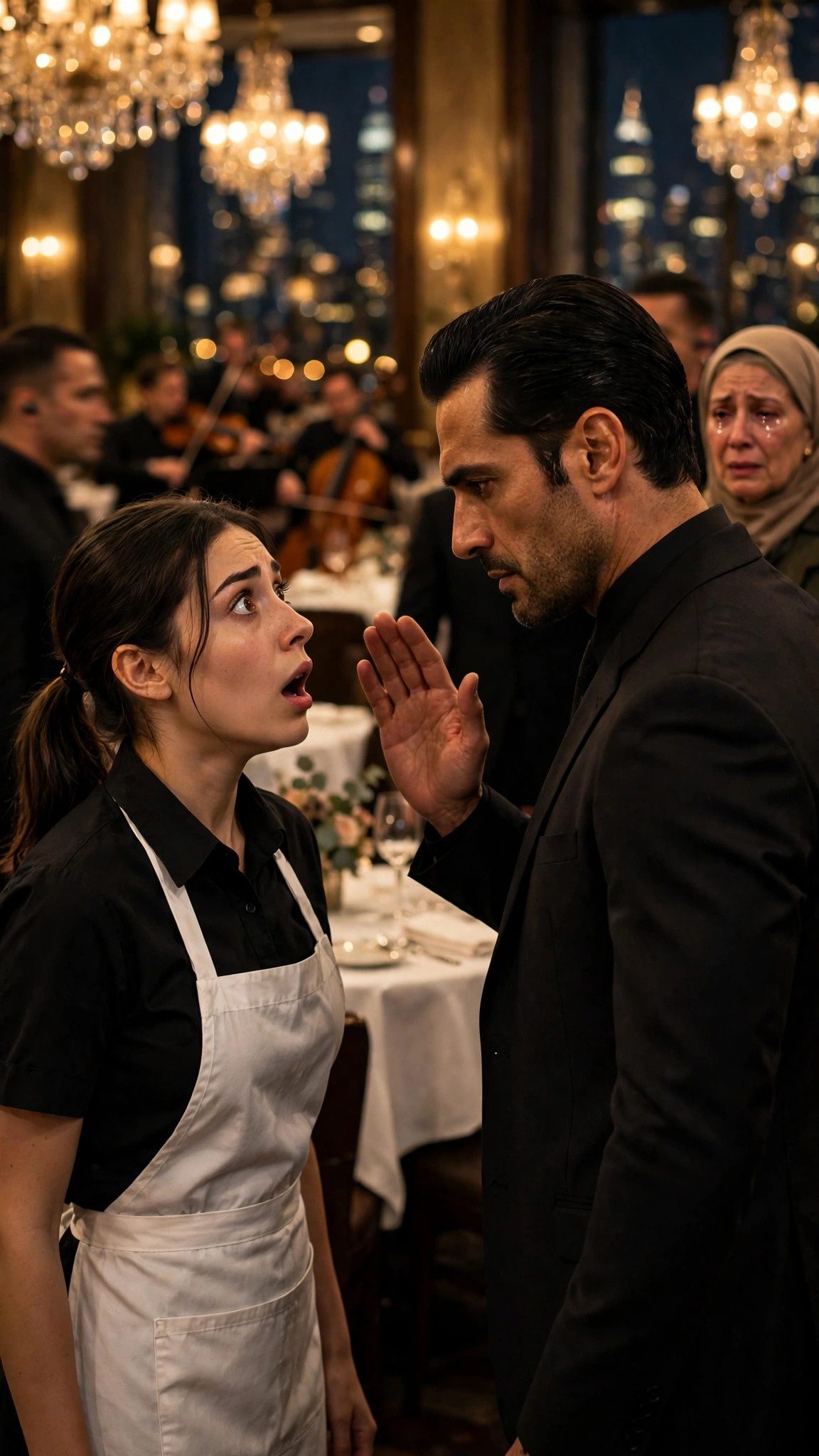
And then, on a Tuesday night in October, Kareem Rahal walked into my restaurant, and sat at the table next to the main window, and spent an hour looking at my face, and an old woman in a head-cover hugged me and asked me who my mother was, and the words came out of my mouth before I could stop them, and the limousine turned around, and my whole life changed.
I did not know it yet, standing there in the dining room with the tray still balanced on my hand. I did not know that my mother had been born Layla Rahal, the youngest daughter of one of the oldest families in Lebanon, and that her brother was the man standing in front of me, and that her mother was the old woman who had just hugged me, and that the words I had carried in my chest for nineteen years were the words of my own family, passed down from grandmother to mother to daughter, a plea that had stopped killings and saved lives for three generations.
I did not know any of that. All I knew was that the man in front of me was looking at me the way my father used to look at my mother's photograph, like he had lost something precious and had just found it again, and that his advisor, Nabil, had his hand on my shoulder, and that the old woman, Amina, was crying quietly into her hands, and that the string quartet had stopped playing, and that the whole restaurant was watching us, and that I, Nia Brooks, a waitress who counted her tips in a little notebook, was suddenly the center of the most important moment of my life.
"Come with us," Kareem said, and his voice was deep and calm, and it did not sound like the voice of the most feared man in New York. It sounded like the voice of a man who was afraid. "Not as a prisoner. Not as a guest. As family. Please. Come and sit with us, and let my mother tell you who you are."
I looked at Marcus Hale, standing by the kitchen door with his face gone white, and I looked at the other waitresses, frozen with their trays in their hands, and I looked at the envelope in my mind, the envelope that had stolen from me for two years, and I thought, I have nothing to lose. I have counted every dollar, and I have saved nothing, and I have no one, and this man is offering me a family.
So I put down my tray. I untied my apron. And I followed Kareem Rahal out of the Bellweather Room, into the October night, where the limousine waited at the curb with its engine running, and the driver held the door open, and Amina took my hand in hers, and her hand was warm and old and shaking, and she whispered, "You look like him, child. You look just like your grandfather. Oh, my Layla. Oh, my baby girl. You brought her back to me."
The car moved through the city slowly, as if the driver knew that what was happening in the back seat was too important to rush, and I looked out the window at the streets sliding past, at the lit windows and the late-night crowds and the steam rising from the manholes, and I thought about my father, asleep in his apartment in Queens, with his saxophone in its case by the door, and I wondered what he would say if he could see me now, sitting in a limousine with the most feared man in New York, on my way to a house I had never seen, to meet a family I had never known existed.
I thought about the little wooden box at the back of his closet, and I thought about the letter I had never read, and the photographs I had never seen, and I felt a strange, fierce anger rising in my chest, not at my father, not really, because I knew he had loved me, and I knew he had been afraid, but at the world, at the years, at all the birthdays and Christmases and ordinary Tuesdays I had spent believing I was alone, when all along there had been a grandmother in Brooklyn Heights, lighting a lamp in a hallway, waiting for me to come home.
Amina squeezed my hand, as if she could hear what I was thinking, and she said, very quietly, so that only I could hear it, "Your mother sang to you, didn't she? In our language. I can see it in your eyes. She sang to you, and you remember, even though you think you have forgotten."
"How did you know?" I whispered.
"Because I sang the same songs to her," she said, "when she was small, and frightened, and the dark pressed in around her bed. And I sang them to Kareem, too, when he was small. They are our family's songs, Nia. They belong to you as much as they belong to me. No one can take them from you. Not time. Not distance. Not even death."
I closed my eyes, and for a moment I was nine years old again, in a room with white walls, and my mother was stroking my hair, and her voice was low and warm, and the words rose around me like water, and I was safe, and I was loved, and I was home.
When I opened my eyes, the limousine was crossing the bridge into Brooklyn, and the city glittered behind us, and Kareem was watching me, not the way he had watched me in the restaurant, like a man studying a painting, but the way a man watches his family, with a kind of quiet wonder, as if he could not quite believe I was real.
"You look like her," he said, softly, so softly I almost did not hear him over the hum of the engine. "You look like Layla. I have not said her name aloud in twenty-five years, and now I have said it twice in one night, and it does not hurt the way I thought it would. It feels like opening a window in a room that has been closed for a very long time."