The next morning, Adrien came back.
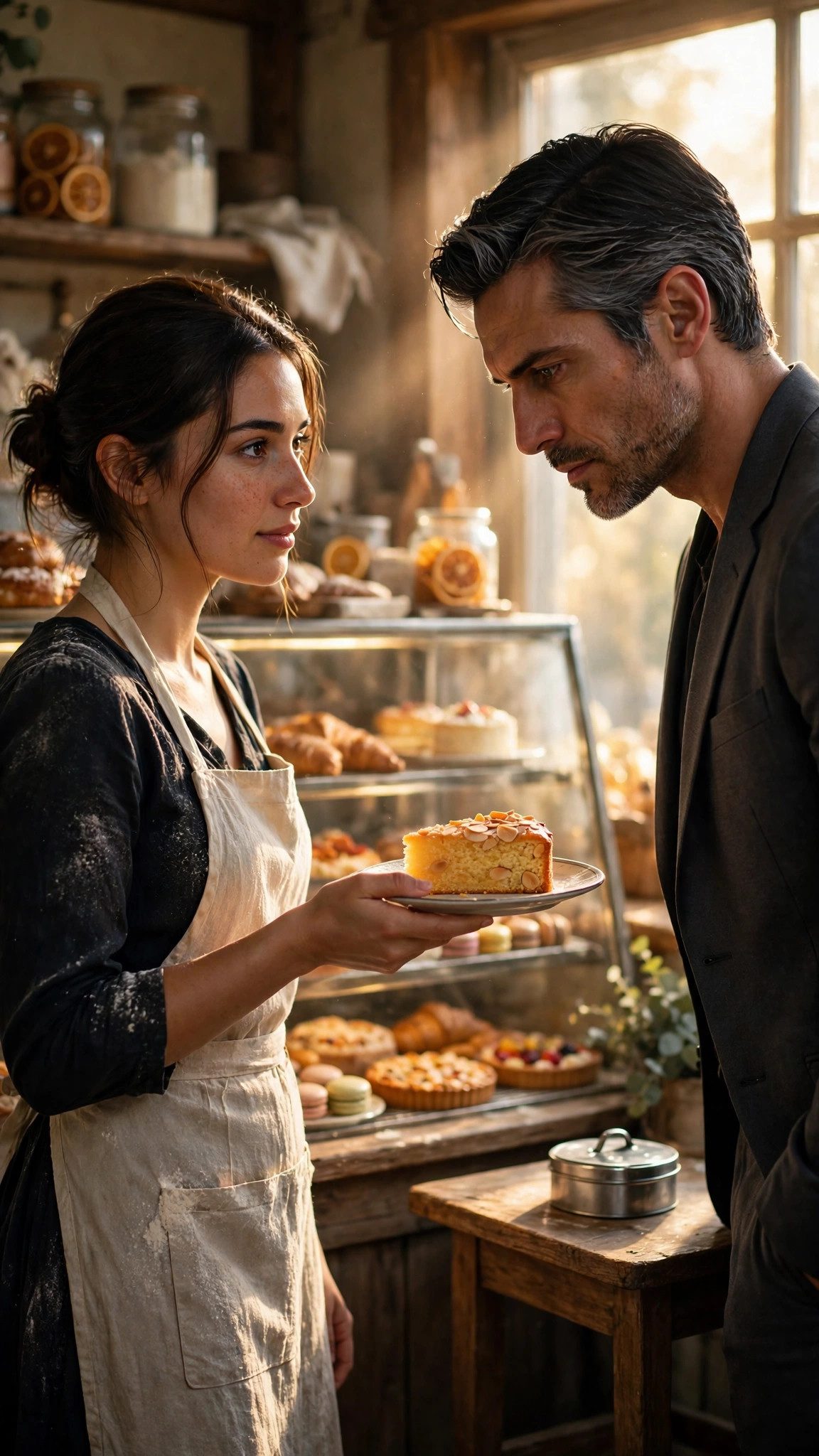
He walked in right when the sun hit the bakery window, the same as always, and his men took their places by the door, and he looked at the display case, and he pointed at the orange almond cake, and he said, "One slice."
But this time, he did not walk out. He sat down at the small table by the window, the same table as yesterday, and he folded his hands, and he waited.
I brought him the slice myself. My hands were shaking so badly I was afraid I would drop the plate, and I set it down very carefully, and I stood there, and I did not know what to do with my own hands, so I wiped them on my apron twice, and then I said, "Would you like anything else, sir?"
"Yes," he said. "I would like you to make me lemon cakes."
I stared at him. "Lemon cakes?"
"Lemon cakes," he said, and he reached into his jacket, and he pulled out a folded piece of paper, and he opened it on the table, and it was a list. Names and numbers, written in a neat, careful hand. The names of the most famous bakeries in the city. The names of the most famous pastry chefs in the country. Beside each name there was a phone number, and beside some of the numbers there were little notes in the margins, in the same neat hand: "best lemon tart in Chicago," "trained in Paris," "worth the price."
"You need to learn from the best," he said, and he pushed the list toward me across the table. "These are the best. My men will arrange it. You will go to their kitchens. You will watch them work. You will learn everything they know. And then you will come back here, and you will make lemon cakes for me."
I looked at the list, and I looked at him, and I did not know whether to laugh or to be afraid. "Mr. Moretti," I said, "I don't need to learn from anyone. I learned from my grandmother. She was the best."
He smiled then, a small, crooked smile, nothing like the terrible smile from yesterday, and he said, "I know. That is why I am here. But a baker who only knows one cake is a baker with one string on her violin. I want to hear the whole orchestra."
I told him, very carefully, that I wanted to learn from the best. I had always wanted to. When I was a little girl, I used to dream about going to Paris and learning to make croissants that shattered like glass, and going to Vienna and learning to make tortes with twenty layers, and coming home and making my grandmother proud. But there had never been money for that. There had been the bakery, and the rent, and the ovens that needed fixing, and Rosa's medicine at the end, and there had never been money for dreams.
He listened to all of it without interrupting me, and when I was finished, he said, "I learned from a man named Asher. Asher Romano. He was my father's consigliere, and after my father died, he was my teacher. And the most important thing he taught me is that you can never be too careful about who you trust."
"Is that why you have men with guns?" I asked, before I could stop myself.
He laughed, a real laugh this time, short and surprised, like a man who had forgotten he knew how. "That is one of the reasons," he said. "The other reason is that men with guns are very good at carrying boxes of cake."
I almost laughed too. I almost did. And then the door banged open, and the morning went cold.
Vincent Castellano walked into my bakery like he owned it.
He was a big man, in his fifties, with a belly that strained against his suit and a mouth full of gold teeth that caught the light every time he opened it, and he opened it a great deal. Behind him came a younger man, thin and nervous, with a notebook clutched to his chest like a shield, and Castellano was shouting at him before he was even properly through the door.
"I told you Tuesday, you idiot!" Castellano shouted, and his voice filled the bakery, and Mrs. Delgado dropped her bag of rolls, and old Mr. Okafor put his newspaper down very slowly, and Priya went very still behind the counter. "Tuesday! Not Wednesday! Tuesday! Do you understand the word Tuesday, or do I need to write it on your forehead?"
The young man nodded and apologized, and Castellano shoved him toward a table, and then he saw Adrien sitting at the window, and his whole face changed, and the gold teeth disappeared behind a smile that was not a smile at all.
"Adrien," he said, spreading his arms wide. "My boy. What a pleasure. I didn't know you took your breakfast in a place like this."
Adrien did not stand up. He did not even turn his head all the way. He only looked at Castellano the way you look at something you have already stepped around, and he said, "Vincent. You are shouting in a lady's bakery. Apologize to the lady, and lower your voice."
For one second, nobody moved. The bakery was so quiet I could hear the ovens humming in the back. Castellano's smile stayed on his face, but his eyes went flat and hard, and he looked at me, really looked at me, for the first time, and I felt my skin go cold, because his eyes were the eyes of a man who was counting something. He was counting the tables. He was counting the ovens. He was counting me.
"My apologies, miss," he said, and he gave me a little bow, and the gold teeth flashed. "I am an old man, and old men forget their manners. A beautiful bakery. A beautiful baker. Your father would be proud, Adrien, to see you taking an interest in local business."
"He would," Adrien said, and his voice was very quiet, and very calm, and that was somehow more frightening than shouting would have been. "And he would want you to remember that this bakery is under my protection. Do you understand me, Vincent?"
Castellano's smile did not move. "Of course," he said. "Of course. I understand everything." And then he turned to his associate, and he said, "Come, we are leaving, we have business across town," and he walked out the door, and the bell rang, and the bakery breathed again.
But I had seen the way he looked at me. I had seen the way he counted. And I understood, in that moment, that the man with the gold teeth had not come into my bakery by accident. He had come to see the bakery. He had come to see me. And whatever he wanted, it was not a slice of cake.
After he left, Adrien sat at the window table for a long time, finishing his slice, and then he stood up, and he left exact change on the table, and he walked to the door, and he stopped, and he said, without turning around, "Castellano is an associate of my late father. He made a deal with the devil a long time ago, Lucia, and he has been trying to collect on it ever since. Do not be alone with him. Do not take his money. Do not sign anything he puts in front of you. Do you understand?"
"I understand," I whispered.
"Good," he said. "And Lucia, about the lemon cakes. Think about the list. The offer stands. My men will handle the paperwork. You only have to say yes."
And then he was gone, and the bell rang, and Priya came out from behind the counter with her hands shaking, and she said, "Lucia, who was that man? Who was the man with the gold teeth?"
And I told her, "That was Vincent Castellano. And I think he wants my bakery."
Priya stared at me. "Why would a man like that want a little bakery on Taylor Street?"
I thought about the envelope of money Rosa had taken from Vittorio Moretti, a long time ago, in a kitchen in Palermo. I thought about the recipe card with Caterina Moretti's name on it. I thought about the way Castellano had counted my tables and my ovens, the way a man counts things he intends to own.
"I don't know," I said. "But I think Adrien does. And I think that is why he comes here every morning."
That night, Priya stayed late, and we sat at the little table by the window after closing, with two cups of tea going cold between us, and she asked me the question I had been asking myself all day.
"Lucia, are you afraid of him?"
I thought about it for a long time before I answered. "Yes," I said. "And no. I am afraid of what he is. I am afraid of the men with guns, and of the way the room goes quiet when he walks in, and of the way Castellano looked at me today, like I was a thing he intended to own. But I am not afraid of Adrien himself. When he sits at that table and looks at me, I do not feel like prey. I feel like… like someone is finally seeing me. Really seeing me. Not the bakery. Not the cake. Me."
Priya reached across the table and took my hand. "Then be careful, Lucia. Men like that do not fall in love the way ordinary men do. When they want something, they take it. And when they love something, they protect it so hard they sometimes break it."
"I know," I said. "Rosa told me the same thing, in different words. She said if a man looks at you the way the devil looks at temptation, run the other way."
"And are you going to run?"
I looked out the window at Taylor Street, dark and quiet, with the streetlights making little pools of gold on the wet pavement. "I don't know," I said. "I have been running my whole life, Priya. I ran from Palermo, in a way, even though I was never there. I ran from my mother's death. I ran from Rosa's death. I ran into this bakery, and I hid here for three years, and I told myself it was enough. But it is not enough. It has never been enough. And Adrien Moretti is the first person who has ever looked at me and seen past the bakery, past the cake, past all of it, and seen me. So no. I am not going to run. Not this time."
The next morning, before Adrien arrived, I did something I had never done before. I took the list he had given me, the list of the most famous bakeries in the city, and I called the first name on it. A woman answered, with a voice like warm bread, and I told her who I was, and I told her that Adrien Moretti had given me her name, and there was a long silence on the other end of the line, and then she said, "If Adrien Moretti gave you my name, then you must be someone very special, my dear. Come tomorrow. Come at dawn. I will show you my kitchen."
I went the next day, before the sun was up, to a bakery on the other side of the city, a grand place with marble counters and copper ovens, and the woman, whose name was Madame Colette, showed me how to make a lemon tart so perfect it shone like glass, and she showed me how to fold butter into dough a hundred times until it shattered like autumn leaves, and she told me that she had once baked for a president, and for a king, and that neither of them had ever looked at her the way Adrien Moretti looked at a slice of orange almond cake.
"That man," she said, wiping her hands on her apron, "has been looking for something for a very long time. I have known his family for forty years. I knew his grandmother. Caterina Moretti was a woman who laughed like a door opening in a quiet house. And when she died, a part of this city died with her. If you have what he is looking for, Lucia, then you hold something more valuable than gold. Hold it carefully. And do not let anyone take it from you. Not even him."
I came home that morning with lemon zest under my fingernails and a head full of new ideas, and when Adrien walked in, right when the sun hit the window, I told him I had gone to Madame Colette's kitchen, and I told him I had learned to make a lemon tart, and he smiled, and he said, "Good. Then you are learning. And Lucia, there is something else you should know about Asher, the man who taught me. Asher was not always a consigliere. When he was young, he was a baker's son, in Naples, and his father had a little shop, like yours, and his father trusted the wrong man, and he lost everything. Asher told me that story on the night my father died, and he said, 'Adrien, you can never be too careful about who you trust, because the people who smile at you in the morning are sometimes the same people who count your money at night.' I have never forgotten it. And I have never trusted easily since. Except you. I trust you, Lucia, and I do not know why. Perhaps because you have never asked me for anything. You have only ever asked me if the cake was good enough."
I stood there behind the counter, with flour on my apron and lemon zest under my fingernails, and I looked at the most dangerous man in Chicago, and I realized that he was not dangerous to me. He was only lonely. And loneliness, I was beginning to understand, was the most dangerous thing of all, because it makes even the strongest men do foolish things, and it makes them vulnerable in ways no gun ever could.