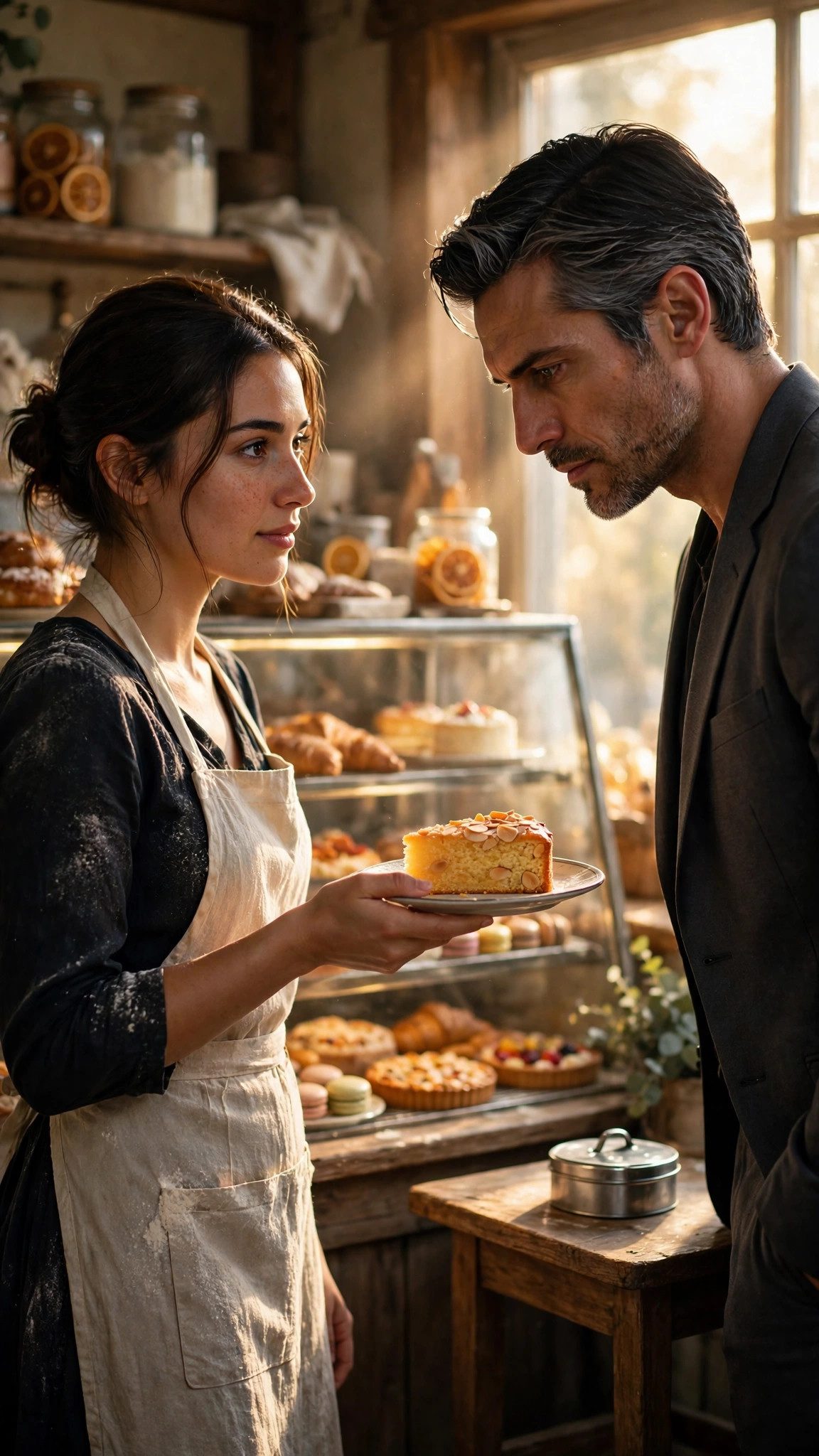
The next morning, Adrien came back, and this time he did not sit at the window table. He stood at the counter, and he waited until Mrs. Delgado had left with her rosemary bread and old Mr. Okafor had folded his newspaper and gone, and then he looked at me, and he said, "I have a proposition for you, Lucia. And I want you to hear all of it before you answer."
My hands went still on the tray I was holding. "A proposition?"
"My men will handle the paperwork," he said. "They will take care of the money. All you need to do is the same thing every morning. The same cake. Every day. For the rest of our lives."
I stared at him. "For the rest of our lives?"
He nodded, and he was very serious, and very calm, the way he always was when he was saying something that mattered. "You will bake the orange almond cake every morning. My men will pick it up, or I will pick it up myself. You will be paid more than this bakery makes in a year, every year, for as long as you live. You will never have to worry about rent, or ovens, or flour, or anything else, ever again. And in return, I ask only one thing."
"Which is?"
"That the cake is always the same," he said. "That it always tastes the way it tasted this morning. That it always tastes like my grandmother's."
Those words made my eyes sting, but there was something else I could see in this man's face, a sincerity that made me stop in my tracks. He closed his eyes and gave me a crooked smile, and for one second he was not a mafia boss at all. He was just a man who missed his grandmother, and who had found the one thing in the world that could bring her back to him, even for a moment.
"I'll pay you whatever it takes," he said. "Just say yes."
I was still looking at him when he said the words that made my heart stop.
"I like the angle. It's different."
I did not know what he meant by that, not then. I thought he meant the bakery, the little shop on Taylor Street with its bell over the door and its window full of morning sun. I thought he meant the way I had built something small and honest in a city that only respected things that were big and loud. I did not understand until later that he meant me. He meant the way I had looked at him, not with fear, and not with hunger, but with the plain, ordinary honesty of a woman who bakes a cake and asks if it is good enough. He had spent his whole life being looked at by people who wanted something from him. I had only ever wanted to know if the cake was good.
He asked me to remember the recipe secret, and he didn't even try to hide his desperation. It was the first time I had ever seen a real human emotion from him, and it frightened me, because a man like Adrien Moretti does not show desperation to anyone, and the fact that he was showing it to me meant that the cake mattered to him more than anything else in his life, more than his money, more than his power, more than his pride.
And then he said the words that would haunt me forever.
"The day my grandmother died, she asked me to bring her a slice of orange almond cake. I never got to bring her one. And in nearly three years, I couldn't bring myself to eat your grandmother's cake because every bite tasted like my grandmother's. It was her recipe, the exact one my father paid for."
I felt the floor go out from under me. "Your father paid for it?"
He nodded. "Twenty-five thousand dollars, in Palermo, a long time ago. My father bought the recipe from a cook named Rosa Benedetti. He believed he was buying the only copy. He believed the cake would belong to our family, and to no one else, forever. He was wrong. Rosa kept the recipe. She brought it to America. She gave it to you. And now you bake it every morning, three blocks from my office, and I have been eating my grandmother's cake for weeks without knowing how it was possible."
"Come home with me," he said. "I have a picture of my grandmother I want to show you."
I should have said no. Every sensible part of me was screaming no. A mafia boss was asking me to come home with him, to his house, to see a picture of his dead grandmother, and my grandmother had told me a hundred times that if a man looks at you the way the devil looks at temptation, you should run the other way. But I did not run. I looked at his face, and I saw the desperation, and I saw the sincerity, and I saw a man who had waited three years for a slice of cake, and I said yes.
I told Priya to watch the bakery. I took off my apron. I washed the flour off my hands twice, the way Rosa had taught me. And I followed Adrien Moretti out of my bakery, past his men with their guns, and I got into his black car, and the door closed, and the city went past the windows, and my heart was beating so loudly I was certain he could hear it.
His house was on the lake, behind a high wall, with a garden full of roses that were still blooming even though it was almost winter. Inside, the house was quiet and dark and full of old furniture and old photographs, and he led me through room after room, past paintings and books and a piano nobody played, until we came to a small room at the back, with a window that looked out over the garden, and on the wall there was a photograph in a silver frame.
It was a photograph of two women in a kitchen, a long time ago, in a stone house in Palermo. One of them was Caterina Moretti, young and laughing, with flour on her cheek. The other was my grandmother Rosa, younger than I had ever seen her, with her hair in a braid and her hands in a bowl, and she was laughing too, and the two of them looked like sisters. On the back of the photograph, in faded blue ink, someone had written: "The only real one. Palermo, 1962."
Adrien stood beside me, and he did not touch me, and he said, very quietly, "My grandmother kept this photograph on her bedside table until the day she died. She told me that the woman beside her was the best friend she ever had, and the best cook who ever lived, and that the cake they made together was the only real one in the world. She told me that if I ever found that cake again, I should hold on to the person who made it, and never let go."
He reached out then, and he pulled me close, and I could feel his heart beating against mine, fast and hard, like a man who had been running for a very long time and had finally stopped.
"Because the cake tastes exactly like my grandmother's," he whispered. "They're always perfect. Always."
And I stood there in his house, in the room with the photograph of our two grandmothers, and I understood that this was not a business proposition at all. It was a man asking me, in the only way he knew how, to be part of his life. And I understood something else, too, something that frightened me even more: I wanted to say yes.
But I did not go home right away. I stayed in that small room at the back of his house for a long time, looking at the photograph of our two grandmothers, and Adrien stood beside me, and he did not rush me, and finally I said, "Show me the rest. Show me where she lived. Show me her kitchen."
So he took me through the house, room by room, and he showed me Caterina's bedroom, which had been kept exactly as she left it, with her rosary on the bedside table and her shawl folded on the chair and a vase of dried roses on the windowsill. And he showed me the library, where his father used to sit, and the dining room, where the family had eaten together on Sundays, and finally he showed me the kitchen, a great kitchen with copper pots hanging from the ceiling and a wood-fired oven that had not been lit in three years.
"This was her kitchen," he said. "She cooked here every day, until the last week of her life, when she was too weak to stand. And on the last day, she asked me to bring her a slice of orange almond cake, and I told her I would, and then the phone rang, and there was a problem with a shipment, and men who needed to be dealt with, and I told myself I would bring it tomorrow. And there was no tomorrow. She died that night, in her sleep, the way your grandmother did. And I have carried that slice of cake with me for three years, Lucia. Everywhere I go. I have never been able to put it down."
I looked at the kitchen, at the cold oven and the copper pots and the empty counters, and I did something I had not planned to do. I took off my coat, and I rolled up my sleeves, and I said, "Is there flour in this house? Is there butter? Is there an orange anywhere in this kitchen?"
He stared at me. "Lucia, what are you doing?"
"I am going to bake the cake," I said. "Right here. In your grandmother's kitchen. In her oven. And you are going to sit at that table, and you are going to eat a whole slice, not one bite in a car, not one bite standing up, but a whole slice, sitting down, in your grandmother's kitchen, the way it was meant to be eaten."
He did not argue. He found the flour, and the butter, and the sugar, and the almonds, and there were oranges in a bowl on the counter, and I lit the oven, and I zested the oranges by hand, and I toasted the almonds until the kitchen smelled like autumn, and I beat the eggs, and I folded the batter, and I added the spoonful of orange blossom water that I had never written down anywhere, and I put the cake in the oven, and I sat on the floor in front of the oven door, the way I used to sit when I was a little girl, and I watched it rise.
Adrien sat at the kitchen table, and he watched me, and he did not say a word, and when the cake came out, golden and perfect, I cut a slice, and I put it on a plate, and I set it down in front of him, and I said, "Eat it, Adrien. All of it. For her."
He picked up the fork, and his hand was shaking, and he took a bite, and he closed his eyes, and he did not move for a very long time. And then he took another bite, and another, until the whole slice was gone, and he set the fork down very carefully, and he looked at me, and there were tears running down his face, and he did not try to hide them, and he said, "It tastes like her. It tastes exactly like her. I have been eating this cake for weeks, Lucia, one slice every morning, and every bite tasted like her, and I could never finish it, because finishing it felt like saying goodbye. But here, in her kitchen, eating it the way she would have wanted, it does not feel like goodbye. It feels like she is here. It feels like she never left."
I sat down beside him at the table, and I took his hand, and I said, "She never left, Adrien. She is in the recipe. She is in the cake. She is in you, and she is in me, and as long as we bake this cake, she will always be here. That is what Rosa taught me. A cake is a kind of memory. And every time you bake it, you bring back everyone who ever made it before you."
He drove me home that night, himself, without his driver, without his men, just the two of us in the black car, driving through the quiet streets of Chicago, and when we stopped outside the bakery, he walked me to the door, and he did not try to kiss me, and he did not try to hold me, and he only said, "Thank you, Lucia. For the cake. For the kitchen. For her. I will come back tomorrow. And the day after that. I have waited three years for this cake. I can wait one more day for you."
I went upstairs to my apartment, and I stood at the window, and I watched his car drive away, and I thought about the photograph on his wall, and about the kitchen with the cold oven, and about the way he had cried over a slice of cake, and I understood something I had not understood before: Adrien Moretti was not a devil. He was a man who had lost his grandmother, and who had never forgiven himself, and who had been punishing himself for three years, one slice of cake at a time. And I was the only person in the world who could forgive him, because I was the only person in the world who could bake the cake the way his grandmother had made it.
And I knew, standing at that window, that I was going to forgive him. I knew I was going to bake that cake for him every morning, for the rest of our lives, whether he asked me to or not. Because that was what the cake was for. That was what it had always been for. It was not for money. It was not for power. It was for bringing back the people we have lost, even for a moment, even for one bite, even for one morning.