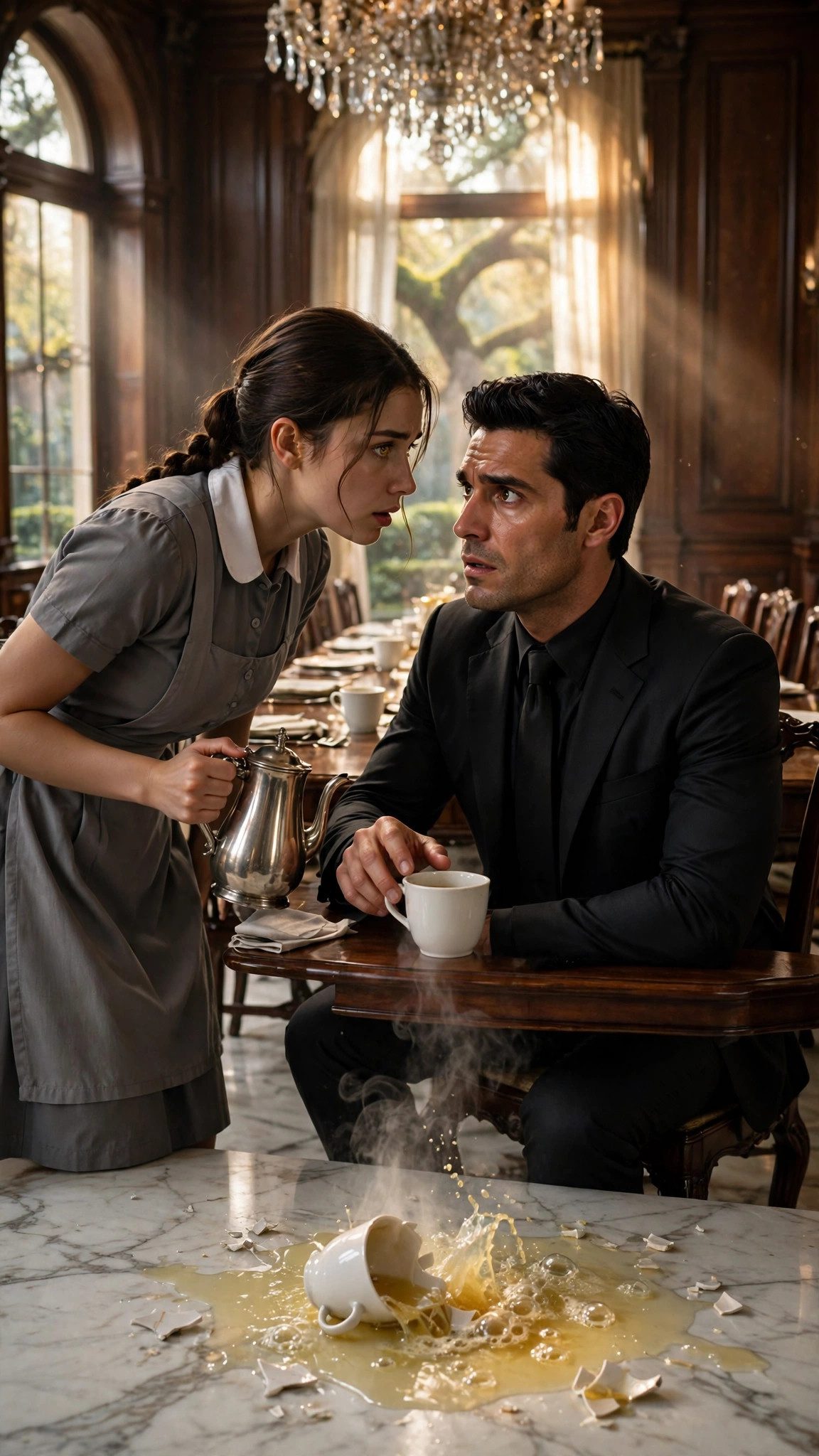
The blood started in the kitchen.
Benny found it first, because Benny always found things first. A drop on the white tile beside the stove, dark and almost black in the morning light. Another drop by the pantry door. A smear on the doorframe, as if someone had steadied themselves there with a bloody hand. And then a trail, thin and deliberate, leading down the back stairs toward the cellar, where the wine was kept and the old servants' quarters had been boarded up for twenty years.
"Don't touch anything," Benny said to his men, and he followed the trail himself, one step at a time, his pistol in his hand and his flashlight in the other, while I stood at the top of the cellar stairs with Violet beside me, because she had refused to leave, and I had not asked her to.
The cellar smelled of damp stone and old wine and dust. The blood trail led past the wine racks, past the crates of champagne no one had opened since my father's time, to the far wall, where a section of paneling stood a finger's width away from the rest of the wall, crooked in a way that was easy to miss if you were not looking for it.
Benny pushed it. It swung open on silent hinges, and behind it was a room no bigger than a closet, with a camp bed, a blanket folded with military neatness, a small radio, a stack of newspapers, and a wooden box full of letters.
Someone had been living inside my house. Inside my walls. For God knew how long.
"Jesus Christ," Benny whispered, and he shone his flashlight around the little room, and the light caught on something gold on the camp bed, and he picked it up with two fingers, the way you pick up a thing that might bite you.
It was a bangle. A round gold bangle, thin and plain, the kind a woman wears every day until it becomes part of her wrist. I knew it. I had seen it a thousand times when I was a boy, on my mother's wrist, catching the light when she reached for a book or poured tea. Elena Orsini's bangle. It had disappeared from her dressing table the week she died, and I had believed it was lost, or stolen by a nurse, or buried with her. It had been here, in a hidden room behind my wine cellar, on a camp bed where someone had been sleeping.
"That's my mother's," I said, and my voice did not sound like my own.
Benny opened the wooden box. It was full of letters, dozens of them, tied in bundles with string. Some were in my mother's handwriting. Some were in a handwriting I did not know. And at the bottom of the box, wrapped in a piece of oilcloth, was a ledger, small and black, with pages full of numbers and names and dates, and on the first page, in the same small careful handwriting as the banknote in the coffee packet, were the words: For the boy who owes us a father.
I took the ledger out of the box, and I held it, and I understood, all at once, that someone had been slipping inside my house for years, moving hidden evidence from room to room, carrying my mother's letters and my mother's jewelry through my walls like a rat carries food through a house, and that everything they had moved was tied back to a night fourteen years ago, when my father died on a river road and a driver named Thomas Delacroix drove his family out of the city instead of driving my father to his meeting.
"Get Clara up here," I said.
They brought her up from the pantry, two guards on either side of her, and she walked between them the way she had walked through my house for six years, with her head high and her gray uniform neat, except now there was blood on her cuff and a knife in an evidence bag in Benny's hand and a gun on the table in the kitchen with her fingerprints on it. She sat down in the chair Benny offered her, and she folded her hands in her lap, and she smiled.
"Good morning, Mr. Orsini," she said, as if we were meeting in the hallway and she was about to ask me if I wanted more coffee.
"How long?" I said.
"How long what?" she asked, and her smile did not move.
"How long have you been putting things in my coffee?"
"Two nights," she said, lightly, as if she were telling me about the weather. "Two nights of a little something to make you sleepy. To make you slow. To make sure that when the morning came, your hands would not be steady enough to catch the cup."
"And this morning?"
"This morning was the real one," she said. "Acid, in the packet, in the chef's room. Marcel made the packet. I carried it to the machine. It was supposed to be the last morning you ever had."
"Why?" I said. "I have never done anything to you."
Clara's smile faded then, and for the first time since I had known her, I saw what was underneath it. Not a maid. Not a servant. A woman with a wound so old it had grown into her bones.
"My father was a Castellano soldier," she said. "His name was Aldo Boudreaux, and he drove a truck for the Castellano family, and twelve years ago, your men stopped his truck on the river road and put two bullets in him and left him in a ditch, and my mother got a letter that said he died in an accident. I was sixteen years old. I buried my father, and I watched my mother cry for a year, and then I watched her die too, of the same grief that killed your mother, and I promised myself that one day I would come into this house and I would take from you what you took from me."
"My men killed your father in a war your family started," I said.
"And your father killed mine by being a man who could not be beaten any other way," she said. "So the Castellanos found me, and they gave me a job in this house, and they told me to wait, and to watch, and to learn your mornings, and when the time was right, to put something in your coffee. Two nights of a little something, to make you slow. And this morning, the acid, to finish it. And Marcel was supposed to drive me out of the city afterward, but Marcel got frightened and ran, and now here we are."
"Who is 'we'?" Benny said. "Who gave you the order?"
Clara looked at him, and her smile came back, thin and cold. "You already know his name. The same name that has been at the bottom of everything in this city for fourteen years. Vincent Castellano. He ordered your father's death, Mr. Orsini, and he ordered yours, and he has been waiting fourteen years for the second one to work."
I held up the ledger. "And this? The letters? The bangle? Who has been living behind my wall?"
Clara laughed then, a short, sharp laugh that did not sound like a laugh at all. "Not me. I sleep in my own bed, in my own room, like a good maid. The room behind the wall belongs to the man who comes and goes through the kitchen door with the delivery boxes. The man who has been carrying your mother's things out of this house for years, one letter at a time, so that when the day came, there would be no proof left of what Elena Orsini knew."
"What did she know?" I said, and my voice was quiet, and the room went quiet with it.
Clara leaned forward in her chair, and her eyes were bright, and she spoke softly, the way you speak a secret you have been keeping for a very long time.
"Your mother knew who killed your father," she said. "She knew the night it happened. She wrote it down. She wrote a letter, and she hid it, and the men who killed your father have been looking for it for fourteen years, and they have been moving every piece of evidence in this house, one letter at a time, to make sure that when you finally found it, there would be nothing left to find. Except they missed one. The one your little maid is carrying in her apron."
I looked at Violet. She was standing in the doorway of the cellar, very still, her hand pressed flat against her apron pocket, where the folded letter was, and her face was white.
"And the blood?" Benny said. "Whose blood is on the stairs?"
Clara looked down at her hands, and for the first time, her composure slipped, and I saw that she was afraid.
"Marcel's," she said. "He cut himself on the packet this morning, when he was mixing the acid. He left the trail. He was in a hurry. He always was in a hurry."
Benny's men searched the hidden room again, top to bottom, and at the very bottom of the wooden box, under the bundles of letters, they found one more thing. A second folded note, written in the same small careful handwriting as the banknote, and it said only four words.
Tomorrow, the girl.
I folded the note and put it in my pocket next to my mother's letter, and I looked at Violet, standing in the doorway with her hand on her apron, and I understood that the people who had tried to kill me that morning had not finished, and that the next thing they intended to take from me was the woman who had saved my life.
"Double the guards," I said to Benny. "No one comes in or out of this house without my say-so. And Violet does not leave my sight."
"Mr. Orsini," Violet said, quietly, "I don't need a guard."
"Yes," I said. "You do. Because tomorrow, the girl means you. And I am not going to let them take the only person in this house who ever told me the truth."
After they took Clara away, I stayed in the cellar for a long time, alone with the little hidden room and the box of letters, and I untied one of the bundles with hands that were not steady, and I opened the top letter, and I read it by flashlight, sitting on the camp bed where a stranger had slept behind my walls.
It was from my mother, Elena, to her sister Maureen, written in the looping handwriting I remembered from birthday cards and notes left on the kitchen table. It was dated three days after my father's death.
"Maureen," it said, "they are telling me Thomas ran, and I do not believe it. Thomas loved Salvatore like a brother, and a man does not run from a brother. I believe someone gave him a choice no man should ever have to make, and I believe he chose his wife and his baby, and I cannot hate him for it, because if someone had come to me and told me to choose between Salvatore and Carmine, I would have chosen Carmine, and I would have lived with it, and I would have died with it, the way Thomas is dying with it now. Do not let them find Thomas. Do not let them hurt his family. Whatever happens to me, keep the baby safe. Her name is Violet, and she is innocent, and one day she may be the only person left who remembers that this family was once capable of mercy."
I sat on the camp bed in the dark, holding my mother's letter, and I understood that my mother had known the truth about my father's death three days after it happened, and that she had chosen mercy over revenge, and that she had spent the last six months of her life protecting the family of the man who had betrayed her husband, while I had spent fourteen years building an empire on revenge against the wrong story.
Violet came down the cellar stairs, quietly, the way she always moved, and she stood in the doorway of the hidden room and looked at me sitting on a stranger's bed with my mother's letter in my hand, and she did not say anything at all, which was exactly right.
"She knew," I said. "My mother knew about your father. She knew he was given a choice. And she forgave him."
"She was a good woman," Violet said softly. "Maureen told me that, too. She said your mother was the only person in this family who understood that a man can be both a traitor and a father, and that the two things can be true at the same time."
"And the ledger?" I said, holding it up. "Who wrote this?"
"I don't know," Violet said. "But I know that someone has been carrying your mother's letters out of this house for years, and I know that the man with the delivery boxes is the same man who has been coming to the kitchen door twice a week, and I know his face, because I have been watching him for three years, and I wrote it down in my notebook. He is tall, with gray hair at the temples, and he wears a wedding ring on his right hand, and he limps on his left leg. His name, on the delivery slips, is Marcel Dubois."
"Marcel is the chef," I said.
"No," Violet said. "Marcel Dubois is the chef's name. The delivery man uses it too. There are two Marcels, or there is one man with two jobs, and I have never been able to decide which. But I know that the chef left in the night, and the delivery man has not come back, and that means they are the same man, or they are working together, and either way, he is the one who has been sleeping behind your wall."
I put my mother's letter back in its bundle, and I tied the string again, carefully, the way it had been tied, and I carried the box up the cellar stairs myself, because I did not trust anyone else to carry it, and Violet walked beside me, and neither of us spoke, because there was nothing left to say that would not sound too small for what we had found.
That night, I sat in my office with the ledger open on my desk and the box of my mother's letters beside it, and I read the names and the numbers, and I saw how fourteen years of theft and murder had been written down in black ink by a careful hand, and I understood that the war I thought I had won twelve years ago had never actually ended. It had only been waiting, behind my walls, in a little room with a camp bed and a radio, for the right morning to come.
The right morning had come. And I was still alive to meet it, because a maid in a gray uniform had been paying attention.