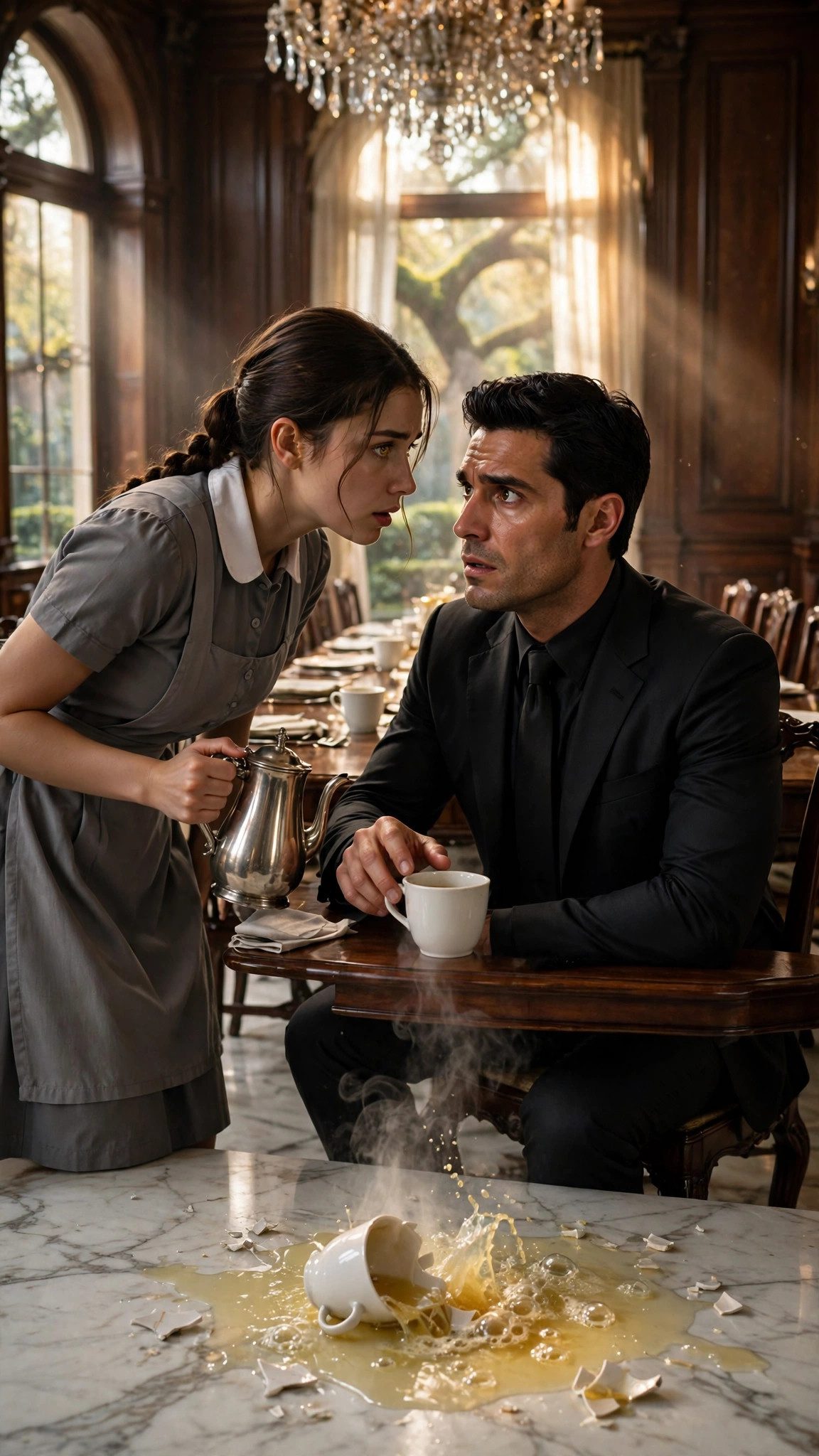
Castellano's house was on the other side of the Garden District, a white-columned mansion that looked like a wedding cake and smelled like money that had been laundered so many times it had forgotten where it came from. I arrived at seven o'clock sharp, alone, in my black suit, with my father's ledger in a leather folder under my arm and my mother's letter in my inside jacket pocket, over my heart.
Benny had wanted to come with me. I told him no. The invitation said come alone, and I wanted Castellano to believe I was alone, because a man who believes you are alone is a man who tells the truth.
I was not alone. Benny had six men in cars on the street outside, and a seventh man, a quiet young federal agent named Daniel Reyes, parked two blocks away with a warrant in his glove compartment and a radio in his hand, waiting for my signal. And Violet was in the back seat of Benny's car, in a gray uniform that was not hers, with a tray in her lap and a plan in her head that she had made herself and refused to explain to me in full, because, as she put it, "You have your way of walking into a room, Mr. Orsini, and I have mine."
A butler led me through a marble hallway into a dining room that was smaller than mine and twice as grand, all gold and candlelight, and Vincent Castellano rose from his chair at the head of the table and spread his arms wide, the way a grandfather greets a grandson he has not seen in years.
"Carmine!" he said. "My boy. Come in, come in. Sit. Eat. We have so much to discuss, and so little time left in this life for old men like me to make peace."
He was seventy-four years old, with white hair and a white mustache and hands that trembled slightly when he reached for his wine glass, and he looked like everybody's grandfather, and I reminded myself that this was the man who had ordered my father's murder, and my murder, and who had paid a maid to put acid in my coffee.
"Thank you for the invitation," I said, and I sat down, and I put the leather folder on the table beside my plate, where he could see it.
"Peace," Castellano said, raising his glass. "To peace between our families. To the end of old quarrels. To the future."
"To the future," I said, and I did not drink.
The first course came, a clear soup, and we talked about the weather, and the Saints, and Commissioner Del Rio's antidrug campaign, and Castellano asked after my health with the tender concern of a man who had tried to kill me that morning and wanted to know if it had worked.
"You look tired, my boy," he said. "Are you sleeping well?"
"Well enough," I said.
The second course came, fish in a butter sauce, and Castellano leaned forward, and his voice dropped, and the grandfather disappeared, and the man underneath showed through, the way the sun shows through a thin curtain.
"I will be honest with you, Carmine," he said. "Your father and I were friends once. Did you know that? Before the docks, before the trouble. We were young men together, and we shared a bottle of wine on a riverboat, and we promised each other that we would never let business come between us. And then business came between us, and I did things I am not proud of, and your father did things he was not proud of, and here we are, two old stories sitting at one table, and I am tired, Carmine. I am tired of the war. Let us end it tonight."
"How?" I said.
"With a handshake," he said. "With an agreement. The docks are yours. The Quarter is mine. We divide the city, and we stop killing each other's men, and we grow old in peace."
I looked at him for a long moment. Then I opened the leather folder, and I took out my father's ledger, and I laid it on the table between us, next to the fish in the butter sauce, and I watched his face.
His face did not change. That was the most frightening thing about him. His face did not change at all.
"Do you know what this is?" I said.
"A book," Castellano said. "I have many books."
"It is my father's ledger," I said. "In his own hand. Every payment you made to the men who betrayed us. Every name. Every date. Marcel Dubois. Aldo Boudreaux. The men on the river road. Fourteen years of it, written down in black ink."
Castellano put down his fork. He dabbed at his mouth with his napkin. He looked at the ledger the way a man looks at a snake that has appeared on his dinner table.
"Your father was a careful man," he said quietly. "I always admired that about him."
"And this," I said, and I took out my father's letter, and I laid it on top of the ledger. "This is a letter my father wrote the night he died. In his own hand. It says: 'If you are reading this, I am gone, and Vincent Castellano did it.'"
For a moment, nobody moved. The candles burned. The soup went cold. The waiter stood frozen in the doorway with the third course in his hands.
Then Castellano smiled. It was a small smile, and a tired one, and it was the smile of a man who has been caught and has decided to stop pretending.
"You found the box," he said. "I wondered if you ever would. Your mother was a clever woman, Carmine. Too clever. I spent fourteen years looking for that letter, and for the ledger, and for the key. I sent men into your house. I sent them to move your mother's letters, one at a time, out of your library, out of your walls, so that when you finally went looking, there would be nothing left. I sent Marcel to live behind your wine cellar. I sent Clara to learn your mornings. I sent them all, and they all failed, because of a maid in a gray uniform who was paying attention."
"Why?" I said. "Why my father? Why me?"
"Because your father would not give me the docks," Castellano said, and his voice was flat now, and old, and empty of the grandfather entirely. "I asked him, man to man, and he said no, and I asked him again, and he said no, and I understood that as long as Salvatore Orsini lived, I would never have the river. So I took the river. I gave Thomas Delacroix a choice, and he chose his baby, and your father drove himself to the meeting, and my men were waiting, and that was that. And then you grew up, Carmine, and you became your father, and you would not give me the docks either, and I understood that I would have to take them from you the same way. So I sent Clara. Two nights to make you slow. And this morning, the acid, to finish it."
"You killed my father for the docks," I said.
"I killed your father for the future," Castellano said. "And I would do it again."
He raised one hand, very slightly, and the doors of the dining room opened, and four men came in with pistols in their hands, and the waiter in the doorway put down the third course and picked up a gun of his own, and I recognized him then, tall, gray at the temples, a wedding ring on his right hand, a limp on his left leg.
Marcel Dubois. The chef. The delivery man. The man who had been sleeping behind my wall.
"Kill him," Castellano said, pleasantly, as if he were asking for more wine. "And bring me the ledger and the letter. Burn them in the fireplace. And then find the girl. The maid. She knows too much, and she has a letter of her own, and I want it."
The four men raised their pistols. And that was when the dessert tray came through the kitchen door.
Violet walked into the dining room carrying a silver tray with a covered dish on it, in a gray uniform, with her hair pulled back and her eyes down, the way a maid walks into a dining room, and nobody stopped her, because nobody in that room was looking at a maid. They were looking at me.
She set the tray down on the sideboard. She lifted the cover off the dish. Underneath it was not dessert. Underneath it was a small tape recorder, and it was running, and on it, in Clara's voice, clear as a bell, were the words: "Vincent Castellano ordered your father's death, Mr. Orsini, and he ordered yours."
Violet looked up then, and she looked at Castellano directly, the way she had looked at me on the morning of July 25th, and she said, in a voice that carried to every corner of the room, "And I have the original of Elena Orsini's letter, in my apron pocket, and a copy is already with a federal agent two blocks from here, along with a copy of the ledger, and a copy of Salvatore Orsini's letter, and Clara's full confession, which Mr. Romano recorded this afternoon."
Castellano's face changed then. It changed all at once, like a mask falling off, and underneath it was rage, pure and old and bottomless.
"You," he said, and he pointed at her with a shaking finger. "You are Thomas's daughter. You are the baby in the car. I told them to kill the baby too, and they didn't, and now here you are, standing in my dining room, ruining everything."
"No," Violet said. "My mother saved me. Your men chose not to kill a baby. And my aunt raised me to be the person standing between you and the people you want to destroy. That is what I am doing. Right now. In your dining room."
I stood up. I took my mother's letter out of my pocket, and I held it up, and I said, "My mother wrote that if I ever had to choose between revenge and mercy, I should remember that every choice in this story was made out of love, even the ones that hurt. So I am going to be better than you, Vincent. I am not going to kill you. I am going to let the law do it."
I pressed the small button in my pocket, the one Benny had given me that morning, and outside, two blocks away, Agent Daniel Reyes started his car, and Benny's men moved in from the street, and the front door of Castellano's mansion burst open, and the dining room filled with federal agents, and the four men with pistols put their guns down, and Marcel Dubois put his gun down, and Vincent Castellano sat in his chair at the head of his table, with his soup going cold in front of him, and he watched them come, and he did not run, because there was nowhere left to run.
As they put the handcuffs on him, he looked at me, and his voice was quiet, and his eyes were clear, and he said the last thing he would ever say to me as a free man.
"You think this is over," he said. "There is one more of mine in your house, Carmine. One more, and you will never find him."
On the ride home, Violet sat beside me in the back seat of Benny's car, and neither of us spoke for a long time, and the streets of the Garden District went past the windows, dark and quiet, with the oak trees making shadows on the road like lace.
"Are you all right?" I asked her finally.
"No," she said. "But I am better than I was this morning. I have been carrying my mother's letter and my aunt's instructions for three years, and tonight I finally did the thing I was raised to do. I stood in a room full of men with guns, and I told the truth, and nobody shot me, and that feels like a miracle."
"You were magnificent," I said.
"I was terrified," she said, and she laughed, a short, surprised laugh, like she had not expected to laugh tonight. "My hands were shaking so hard I thought I would drop the tray. I kept thinking about Maureen, and about my mother, and about your mother, and I kept thinking that all three of them were standing behind me in that dining room, and that I was not alone, even though I looked alone."
Benny's phone rang then, and he answered it, and he listened, and his face went grim in the dashboard light.
"Marcel is in custody," he said, turning around in his seat. "Clara is talking to Agent Reyes right now, and she is giving him everything. Names, dates, bank accounts. She says Castellano paid her father to drive a truck full of guns, and when your men stopped the truck, they shot him, and she has been waiting twelve years to make you pay for it. She says she is sorry she tried to kill you, and she is not sorry she tried, and both of those things are true at the same time."
"And the house?" I said.
"My men are searching it now," Benny said. "Top to bottom. Every room, every closet, every wall. If there is one more of Castellano's men in that house, we will find him tonight."
I looked at Violet beside me in the back seat, her hands folded in her lap, her face calm in the passing streetlight, and I knew, with a certainty I could not explain, that whatever Castellano meant, whatever man was still hiding in my house, we would find him together.
Because that was what she had been doing for three years. Standing guard. Paying attention. Waiting for the day I would finally notice her.
That day had come. And I was never going to stop noticing her again.