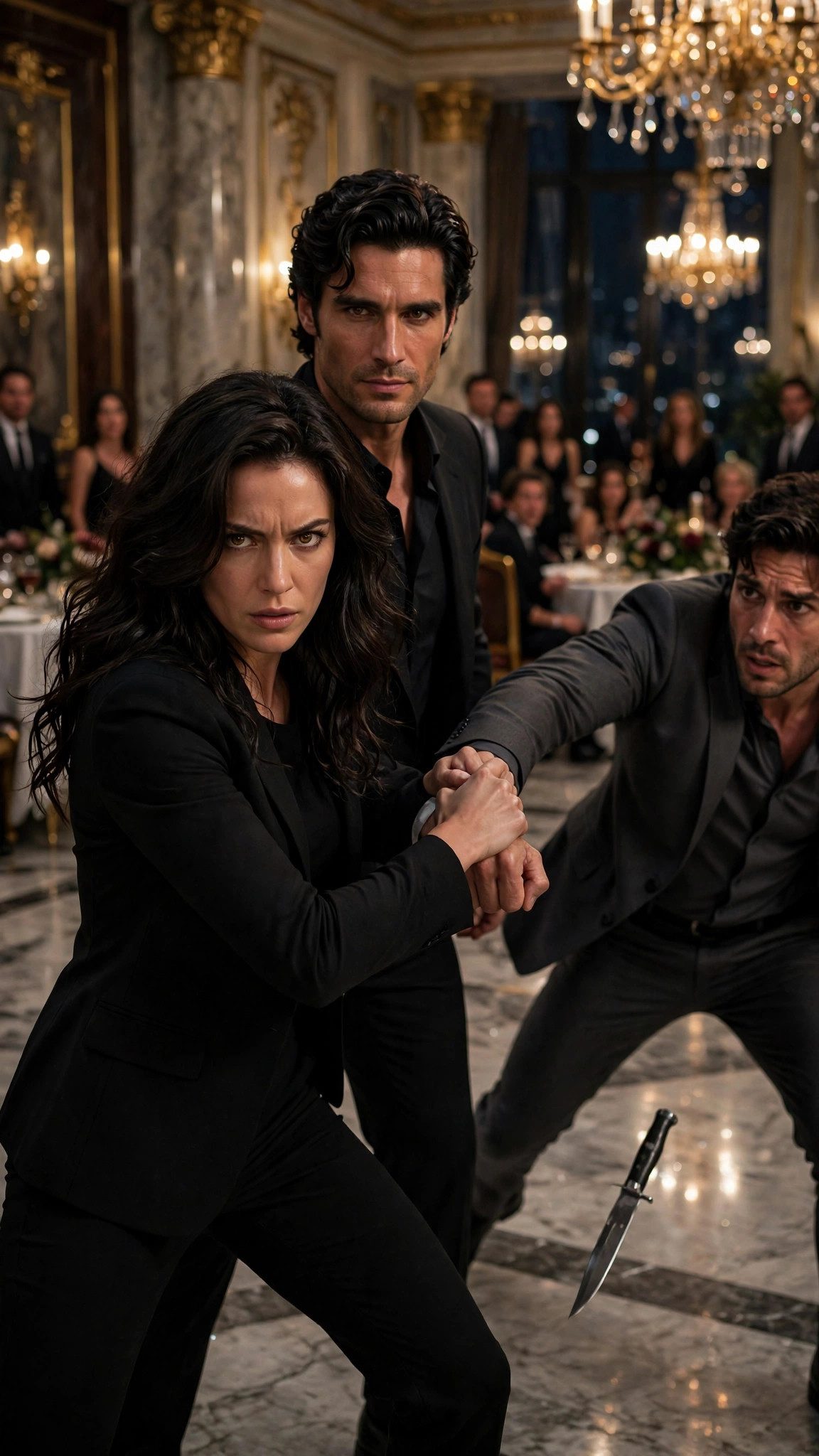
Marco's next move came three days later, and it came wearing the face of an order.
Leo was away that morning — a meeting with the city council about a charity the family funded, the kind of meeting where Leo wore his most expensive suit and smiled for cameras — and Marco found me in the security room, where I was reviewing the duty roster for the coming week.
"Leo has an assignment for you," Marco said.
I looked up. "Leo didn't mention an assignment."
"Leo doesn't mention everything," Marco said. "That's what I'm for. He trusts me to handle the details. You remember that, don't you?"
I waited. I did not say anything. Silence is a useful tool; it makes men fill the space with more than they meant to say.
"Vincent Castellano is meeting a buyer tonight," Marco said. "Alone. No guards. A warehouse on the river road, ten o'clock. Leo wants you to go in alone and take him down. His greatest adversary, finished in one night. That's what Leo wants."
I stared at him. "Leo wants me to walk into a warehouse alone and take down Vincent Castellano."
"Those are the orders," Marco said.
"Castellano never goes anywhere alone," I said. "He has twenty men around him at all times. Everyone in this city knows that."
"Tonight he will be alone," Marco said. "We have it on good authority. The buyer is a man from out of town. Castellano doesn't want his own people to know about the deal."
"Whose authority?" I asked.
Marco's eyes went flat. "Mine."
I stood up slowly, and I looked at him for a long moment, and I thought about the notebook in my pocket and the road I had laid out in it, and I understood, all at once, exactly what this was.
It was not a mission. It was an execution — mine.
If I went to that warehouse alone, I would walk into a room full of Castellano's men, and I would not walk out. And with me gone, Leo would have no one left who saw the pattern. No one left who had written Marco's name in a notebook. No one left standing between him and whatever was coming.
And if I refused, Marco would tell Leo that his new bodyguard had disobeyed a direct order, and Leo would have to choose between the woman he had hired three weeks ago and the man who had carried his father's coffin.
It was a good trap. I had to give him that. It was a very good trap.
"I'll need to see the details," I said. "The address. The layout. The entry points."
Marco slid a folded piece of paper across the desk. An address. A time. Nothing else. No layout. No entry points. No plan for getting out.
"I'll take it to Leo when he gets back," I said.
"Leo is busy," Marco said. "This comes from him. Don't waste his time."
He left, and I stood in the security room with the piece of paper in my hand, and I thought about Danny, and about the way he used to say that the only thing worse than being afraid was being afraid and doing nothing about it.
Then I did what I had been trained to do. I checked.
I drove to the river road that afternoon, alone, in my own car, and I found the warehouse — a long low building with a rusted roof and a chain-link fence and a single door facing the water. I parked two streets away and I walked the perimeter, the way I had walked a hundred perimeters in the Army, and I looked for the things that would tell me the truth: fresh tire tracks, cigarette butts, a camera, a lookout, a second car hidden behind the building.
I found all of them.
There were fresh tire tracks at the back gate, from at least three vehicles. There was a cigarette butt by the door, still warm. There was a man sitting in a parked car a block away, reading a newspaper he was not reading, watching the warehouse the way a man watches a door he has been told to watch. And on the roof of the building across the street, half-hidden behind a ventilation unit, there was the glint of a scope.
This was not a meeting. This was a killing ground. Whoever walked through that door at ten o'clock was going to die in it.
I went home, and I sat in my room, and I opened both notebooks, and I wrote down everything I had seen. And then I did something else. I went to find Enzo.
Enzo was in the garage, polishing the black car the way he always did when he was thinking about something he did not want to think about.
"I need your help," I said.
He looked up. "What kind of help?"
"The kind that stays between us," I said.
He put the cloth down. "Tell me."
I told him about the mission, and the warehouse, and the scope on the roof, and the man with the newspaper. I told him about the truck, and the camera, and the meeting, and the sedan, and the fire, and the convoy, and the matchbook. I told him everything, from the beginning, because Enzo was the one man in the house I was sure of, and because a soldier knows when she needs another soldier beside her.
When I finished, Enzo was quiet for a long time. Then he said, "My father worked for Vincent Costello. The old man. Leo's father. He drove for him for thirty years. When the old man died, Leo kept me on, and I have driven for him ever since. I have seen a lot of things in this family, Miss Quinn. But I have never seen a lieutenant order a bodyguard to walk into a trap."
"So what do I do?" I asked.
"You don't go," Enzo said. "You go to Leo. You tell him. And you bring proof."
"I don't have proof," I said. "I have a matchbook and a scope on a roof."
"Then we get proof," Enzo said. "Tonight. Before ten o'clock."
That was how I found myself, at nine o'clock that night, sitting in Enzo's car outside Marco's house in the suburbs, watching the windows of a quiet home where a wife was washing dishes and a daughter was doing her homework at the kitchen table, and wondering what kind of man could sit down to dinner with his family and then drive out into the night to sell his boss to the enemy.
At nine-twenty, Marco came out of the house, got into his car, and drove away. We followed him — not to the river road, but to a parking garage downtown, where he met a man in a dark grey suit. I did not recognize the man. Enzo did.
"That's Aldo," Enzo whispered. "Aldo Ferrante. Castellano's right hand. He does the jobs Castellano doesn't want his name on."
Marco and Aldo talked for ten minutes. Then Aldo handed Marco an envelope, and Marco put it in his jacket pocket, and they shook hands, and Marco drove away.
I took out my phone, and I took a photograph. It was dark, and the photograph was not good — two men, a parking garage, an envelope changing hands — but it was a photograph, and a photograph is a thing you can put on a table in front of a man and say, "Explain this."
We followed Marco to the river road. He parked a block from the warehouse, got out, and stood in the shadows, looking at his watch. At ten o'clock exactly, a black car pulled up to the warehouse door, and four men got out, and they went inside, and the door closed behind them.
Marco stood in the dark for another ten minutes. Then he got back in his car and drove away.
"He was waiting to see if you came," Enzo said quietly. "He was waiting to see if you walked through that door."
I sat in the passenger seat, and my hands were steady, and my heart was beating the way it always beat before a fight — slow and hard, like a drum — and I thought about the woman I had been three weeks ago, standing by the door of a nightclub, checking IDs, believing that the most dangerous part of my life was behind me.
"Take me home," I said. "I need to talk to Leo."
Leo was waiting in the study when we got back, and he looked up when I came in, and he saw my face, and he put down the papers he had been reading.
"Tell me," he said.
So I told him. I told him about the mission, and the warehouse, and the scope, and the man with the newspaper. I told him about the parking garage, and Aldo Ferrante, and the envelope. And then I put my phone on his desk, and I showed him the photograph.
Leo looked at the photograph for a long time. He did not speak. He did not move. He just looked at it, and the silence in the room grew heavier with every second that passed, until finally he said, very quietly, "What did Marco tell you?"
I thought about the question. About the mission. About the warehouse. About the trap.
"His real target was never your enemy," I said. "It was—"
I stopped. Because I understood, in that moment, that the sentence I was about to finish was the sentence that would change everything. Once I said it, there would be no going back. Leo would have to act. Marco would have to answer. And the family that had stood for forty years would split down the middle, in the open, where everyone could see it.
"It was you," I said. "His real target was always you."
Leo stood up, very slowly, and walked to the window, and stood there with his back to me, looking out at the garden in the dark.
"Tomorrow night," he said, "there is a gala in the grand hall. The whole family will be there. The captains, the council, everyone. Marco will be there too." He turned around, and his eyes were the eyes of a man who had just decided something terrible and necessary. "I want you beside me tomorrow night, Quinn. Not behind me. Beside me. Whatever happens, you stay beside me. Do you understand?"
"I understand," I said.
"Good," he said. "Because tomorrow night, Marco is going to make his move. And when he does, I want the whole family to see it."
I went back to my room, and I sat on the edge of the narrow bed, and I opened my notebook, and I wrote down everything that had happened that night, in the small neat handwriting the Army had drilled into me. Then I took out a second piece of paper — not the notebook, just a plain sheet — and I wrote a letter.
It was not a long letter. It was to Danny. It said that I had found a job that mattered, and a man worth protecting, and that if anything happened to me, I wanted him to know that I had finally stopped running from the day he died. I folded it and put it in the drawer of the small table beside my bed, next to my brother's photograph, and I told myself I was being dramatic, and I knew I was not.
The next morning, Enzo and I walked the grand hall together, the way soldiers walk a ground they are about to defend. We checked every door, every window, every blind corner. We moved two of Leo's most trusted men — men Enzo swore by, men who had been with the family since before Leo took the chair — into positions near the exits, dressed as guests. We told the kitchen staff to keep the back corridor clear. We told the valet to park no unfamiliar cars near the main entrance.
"Marco will notice," Enzo said.
"Let him notice," I said. "Let him wonder what we know."
At noon, Leo found me in the security room, and he closed the door behind him, and he stood there for a moment, looking at the camera feeds the way a man looks at a map of a country he is about to go to war in.
"My father used to say that the chair is not a throne," Leo said. "It's a weight. You sit in it, and it presses down on you, and every day you have to decide whether to carry it or let it crush you. He carried it for forty years. I've carried it for six. And tonight, for the first time, I'm afraid I'm going to have to choose between the chair and a man I loved like a brother."
"You don't have to choose," I said. "Marco already chose. Tonight, everyone will see it."
Leo looked at me then, and something in his face changed — the control slipped, just for a moment, and underneath it I saw the man he might have been if his father had been a baker or a teacher instead of the head of a crime family. A man who was tired. A man who wanted, more than anything, to believe that the people he loved were who he thought they were.
"Quinn," he said, "whatever happens tonight — if it goes wrong, if I fall — you run. You hear me? You don't die for me. You run, and you live, and you remember that you were the one person in this house who told me the truth."
"I don't run," I said.
"Quinn—"
"I don't run," I said again. "That's not what I do. I stand. That's what I was hired to do, and that's what I'm going to do. So don't ask me to run, Leo. Ask me to stand. And I will."
He looked at me for a long moment. Then he nodded, once, the way he had nodded on the first day, when he had made a decision he did not intend to revisit.
"Then stand," he said. "And I will stand beside you."
That evening, as the sun went down over the garden, I put on my black blazer, my black top, and my black trousers, and I checked my notebook one last time, and I put it in my pocket, and I walked down the stairs to the grand hall, where the chandeliers were already lit and the guests were already arriving, and the polished marble floor shone like still water under the golden light.
Marco was standing near the far wall, talking to two of the captains, laughing at something one of them had said, and he looked, to anyone who did not know better, like the most loyal man in the world.
I took my place beside Leo, at the head of the room, and I did not take my eyes off Marco for the rest of the night.
The trap was set. The only question left was who would walk into it first.