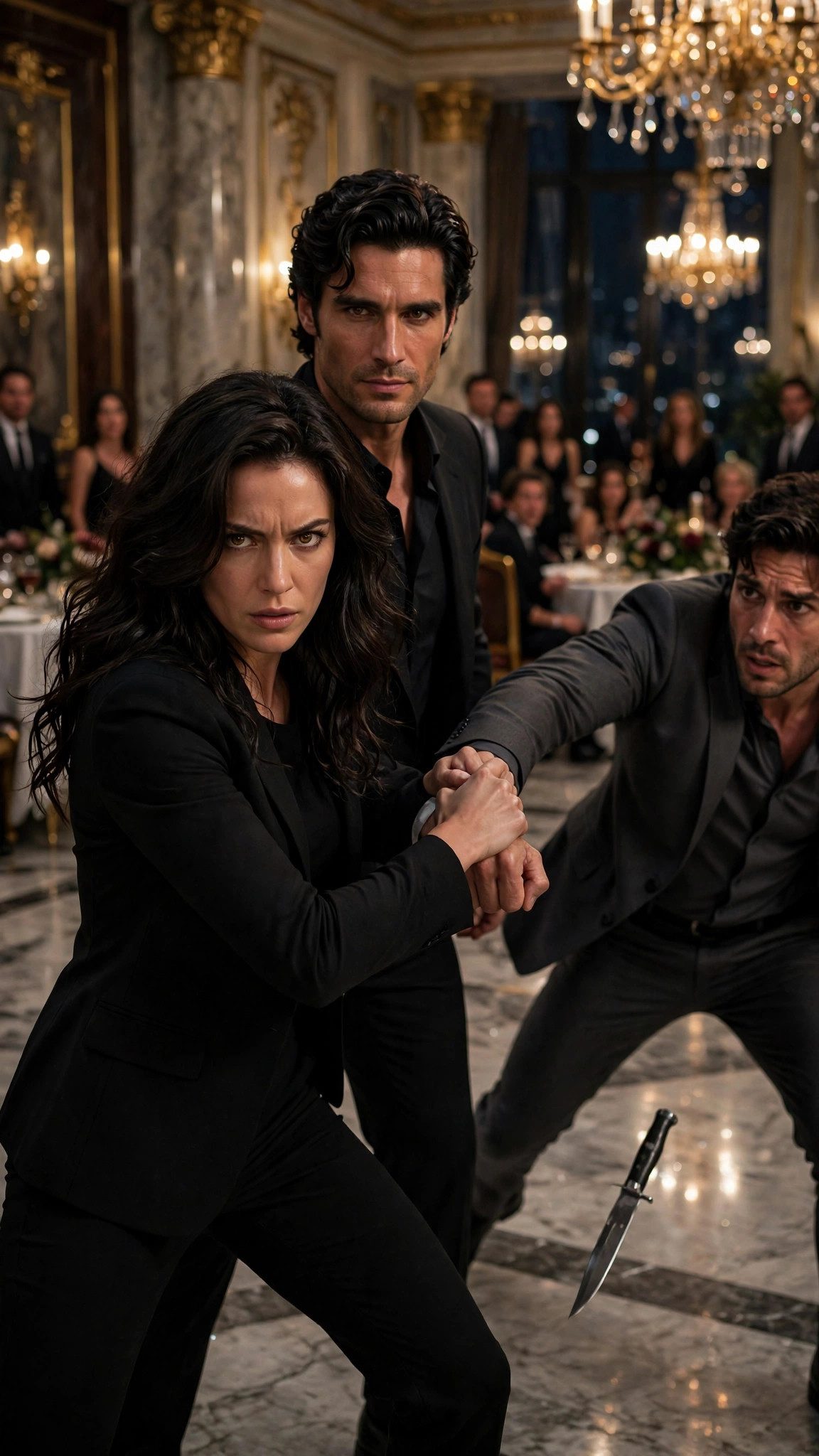
The grand hall was full by nine o'clock.
Elegant guests sat at distant tables, drinking wine and talking in low voices, and the golden chandeliers threw warm light across the polished marble floor, and a string quartet played in the corner, soft and forgettable, the way music is supposed to be at a party where nobody is really listening to it. Leo stood near the head of the room, greeting his captains one by one, shaking hands, smiling the practiced smile of a man who has done this a thousand times. I stood beside him, exactly where he had told me to stand, my hands loose at my sides, my eyes moving across the room the way I had been trained to move them: doors first, then windows, then hands, then eyes.
Marco was near the far wall, talking to Aldo Ferrante.
I saw Aldo the moment he came in. He was not a guest. He was not on the list. He was wearing a dark grey suit, and he had short dark hair, and he moved through the room like a man who knew exactly where he was going and did not want anyone to notice him going there. He stopped beside Marco, and they spoke for a few seconds, too quietly for me to hear, and then Aldo drifted toward the back of the room, near the corridor that led to the kitchen, and Marco drifted toward the bar.
I leaned toward Leo, very slightly, and said, very quietly, "Aldo Ferrante is here. Back of the room, near the kitchen corridor."
Leo did not turn his head. He did not change his expression. He just said, "I see him," and kept smiling at the captain in front of him, and I understood, in that moment, that Leo had known Aldo would be here, and that he had planned for it, and that the trap was not only mine. It was his too.
At nine-forty, the music stopped.
It stopped the way music stops when someone has cut the power to the speakers — all at once, in the middle of a note — and the whole room went quiet, and every head turned toward the quartet, and then toward the doors, and then a man I had never seen before came through the main entrance, walking fast, his hand inside his jacket, his eyes locked on Leo.
He was mid-thirties, short dark hair, dark grey suit. He did not look like a guest. He looked like a weapon that had been pointed at a target.
"Get down, Costello!" he shouted, and he pulled a knife from inside his jacket, and he lunged.
The room went silent at once, the way a room does when everyone realizes, in the same half second, that someone is about to die.
I was already moving.
I caught the attacker's wrist in mid-lunge and twisted it aside with one controlled motion, the way the Army had taught me a lifetime ago, and the knife clattered onto the polished marble floor and spun away under a table. The man stumbled backward one step, his arm bent at an angle that hurt to look at, and two of Leo's men closed in on him from either side.
"Wrong move," I said.
Leo stood directly behind me, exactly where I had told him to stay, his dark eyes fixed on the man on the floor. He did not look frightened. Leo Costello never looked frightened. He looked like a man doing arithmetic.
"Quinn, behind me!" he said.
"Stay exactly where you are," I told him, without turning around.
"Who sent him?" Leo asked.
The attacker spat blood onto the marble. He looked up at Leo, and then at me, and something like a laugh moved across his face.
"Ask your lieutenant," he said.
The whole room heard it. Every captain, every guest, every man who had ever sat at Leo's table heard it, and the silence that followed was so complete that I could hear the chandeliers humming overhead.
Leo looked at Marco.
Marco was standing near the bar, a glass of wine in his hand, and his face was perfectly calm, and he said, in a voice that carried across the silent room, "I don't know what this man is talking about."
But I was watching his eyes, and his eyes were moving — toward the kitchen corridor, toward Aldo, toward the back of the room — and I understood, a half second before it happened, what was about to happen.
Aldo Ferrante stepped out of the corridor with a gun in his hand.
He raised it, and he aimed it at Leo, and the whole room seemed to hold its breath, and I did not think. I did not plan. I did not calculate the distance or the angle or the odds. I just moved, the way I had moved in the club, the way I had moved in the Army, the way I had moved every time in my life when someone I was supposed to protect was about to die.
I stepped between Leo Costello and the gun.
I stood there, in my black blazer, in the middle of the grand hall, with a gun pointed at my chest, and I looked at Aldo Ferrante, and I said, very calmly, "Wrong move."
Aldo's hand shook. Just a little. Just enough for me to see it. He had not expected this. He had expected Leo to be alone, or to be running, or to be cowering behind his men. He had not expected a woman in a black blazer to step in front of a gun and look at him like he was the one in danger.
"Step aside," Aldo said.
"No," I said.
Behind me, I heard Leo say, very quietly, "Quinn. Get out of the way."
"No," I said again, without turning around. "Stay exactly where you are."
And then the room moved. Enzo came from the left, fast and low, and one of Leo's captains came from the right, and Aldo's gun wavered, and in the half second when his eyes flicked toward Enzo, I moved.
I caught his wrist — the same motion, the same twist, the same controlled violence I had used on the attacker — and the gun came out of his hand and skittered across the marble, and Aldo went down on one knee, his arm bent, his face white with pain.
"Hold him," I said, and Leo's men closed in, and Aldo was on the floor, and the gun was on the marble, and the grand hall was silent except for the sound of a hundred people breathing too fast.
Leo stepped out from behind me, slowly, and he looked at the two men on the floor — the attacker with the knife, and Aldo with the gun — and then he looked at Marco.
"Marco," Leo said, and his voice was very quiet, and very calm, and that was how I knew how angry he was. "Come here."
Marco did not move. He stood near the bar, the glass of wine still in his hand, and he looked at Leo, and then at me, and then at the two men on the floor, and I saw the calculation happening behind his eyes. He was weighing his chances. He was counting his friends in the room. He was deciding whether to run, or to lie, or to fight.
"Come here, Marco," Leo said again.
Marco set his glass down on the bar, very carefully, the way a man sets down something he does not intend to pick up again. And he walked across the grand hall, across the polished marble floor, past the staring guests and the silent captains, and he stopped in front of Leo, and he stood there, and he waited.
"Did you order this?" Leo asked.
"No," Marco said.
"Did you take money from Vincent Castellano?"
"No."
"Did you send Quinn to a warehouse on the river road to die?"
Marco's eyes flicked toward me, and for the first time since I had met him, I saw something in his face that was not control. It was fear.
"No," he said.
Leo took out his phone, and he held it up, and on the screen was the photograph I had taken in the parking garage: Marco, and Aldo Ferrante, and the envelope changing hands.
The whole room saw it. Every captain, every guest, every man who had ever trusted Marco saw it, and the silence in the grand hall grew deeper, and darker, and colder.
"Explain this," Leo said.
Marco looked at the photograph for a long time. Then he looked at me, and he said, very quietly, "You. It was you. You were following me."
"Yes," I said. "I was."
He turned back to Leo, and his shoulders dropped, just a little, the way a man's shoulders drop when he finally stops carrying something too heavy for him.
"Vincent Castellano promised me the chair," Marco said, and his voice was flat, and tired, and almost relieved. "He said the family needed a stronger hand. He said you were too soft, too slow, too willing to trust people who hadn't earned it. He said if I helped him, he would help me take what should have been mine twenty years ago."
"And the warehouse?" Leo asked. "And the convoy? And the fire?"
"All mine," Marco said. "All to make you look weak. All to make the family doubt you. And tonight — tonight was supposed to be the end of it. The attacker was supposed to get close enough to frighten you. Aldo was supposed to finish it. And Quinn —" He looked at me again. "Quinn was supposed to be dead already, in a warehouse on the river road. I didn't expect her to be standing here."
"You didn't expect a lot of things," I said.
Leo looked at Marco for a long time. Then he said, "Take him to the study. All of you, out. The party is over."
The guests left in silence. The captains left in silence. Enzo and two of Leo's men took Marco by the arms and walked him out of the grand hall, and Aldo and the attacker were taken away behind them, and the string quartet packed up their instruments without playing another note, and the chandeliers burned on over an empty room.
Leo and I stood alone in the grand hall, on the polished marble floor, in the golden light, and neither of us said anything for a long time.
Then Leo said, very quietly, "You stood between me and a gun."
"That's my job," I said.
"No," he said. "Your job was to see the danger before it happened. What you did tonight was something else. You stood between me and death, Quinn. No one has ever done that for me before. Not in my whole life."
I did not know what to say to that. So I said nothing. I just stood there beside him, in my black blazer, in the middle of the grand hall, and I thought about Danny, and about the day I buried him in the rain, and about the promise I had made to myself that day — that I would never again stand by and watch someone I loved die.
I had kept that promise. And for the first time since Danny died, it felt like enough.
It was only later, in the study, that my hands started to shake.
Adrenaline does that. It holds you together while you need it, and then it lets go all at once, and your body remembers everything it did not have time to feel. I sat in the chair across from Leo's desk, and I looked at my hands, and they were shaking, and there was a scrape across my knuckles where Aldo's gun had caught my skin, and a thin line of blood had dried along the edge of my palm.
Leo saw it. He opened a drawer, took out a clean cloth and a bottle of antiseptic, and he came around the desk, and he knelt beside my chair — Leo Costello, head of the Costello family, kneeling on the floor of his own study — and he cleaned the scrape on my hand the way a man cleans a wound he feels responsible for.
"You should have let me handle Aldo," he said quietly.
"You hired me to handle Aldo," I said.
He almost smiled at that. Then he stood up, and he went back behind his desk, and he looked at the door, and he said, "Bring him in."
Enzo brought Marco in, his hands bound in front of him, his suit torn at the shoulder, his face gray. He sat in the chair I had just left, and he looked at Leo, and he did not look away.
"Tell me all of it," Leo said. "From the beginning. Every name. Every payment. Every plan. And if you lie to me about one thing, I will know, and it will be the last thing you ever say to me."
Marco told him. It took an hour, and by the end of it, the whole story was laid out on the table between them like a map of a country neither of them had wanted to visit.
Castellano had approached Marco two years ago, at a funeral, of all places. He had offered him money — first a little, then more, then more than Marco had ever seen in his life. Fifty thousand dollars a month, paid through a shell company called Lakeshore Properties, the same company that owned the warehouse on the south side. In return, Marco fed Castellano the family's routes, the convoy schedules, the warehouse manifests, the names of the men who guarded the docks. Little things, at first. Then bigger things. Then, six months ago, Castellano had made the real offer: help him take the chair, and the chair would be Marco's. Leo would be gone — not killed in the open, because that would start a war, but frightened, weakened, pushed aside by a family that had lost faith in him. And if frightening him did not work, then the gala would finish it.
"The attacker was Castellano's man," Marco said. "His name is Rocco. He was supposed to get close enough to make Leo afraid. Aldo was supposed to be the one who finished it, from the corridor, while everyone was watching Rocco. And you —" He looked at me. "You were supposed to be dead three nights ago. The warehouse on the river road. Castellano had six men waiting. I didn't know you would check the place first. I didn't know you would see the scope on the roof."
"You're lucky I checked," I said. "You're lucky I didn't walk through that door. Because if I had, Leo would have no one left to warn him, and tonight would have ended very differently."
Marco looked down at his bound hands. "I know," he said. "I have known it since the moment you stepped in front of that gun."
Leo stood up, and he walked to the window, and he stood there for a long time, looking out at the garden in the dark. When he finally turned around, his face was the face of a man who had made a decision he did not want to make, and was going to make it anyway.
"Enzo," he said. "Take Marco to the house in the country. He stays there, under guard, until I decide what to do with him. No phone. No visitors. No one talks to him except me."
Enzo nodded, and he took Marco by the arm, and they went out, and the study was quiet again, and Leo and I were alone.
"You're wondering why I didn't kill him," Leo said.
"No," I said. "I'm wondering why you didn't kill him in the grand hall, in front of everyone."
"Because that's what Castellano wanted," Leo said. "He wanted a public execution. He wanted the family to see me kill my own right hand, so they would be afraid of me instead of loyal to me. Fear is cheaper than loyalty, Quinn. But it doesn't last. And I am not going to give him what he wants."
He sat down behind his desk, and he looked at me, and for the first time that night, he looked tired — not the tired of a man who has not slept, but the tired of a man who has carried a weight for a very long time and has just discovered how heavy it really is.
"Tomorrow," he said, "we go to war with Vincent Castellano. Not with guns. With paper. With proof. With everything Marco just told us. And you are going to help me end it — not by standing in front of a gun, but by standing beside me while I tear his empire apart, piece by piece, in the open, where everyone can see it."
"I'm not going anywhere," I said.
"I know," he said. "That's why you're still here."