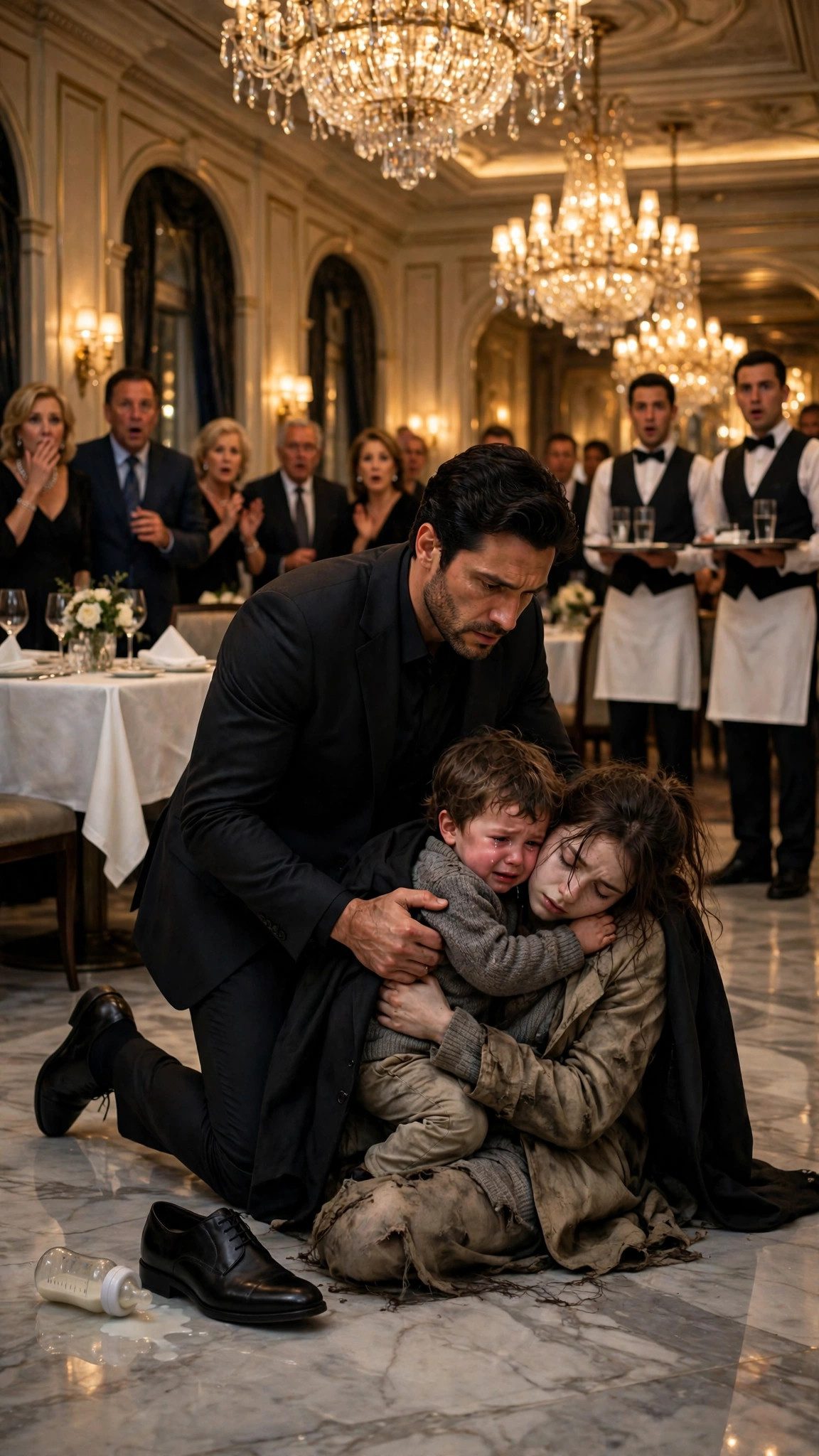
The glass baby bottle slipped from her hand and rolled across the polished marble floor of the Marlowe Room, and it came to rest against the tip of a man's brand-new Oxford shoe.
The man was Ethan Hayes, thirty-eight years old, head of the Hayes family, the most feared man in Chicago. He had stepped out of his black Lamborghini not ten minutes earlier, his armed bodyguards fanning out around him, scanning the room for any threat the way they always did. The waiters had frozen in place. The billionaires at the nearby tables had suddenly fallen silent, their forks hovering over plates that cost more than most people made in a month.
But the woman did not have time to be embarrassed. She collapsed onto the cold marble floor, her body weak and starved, her fingers still gripping the sleeve of her young son's shirt. The world spun around her. She could hear someone screaming, glass breaking, and then a strange, terrifying silence.
Within seconds, the little boy clung to his mother's chest, crying uncontrollably.
Ethan Hayes looked down at the mother and child, then turned toward the restaurant manager. In a voice so cold it sent shivers down everyone's spine, he said, "I did not buy this restaurant for fifty million dollars just so hungry people could collapse at my feet."
He raised a hand, signaling his bodyguards. The two bodyguards immediately shut down the entire dining room. The evening's billionaire guests were ordered to leave. And the entire restaurant fell completely silent.
Ethan Hayes knelt down beside the starving woman. He touched her hand. Her fingers were icy. Her face was pale. Her heartbeat was barely there. For the first time in years, Ethan Hayes felt something he had never allowed himself to feel: fear. Fear for a stranger.
Then he did something no one in Chicago had ever seen the infamous mafia boss do. He took off his jacket and placed it over the woman's cold body. He picked up her tiny son and held him in his arms. He said to the terrified boy, "Hey, kid. Your mom's not going anywhere. I didn't fall asleep when I heard your mother cry for help."
And then he looked up at the waiters and said, "You're going to feed her. You're going to feed her son. And you're going to tell me why my restaurant manager owes you money."
Three hours earlier, Maya Carter had woken up on a narrow cot in the basement of St. Brigid's Church on West Taylor Street, and her first thought was that the cold had gotten into her bones so deep it might never come out. Her second thought was Leo. He was curled against her side under the thin gray blanket, his small body warm against her ribs, his thumb in his mouth, his other hand clutching the glass baby bottle that had been his since he was born. He was three years old and far too small for three, and Maya knew exactly why, and the knowing was the worst part of every morning.
She had been a waitress at the Marlowe Room for four years. Four years of carrying trays across that same polished marble floor, of smiling at men who spent a thousand dollars on dinner and never once looked at her face, of folding napkins into swans and lilies until her fingers ached. She had been good at it. The regulars had asked for her section. The tips had been good, when the tips reached her.
They had stopped reaching her eight months ago. That was when Derek Voss, the restaurant manager, had started holding back the tip pool, telling the staff the credit card tips were "delayed in processing," telling them the cash tips had to be "counted and verified," telling them anything at all while the money disappeared into a pocket Maya could never see into. She had asked him about it once, in his office, quietly, politely, with the pay stubs in her hand. He had looked at her the way a man looks at a stain on a tablecloth and told her that if she didn't like the way the Marlowe Room ran its business, the door was right there.
She had needed the job too much to argue. Her husband, Daniel, had died two years earlier when a scaffold collapsed on a construction site on the South Side, and the settlement had been eaten alive by hospital bills and funeral costs and the months Maya couldn't work because her grief had hollowed her out from the inside. After Daniel, there was only Leo, and Leo's shoes, and Leo's milk, and the rent on the two-room apartment on Damen Avenue that went up every single year as if the landlord were daring her to leave.
So Maya had kept quiet and kept working, and the tips had kept disappearing, and then one Tuesday morning in October, she had gone to Voss's office again, because the rent was due and Leo needed new shoes and her wages for the last two weeks had come in short by four hundred dollars. This time she had not been polite. She had put the pay stubs on his desk and said the word "theft" out loud, and Voss had stood up from behind his desk and told her she was fired for insubordination, effective immediately, and that if she ever came back to the Marlowe Room he would have security throw her out onto the street.
She had walked out of the restaurant that day with nothing but her apron in her hands and one thousand eight hundred and forty dollars owed to her that she would never see, and in the eight weeks since, everything she had built had come apart like a seam pulled loose. The savings went first. Then the furniture, sold piece by piece. Then the apartment, when the landlord changed the locks on a Thursday morning while she and Leo were at the food pantry, and all their clothes and Leo's toys and Daniel's photograph were left behind a door she no longer had a key to.
St. Brigid's had taken them in. The basement had cots and a shared bathroom and a rule that everyone had to be out by eight in the morning. Sister Agnes, who ran the place, had given Maya a list of shelters and a list of jobs and a look that said she had seen this story a hundred times before and it never ended well. Maya had applied for every job on the list. Nobody hired a woman who had no address and a three-year-old child and a gap in her employment that she could not explain without saying the words "I was fired for asking where my tips went."
That morning, the morning of the collapse, Maya had woken on the cot and counted what she had left. Twelve dollars and forty cents. A bus pass with two rides on it. Half a loaf of bread. The bottle, which Leo still carried everywhere, though there was no milk to put in it. And one thing more, the thing she had been turning over in her mind for three days: the Marlowe Room had a new owner. Everyone in the neighborhood was talking about it. Ethan Hayes had bought the restaurant for fifty million dollars, cash, and the word on the street was that he was not the kind of man you stole from.
Maya did not know anything about Ethan Hayes except what everyone in Chicago knew: that he was the most feared man in the city, that his name made grown men lower their voices, that his family had run the docks and the trucking routes and the gambling rooms for thirty years. She did not care. Fear was a luxury for people who had something left to lose, and Maya Carter had nothing left to lose except the twelve dollars and forty cents and the boy asleep against her ribs.
So she had gotten up, washed her face in the basement sink, braided her dark brown hair the way she used to braid it before her shifts, and put on the one clean blouse she had left. She had woken Leo gently, given him the last of the bread, and told him they were going to see about the money the restaurant owed his mama. Leo had nodded solemnly, the way he always did when she spoke to him like a grown-up, and had slipped his small hand into hers, and together they had walked the two miles to Michigan Avenue, because she could not waste the bus rides, not when she might need them to get home.
On the walk, Leo had asked her the question he asked every morning now, in the small, careful voice he used when he already knew the answer would hurt. "Mama, are we going to eat today?"
"Yes, baby," Maya had said, because a mother does not tell a three-year-old child that she does not know. "We're going to eat today. I promise."
Leo had nodded and swung the empty bottle by its neck, and after a while he had said, "Daddy used to bring me milk. Daddy brought the milk in the big bag from the store."
Maya's throat had closed. Daniel had been gone for two years, and Leo still talked about him in the present tense, as if his father had only stepped out for a moment and might come back through any door at any time. She remembered the way Daniel used to come home from the construction site with his boots caked in dust, and the first thing he did, before he even took off his coat, was lift Leo out of his crib and hold him up to the kitchen window so he could see the streetlights come on. She remembered the night Leo was born, Daniel pacing the hallway of the hospital with his hard hat still in his hand because he had come straight from the site, and the way he had cried when the nurse put the baby in his arms, a big man with concrete dust on his shoulders crying like a child himself.
She remembered the phone call, too, the one that had come on a Tuesday afternoon while she was folding laundry, the foreman's voice flat and careful, telling her there had been an accident, telling her Daniel had been taken to County General, telling her to come quickly, and by the time she got there with Leo in her arms, Daniel was already gone, and a doctor with tired eyes had told her that the scaffold had given way and there was nothing anyone could have done, and Maya had stood in that hallway holding her son and understood, for the first time in her life, what it meant for the floor to drop out from under you.
After Daniel, the settlement had come, and the settlement had gone, and the hospital had sent bills for the ambulance and the emergency room and the three days Daniel had spent in intensive care before the end, bills that arrived in envelopes with windows in them, month after month, until Maya had stopped opening them and simply stacked them in a drawer. She had gone back to work at the Marlowe Room six weeks after the funeral because there was no other choice, and she had carried trays with a grief so heavy it felt like a second child in her arms, and the other waitresses had covered her tables when she had to step into the kitchen to cry, and the chef, old Benito, had saved her the staff meal every night and pretended it was an accident that there was always an extra plate.
Benito was gone now. Voss had fired him six months ago, the same week he had fired two busboys and a dishwasher, all of them people who had worked at the Marlowe Room for years, all of them replaced by younger kids Voss could pay less and cheat more easily. Maya had watched it happen and said nothing, because she had Leo, and Leo had no one but her, and a mother does not risk the only roof over her child's head for a principle. She had told herself that every night. She had believed it every night. And then Voss had fired her anyway, for asking where her own money had gone, and the roof had come down regardless.
Sister Agnes had pressed a boiled egg into her hand that morning before they left the church basement, and Maya had peeled it and given half to Leo and eaten the other half herself, and it had been the first real food she had tasted in two days, and she had nearly cried at the taste of it. Sister Agnes had also given her a piece of advice, in her dry, practical voice: "If the new owner is half the man they say he is, he'll listen. And if he's the other half, you'll walk out the same door you walked in. Either way, child, you'll still be standing at the end of the day, because that's what mothers do."
Maya had not believed her. She had believed, as she walked those two miles with Leo's hand in hers, that she was walking into the Marlowe Room to be humiliated one final time, to be thrown out by security in front of the same rich people she used to serve, and that afterward she would take Leo back to the church basement and figure out what came next. She had not believed that the most feared man in Chicago would be standing in that dining room when she fell, or that he would kneel down on the marble floor in his brand-new Oxford shoes and put his jacket over a starving stranger, or that he would pick up her son and hold him like something precious.
She had not believed any of it. But as her legs gave out beneath her and the room tilted and the bottle rolled away across the floor, the last clear thought in her mind was Sister Agnes's voice, saying, "You'll still be standing at the end of the day, because that's what mothers do." And Maya had thought, as the darkness closed in, that she was not standing at all, and that she had failed, and that Leo would be alone in a room full of strangers who had never once gone hungry.
The Marlowe Room looked the same as it always had. White tablecloths. Crystal chandeliers. A doorman in a black coat who looked at Maya's worn coat and Leo's scuffed shoes and stepped forward with his hand already raised to turn them away. Maya had lifted her chin and told him she was there to see Mr. Voss about wages owed, and the doorman had hesitated, and in that hesitation she had slipped past him and through the doors and into the dining room, where the marble floor gleamed under the lights and the smell of roast lamb and fresh bread hit her like a physical blow, because she had not eaten a real meal in three days.
She had made it six steps inside before her legs gave out. She had felt the floor tilt under her, felt Leo's hand tighten on her sleeve, felt the bottle slip from her fingers and roll away across the marble. She had heard someone scream, and then glass breaking somewhere, and then the silence, and then she had felt the cold floor against her cheek and thought, with a strange and terrible clarity, that this was how it ended: not with a fight, not with a shout, but with her body simply giving up in the middle of a room full of people who had never once gone hungry.
And then a shadow had fallen over her, and a man's hand had touched hers, and a voice she did not know had said her name was not important, that what mattered was that she was still breathing, and then everything had gone dark, and the last thing she heard before the dark took her was a small voice crying, "Mama, Mama, Mama," and a deep voice answering, steady as stone, "Your mom's not going anywhere."