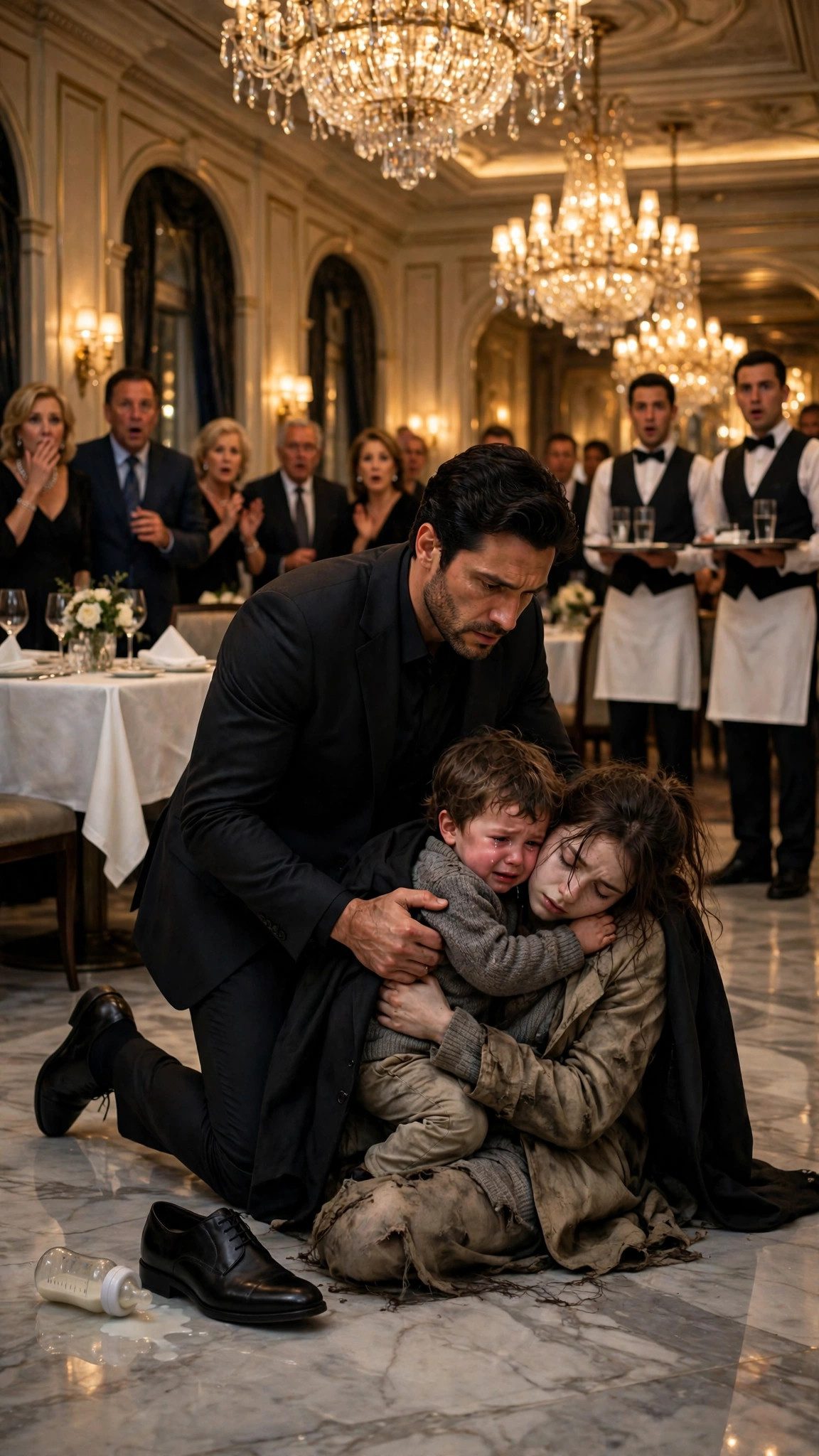
Maya Carter had been twenty-two years old when she first walked into the Marlowe Room, and she had been wearing the only good dress she owned, a navy blue thing she had bought on sale at a department store on State Street, and she had been so nervous that she had rehearsed her answers to the interview questions all the way there on the bus.
She had not grown up dreaming of carrying trays. She had grown up in a two-bedroom apartment above a laundromat in Pilsen, the daughter of a bus driver and a school cafeteria cook, and she had gone to community college for two years before the money ran out, and she had worked in a diner and a coffee shop and a dry cleaner's before a friend told her the Marlowe Room was hiring waitresses and the tips were the best in the city. She had applied because the rent was due and her mother needed a new prescription and the diner paid nine dollars an hour and the Marlowe Room paid fourteen plus tips, and that difference, that five dollars and the tips on top of it, was the difference between getting by and drowning.
The man who interviewed her was old Mr. Marlowe himself, the founder, a white-haired gentleman in his seventies who had built the restaurant from a single room with six tables into the most expensive dining room in Chicago. He had asked her three questions. Could she carry a tray with one hand? Could she smile when she was tired? Could she remember that a guest who spends a thousand dollars on dinner is still just a person who is hungry? She had answered yes to all three, and he had hired her on the spot, and for the first two years, working at the Marlowe Room had felt like being let into a secret world.
She learned the work the way you learn a dance. The weight of the tray on her palm. The order of the courses. The names of the regulars and what they drank and which tables they liked and which ones they avoided. She learned that Mr. Abernathy at table twelve always wanted his steak rare and his wife's salad without dressing, and that the old judge at table four tipped in cash and always left a twenty for the busboy, and that the young couples who came for anniversaries wanted to be left alone, and the businessmen who came to impress each other wanted to be watched. She learned to fold napkins into swans and lilies and roses, and she learned to open a bottle of wine without spilling a drop, and she learned that the most important thing a waitress could do was to be invisible at the right moment and present at the exact moment she was needed.
And then she met Daniel Carter. He came into the restaurant one rainy Thursday night with a crew of construction workers, all of them dusty and loud and laughing, celebrating the end of a job, and Daniel was the quiet one at the end of the table, the one who ordered a beer and nursed it all night and watched her work with an expression she could not read. When she brought the check, he had left her a tip of twenty dollars on a sixty-dollar bill, and written on the back of the receipt, in careful block letters, "You have the prettiest smile in Chicago. Can I buy you a coffee sometime? — Daniel."
She had laughed at that, because construction workers did not usually write notes on receipts, and because his handwriting was so neat it looked like a schoolboy's. She had said yes, because he had kind eyes and because he had tipped twenty dollars on sixty, which told her everything she needed to know about the kind of man he was. They had coffee the next Sunday. They were married eleven months later in St. Brigid's Church, with her mother crying in the front row and Daniel's crew filling three pews in their best shirts, and Mr. Marlowe had sent a cake from the restaurant kitchen as a wedding gift, a white cake with sugar roses on it, and Maya had cried when she saw it, because it meant the old man had noticed her, and that she mattered.
Leo was born two years later, on a snowy night in February, and Daniel had paced the hospital hallway with his hard hat still in his hand, and when the nurse put the baby in his arms he had cried, and Maya had never loved him more than in that moment. They were not rich. They were never rich. But they had the two-room apartment on Damen Avenue, and Daniel's steady work, and Maya's tips, and on Sundays they went to her mother's house for dinner, and life was small and ordinary and entirely theirs, and Maya had thought it would go on that way forever.
It did not. The scaffold collapsed on a Tuesday in March, and Daniel was gone, and the world went gray for a long time after that. Maya went back to work six weeks later because there was no other choice, and old Benito the chef saved her a plate every night, and the other waitresses covered her tables when she had to step into the kitchen to cry, and Mr. Marlowe himself came down from his office one evening and put his hand on her shoulder and told her the restaurant would always have a place for her, and Maya believed him, because Mr. Marlowe was a man whose word had built an empire.
Through all of it, there was her mother. Elena Carter was sixty-one years old, a school cafeteria cook with hands roughened by thirty years of hot water and steam, and she was the only family Maya had left in the world. Every Sunday, Maya and Leo went to her mother's small apartment above the laundromat in Pilsen, and Elena cooked a pot of beans and rice, the way she always had, and Leo sat on the floor with his toy cars, and for a few hours, the world felt almost normal again.
Elena watched Leo on the days Maya worked doubles, and she never once complained, and she never once asked for money, though Maya knew her mother's pension barely covered her own rent. When Maya came home exhausted, her feet aching from ten hours on the marble floor, Elena would put a plate in front of her and say, "Eat, mija. A woman who doesn't eat can't take care of anybody." And Maya would eat, and her mother would watch her, and neither of them would say the thing they were both thinking: that Maya was running on empty, and that something had to change.
It was Elena who first warned her about Derek Voss. She had come to the restaurant one afternoon to drop off a container of soup for Maya, and she had stood in the kitchen doorway for five minutes, watching Voss walk through the dining room, and when she left, she had said to Maya, very quietly, "That man counts money the way a cat watches a bird, mija. Be careful around him." Maya had laughed it off at the time. Her mother was old-fashioned, she thought. Her mother saw thieves everywhere. But Elena had been right, the way mothers so often are, and by the time Maya understood it, it was already too late.
Elena also watched Leo in the weeks after Maya was fired, when there was no money for daycare and no money for anything else. She took Leo to the park. She read him stories. She taught him to count to ten in Spanish, the way she had taught Maya when Maya was small. And when the landlord changed the locks on the apartment on Damen Avenue, it was Elena who called Sister Agnes at St. Brigid's and begged her to find a cot for her daughter and her grandson, and it was Elena who gave Maya her own savings, forty-seven dollars folded into an envelope, every cent she had, and said, "Take it. Take it and don't argue with me. I have lived a long life, mija. You still have yours ahead of you."
Maya had taken the envelope, and she had cried, and Elena had held her, and for the first time since Daniel died, Maya had felt like a child again, small and safe in her mother's arms. But she had also known, with a certainty that sat in her chest like a stone, that she could not keep taking from her mother. Elena had given her everything she had. It was time for Maya to find a way to stand on her own feet again, even if she had to walk two miles to Michigan Avenue to do it.
Mr. Marlowe died eight months later, quietly, in his sleep, at the age of seventy-nine. His children sold the restaurant to a holding company within the year, and the holding company hired a new manager, and the new manager's name was Derek Voss.
Voss was fifty-two years old, tall and thin, with gray hair combed back from a high forehead and a smile that never reached his eyes. He had managed restaurants in New York and Las Vegas, and he spoke about "efficiency" and "margin" and "streamlining" the way other men spoke about weather, and within a month of his arrival, things at the Marlowe Room began to change. The staff meal got smaller. The overtime disappeared. The tip pool, which had always been counted openly at the end of every shift, with two waitresses watching and the totals written on a whiteboard in the kitchen, was suddenly counted behind the closed door of Voss's office, and the totals were announced, not shown, and the numbers began to shrink.
Maya noticed it first in the way she always noticed things: in her hands. The tips she took home on Friday nights got lighter. A hundred and eighty dollars became a hundred and forty. A hundred and forty became a hundred and ten. Then ninety. She asked the other waitresses, quietly, in the locker room, and they all said the same thing: their tips were shrinking too. Rosa, who had worked at the Marlowe Room for eleven years, said she had kept a notebook, and according to her notebook, the restaurant was taking in the same amount of money it always had, but the staff was taking home almost a third less. Somebody was keeping the difference, and the only person who touched the tip pool between the dining room and the waitresses' hands was Derek Voss.
Maya went to his office on a Monday morning, before her shift, with her pay stubs in a folder and Rosa's notebook numbers written on a piece of paper, and she laid them on his desk and asked him, politely, if there had been a mistake. Voss looked at the papers for a long time without touching them, and then he looked at Maya, and his smile was the same smile he always wore, the one that never reached his eyes, and he said, "Maya, Maya. You are a good waitress. But you are not an accountant. The tip pool is complicated. There are processing fees. There are adjustments. You wouldn't understand."
"I understand that my tips are a third of what they were six months ago," Maya said. "And I understand that the restaurant is just as busy as it ever was."
"Then you understand nothing," Voss said, and his voice went cold. "Let me explain something to you. This restaurant does not owe you anything beyond your hourly wage. The tips are a privilege, not a right. And if you don't like the way I run my dining room, the door is right there."
Maya had stood in that office with her hands shaking and her folder of pay stubs, and she had thought about Leo, and about the rent, and about the fact that she had nowhere else to go, and she had picked up her folder and walked out without another word. She had told herself she would go back. She had told herself she would write a letter, or call the labor board, or talk to the other waitresses and go to Voss together. But the weeks went by, and the tips kept shrinking, and the rent kept coming, and Leo kept growing out of his shoes, and every time she thought about confronting Voss again, she remembered the look in his eyes when he said "the door is right there," and she stayed silent.
Until the Tuesday in October when her wages came in short by four hundred dollars. Four hundred dollars, on top of the missing tips, on top of everything else. She had stood in the kitchen that morning with the pay stub in her hand, and Rosa had looked at it over her shoulder and said, very quietly, "That's rent money, Maya. That's your boy's shoes." And something in Maya had finally broken loose, the way a dam breaks after a long rain, and she had walked into Voss's office and put the pay stub on his desk and said the word she had been holding back for eight months.
"Theft," she said. "This is theft, Mr. Voss, and I want my money."
Voss had stood up slowly from behind his desk, and his face had gone the color of old paper, and he had said, "You are fired, Mrs. Carter. For insubordination. Effective immediately. Your final check will be mailed to you. And if you ever come back to this restaurant, I will have security throw you out onto the street."
She had walked out of the Marlowe Room that day with her apron folded in her hands and one thousand eight hundred and forty dollars owed to her, and she had not cried until she was three blocks away, standing on a corner with the traffic going past, holding her apron like it was the only thing she had left in the world. Because in a way, it was.