The next morning, the city woke up to the news.
Vincent Castellano had been arrested at his home at dawn by federal agents, charged with arson, kidnapping, extortion, and conspiracy. His lieutenant, Dominic Voss, was still missing, but the FBI had his photograph on every screen in the city, and Agent Daniel Reyes told the cameras that it was only a matter of time.
I watched it all from my hospital bed, with Sofia asleep in the chair beside me and Priya on the phone in the hallway, telling everyone in our kitchen that we were alive.
At noon, Agent Reyes came to see me himself. He was a tall man in his forties with tired eyes and a notebook full of questions, and he sat beside my bed and asked me to tell him everything, from the beginning. I told him about the glass, and the claim, and Voss on the sidewalk, and the poisoned cake, and the brown bottle, and the fire. He wrote it all down, and when I finished, he closed his notebook and looked at me for a long moment.
"Miss Williams," he said, "I have been building a case against Vincent Castellano for two years. I have had informants, wiretaps, bank records, all of it. But I never had the one thing I needed most, which was a witness who was willing to talk, and a paper trail that led straight to him. You gave me both. Anthony Russo's payment records, the ledger we found in the warehouse, the phone records from Voss's men, all of it connects. Castellano is going to prison for a very long time, and it is because of you."
"I didn't do anything," I said. "I made a cake."
"That is what everyone says," Reyes said, with a small smile. "But the cake is what started all of this, and the cake is what will finish it. The jury is going to love you, Miss Williams. A pastry chef who ran into a burning building to save her grandmother's recipes, and a sister who refused to be bought. Castellano never stood a chance against that."
After he left, Marcus Hale came to see me. He looked older than he had a week ago, and his hands shook when he held his hat.
"Camila," he said, "I came to tell you that the Imperial is closed until the kitchen is rebuilt. It will take at least two months. I have paid the staff for the full two months, out of my own pocket, because they did not ask for any of this. And I have come to tell you something else. Mr. Moretti bought my debt, as you know. He has forgiven half of it, and he has given me five years to pay the rest, at a rate I can actually afford. The Imperial is safe. It is mine again. And when it reopens, I want you back in your kitchen, if you will have me."
He paused, and his voice grew rough.
"And I want to say that I am sorry. I gambled away the restaurant you gave four years of your life to, and I put you and your sister in danger, and I will never forgive myself for that. You deserved better from me, Camila. You deserved a boss who protected you, not one who needed a mafia boss to do it for him."
I took his hand, because he was crying now, and because he was a tired, foolish man, but he was not a cruel one.
"Mr. Hale," I said, "you built the Imperial from nothing, the same way my grandmother built her bakery. Men who build things make mistakes. What matters is what they do after. And you came here to apologize, and you paid my staff, and you are going to rebuild. That is enough for me."
He nodded, and he left, and I sat in my hospital bed thinking about how strange life was, that a week ago my biggest worry had been a collapsing soufflé, and now I was the reason a mafia boss was going to prison.
That afternoon, Lorenzo came to see me, and he brought something with him. A folder, thick and heavy, with papers inside it. He set it on the bed beside me and opened it, and I saw that it was a ledger, old and handwritten, full of names and numbers and dates.
"This is Castellano's ledger," he said. "My men found it in the warehouse, in a safe behind a false wall. It is everything. Every payment, every threat, every restaurant he took, every person he bought. It is the reason Agent Reyes was able to arrest him this morning. And there is something in it I think you should see."
He turned the pages until he found the one he wanted, and he pointed to a line near the bottom. It was a payment, dated two years ago, for eight thousand dollars a month, to a name I recognized.
Anthony Russo.
And below it, another line, dated three weeks ago, for five hundred dollars, to a boy named Danny.
And below that, a line that made my blood run cold. A payment of fifty thousand dollars, dated the day before the fire, to two men whose names I did not know, with a note beside it in Castellano's own handwriting: "Burn the kitchen. Take the girl."
"That is what the ledger said," Lorenzo said quietly. "It said that Castellano was never going to stop. Not after the offer. Not after the fire. He was going to take Sofia, and then he was going to take you, and he was going to burn down everything you loved until you had nothing left but him. That is who he is. That is what I have been protecting you from."
I looked at the ledger, at the neat handwriting and the cold numbers, and I felt the last piece of the puzzle click into place. It had never been about my cake. It had never been about Marcus Hale's debt, or the restaurant, or any of it. It had been about ownership. Castellano wanted to own me the way he owned everything else in his life, and Lorenzo had stood in his way.
"Thank you," I said. "For showing me this. For telling me the truth."
"I promised you the truth," he said. "In the café, I promised you an explanation and an apology, and I have given you both. But there is one more thing I owe you, Camila, and it is the most important one."
He stood up then, and he reached into his jacket, and he took out a small piece of paper, folded in half. He handed it to me, and I opened it, and I saw that it was a document, written in his own handwriting, and signed at the bottom.
It said, in simple words, that the claim he had made in the private dining room was ended. That I belonged to no one but myself. That he released me, freely and completely, and that no man in his family would ever speak of the claim again.
"I made the claim to protect you," he said. "It did its job. You are safe now. Castellano is in prison. Voss is running. The restaurant is safe. Your sister is safe. You do not need my protection anymore, and you do not need my claim. So I am ending it. You are free, Camila Williams. Free to bake, free to live, free to love whoever you want, whenever you want. And I will not come near you again unless you ask me to."
He put the paper in my hand, and he turned to leave, and for one terrible moment, I thought about letting him walk out of that hospital room and out of my life forever.
And then I thought about Rosa, and her last words to me. A woman who can feed people will never be helpless. And I thought about Enzo, and the cake, and the smile I had seen on Lorenzo's face that first night, and the way he had carried me out of a burning building, and the way he had sat with Sofia until she fell asleep.
"Wait," I said.
He stopped, and he turned back, and he looked at me with those dark eyes, and I saw in them something I had never seen before. Not danger. Not possession. Hope.
"Stay," I said. "Just for a little while. Sit with me. Tell me about Enzo. Tell me about your mother, and the kitchen in Palermo, and the cake. I want to know who you are, Lorenzo Moretti, not the stories people tell about you. I want to know the real you."
He sat down beside my bed, slowly, like a man who had been given something he did not expect and did not want to break, and he began to talk. He told me about Palermo, and about his mother, and about Enzo stealing cake with his fingers. He told me about the night Enzo died, and about the seven years since, and about how he had forgotten what it felt like to be a person instead of a boss.
And I listened, and Sofia slept in the chair beside me, and the city outside the window went on with its life, and for the first time since that night in the dining room, I did not feel afraid.
I felt like I was finally seeing the man behind the claim. And I liked what I saw.
The next morning, the doctors discharged me. My lungs were clear, my throat was sore but healing, and I was free to go home. Lorenzo drove me himself, which surprised me, because men like him usually had drivers, but he told me he wanted to drive, and I did not argue.
On the way home, he took a detour, and we stopped outside the Imperial. The building was still standing, but the back of it was blackened, and the windows of the kitchen were boarded up. I stood on the sidewalk and looked at it, and I felt my throat tighten, not from the smoke, but from grief.
"Come inside," Lorenzo said gently. "I want to show you something."
We went in through the front, past the dining room, which was untouched, the white linen still on the tables, the crystal still shining. And then we went into the kitchen, and it was worse than I had imagined. The ovens were black. The shelves were gone. The floor was covered in ash and broken glass.
But my locker was still standing, and my station, where I had worked every morning for four years, was still there, blackened but standing.
"I am going to rebuild it," I said, and my voice was steady. "All of it. Better than before. New ovens, new shelves, a bigger pastry station. And I am going to put Rosa's photograph on the wall, right where everyone can see it, because she is the reason I am here."
Lorenzo looked at me, and he smiled, a real smile, the kind that reached his eyes.
"Then I will pay for it," he said. "All of it. Not as a claim. Not as a debt. As a gift. Because a kitchen that makes a cake like yours deserves to exist, and because I want to walk into this restaurant in two months and taste that cake again."
I wanted to argue. I wanted to tell him I did not need his money. But I thought about Rosa, and about the bakery on 18th Street that had died because no one had helped, and I thought about the fact that accepting help was not the same as being owned.
"All right," I said. "But on one condition. You let me bake for you first. Not in this kitchen. In yours. I want to make the cake in your home, in your kitchen, for your men, and I want you to taste it there, where you live, not where you work. Because I think that is the only way you will ever believe that I am choosing this, and that no one is making me."
He looked at me for a long moment, and then he nodded.
"Tomorrow night," he said. "My house. Bring your notebook."
That night, I went home to my apartment, and Sofia was already there, safe and asleep in her own bed, and I stood in my kitchen and looked at Rosa's photograph on the wall, and I thought about everything that had happened in the last week.
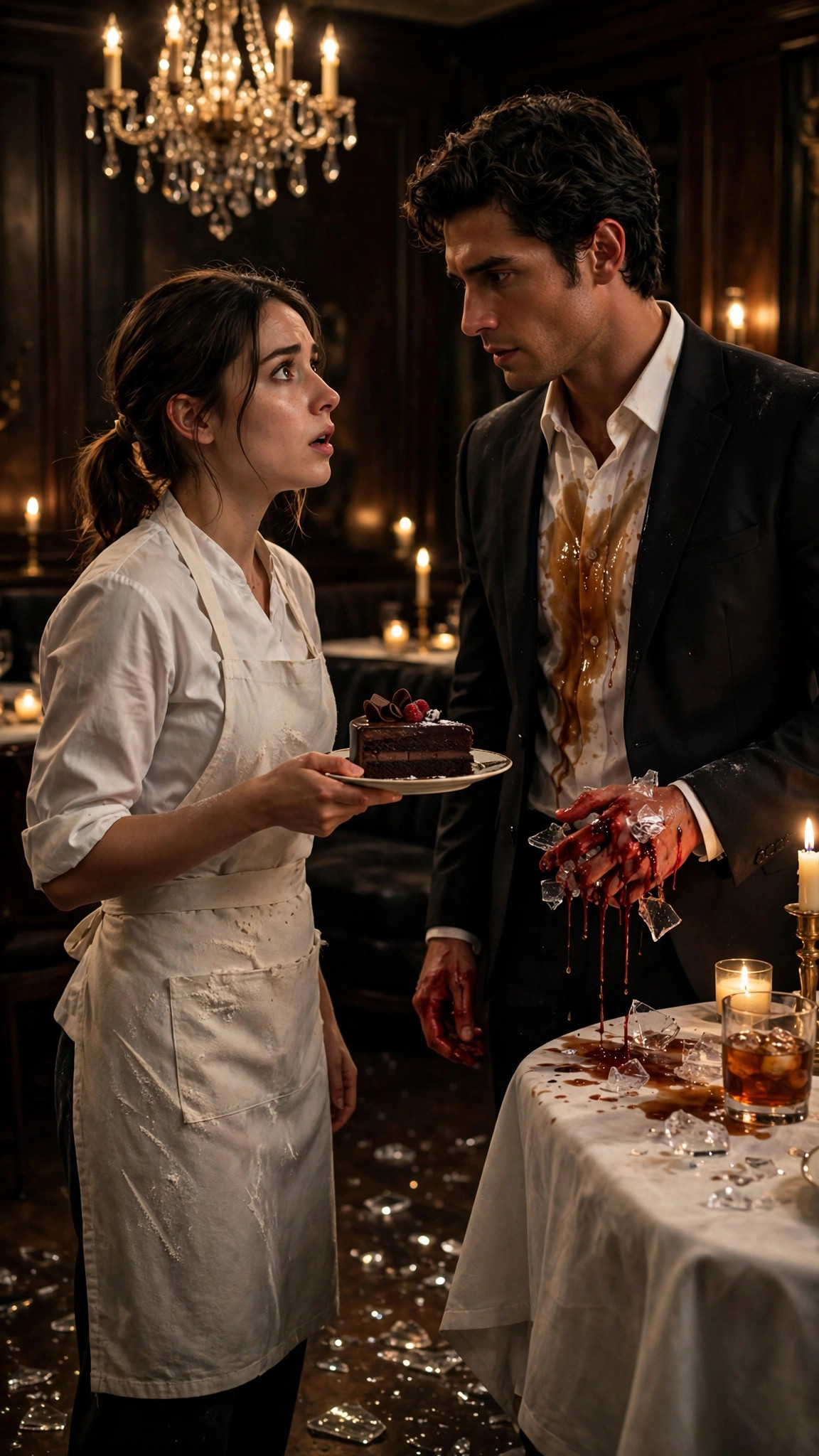
I thought about the glass exploding in Lorenzo's hand. I thought about the blood and the bourbon. I thought about the fire, and the warehouse, and the ledger, and the paper he had given me that ended the claim.
And I thought about tomorrow night, when I would walk into his house with my grandmother's notebook under my arm, and I would bake a cake for a man who had once claimed me, and I would do it because I wanted to, not because I had to.
For the first time in seven days, I was not afraid. I was curious. And curiosity, I was beginning to learn, was a much better feeling than fear.
Before I went to bed, my phone rang. It was Agent Reyes.
"Miss Williams," he said, "I thought you would want to know. We caught Dominic Voss tonight, trying to leave the city on a bus to Milwaukee. He is in custody, and he is talking. He has already told us about the fire, and the warehouse, and the payments. Castellano's case is closed. It is over."
"Thank you, Agent Reyes," I said.
"No, Miss Williams," he said. "Thank you. You did what two years of federal investigation could not do. You made Castellano angry enough to make a mistake. And that mistake is going to put him away for the rest of his life."
After he hung up, I stood at my kitchen window and looked out at the city, at the lights and the streets, and I thought about how a week ago, I had been a pastry chef with a small life and a smaller apartment, and now I was the reason a mafia boss was in prison, and another mafia boss was rebuilding my kitchen, and tomorrow night I was going to bake a cake in his house.
I did not know what would happen next. But for the first time, I was not afraid to find out.