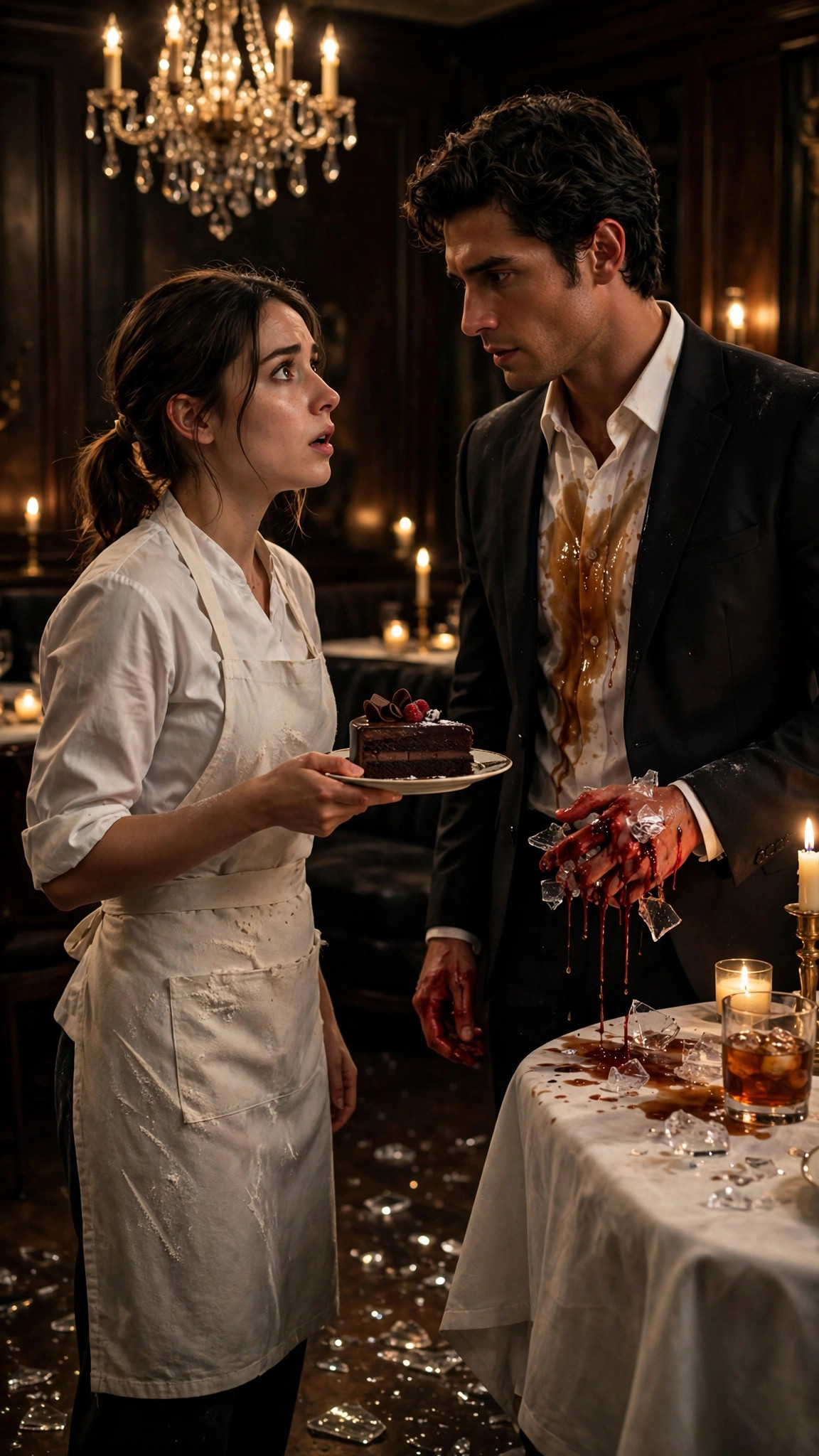
The next night, I walked into Lorenzo Moretti's house with my grandmother's notebook under my arm, and I understood, for the first time, who he really was.
The house was not what I had expected. It was not a fortress. It was not dark and cold. It was a warm, old house on a quiet street, with a garden in the back and photographs on the walls, and in the kitchen, there was a stove that had been used every day for thirty years, and a table where a family had once eaten together.
"This was my mother's kitchen," Lorenzo said quietly, standing in the doorway. "She cooked here every Sunday. Enzo and I used to sit at that table and steal cake with our fingers. After she died, I kept the house, but I stopped cooking in this kitchen. I told myself it was because I was too busy. The truth was that it hurt too much to be in here."
He looked around the room, at the old stove and the worn table and the photographs, and his voice grew rough.
"I have not baked anything in this kitchen in seven years," he said. "But tonight, you are going to. And I am going to sit at that table and watch you, the way I used to watch my mother, and I am going to remember what it felt like to be part of a family."
I opened Rosa's notebook on the counter, and I started to work. I measured the chocolate, and the butter, and the eggs, and the sugar. I brewed the espresso, strong and bitter. I mixed the batter by hand, the way Rosa had taught me, listening to it, feeling it, knowing when it was right. I poured it into the pans and put them in the oven, and the kitchen filled with the smell of dark chocolate, and Lorenzo sat at the table and watched me, and neither of us spoke, because we did not need to.
When the cakes came out of the oven, I let them cool, and then I made the ganache, and I brushed the layers with bourbon syrup, and I put the cakes together, layer by layer, and I finished them with a pinch of flaky sea salt on top, the way I always did.
And then I cut two slices, and I put them on plates, and I sat down across from Lorenzo at his mother's table, and I watched him take the first bite.
He closed his eyes. He was quiet for a long time. And when he opened them again, they were shining.
"It tastes the same," he said quietly. "After seven years, it tastes exactly the same."
"It is not the same cake," I said. "It is my cake. My grandmother's recipe, my hands, my kitchen. But I am glad it reminds you of home, Lorenzo, because that is what a cake is supposed to do. It is supposed to taste like the people you love."
He reached across the table then, slowly, and he took my hand, and his hand was warm, and the scar across his palm was smooth under my fingers.
"Camila," he said, "I have something to ask you, and I want you to know that this is not a claim. I ended the claim. You are free. You will always be free. This is a question, and you can say no, and if you say no, I will accept it, and I will still rebuild your kitchen, and I will still make sure you and Sofia are safe, and nothing between us will change. Do you understand?"
"I understand," I said, and my heart was beating so hard I thought he could hear it.
"Then here is my question," he said. "Will you let me court you? Properly. Slowly. Dinners, and walks, and conversations. No claims, no orders, no men outside your door unless you ask for them. Just a man who tasted your cake and remembered what it was like to feel alive, asking a woman if she will give him the chance to earn what he once tried to take."
I looked at him for a long time, at his dark eyes and his scarred hand and the kitchen around us, at the photographs of his mother and his brother on the wall, and I thought about everything that had happened, from the glass exploding in his hand to the fire to the hospital room, and I thought about Rosa's words, and about the life I had built out of flour and early mornings, and about how small that life had been until a man walked into my restaurant and smiled at my cake.
"Yes," I said. "Yes, Lorenzo. I will let you court me. Properly. Slowly. And we will see where it goes."
He smiled then, a real smile, the kind that reached his eyes and stayed there, and he lifted my hand to his lips and kissed the back of it, very gently, like a man touching something precious.
"Thank you," he said. "Thank you, Camila."
That was the beginning. Not of a claim, but of a courtship.
Over the next two months, while the Imperial was rebuilt, Lorenzo courted me the way he had promised. He took me to dinner, and he walked with me along the river, and he came to my apartment on Sundays and helped Sofia with her homework, and he sat in my kitchen and watched me bake, and he asked me questions about Rosa, and about my mother, and about my life, and he listened to the answers like they mattered, because to him, they did.
He told me about Enzo, more and more, until the grief in his voice softened into something like peace. He told me about his mother, and about Palermo, and about the house he had grown up in. He told me about the business, honestly, about the parts he was proud of and the parts he was trying to change, and about his plan to make the Moretti family legitimate, to leave the old world behind, the way he had left the claim behind.
One Sunday afternoon, he asked me to teach him to bake the cake. He stood in my kitchen in his shirtsleeves, with flour on his hands and chocolate on his cheek, and he measured everything wrong, and he burned the first batch, and the second batch came out lopsided, and he looked at it with the same serious face he used in business meetings, and he said, "This is harder than negotiating with the Castellanos."
"It is," I said, laughing. "The cake does not negotiate. It either rises or it doesn't."
On the third try, it came out right, and he cut himself a slice, and he tasted it, and he closed his eyes, and he said, very quietly, "I understand now. I understand why you love this. It is not about the cake. It is about making something good with your own hands, and giving it to someone, and watching their face change. That is what my mother used to do. That is what Enzo used to steal. That is what you do, every single morning, for strangers. And I think that is the bravest thing I have ever seen."
He put his arms around me then, there in my kitchen, with flour on both of us and the smell of chocolate in the air, and he held me, and I held him back, and I thought about how strange it was that the most dangerous man in Chicago was also the gentlest man I had ever known, and that I had found that out because of a cake.
And I told him about Rosa, and about the bakery on 18th Street, and about Sofia, and about the cake, and about the life I wanted to build. I told him I wanted my own bakery one day, a small one, with Rosa's name on the sign, and he said, "Then you will have it," and I believed him, because he was a man who kept his promises.
Two months later, the Imperial reopened. The kitchen was new, bigger and brighter than before, with new ovens and new shelves and a pastry station built exactly the way I had drawn it. Rosa's photograph hung on the wall where everyone could see it, and on the menu, under the desserts, there was a new line, written in elegant script: "The Midnight Chocolate Cake. Our head pastry chef's signature. Ask about the story behind it."
On opening night, the dining room was full, and Lorenzo was there, sitting at the head of the private dining room table, and he ordered the cake, and he ate two slices, and he smiled, and everyone in the room saw it, and no one was afraid anymore.
After dinner, he came into my kitchen, the way he had come into it a hundred times by then, and he waited until the staff had gone home, and then he took my hand, and he got down on one knee, right there on the kitchen floor, in front of the ovens and the flour and Rosa's photograph on the wall.
"Camila Williams," he said, and his voice was steady, but his hands were shaking, just a little. "I once stood up in a dining room and told you that you belonged to me. I was wrong. You never belonged to me. You belonged to yourself, and to your sister, and to your grandmother's memory. But tonight, I am asking you, not telling you, not claiming you, asking you, if you will belong with me. Not to me. With me. As my wife, as my partner, as the woman who taught me how to smile again. Will you marry me?"
I looked down at him, at this tall, dark, dangerous man kneeling on my kitchen floor with flour on his shoes, and I thought about the first night, and the glass, and the blood, and the bourbon, and how far we had come from that room.
"Yes," I said. "Yes, Lorenzo. I will marry you."
He stood up, and he took my face in his hands, and he kissed me, there in my kitchen, with the ovens still warm and the smell of chocolate in the air, and it was the first time he had ever kissed me, and it felt like coming home.
We were married three months later, in the garden behind his mother's house, with Sofia as my maid of honor and Marco as his best man, and Priya crying in the front row, and Marcus Hale raising a glass to us, and the whole city, it seemed, talking about the mafia boss who had married a pastry chef.
The wedding was small, the way I wanted it. White flowers, a string quartet, a cake I had made myself, three layers of dark chocolate with espresso ganache, the same cake that had started everything. Lorenzo cried when he saw me walk down the aisle, and he did not try to hide it, and Marco, who had known him for thirty years, told me afterward that he had never seen Lorenzo cry before, not even the night Enzo died.
"Do you know what he said to me this morning?" Marco told me at the reception, his voice rough with emotion. "He said, 'Marco, I spent seven years being a ghost, and this woman brought me back to life with a cake.' And I told him, 'Then you had better spend the rest of your life making sure she never regrets it.' And he said, 'I will. Every day. For the rest of my life.'"
Sofia graduated from culinary school the following spring, and she came to work with me at the Imperial, and then, a year later, Lorenzo kept his promise, and we opened a small bakery on 18th Street, in the same building where Rosa's bakery had been, with a sign painted by hand that read "Rosa's," and Sofia ran it, and I taught there on Sundays, and the line went out the door every morning.
On the first anniversary of the night we met, Lorenzo took me back to the Imperial, to the same private dining room, and he ordered the same dinner, and the same cake, and when I came out of the kitchen in my white blouse, the way I had that first night, he stood up from the table, in front of all his men, and he said, very clearly, so that everyone in the room could hear him, "A year ago, I stood in this room and told this woman she belonged to me. I was wrong. She belonged to no one. But she chose me, and I have spent every day since trying to deserve that choice. Camila Moretti, will you dance with me?"
And there, in the private dining room of the Imperial, with the crystal glasses shining and the white linen glowing in the soft light, Lorenzo Moretti took me in his arms and danced with me, slowly, while his men watched and smiled, and I thought about how far we had come from the night a glass had exploded in his hand.
And every morning, before dawn, I still went to the Imperial, and I still made the Midnight Chocolate Cake, with the espresso and the sea salt and the bourbon syrup, the way Rosa had taught me, and Lorenzo still came to the restaurant sometimes, and he still ordered two slices, and he still smiled when he tasted it.
People in Chicago still tell the story of the night Lorenzo Moretti claimed a pastry chef in front of a room full of his men. They tell it as a story about power, and danger, and a man who took what he wanted.
But that is not the real story. The real story is about a cake, and a grandmother's notebook, and a man who had not smiled in seven years, and a woman who answered a question honestly.
He asked me if I had a boyfriend. I said, "Not yet."
And he said, "Then you will be mine."
But in the end, I was never his. I was mine. And I chose him. And that made all the difference.
The End.
THE END