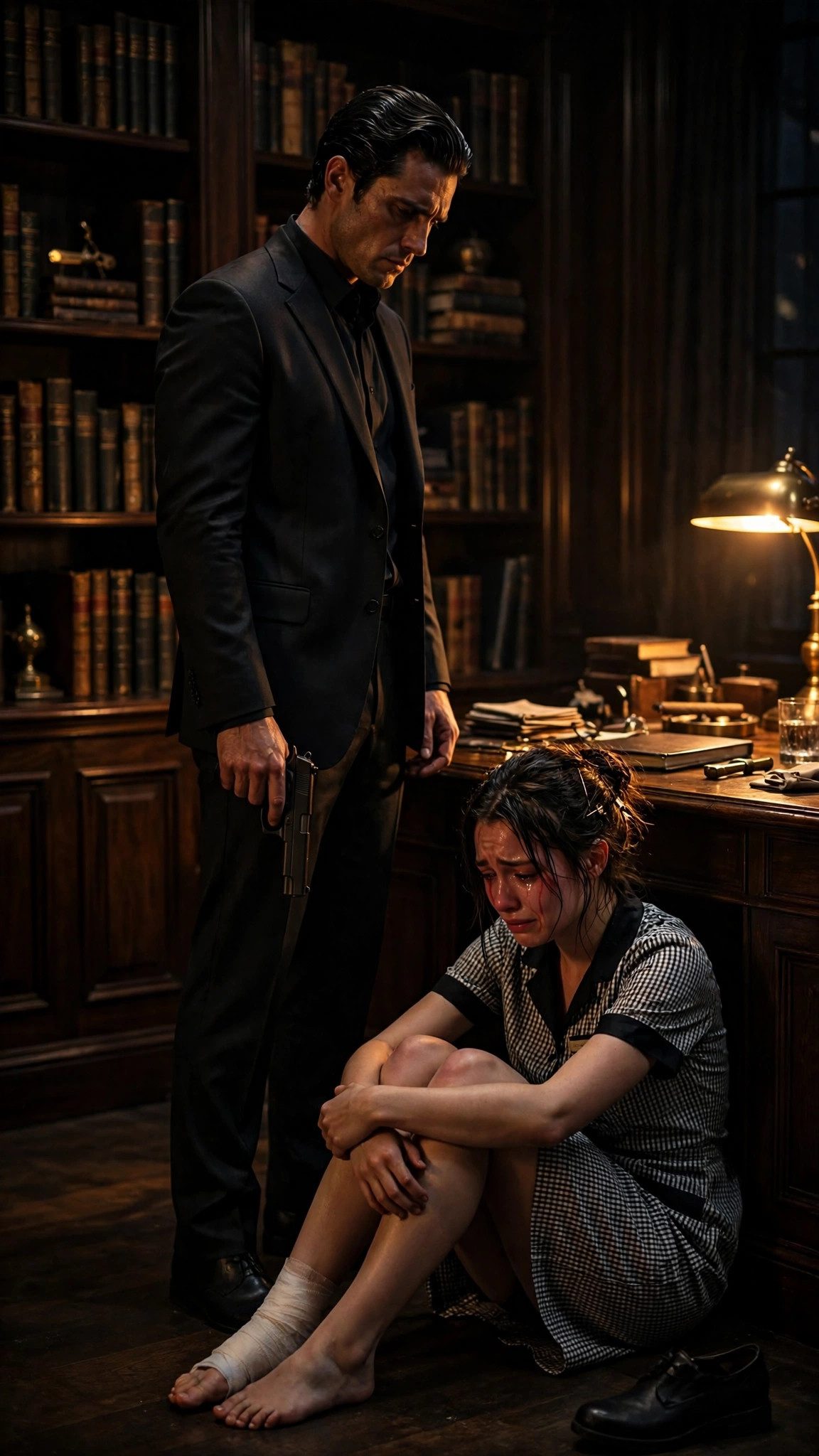
The library was the quietest room in the house. It smelled of old paper and leather and the faint tobacco that had soaked into the walls over forty years. Gabriel had spent half his childhood in this room, hiding behind the tall shelves while his father held meetings at the big table. He knew every inch of it. He knew which floorboard creaked. He knew which shelf hid the narrow staircase to the second floor. He knew that the room had only one door, and that the man sitting in the chair by the fireplace had nowhere to run.
Higgins sat with his hands folded in his lap, shaking. Thomas stood by the door, massive and silent, his arms crossed. The family doctor, a thin man named Dr. Patel with tired eyes and steady hands, stood beside the table, holding a small glass vial up to the light.
"It is a poison," Dr. Patel said quietly. "A slow one. Tasteless in water. It would have taken six to eight hours to work. By morning, Mr. Hayes would have been too weak to stand. By tomorrow night, his heart would have stopped. It is a professional's poison. Expensive. Difficult to trace."
Gabriel nodded. He did not look at the doctor. He looked at Higgins.
"Tell me everything," Gabriel said. "From the beginning. And do not leave anything out."
Higgins talked for twenty minutes. He talked the way drowning men talk, in a rush, gasping, trying to get it all out before the water closed over his head. Sullivan had approached him six weeks ago, at a bar on the South Side, after Higgins's shift. Sullivan had known about the gambling debts. Higgins owed forty thousand dollars to a bookmaker who worked for Sullivan's people. Sullivan had offered him a choice. The debt would disappear. In exchange, Higgins would do one small thing. One small thing, and nobody would get hurt.
The small thing was the glass. On Gabriel's birthday, at midnight, Higgins was to carry a glass of water to the fireplace and hand it to Gabriel Hayes. The water had been prepared in advance. A man Higgins had never seen before had given him a small vial in the alley behind the catering company's warehouse and told him to pour it into the glass an hour before the toast. The man had said it would only make Gabriel sick for a few days. Just sick enough that Sullivan could take the docks while Gabriel was weak. Nobody would die. The man had sworn it.
"Did you believe him?" Gabriel asked.
Higgins looked up at him. His eyes were red. "I wanted to believe him, Mr. Hayes. I have a daughter. She's twelve. The bookmaker said he would go to her school. I didn't know what else to do."
Gabriel said nothing for a long time. He walked to the window and looked out at the dark garden. Somewhere across the city, in a hospital called St. Jude's, a nineteen-year-old girl named Sophie Dawson was lying in a bed with an infection in her body and a bill that her sister could not pay. Somewhere in this house, a twelve-year-old girl's father was sitting in a chair, shaking, because a man named Sullivan had used his daughter the way a man uses a key.
Sullivan had used everyone's family. That was his weapon. He found the person you loved most, and he put a price on them, and he waited to see what you would do.
Gabriel had spent twelve years in the chair, and he had seen this trick a hundred times. He had never once felt sorry for the man who fell for it. A man who sells out his boss for his family is still a man who sold out his boss. That was the rule. That was the world.
But tonight, Gabriel Hayes was tired of the rule. Tonight, a girl had cried on the floor of his study, and he had knelt down and bandaged her heel, and something in his chest had cracked open like ice on a river in spring.
"How much did Sullivan pay you?" Gabriel asked.
"Twenty thousand dollars," Higgins whispered. "In cash. In an envelope. He said there would be twenty thousand more after. After it was done."
"And the man in the alley? The one with the vial?"
"I never saw his face. He wore a cap. He had a scar on his left hand. That is all I remember."
Gabriel nodded. He turned to Thomas.
"Take him to the small room downstairs," Gabriel said. "Keep him there. No phone. No visitors. He stays until I say otherwise. And Thomas, call the bookmaker. The one Higgins owes. Tell him the debt is paid. Tell him that if he ever goes near Higgins's daughter again, I will come to his house myself, and I will not bring a glass of water."
Thomas nodded. He took Higgins by the arm, gently, almost kindly, and led him out of the library.
Gabriel stood alone. He picked up the vial Dr. Patel had left on the table. He held it up to the light. Clear liquid. Tasteless. Invisible. A professional's poison.
His phone buzzed. A text from Thomas.
"At the hospital. Bill paid. Thirty thousand. Private room. Sophie is stable. Fever down. Clare is with her."
Gabriel closed his eyes. He let out a breath he had not realized he was holding. Thirty thousand dollars. A private room. A fever coming down. A nineteen-year-old girl who was going to live, because her sister had cried in the wrong room on the wrong night, in the house of the coldest man in the room.
He texted back. "Stay with them until I call. No one in or out without my word."
Then he went back to the ballroom.
The party was winding down. The band had packed up. The guests were leaving in ones and twos, shaking hands, calling cars, pretending they had not seen anything. Sullivan was still there, standing by the fireplace with his two men, a fresh glass of Scotch in his hand, smiling like a man who had just won a game.
Gabriel walked straight toward him. He did not hurry. He did not raise his voice. He stopped three feet away, close enough that Sullivan could see his eyes, far enough that Sullivan's men would have to take a step to reach him.
"Happy birthday, Gabriel," Sullivan said. "I was sorry to miss the toast."
"There was no toast," Gabriel said. "Higgins is in my library. He told me everything. The vial. The twenty thousand dollars. The man in the alley with the scar on his left hand. He told me about your plan to make me sick for a few days, so you could take the docks while I was weak."
Sullivan's smile did not move. "Higgins is a frightened man, Gabriel. Frightened men say anything. You know that."
"I know that poisoned water does not lie," Gabriel said. "And I know that my doctor tested the glass. And I know that the tray your man prepared never reached me, because a girl I had never met cried in my study, and I went upstairs to find out why."
Sullivan's eyes narrowed. "A girl?"
"A catering waitress," Gabriel said. "Twenty-four years old. She works three jobs. Her sister is dying in a hospital. She walked into my study by mistake, and she cried, and I listened to her. And because I listened to her, I was not standing by the fireplace at midnight. And because I was not standing by the fireplace, your poison is sitting in a vial on my library table, and Higgins is sitting in my small room downstairs, and you are standing here, smiling, pretending you do not know what I am talking about."
Sullivan set his glass down on the mantelpiece. Very carefully. The way a man sets down a glass when he is about to do something he cannot take back.
"You always were sentimental, Gabriel," Sullivan said. "Your father warned me about that. He said you had a soft spot. He said it would get you killed one day."
"My father is dead," Gabriel said. "You will not use him against me. You will not use anyone against me. Not anymore."
He turned and walked away, leaving Sullivan standing by the fireplace, his smile finally gone.
Behind him, Thomas appeared at his shoulder, silent as always.
"The sit-down," Gabriel said. "Tomorrow night. Eight o'clock. The warehouse on Pier Nine. Every capo in the city. I want Sullivan there. I want his men there. I want everyone to hear what Higgins has to say."
Thomas nodded. "And the girl?"
Gabriel paused. He thought about Clare Dawson, sitting in a hospital room across the city, holding her sister's hand, her heel bandaged, her phone finally silent.
"She stays under my protection," Gabriel said. "Her sister stays under my protection. Anyone who touches either of them answers to me. Do you understand?"
Thomas nodded. "Understood."
Gabriel walked up the grand staircase, past the portraits, past the dark wood paneling, and into his study. He sat down in the leather chair behind his desk, the same chair his father had sat in, the same chair he had sat in on the night his father died. He looked at the place on the floor where Clare had sat and cried, and he looked at the small red smear on the wood where her bleeding heel had rested.
He had spent eighteen years being the coldest man in the room. He had spent eighteen years keeping a promise he had made at his sister's funeral. Never be helpless again. Never need anyone's mercy. Never care about someone you cannot protect.
Tonight, he had broken that promise. And for the first time in eighteen years, he did not feel cold at all.
Across the city, in a private room on the fourth floor of St. Jude's Hospital, Clare Dawson sat in a chair beside her sister's bed and held Sophie's hand, and watched her breathe.
The room was quiet. The machines hummed softly. A nurse came in every hour, checked the monitors, wrote numbers on a chart, and left. The fever had come down. Sophie's skin was no longer burning to the touch. Her breathing was slow and even, the breathing of a girl who was finally, after three weeks of fighting, winning.
Clare had not slept. She had not eaten. She had not left the chair since Thomas brought her here, except once, to wash her face in the small bathroom, where she had looked at herself in the mirror and barely recognized the woman staring back. Her hair was loose. Her mascara was gone. Her left heel was bandaged, and her shoe sat on the floor beside the bed, and she was wearing a hospital blanket around her shoulders because someone, a nurse whose name she did not know, had draped it over her without a word.
Sophie stirred. Her eyes opened, slowly, the way a person's eyes open when they have been asleep for a long time and are not sure where they are.
"Clare?" she whispered. Her voice was rough, barely there.
"I'm here," Clare said. She leaned forward. She took Sophie's hand in both of hers. "I'm right here. You're all right. You're in a private room. The fever is down. You're going to be okay."
Sophie blinked. She looked around the room, at the machines, at the window, at the blanket around Clare's shoulders.
"How?" she asked. "How did we pay for this? Clare, how much did this cost?"
Clare hesitated. She did not know how to explain it. She did not know how to tell her nineteen-year-old sister that a mafia boss had knelt on the floor of his study and bandaged her heel, and then paid thirty thousand dollars to save a stranger's life, because once, a very long time ago, his own sister had died in a crowded ward because nobody paid.
"Someone helped us," Clare said finally. "A good man. I will tell you everything when you are stronger. Right now, you need to rest."
Sophie closed her eyes. She squeezed Clare's hand, weakly, but it was a squeeze, and Clare felt it all the way down to her bones.
"Don't leave," Sophie whispered.
"I won't," Clare said. "I am not going anywhere. I am right here. I will always be right here."
She sat back in the chair. She watched her sister breathe. And for the first time in three weeks, Clare Dawson allowed herself to believe that Sophie was going to live.
In the library, Gabriel Hayes picked up his phone and dialed a number he had not dialed in years. The bookmaker answered on the third ring, his voice wary, his words careful, the way a man's words get careful when he knows who is calling.
"Mr. Hayes," the bookmaker said. "To what do I owe the honor?"
"Higgins," Gabriel said. "The floor manager. He owes you forty thousand dollars. The debt is paid. I am paying it. Tonight. In cash. Thomas will bring it to you within the hour."
There was a long silence on the other end of the line.
"Mr. Hayes," the bookmaker said slowly, "with respect, that is not how this works. Higgins owes me. He pays me. That is the arrangement."
"The arrangement has changed," Gabriel said. His voice was flat and cold, the voice he used when a conversation was over and the other man had not yet realized it. "The debt is paid. Higgins owes you nothing. And if you ever go near his daughter again, if you ever stand outside her school, if you ever say her name to anyone, I will come to your house myself, and I will not bring a glass of water. Do you understand me?"
Another silence. Longer this time.
"I understand, Mr. Hayes," the bookmaker said quietly. "The debt is paid. I will not go near the girl."
Gabriel ended the call. He set the phone down on his desk. He looked out the window at the dark garden, and he thought about a twelve-year-old girl he had never met, sleeping in her bed tonight, safe, because her father's debt was paid and no one would ever threaten her again.
Mercy, he was learning, was more expensive than revenge. But it was also the only thing that left you able to sleep at night.