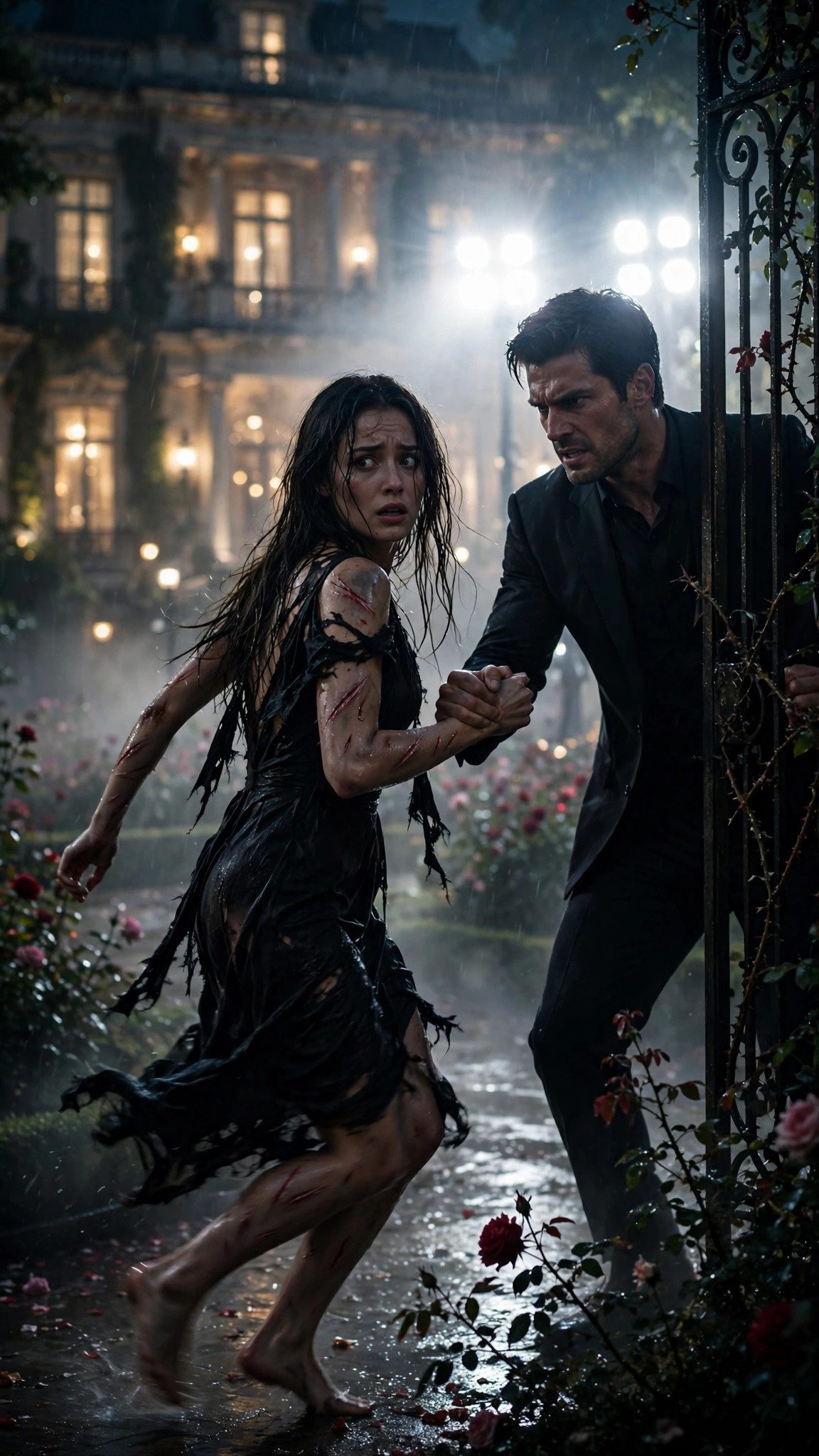
Nico kept his word. That night, in my room, with the door closed and the house quiet around us, he told me everything.
It started, he said, six weeks ago, with a phone call. Not to him. To Enzo Marchetti, his consigliere, the one man in his organization Nico trusted the way other men trust their own hands. The call had come from a source inside Castellano's crew, a man Enzo had been paying for two years. The message was simple. Castellano had a new plan. He was done trying to kill Nico directly. He had tried four times in ten years, and each time Nico had survived, and each time Castellano had lost good men. So Castellano had found a softer target.
Me.
"They know about you," Nico said. "They know your name. They know your routine. They know you go to the same coffee shop every morning at eight, and the same grocery store on Thursdays, and the same bookshop on Sundays. They know you are the only person in my life I would burn the city down to protect. And they know that if they take you, I will come for them, and when I come for them, I will be reckless, and reckless men make mistakes."
"How did they find out?" I asked.
"Arthur," Nico said. "I believe it was Arthur. I cannot prove it yet. But the information Castellano has could only have come from inside my house. From someone who eats at my table and walks my halls. Arthur has been my underboss for eight years. He has been Castellano's man for longer. I do not know when it started. I do not know what Castellano offered him. Money, probably. Arthur has always loved money more than loyalty."
I thought about Arthur's smile, the one that never reached his eyes. I thought about the way he had kissed Sofia Romano's hand that afternoon, like a man greeting an old friend. I thought about all the times Arthur had asked me, casually, about my schedule. Where I would be on Thursday. What time I left the office. Which route I took home.
I had answered him every time. Because he was Nico's underboss. Because he was family. Because I had no reason not to.
"I have been feeding Arthur false information for a month," Nico said. "Small things. Wrong times. Wrong places. Watching to see which ones reached Castellano. Every one of them did. So I know. It is him. I just do not have the proof yet, and without proof, if I move against my own underboss, the family splits. Half of them will follow Arthur. There will be a war in my own house, and Castellano will win it without firing a shot."
"So your plan is to pretend I mean nothing to you," I said.
"My plan is to make Arthur believe you mean nothing to me," Nico said. "So that Arthur tells Castellano you mean nothing to me. So that Castellano stops wasting men on you and starts looking for another way in. And in the meantime, I put Sofia in your place, in public, where Castellano's men can see her, and I wait for them to come for her. Because when they do, I will be ready. Enzo will be ready. And we will finally have what we need."
"And Sofia agreed to this?" I asked.
"Sofia Romano spent six years in the army," Nico said. "She lost her brother to a man like Castellano. She came to me two years ago and asked for work, and I gave her a job in my security team, and she has been waiting for a chance like this ever since. She is not a victim, Norah. She is a soldier. She knows exactly what she signed up for."
"And what did I sign up for?" I asked. "Because no one asked me."
Nico was quiet for a moment. Then he said, "You signed up for me. Three years ago, in a hotel ballroom, you caught a falling tray and you smiled at two hundred people like nothing had happened. That was the day I decided I wanted you in my life. I never asked you if you wanted to be in mine. I never asked you if you understood what my life was. I just built a world around you and called it protection, and I told myself that was the same as love."
"It is not the same," I said.
"No," he said. "It is not. I know that now. I knew it the moment I saw your shadow under the study door and realized I was about to say the cruelest thing I have ever said to another human being, and that you were going to hear every word of it, and that there was nothing I could do to stop it, because Arthur was standing right there, watching my face."
"Did you mean any of it?" I asked. "When you said you would forget my name by Friday?"
"I have known your name for three years," Nico said. "I will know it on my deathbed. There is no Friday in my life where your name is forgotten. But Arthur needed to hear me say it. And you needed to be the one who heard it, because if you had not run, if you had not heard it, Arthur would have wondered why you were so calm. Your fear made it real. Your running made it real. I am sorry for that. I am sorry for all of it. But I am not sorry I did it, because it kept you alive."
I wanted to believe him. I wanted it so badly that my hands were shaking with it. But I had spent three years learning how Nico Moretti worked, and I knew one thing about him above all else. Nico Moretti was a man who always had a plan, and his plans always had a price, and the price was always paid by someone else.
"What is the price this time?" I asked.
"The price," he said, "is that you stay in this house until it is over. No coffee shop. No bookshop. No Sundays. No phone. No contact with anyone outside these walls except through me. And you do it knowing that the woman the world thinks replaced you is sleeping in the guest room down the hall, eating at my table, riding in my car, while you sit in this room and wait."
"For how long?" I asked.
"Until Castellano moves," Nico said. "Days. Weeks. I do not know. But I promise you this, Norah. When it is over, you will have a choice. A real one. Not the choice I gave you three years ago, which was no choice at all. You will be able to walk out of this house with money and a new name and a life anywhere in the world, and I will never come after you. Or you will be able to stay. As my equal. Not my assistant. Not my woman. My partner. That is the choice I owe you."
I looked at him for a long time. At the man who had just offered me my freedom in the same breath as he had told me I was a prisoner. And I realized, with a clarity that hurt, that I did not know whether to believe him or to run again the first chance I got.
But I was tired. My feet were bandaged. My arms were scratched. My heart was bruised in ways no bandage could reach. And the truth was, I had nowhere to run to. No phone. No keys. No money of my own. The world outside Nico's walls was Castellano's world, and Castellano's world wanted me dead.
So I said the only thing I could say.
"Tell me about Sofia," I said. "If I am going to hide in this house while another woman takes my place and takes my bullets, I want to know who she is."
Nico nodded, and he told me. Sofia Romano, thirty-four, born in Naples, raised in Queens. Six years in the army, two tours, a commendation she never talked about and a brother she never stopped talking about. Marco Romano, killed in a drive-by shooting when Sofia was twenty-six, a shooting ordered by a man who wanted to send a message to a rival family and did not care whose brother died delivering it. Sofia had spent eight years looking for the men who ordered it, and she had found three of them, and the fourth was Vincent Castellano.
"She is not afraid of him," Nico said. "She has been waiting eight years to stand in front of him."
"And Arthur?" I asked. "What happens to Arthur when this is over?"
Nico's face went still, the way it went still when his phone rang after midnight. "Arthur made his choice a long time ago," he said. "When this is over, he will answer for it. In my house, there is only one punishment for betrayal. But I will not ask you to watch it. That is not your burden."
I should have been satisfied with that. I was not. I was a woman who had just learned that the man she loved had been lying to her for a month, that his underboss had been selling her life to a killer, and that a stranger was about to risk her life pretending to be me. Satisfaction was not on the menu.
But exhaustion was. I fell asleep sitting up, with Nico still talking, and when I woke up, it was morning, and he was gone, and the door was unlocked, and there was a note on the dresser.
"Breakfast is downstairs. Sofia will be there. Be kind to her. She is braver than both of us."
I went downstairs. The dining room was bright with morning light, and Sofia Romano was sitting at my place at the table, drinking my coffee from my cup, wearing a dress I recognized as one of mine. She looked up when I came in, and she smiled, and the smile reached her eyes, and I hated her for it.
"You must be Norah," she said. "I am Sofia. Nico told me everything. I am sorry about last night. I am sorry about the keyhole. I am sorry about all of it. But I am not sorry to be here. I have been waiting eight years for a man like Castellano to look at me and see a target instead of a soldier. He is going to be very disappointed."
She stood up and held out her hand. I looked at it for a moment. Then I shook it, because my mother had raised me to be polite even to women who were wearing my dress and drinking my coffee and about to die in my place.
"How long have you known?" I asked her.
"Two weeks," Sofia said. "Nico came to me himself. He told me the whole plan. He told me about you. He told me you were the bravest person he had ever met, and that he was going to ask you to do the hardest thing in the world, which was nothing. Sit still. Stay hidden. Let someone else be you. He said you would hate it. He was right. I can see it in your face."
"I do hate it," I said.
"Good," Sofia said. "Hating it means you are alive. Dead women do not hate anything. Now sit down. Eat something. You look like you have not slept in a month, and I need you sharp. If I am going to be you, I need to know how you move, how you talk, how you drink your coffee. Nico says you take it black. Is that true?"
"Yes," I said.
"Then I will take it black," Sofia said, and she pushed my cup across the table toward me, and she poured herself a fresh one, and she drank it black, and she did not flinch.
We spent the morning together, Sofia and I, in the dining room of the house I had lived in for three years, and she asked me questions about my life. What time I woke up. What route I took to the office. Which coffee shop I went to. What I ordered. Who I talked to. What my favorite book was. What my mother's name had been. Small things. The details of a life. The details a killer would need to believe she was me.
And as I answered her, I realized something strange. Sofia Romano was not stealing my life. She was studying it the way a soldier studies a map. Carefully. Respectfully. Like it mattered.
By noon, I did not hate her anymore. By evening, I almost liked her. By the end of the second day, I understood something Nico had not said out loud. Sofia was not just my replacement. She was my mirror. And the woman in the mirror was braver than I had ever been.
On the third day, the phone in the kitchen rang. Not my phone. The house phone. Sofia answered it, because she was the woman of the house now, and she listened, and her face went very still, and she said, "Thank you," and she hung up, and she looked at me.
"That was the coffee shop," she said. "Someone left a package for you there this morning. The owner opened it. It was a box of roses. White roses. With a card. The card said, 'For the woman he called replaceable. We know where you drink your coffee.'"
My hands went cold. The coffee shop. Eight o'clock every morning. The same table by the window. The same order. Castellano's men had been there. They had been watching. They knew.
Sofia put her hand over mine. Her hand was warm. Steady. A soldier's hand.
"Good," she said. "Let them come. I have been waiting eight years. Let them come."
That evening, Nico came home early, which he never did, and he found the box of white roses on the kitchen counter, where Sofia had left it, and he went very still, the way he had gone still at the dinner table with Charles Whitfield all those years ago. He did not touch the box. He just looked at it, and at the card, and at Sofia, and at me, and something in his face changed, the way a sky changes before a storm.
"They were in the coffee shop," he said. "They stood at the counter where you stand every morning, Norah. They spoke to the owner. They smiled. And then they left this, so that you would know."
"They wanted me to be afraid," I said.
"Are you?" he asked.
I thought about it. I thought about the roses tearing my arms in the garden, and the floodlights, and the alarm, and the sound of my own name shouted into the dark. I thought about the box on the counter, white and clean and terrible.
"No," I said, and I was surprised to find that it was true. "Not anymore. I was afraid when I did not understand what was happening. Now I understand. They want me because you love me. That is not something to be afraid of. That is something to be proud of."
Nico looked at me for a long moment. Then he crossed the kitchen, and he took my hands in his, and he looked at the scratches on my arms, still faintly pink from the roses, and he said, very quietly, "I am going to end this, Norah. Soon. I promise you. No more boxes. No more roses. No more men standing at your coffee shop counter."
He doubled the guards that night. He moved a car to the end of the street. He put a man on the roof, though he did not tell me that until much later. And he sat in the kitchen with Sofia and me until midnight, drinking coffee, going over the plan again and again, until every detail was perfect, until there was nothing left to chance.
"Sleep," he said to me, finally. "Tomorrow will be a long day."
I slept. And I dreamed of white roses, and of a coffee shop, and of a man standing at a counter, smiling, with no face at all.