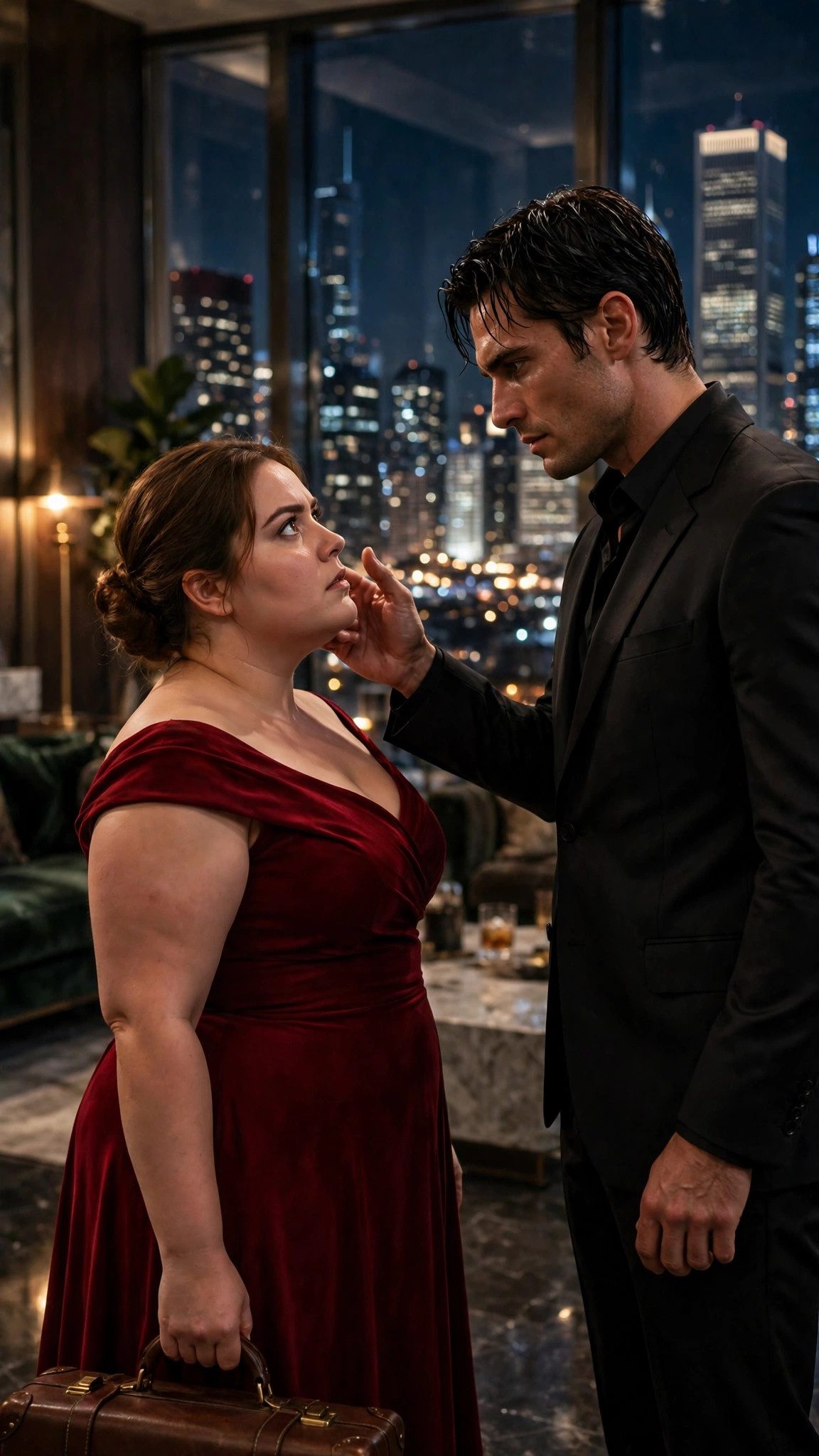
Dinner was served in a dining room the size of a ballroom, under chandeliers that dripped light like honey, and Charlotte was seated at Roman's right hand, in the place of honor, where everyone in the room could see her and she could see everyone in the room.
It was the worst seat in the house. She knew it the moment she sat down. From here, there was nowhere to hide. The long table stretched out in front of her, white cloth and silver and crystal, and along both sides sat the heads of the families — men with grey hair and heavy rings and faces that had seen everything, and their wives, elegant and watchful, with diamonds at their throats and questions in their eyes. At the far end, beside the Moretti patriarch, sat Salvatore, and beside Salvatore sat Marco, and both of them were looking at her the way hunters look at something they have already decided to catch.
Roman leaned close to her as the first course arrived, and said, very quietly, "Eat slowly. Drink water. Do not drink the wine. And whatever he asks you, answer it like you are telling the truth, because you are."
"Easy for you to say," she whispered back, and to her surprise, the corner of his mouth twitched, almost a smile.
"Charlotte," he said, "you have been lying to your mother for three months and you have not slept properly in a week, and you still walked into this room with your head held high. You are braver than anyone at this table. Do not forget that."
She did not forget it. She held onto it like a rope while the soup was served and the bread was passed and the conversation flowed around her like a river she was not supposed to swim in.
Salvatore waited until the second course. He was patient, the way a cat is patient, and when he finally spoke, his voice carried easily down the length of the table, friendly and warm and sharp as a razor.
"Charlotte," he said, smiling. "Such a beautiful name. Tell me, my dear, how did you and my nephew meet?"
The table went quiet. Everyone stopped eating. Everyone looked at her.
Charlotte set down her fork, very carefully, and folded her hands in her lap, and looked Salvatore straight in the eye.
"We met in his home," she said, and her voice was clear and steady, and she was proud of how steady it was, because her heart was beating so hard she was certain the whole table could hear it. "I work there."
A small ripple went around the table. Someone coughed. Someone else set down a glass a little too hard.
Salvatore's smile widened. "You work there," he repeated. "How interesting. And what is it that you do, exactly, in my nephew's home?"
"I take care of it," Charlotte said. "I make sure everything is clean, and everything is in its place, and everyone who lives there is looked after. It is honest work, Mr. Rossi. I am proud of it."
"Honest work," Salvatore said, and he said it the way a man says a word he does not believe in. "How admirable. And how long have you been… taking care of my nephew's home?"
"Eleven months," Charlotte said.
"Eleven months," Salvatore repeated. "And in eleven months, my nephew has never once mentioned you. Not to me. Not to anyone at this table. And yet tonight, at the most important dinner of the year, he brings you here, in a red dress, and sits you at his right hand. Do you not find that… sudden, my dear?"
Charlotte felt Roman tense beside her, and she put her hand on his arm under the table, very lightly, just enough to say, let me handle this, and she turned back to Salvatore with her mother's smile on her face — the smile her mother used when a man thought he could frighten her.
"Mr. Rossi," she said, "I have spent eleven months making a home for a man who lives alone and eats standing up at his kitchen counter because he has forgotten how to sit down at a table with another person. If that seems sudden to you, then perhaps you have not been paying attention to your nephew."
There was a sound from somewhere down the table — a woman's laugh, quickly stifled. Salvatore's eyes narrowed.
"And what do you know about my nephew?" he asked, and his voice had lost some of its warmth. "What do you know about this family, and what it takes to lead it?"
"I know that he works eighteen hours a day," Charlotte said. "I know that he reads the newspaper with a pen in his hand and underlines the things that matter. I know that he drinks his coffee black and that he leaves a glass of water on his desk every night and it is always empty in the morning. I know that he has not smiled in two years, and I know that his father died, and I know that he carries that with him every single day. That is what I know about your nephew, Mr. Rossi. What do you know about him?"
The silence at the table was so complete that Charlotte could hear the chandeliers humming.
Salvatore stared at her. Marco stared at her. The wives stared at her. Roman stared at her, and there was something in his eyes she had never seen before, something fierce and proud and almost tender, all at once.
Then Salvatore laughed. It was a big, booming laugh, the laugh of a man who has just been handed a gift, and he slapped the table with one heavy hand, and he said, "Well! She has spirit, I will give her that. My nephew has chosen a spirited one. Tell me, my dear, do you know what it takes to be the woman of a man like Roman? Do you know what the family expects?"
"I know what I expect," Charlotte said. "I expect to be treated like a person, not a decoration. I expect the man I am with to be honest with me, and I expect to be honest with him. And I expect that if someone at this table thinks I do not belong here, they will say so to my face, the way you are doing now, and I will answer them to their face, the way I am doing now."
Marco leaned forward, smiling his smooth, empty smile. "You are very confident, Charlotte, for a woman who mops floors."
"And you are very confident, Marco," Charlotte said, without missing a beat, "for a man who has never mopped one."
Someone at the table laughed out loud. Someone else choked on their wine. Marco's smile froze on his face, and Salvatore's eyes went flat and cold, and Charlotte understood that she had just made an enemy for life, and she did not care, because her mother had taught her that a woman who lets a man talk to her like that will let a man do worse, and she was not that woman.
Roman put his hand over hers on the table, in full view of everyone, and his fingers were warm and steady, and he said, in a voice that carried to every corner of the room, "My uncle asked what it takes to be my woman. I will tell you what it takes. It takes honesty. It takes courage. It takes a person who does not flinch. Charlotte has all three. I chose her. That is all anyone at this table needs to know."
He looked down the length of the table, slowly, meeting every eye, and the room was very quiet.
"And if anyone here has a problem with my choice," he said, "they can say so now, to my face, the way a man says it. Or they can keep their peace for the rest of the night."
Nobody said anything. Salvatore picked up his glass and drank, slowly, and his eyes were on Charlotte the whole time, and she could see the calculation happening behind them, the way a chess player recalculates when a piece moves in a way he did not expect.
Dinner went on. The courses came and went. The conversation started again, quieter now, more careful. Charlotte ate slowly, the way Roman had told her to, and drank water, and smiled when she was spoken to, and answered questions about Cicero and her mother and the bakery on Cermak, and she did it all without flinching, without looking away, without apologizing for who she was.
Between the soup and the fish, the elderly woman seated across from her leaned forward. She was the Moretti matriarch, white-haired and straight-backed, with diamonds at her throat and eyes like a hawk's, and Charlotte had been aware of her watching all evening, the way a judge watches a witness.
"Tell me about your mother," the old woman said, and her voice was softer than Charlotte expected. "You mentioned Cicero. You mentioned a bakery."
So Charlotte told her. She told her about Angela, and the little house, and the hospital, and the pan dulce from the bakery on Cermak, and the way her mother had raised her alone after her father died, and the way her mother still called every Sunday at seven o'clock sharp. And as she spoke, the old woman's face changed, the hawk's eyes softening, and she reached across the table and patted Charlotte's hand with a hand that was thin and spotted with age and surprisingly warm.
"My own mother scrubbed floors," the matriarch said, quietly, so only Charlotte could hear. "In a hotel in Palermo, before we came to this country. She scrubbed floors until her hands bled, and she sent me to school with the money, and I married a man who built all of this." She gestured at the great room, at the chandeliers, at the silver. "Do not let anyone in this room make you ashamed of honest work, child. The ones who do have forgotten where they came from. I have not forgotten."
Charlotte's throat went tight, and she squeezed the old woman's hand, and she understood that she had an ally at the table, one she had not expected, and that the room was not entirely against her.
Roman leaned close then, and said under his breath, "That is Don Enrico's wife. She has been the real head of this family for forty years. If she likes you, Salvatore has already lost."
Charlotte almost laughed, and she had to cover it with a cough, and Roman's mouth twitched, almost a smile, and for a moment, in the middle of the most dangerous dinner of her life, Charlotte felt something she had not expected to feel.
She felt like she belonged.
And then, between the main course and the dessert, Roman stood up and said, "Excuse us," and took her hand, and led her out onto the terrace, into the cool night air, away from the eyes and the questions and the chandeliers.
The terrace overlooked a garden, dark and sweet-smelling, and the city glittered far away beyond the trees, and for a moment they just stood there, side by side, not touching, breathing.
"You were magnificent," Roman said finally, and his voice was low and rough. "Do you know that? You were magnificent in there."
"I was terrified," Charlotte said.
"I know," he said. "That is what made it magnificent. You were terrified and you did not flinch. Do you know how rare that is, in my world? Everyone in that room is afraid of something, and every one of them hides it. You did not hide it. You let them see you were afraid, and you stood your ground anyway. That is the bravest thing I have ever seen."
She looked at him, there in the dark with the garden smells around them, and she asked him the question she had been carrying since the night with the suitcase.
"Why me, Roman? Really. Why did you choose me? There are a hundred beautiful women in this city who would kill to sit at your right hand. Why a maid?"
He was quiet for a long time. He looked out at the garden, and then he looked at her, and when he spoke, his voice was different from any voice she had ever heard from him — not the boss's voice, not the measured voice, but the voice of a man telling the truth for the first time in years.
"Because my father died two years ago," he said, "and since then, everyone in my life has wanted something from me. My uncle wants my chair. My captains want more territory. My lawyers want more money. The women I have met want the penthouse and the cars and the name. Everyone wants something, Charlotte. Everyone except you."
He turned to face her fully, and his dark eyes were steady on hers.
"You never wanted anything from me. You came to my house every morning and you made it shine, and you folded my shirts, and you left a glass of water on my desk, and you never asked me for a thing. Not a raise. Not a favor. Not a kind word. You just… took care of me, the way you take care of everyone, because that is who you are. And I watched you do it for eleven months, and I realized that you were the only honest person in my life, and that I had not had an honest person in my life since my father died."
He took a step closer, and his voice dropped lower.
"And then I heard you in the kitchen, whispering that you needed a boyfriend by tomorrow, and I heard the fear in your voice, and I understood something. You needed someone to stand next to you, the way I needed someone to stand next to me. And I thought — maybe we could stand next to each other. Just for one night. Just to see what it felt like."
Charlotte's eyes filled with tears, and she did not try to hide them, because she was done hiding things from this man.
"It feels like this," she said, and her voice shook. "It feels like being seen for the first time in my life."
Roman reached out, slowly, giving her time to pull away, and he touched her face, very gently, with the back of his fingers, the way you touch something precious.
"Then let me see you," he said. "For the rest of the night. No pretending. Just you, and me, and whatever happens next."
She leaned into his touch, just a little, and closed her eyes, and for one moment, on a terrace in the dark with a garden below and a room full of dangerous men behind them, Charlotte felt something she had not felt in years.
She felt safe.
And then, from inside the dining room, a voice called out, loud and cheerful and false: "Roman! Charlotte! Dessert is served! Come back inside, my dears. The night is young, and my uncle has a toast to make."
Charlotte opened her eyes. Roman's hand dropped from her face. They looked at each other, and they both understood the same thing at the same time.
Salvatore was not finished. The test was not over. The toast was coming, and whatever Salvatore was about to say, it was going to be the real attack.
Roman held out his hand. Charlotte took it. And together, they walked back into the dining room, into the light, into the danger, side by side.
And Charlotte did not flinch.