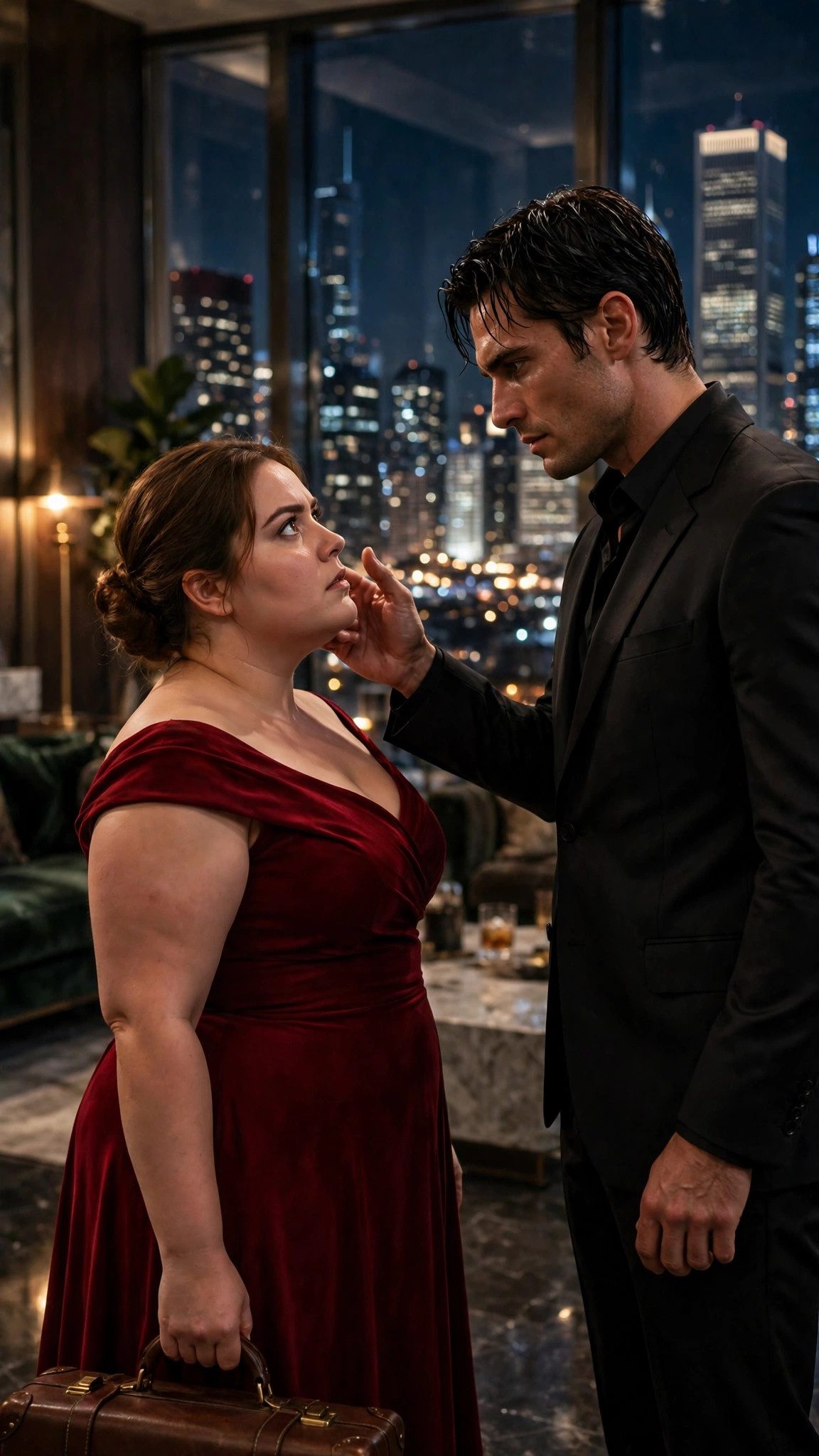
Dessert was a chocolate cake, dark and rich, and no one was eating it, because everyone in the room was watching Salvatore.
He stood at the head of the table, his glass raised, his smile wide and warm, and he looked like a man about to give a toast at a wedding, and Charlotte knew, with a cold certainty in her stomach, that this was the moment he had been waiting for all night.
"My friends," Salvatore said, his deep voice rolling across the room. "My family. Tonight we are gathered to celebrate strength, and loyalty, and the future of this family. And I would like to propose a toast — to my nephew, Roman, who has led us for two years, and who tonight has brought us a… surprise."
He paused, and his eyes found Charlotte, and his smile sharpened.
"To Roman," he said, "and to his lovely date, Charlotte. A woman of spirit. A woman of honesty. A woman who told us herself, with such pride, that she takes care of my nephew's home. That she mops his floors."
The room went very still.
"But I wonder," Salvatore said, and he set down his glass, and he reached into his jacket, and he took out a photograph, and he held it up for the whole table to see, "if my nephew's lovely date has told us everything."
It was a photograph of Charlotte. She recognized it instantly, and her blood went cold, because it was a photograph of her that morning, in the penthouse, on her knees on the marble floor, in her black uniform with the white apron, scrubbing the grout between the tiles with a brush. Her hair was in its low bun. Her face was red from the work. She looked tired, and ordinary, and small.
Someone had taken it that morning. Someone had been in the penthouse, watching her, waiting. Salvatore had planned this. He had planned all of it — the questions, the test, the photograph — and he had been saving the photograph for this moment, for the toast, for the moment when the whole room was watching.
"This," Salvatore said, holding the photograph higher, "is Charlotte. Not a date. Not a lady. A maid. A servant. A woman who scrubs my nephew's floors on her knees. And my nephew has brought her here, to the most important dinner of the year, in a red dress he bought her, and sat her at his right hand, and asked this family to respect her as his equal."
He lowered the photograph, slowly, and looked around the table, and his voice dropped to something cold and hard.
"Is this what we have become? Is this the judgment of the man who leads us? A boss who cannot tell the difference between a woman and a servant? A boss who brings his cleaning girl to the family table and calls her his?"
Marco stood up beside his father, smooth and smiling, and said, "Father is right. We all love Roman. But a leader must have judgment, and tonight Roman has shown us that his judgment is… clouded. I move that we take a vote. A vote of confidence. Tonight. Right now. Let the family decide whether Roman Rossi is still fit to lead us."
The room erupted. Men were talking over each other, shouting, arguing, and Charlotte sat very still in the middle of it, with the photograph of herself on her knees still hanging in the air, and she felt the whole room's eyes on her, and she felt the shame rising in her throat like something hot and bitter, and she understood that this was the moment Salvatore had designed: not to expose her, but to destroy her, to make her so small and so ashamed that she would run from the room, and Roman would be left standing alone, humiliated, with his family's respect in ruins.
She did not run. She stood up.
She stood up slowly, in the red dress, and she pushed her chair back, and the sound of it scraping on the floor cut through the shouting, and the room went quiet again, and every eye turned to her.
And Charlotte, who had spent eleven months being invisible, looked at Salvatore Rossi, and looked at Marco Rossi, and looked at every man and woman at that long table, and she spoke, in a clear, steady voice that carried to every corner of the room.
"Yes," she said. "That photograph is me. That is who I am. I am a maid. I scrub floors. I mop marble. I fold shirts. I change sheets. I have done it for eleven months in your nephew's house, and I did it for three years before that in a hotel in the Loop, and I did it before that in offices at night, beside my mother, when I was sixteen years old and my father had just died and someone had to pay the rent."
She took a breath, and her voice did not shake.
"I am not ashamed of that photograph. I am proud of it. That woman on her knees, scrubbing grout, is a woman who works, and who takes care of people, and who has never stolen a dollar or lied to a friend or betrayed anyone who trusted her. Can everyone at this table say the same?"
She looked at Salvatore, and her eyes were steady.
"You asked me tonight what I do, Mr. Rossi, and I told you the truth. You asked me how Roman and I met, and I told you the truth. You asked me what I know about your nephew, and I told you the truth. I have not lied to anyone in this room tonight, and I will not start now. I am a maid. I am also the woman Roman Rossi chose to sit at his right hand. Both of those things are true. And if you think one of them cancels out the other, then you do not understand your nephew at all."
She turned to the table, to the wives with their diamonds, to the old men with their heavy rings, and she said, "You all know what it is to work. Every one of you started somewhere. Your fathers started somewhere. Your grandfathers started somewhere. Some of them scrubbed floors, too. Some of them washed dishes. Some of them carried boxes on the docks until their backs broke. And now you sit here in a beautiful house, eating chocolate cake, and you look at a woman who does honest work and you call her nothing. I am not nothing. I am Charlotte. I am thirty years old. I take care of my mother. I take care of the people around me. And I am standing here, in a red dress, telling you the truth, while a man who has never worked an honest day in his life tries to use me to steal his nephew's chair."
She pointed at Salvatore, and her hand did not shake.
"That is what this is about. It is not about me. It has never been about me. It is about power. Your uncle wants his son to lead this family, and he thinks the way to do it is to humiliate me in front of all of you. And if you let him do it, if you sit here and let him turn a working woman into a weapon, then you are not a family. You are an audience. And I will not perform for you."
The silence in the room was enormous. It filled the dining room like water filling a glass, and Charlotte stood in the middle of it, breathing hard, her heart hammering, her hands shaking now, finally, now that it was over, and she waited for someone to speak.
Roman stood up.
He stood up slowly, and he came around the table to her side, and he took her hand in his, in full view of everyone, and he turned to face the room, and when he spoke, his voice was the voice of a boss, low and measured and absolutely certain.
"My uncle is right about one thing," he said. "Charlotte is a maid. She scrubs my floors. She folds my shirts. She leaves a glass of water on my desk every night. And she is the most honest person I have ever known."
He looked down the table, slowly, meeting every eye.
"My father taught me that a boss is judged by the people he surrounds himself with. Not by how feared he is. Not by how rich he is. By who stands beside him. My father surrounded himself with honest men, and he led this family for thirty years, and no one ever questioned him. Tonight, I have surrounded myself with the most honest person I know. If that makes me unfit to lead, then vote. Vote now. I will accept whatever this family decides."
He paused, and his hand tightened around Charlotte's.
"But know this. If you vote against me tonight, you are not voting against a boss who brought a maid to dinner. You are voting against a boss who tells you the truth, and who stands by his people, and who refuses to be ashamed of them. And if that is not the kind of boss you want, then perhaps you should ask yourselves what kind of boss you do want — and whether my uncle, who sent a man into my home this morning to photograph a woman on her knees, is the kind of man you trust to lead you."
A murmur ran around the table. An old man at the far end, white-haired, with a face like carved wood, stood up slowly and said, "Roman is right. A man who spies on a woman in her own workplace is not a man I follow. I vote confidence."
One by one, around the table, the men stood. One by one, they said the same words. "Confidence." "Confidence." "I vote confidence." The wives nodded. The old men nodded. And Salvatore stood at the head of the table with the photograph still in his hand, and his face went white, and then red, and then white again, and Marco sat down slowly, as if his legs had given out, and the vote was over before it had properly begun.
Roman looked at his uncle, and his voice was quiet, and it was the quietest voice in the room, and that made it the loudest.
"Uncle," he said. "You have embarrassed yourself, and you have embarrassed this family, and you have tried to embarrass the woman I chose. I will not have you killed. I will not have you hurt. You are my blood, and my father loved you, and I will honor that. But you will no longer sit at this table. Tomorrow morning, you will go to Milwaukee, and you will run the family's shipping business there, and you will do it honestly, and you will stay there until I say otherwise. That is my mercy. Do not mistake it for weakness."
Salvatore stared at him. For a moment, Charlotte thought he might argue. For a moment, she thought he might shout, or threaten, or do something desperate. But then he looked around the table, and he saw that no one would meet his eyes, not even his own son, and he folded the photograph, slowly, and put it back in his jacket, and he nodded once, stiffly, like a man accepting a sentence.
"As you wish," he said, and his voice was hoarse. "Nephew."
And then he walked out of the dining room, and the door closed behind him, and the room let out a breath it had been holding all night, and Charlotte stood there in the red dress with Roman's hand in hers, and she realized that she was shaking, and that Roman was holding her up, and that the whole room was looking at her with something she had never seen directed at her before.
Respect.
It was the strangest feeling in the world. It was better than the dress. It was better than the chandeliers. It was better than anything she had ever owned.
And then the old white-haired man at the far end of the table raised his glass, and he said, in a voice that shook a little with age and with feeling, "To Charlotte. To the woman who did not flinch."
And the whole table raised their glasses, and said it back, and Charlotte stood there with tears running down her face, in a red dress, in a room full of dangerous men, and she did not try to hide them, because she had nothing left to hide.
The Moretti matriarch came around the table then, slowly, leaning on her cane, and she took Charlotte's face in her hands, the way a grandmother takes a granddaughter's face, and she kissed her on both cheeks, and she said, loudly enough for everyone to hear, "My mother scrubbed floors in Palermo. My mother would have been proud to stand where you are standing. Welcome to this family, child."
Don Enrico, the white-haired old man, came next, and he took Charlotte's hand in both of his, and his hands were shaking a little with age, and he said, "My wife is right. I started on the docks, carrying boxes until my back broke, and I never forgot it. A family that forgets where it came from is already dead. You reminded us tonight, Charlotte. You reminded all of us."
One by one, the captains came to her. A big man with a scar through his eyebrow shook her hand and said, "You have more guts than most men I know." A younger captain, barely thirty, said, "My sister cleans houses in Pilsen. I am going to tell her about you." And the wives came, too, touching her arm, asking her name again, telling her she must come to tea, telling her she looked beautiful in the dress, and Charlotte stood there in the middle of it all, dazed and overwhelmed, with Roman's hand on her back, steady as a wall, and she thought about the photograph, still folded in Salvatore's jacket, and how it had been meant to destroy her, and how it had done the opposite.
It had shown the room who she was. And the room had decided that who she was was enough.
She had told the truth. She had not flinched. And she had won.