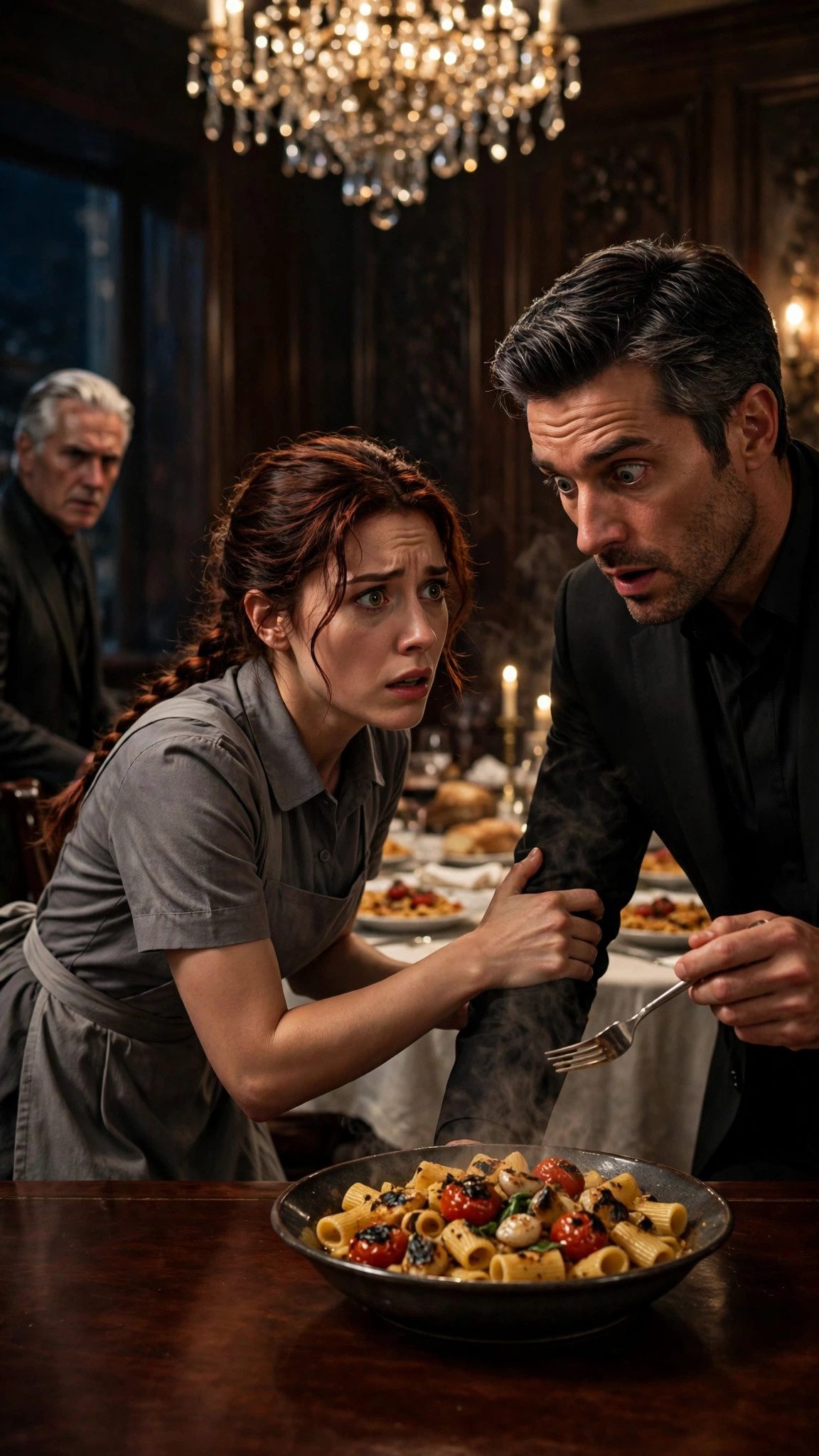
They kept Dominic in the small room off the library — the room with no windows, where the family had always kept its most difficult conversations. Arthur went in alone, and he stayed in there for a long time, and no one in the house spoke above a whisper while he was gone.
I waited in the kitchen with Dr. Ellison and Mrs. Delgado and Chef Pascal, and none of us said anything, because there was nothing to say. The pasta had been taken away. The table had been cleared. The candles had been blown out. And the house, which had been silent for three weeks, was silent in a different way now — not the silence of fear, but the silence of a wound that has finally been opened and cleaned.
After an hour, Arthur came out. His face was gray, and his hands were steady, and he looked older than he had looked that morning, as if the night had added ten years to him. He sat down at the kitchen table — not the great mahogany table in the dining room, but the small wooden table in the kitchen where the staff ate — and he put his head in his hands, and for a moment, he was not the Don of the Moretti family. He was a son who had lost his father, and a brother who had almost lost his sister, and a man who had almost been killed in his own house.
"He confessed," he said. His voice was flat, the way it had been flat for three weeks, but underneath the flatness there was something else now — relief, and grief, and a terrible, tired anger. "All of it. The tea. The pasta. The Castellanos."
He told us then, slowly, what Dominic had said in that small room. How Vincent Castellano had come to him a year ago, with money, and with promises, and with a plan. How the Castellanos had been trying to destroy the Morettis for thirty years, and how they had finally understood that they could not do it from the outside — the Morettis were too strong, too loyal, too feared — so they would do it from the inside, with a man the family trusted, and a poison no one could taste, and a death that would look like a heart attack.
How Dominic had poisoned Vittorio's birthday tea — just a pinch of rhubarb root in the pot, enough to make the tea taste bitter, enough to stop an old man's heart. How he had laughed afterward, on the telephone, and said, "It worked. The old man is dead." How he had hidden the paper bag in the pantry ceiling, where no one would look, and how he had dosed Arthur's food lightly, day after day, so that Arthur would grow weaker and weaker, and more and more afraid, until the family lost faith in him and turned to Dominic instead.
"He said the boy wouldn't eat," Arthur said, and his voice cracked, just once, on the word "boy." "He said I was too frightened to eat, and that was even better, because a Don who won't eat is a Don who can't lead. He was right. I was frightened. I have been frightened for three weeks. I sat at that table every night and I stared at the food, and my body told me not to eat it, and my mind told me I was going mad, and I did not know which one to believe."
"You believed your body," I said. "That is why you are alive."
Arthur looked at me. "My father used to say that a Don's instincts are his best weapon. I thought I had lost mine. I thought grief had taken them. But you —" He stopped. "You smelled it. In three days. What I could not prove in three weeks, you smelled in three days."
"I smelled it because I have smelled it before," I said. "My father died of it. When I was nine years old. I have carried that smell with me ever since, and I have been waiting for the day I could use it to save someone instead of just remembering it."
Arthur was quiet for a long time. Then he said, "Dominic asked me for mercy. He said he did it for the money, and for the promise of the family, and that Castellano had threatened his own daughter if he refused. I don't know if that's true. I don't know if any of it is true. But I know this: my father believed in mercy, even for his enemies. He believed that a man who chooses revenge over justice becomes the thing he is fighting." He looked at Dr. Ellison, and at Mrs. Delgado, and at Chef Pascal, and then at me. "So I am not going to kill him. I am going to hand him to the police, with the ledger, and the bag, and Gabby's testimony, and Dr. Ellison's test. And Vincent Castellano —" His gray eyes went cold. "Vincent Castellano will answer for this, too. In a courtroom. In front of the whole city. Not in an alley. Not in the dark. In the light."
It was the right decision. I knew it as soon as he said it, because it was the decision of a man who had chosen to live, and to lead, instead of to die of poison or of revenge.
The next morning, the police came. They took Dominic away in handcuffs, and they took the paper bag, and the ledger, and the handkerchief, and they took statements from Dr. Ellison and Mrs. Delgado and Chef Pascal and Gabby — Gabby, who came back to the house for one hour, with her baby in her arms, and told the police everything she had heard on the landing, and then left again, to her small flat above the laundry, to a life that was finally safe.
Aria came to find me that afternoon. She found me in the kitchen, scrubbing the great iron pans, and she stood in the doorway for a long time without saying anything, and then she said, "I was wrong about you."
I kept scrubbing. "Wrong about what, miss?"
"About everything," Aria said. "I thought you were a silly girl with an imagination. I thought my brother had lost his mind. I thought —" She stopped. Her voice shook, just once. "I thought my father died of a broken heart, and that my brother was dying of one too. I was wrong. My father was murdered. And my brother was right. And you — you saved us. All of us. You saved the whole family."
She came into the kitchen then, and she did something I had never seen a Moretti do. She took my hands — my wet, soapy hands, the hands of a maid — and she held them, and she said, "Thank you, Nora. Thank you for smelling it first."
Chef Pascal cleared his throat, loudly, from the other side of the kitchen. "The girl is right about the kitchen, too," he said, gruffly, staring at his stove. "I have cooked for this family for thirty years, and I did not smell it. I did not see it. I thought the tea tasted bitter because I was getting old and heavy-handed with the leaves." He turned to me, and his red eyes were wet. "You smelled it. You saved us. And I — I owe you an apology, girl. And a debt. A debt I can never repay."
"You don't owe me anything," I said. "You cooked the food. Someone else poisoned it. That is not your fault."
"It is my kitchen," Pascal said. "And from now on, no one touches my kitchen without my say-so. No deliveries I haven't checked. No bags I haven't opened. No one." He looked at Arthur, who had come into the kitchen behind Aria, and he said, "And you, young man. You will eat in my kitchen again. Starting tonight. I will cook for you myself, and I will taste every dish before it leaves my stove, and if anyone tries to poison my food again, they will have to go through me first."
Arthur smiled. It was the first time I had seen him smile — really smile, not the cold, careful smile of a Don, but the smile of a man who has been given his life back. "I would like that, Pascal," he said. "Very much."
And then he turned to me, and his gray eyes were warm, and he said, "Nora. Walk with me."
But before we walked, there was one more thing Arthur had to do, and it was the hardest thing of all — harder than facing Dominic, harder than facing the police, harder than facing his own grief. He had to face his family. Not the twenty frightened faces at the dinner table, but the men who ran the family with him — the capos, the lieutenants, the old soldiers who had served his father and who had watched him starve himself for three weeks and wondered if the Moretti family still had a Don at all.
The next morning, Arthur called the council. They met in the library, in the great room with the dark wood and the leather chairs, and I was not invited — I was a maid, and councils are not for maids — but Mrs. Delgado left the door open a crack, and I stood in the hall, and I listened, because I had earned the right to listen.
There were eight of them. Old Enzo, who had been Vittorio's right hand for forty years, with his white hair and his scarred hands. Frankie the Bull, who was not a bull at all, but a thin, quiet man with glasses. Sal, and Marco, and Tony, and the others — men who had built the family with their hands and their blood, and who had watched Arthur fall apart for three weeks and wondered if they would have to choose a new Don.
Arthur stood at the head of the room, and he told them everything. He told them about the tea. He told them about the pasta. He told them about the paper bag, and the handkerchief, and the ledger, and Gabby, and the doctor's test. He laid it all out on the table, piece by piece, the way a man lays out evidence in a courtroom, and when he was done, the room was silent.
Then Old Enzo spoke. His voice was rough, and slow, and it carried the weight of forty years. "Your father," he said, "would have killed him. Dominic. He would have killed him in that small room, with his own hands, and he would not have lost a night's sleep over it. That is how the family has always done it. That is the law."
"I know," Arthur said. "My father believed in the old law. And the old law kept this family alive for fifty years. But the old law also made us feared, and hated, and alone. And the old law did not save my father. It did not save him from a teacup, Arthur. It did not save him from a paper bag in a ceiling."
Frankie the Bull cleared his throat. "What are you saying, boss?"
"I am saying that Dominic will go to prison," Arthur said. "Not to a grave. To a prison. With the ledger, and the bag, and the testimony, and the doctor's test. And Vincent Castellano will go to prison with him. In a courtroom. In front of the whole city. In the light. Because I am not going to be the Don who kills his enemies in dark rooms anymore. I am going to be the Don who puts them in prison, and who keeps his family alive, and who eats dinner with his family at night, in his own kitchen, without being afraid of his own food."
The room was silent. Then Old Enzo stood up, slowly, and he walked around the table, and he put his scarred hand on Arthur's shoulder, and he said, "Your father would have killed him. But your father is dead. And you are the Don now. And a Don who chooses the law over revenge — that is a Don I can follow." He turned to the others. "Any man here who disagrees can say so now."
No one disagreed. One by one, they stood up, and they put their hands on Arthur's shoulders, and they said his name, and they said the family's name, and the council was over.
Later that day, Dominic's daughter came to the house. She was nineteen years old, thin, frightened, with her father's eyes and none of his cruelty, and she stood at the front door with her hands twisted together, and she asked to see Arthur. He met her in the garden, and she cried, and she said, "My father did a terrible thing. I know he did. But he is still my father. Please. Please don't kill him."
"I am not going to kill him," Arthur said. "He is going to prison, and he is going to answer for what he did, in front of a judge, and in front of this city. And you — you are not your father. You are welcome in this house. You are welcome at our table. That is my promise to you, and it is a promise I will keep."
She cried harder then, and she thanked him, and she left, and Arthur stood in the garden for a long time, looking at the roses, and I stood in the doorway, watching him, and I understood something I had not understood before: mercy is harder than revenge. Revenge is easy. It is quick, and it is clean, and it feels like justice. Mercy is slow, and it is messy, and it costs you something. But mercy is what keeps a family alive, and revenge is what kills it, one dark room at a time.