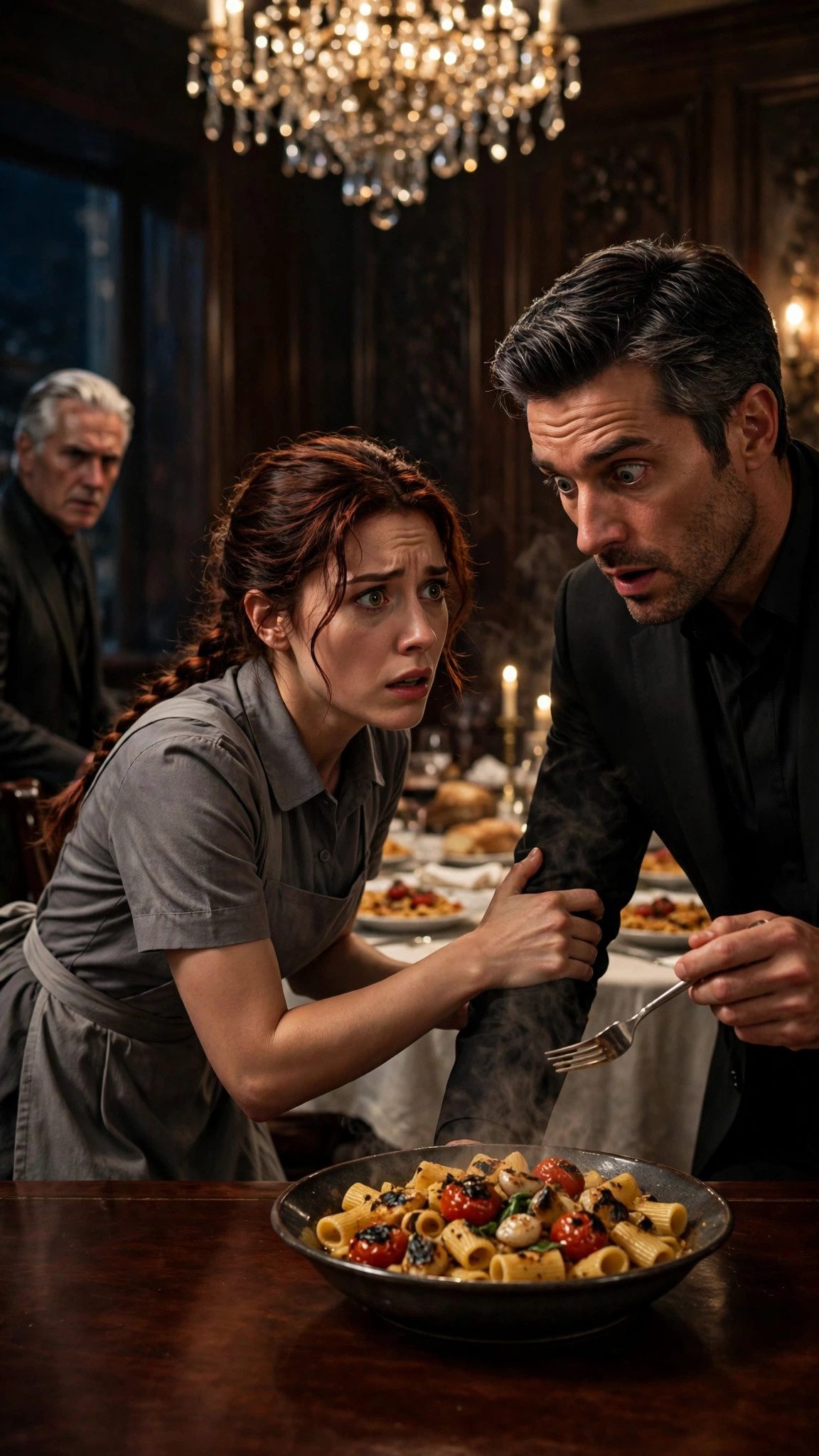
The dining room had never looked more beautiful, or more frightening.
By seven o'clock, the great mahogany table was laid for twenty, with white linen and silver and candles in tall glass holders, and the chandeliers threw their hard small lights down onto the polished wood. The family came in slowly, in their best clothes, talking in low voices, as if they were arriving at a funeral instead of a dinner — and in a way, they were. This was the first family dinner since Vittorio had died. Everyone in the room knew it. Everyone in the room felt it.
Aria came in last, in a black dress, her dark hair pulled back, her face pale and set. She went to her place, halfway down the table, and she did not look at her brother. Arthur came in after her, and the room went quiet, the way a room goes quiet when the most dangerous man in it walks through the door. He was thinner than he had been three weeks ago. His suit hung on him. His gray eyes moved slowly around the table, taking in every face, and I saw him pause on Dominic, who was already seated near the head of the table, smiling, relaxed, a glass of wine in his hand.
"Eat," Dominic said, raising his glass. "Tonight, we eat together, like a family. For Vittorio."
The staff brought the pasta in on great silver trays. It was beautiful — the blistered tomatoes shining, the garlic golden at the edges, the steam rising in the candlelight. Chef Pascal had outdone himself. Every plate looked as if it had been created by an artist. Each was seasoned with care. And every single plate was poisoned.
I stood against the wall with my own bowl in my hands — the bowl I had cooked myself the night before, clean, safe, warm — and I waited. Dr. Ellison stood beside me, his medical bag in his hand, his face white. We had agreed on the plan that morning: I would put my bowl in front of Arthur, and the doctor would test the house pasta, and whatever happened next would happen in front of everyone, so that no one could bury it afterward.
But before I could move, Dominic stood up.
"Before we eat," he said, "I want to say something." He looked around the table, and his voice was warm, and reasonable, and full of the easy charm that had made him the family's second-in-command for twenty years. "Arthur has not eaten in three weeks. He sits at this table and stares at his food, and we all pretend it is grief. But it is not grief. It is madness. And a family cannot be led by a man who is afraid of his own kitchen." He turned to Arthur. "So tonight, I am going to eat first. I am going to eat the pasta, here, in front of everyone, to show you that there is nothing wrong with it. And then you are going to eat, and you are going to stop this — this performance — and you are going to be the Don again."
He picked up his fork. He took a mouthful of pasta. He chewed it slowly, theatrically, and swallowed, and spread his arms wide, and smiled.
"There," he said. "You see? Nothing. No poison. No curse. Just pasta."
The room exhaled. Aria's shoulders dropped. One of the cousins laughed, a short, relieved sound. Someone raised a glass. And I stood against the wall with my bowl in my hands, and I felt the whole plan falling apart in front of me — because Dominic had just eaten the poisoned pasta, in front of everyone, and nothing had happened to him.
Except that I knew something the rest of the room did not know. I knew that rhubarb-root poison does not work in a single mouthful. A pinch makes the food taste bitter. A spoonful stops a man's heart. But a single mouthful, eaten slowly, by a man who knows what he is eating — a man who has been building up a tolerance, a mouthful at a time, for three weeks — that mouthful does nothing at all.
Dominic knew. He had been tasting his own poison for weeks, a little at a time, so that tonight he could eat it in front of the family and smile.
But I also knew something else. I knew about the paper bag in the ceiling. And I knew about Gabby. And I knew about the tea. And I knew that a man who will eat poison to prove a lie will do anything to protect that lie.
So I stepped forward, and I put my bowl down on the table in front of Arthur, and I said, in a voice loud enough for the whole room to hear, "Don't eat the pasta, Mr. Moretti. It was poison."
The room went silent. Not the ordinary silence. The other kind. The kind that comes after a gunshot.
Dominic's smile froze. "She made all of this?" he said, turning to Arthur. "She made this? A girl who has been here three days is telling the Don of this family that his own kitchen is poisoned? Arthur, this girl is hysterical. She has been asking questions all week. She accused the tea. She accused the pantry. Now she accuses the dinner. She is a silly girl with an imagination, and she is making a fool of you in front of your own family."
"She made this?" Aria said, standing up. "Nora. What are you doing? I told you — my brother is grieving. He is not —"
"Your brother is not grieving," I said. My voice did not shake. I was surprised, but it did not shake. "Your brother is right. He has been right for three weeks. Someone in this house has been poisoning the food, and your father died of it, and your brother's body knew it before his mind could prove it. And I can prove it. Now. Here. In front of everyone."
Arthur had not moved. He sat at the head of the table with his hands flat on the wood, and his gray eyes were fixed on me, and I saw in them something I had not seen before — not suspicion, and not anger, but hope. A thin, desperate hope, the hope of a man who has been waiting three weeks for someone to say the thing he could not say himself.
"Show me," he said.
So I showed them. I turned to Dr. Ellison, and he stepped forward, and he opened his bag, and he took out a small glass vial and a strip of paper, and he scraped a little of the pasta sauce onto the paper, and he added a drop from the vial, and the paper turned a deep, ugly purple — the color, the doctor said, of rhubarb-root poison, the color it turns when it meets the reagent.
A gasp went around the table. A woman put her hand to her mouth. A glass tipped over and rolled, and no one caught it.
"That proves nothing," Dominic said. His voice was still calm, but there was an edge under it now, like a knife under silk. "A parlor trick. A piece of paper that turns purple. The girl could have put anything on that paper."
"Then let me show you something else," I said. And I turned to Mrs. Delgado, who was standing in the doorway with her hands twisted in her apron, and I said, "Mrs. Delgado, would you fetch the paper bag from the pantry? The one above the ceiling tiles. The one Mr. Dominic hid there the night before the birthday party."
Mrs. Delgado went white. Dominic went whiter. And for a moment, no one in the room moved at all.
Then Dominic laughed. It was a short, hard laugh, and it did not sound like the laugh of a man who was innocent. "A paper bag," he said. "In the ceiling. You are inventing fairy tales now, girl."
But Mrs. Delgado had already gone, and she came back a moment later with a chair, and she stood on it, and she lifted the ceiling tile in the pantry — I could hear the scrape of it from the dining room — and she came back carrying the paper bag, folded over at the top, with the white powder inside it, and the handkerchief tucked into the fold.
She set it on the table in front of Arthur. And Arthur opened it. And he looked at the powder. And he picked up the handkerchief, and he read the initials stitched into the corner in dark blue thread, and his face changed — not all at once, but slowly, the way a man's face changes when he understands that the person he trusted most in the world has been killing his family.
"D.F.," he said, very quietly. "Dominic Ferrante."
"It is not mine," Dominic said. "Anyone could have put that there. Anyone could have —"
"Gabby saw you," I said. "Gabby, the maid before me. She saw you stand on a chair in the pantry the night before the birthday party, and lift the ceiling tile, and hide this bag. She heard you on the telephone, talking about the tea. She heard you say, 'It worked. The old man is dead.' She heard you say, 'The next one will be the pasta. All of it. The whole order. Let them eat it together, like a family.' She left that night because she was afraid you would kill her next. And she was right to be afraid."
The room was so silent now that I could hear the candles burning. Dominic stood at the table with his wine glass in his hand, and his face was gray, and his eyes moved from me to Arthur to the bag to the door, the way a trapped animal's eyes move, looking for a way out.
"You were wrong about me, Aria," Arthur said. He did not raise his voice. He did not have to. Every person in the room heard him. "You said grief had broken me. You said I had lost my mind. You were wrong. I was right. I knew the food was poisoned. My body knew it. I just didn't know who." He stood up, slowly, and he looked at Dominic, and his gray eyes were cold as winter. "Now I know."
"Arthur," Dominic said. "Arthur, listen to me. I have served this family for twenty years. I have —"
"You poisoned my father's tea," Arthur said. "You poisoned my food. You poisoned this table. You would have poisoned every person in this room tonight, and you would have called it a tragedy, and you would have taken this family for yourself." He picked up the paper bag, and he held it out, and his hand did not shake. "I will swallow the poison, but I need to think," Dominic had said once, in the kitchen, when I asked him about the tea. Now I understood what he had meant. He had been thinking about it for weeks. He had been thinking about how to kill us all, and make it look like grief.
Dominic set his wine glass down, very carefully. "You can't prove any of this," he said. "A maid's word. A purple piece of paper. A bag that anyone could have hidden. You can't prove it."
"Then I will prove it another way," Arthur said. And he turned to the door, and he said, "Bring him in."
The door opened. Two of Arthur's men came in, holding a third man between them — a thin, frightened man in a delivery uniform, with his cap in his hands. And behind them came a woman I had never seen before, carrying a leather ledger, and she set it on the table, and she opened it, and the pages were full of numbers, and names, and dates.
"His name is Marco," Arthur said. "He delivers flour to this house. And to three other houses. And he keeps a ledger. And in that ledger, there is a page for Dominic Ferrante — every bag of rhubarb root he ever ordered, every payment he ever made, every delivery he ever received. And at the bottom of the page, there is a name. The name of the man who paid for it all."
He turned the ledger around, so that everyone at the table could see it. And at the bottom of the page, written in a careful hand, was a name I had never heard before, but that made every person in the room go still.
Vincent Castellano.
"The Castellanos have been trying to destroy this family for thirty years," Arthur said. "And tonight, they almost did it. With a paper bag. And a teacup. And a bowl of pasta." He looked at Dominic. "Take him away."
Dominic did not struggle. He stood very still as Arthur's men took his arms, and he looked at me — just once — and in his eyes there was no anger. There was only a kind of tired surprise, as if he could not understand how a girl who had been in the house for three days had seen what no one else had seen in three weeks.
"It was the smell," I said, though he had not asked. "You forgot about the smell."
And then they took him away, and the dining room was silent, and the pasta sat on the table, steaming, beautiful, poisoned, and nobody in the room ate a single bite.
For a long moment, no one in the dining room moved. The candles burned. The pasta steamed. The great silver trays sat on the white linen like accusations. And then Aria stood up, slowly, and she walked around the table to where I was standing, and she took my hands — my hands, the hands of a maid, still holding the empty bowl — and she held them, and she looked into my eyes, and she said, in a voice that everyone in the room could hear, "Thank you."
It was the first time anyone in that house had thanked me. It would not be the last.
Arthur stood at the head of the table, and he looked at the pasta, and at the paper bag, and at the ledger, and at the faces of his family — twenty faces, pale, frightened, alive — and he said, very quietly, "Clear the table. All of it. Take it away. Nothing on this table is to be eaten. Not tonight. Not ever again."
Mrs. Delgado and the staff moved then, quickly and quietly, the way staff move when they have been given an order they understand. They took the trays away. They took the plates away. They took the bread, and the wine, and the candles, and they left the table bare — white linen, polished wood, nothing else. And Arthur stood at the head of that bare table, and he looked at his family, and he said, "We will eat again. Tomorrow. In the kitchen. Together. Food cooked by hands we trust, in a kitchen we have cleaned ourselves. But tonight, we will not eat. Tonight, we will remember my father. And we will remember that this family is still alive — all of us, every one of us — because a girl who had been in this house for three days smelled what none of us could smell."
He turned to me then, and his gray eyes were wet, and he said, "Nora. Come with me. There is something I need to do, and I need you to be there when I do it."