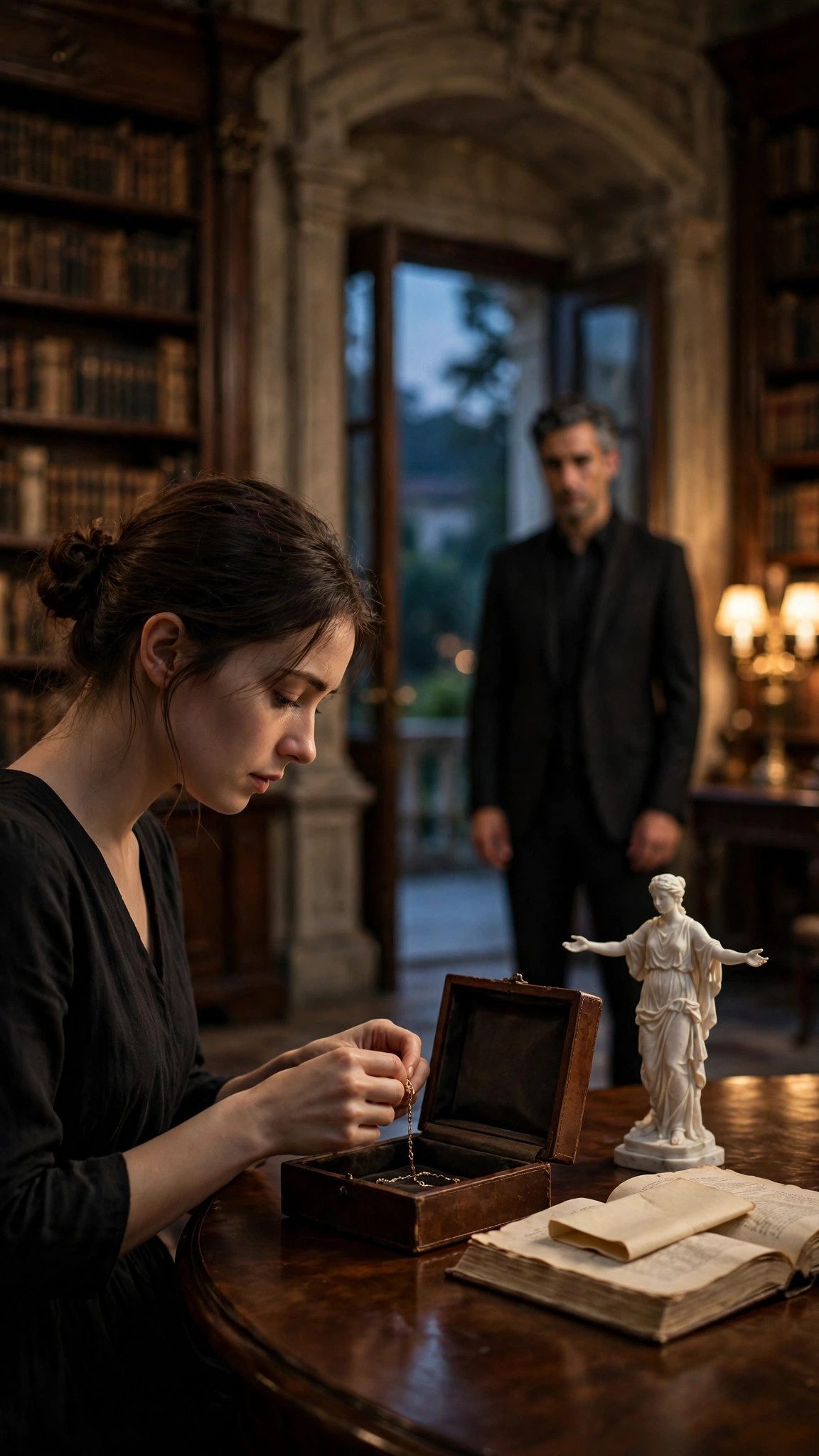
Giulia left on a Thursday morning in November, three weeks after the night in the study.
She had spent those three weeks the way a woman spends the weeks before a journey she does not want to take: quietly, carefully, putting things in order. She cleaned her room. She folded the dresses and laid them on the bed. She wrapped the statue in tissue paper. She put the necklace and the earrings in their velvet boxes. She placed everything in the leather box, one piece at a time, the way you lay flowers on a grave.
Last, she took the gold bracelet from her wrist, and she held it for a moment, and she remembered Elena's hands, light as a bird, and Elena's voice saying that she was the daughter she never had. The bracelet was different. The bracelet had been given in love, not in fear. But it had his name on it too, in the end, because everything in that house had his name on it, and she could not keep one piece and return the rest without the whole thing becoming a lie.
She put the bracelet in the box, beside the statue, and she closed the lid.
Then she sat down at the small desk in her room, and she took out a sheet of paper, and she wrote the letter. She wrote it slowly, because she wanted every word to be true, and she wanted it to be the kind of letter a person keeps, not the kind a person burns.
She began it with the word Victor.
"Victor," she wrote, "I do not hate you. I want you to know that first, because everything else I have to say will be easier to hear if you know that. I do not hate you. I love you. I have loved you for a long time, and I think you know that, because you have always known more than you let yourself say.
"But the man I love is not the Boss. The man I love is the man who sat with his dying mother and held her hand. The man I love is the man who left coffee outside a study door and noticed that my hands got cold. The man I love is Victor, the boy who picked dandelions and brought them to his mother because he thought they were the most beautiful flowers in the world.
"I cannot live beside the Boss. I have tried. For three years I have tried, and I have told myself that the gifts meant love, and that the fear was only the world's problem, not ours. But it is ours, Victor. It is in this house. It is in the way your men lower their eyes. It is in the way my friend's hands shook when she heard your name. It is in the way Antonio the baker does not sleep.
"I am returning every gift you ever gave me, because gifts bought with fear are not gifts. I am keeping nothing, because I want you to understand that I did not stay for the gifts. I stayed for you. And I am leaving for the same reason.
"If you ever want to find me, do not send your men. Do not send your cars. Do not send your money. Come yourself. Come without your guards and without your name. Come as Victor. And knock on my door the way an ordinary man knocks, and ask me, the way an ordinary man asks, if I will come home.
"Giulia."
She folded the letter, and she pressed it between the pages of a book — the book of poems Elena had loved, the one with the worn leather cover — and she left it on the polished table in the library, where she knew he would find it.
And then she walked toward the door.
Raphael found the letter an hour later. He had come home early from a meeting, and the villa was quiet, and he had gone to the library looking for her, the way he had gone to the library looking for her every evening for three years, and the room was empty. The book was on the table. The letter was inside it. The leather box was on the table beside the book, closed, its lid smooth and dark.
He stood there for a long time, holding the letter in his hands, and he did not open it at first, because some part of him already knew what it would say, and some part of him was afraid to know.
When he finally read it, he read it twice. Then he read it a third time. Then he sat down in Elena's old chair by the window, and he put his face in his hands, and he stayed that way for a very long time.
Charles found him there an hour later.
"Boss," Charles said, and then he stopped, because in twenty years of service he had never once seen Raphael Carbone sit with his face in his hands.
"She is gone," Raphael said, without looking up.
"Giulia?" Charles said. "Gone where?"
"She returned everything," Raphael said. "Every gift. She put them in a box and left them on the table. And she left me a letter."
Charles was silent for a moment. Then he said, carefully, "Shall I send men to bring her back?"
Raphael looked up then, and his eyes were red, and Charles took a step backward, because he had never seen the boss cry, and he did not know what to do with a boss who cried.
"No," Raphael said. "No men. No cars. No money. She said to come myself. She said to come as Victor."
"Boss, with respect," Charles said, "you are not Victor. You are the head of this family. You cannot go knocking on doors like an ordinary man."
"Then what am I?" Raphael asked, and his voice was quiet, so quiet that Charles had to lean forward to hear it. "If I am not Victor, and I am not the man she loves, then what am I? A name that frightens people? A chair that men bow to? Is that all I am?"
Charles had no answer. He had served Raphael's father, and he had served Raphael, and he had never once been asked a question he could not answer with a plan. But this was not a question with a plan in it. This was a question with a wound in it.
Raphael stood up, and he put the letter in his jacket pocket, next to his heart, and he walked out of the library, and he went to the door, and he did not call for his car, and he did not call for his men. He walked, alone, down the hill from the villa, through the streets he had ruled for twenty years, to the small flat where Giulia had gone to stay with her friend Marta.
He stood outside her door as the silence stretched. No words were spoken. He saw her, through the small window beside the door, sitting at a table with a cup of tea, and something in his expression changed. He raised his hand to knock, and then he lowered it, because he did not know what he would say if she opened the door.
He stood there for a long time. Then he turned around and walked back up the hill, alone, in the dark.
The next day, he came back. He knocked softly, as he had the day before, and this time Giulia opened the door.
She stood in the doorway, and she looked at him, and he looked at her, and neither of them spoke for a long moment.
"I read your letter," he said.
"I know," she said.
"I did not send men," he said. "I did not send cars. I came myself."
"I know," she said again.
He stood there, and he did not know what to do with his hands, and for the first time in his life, Raphael Carbone, the most feared man in the city, stood in front of a woman and felt helpless. He had built an empire on the certainty that he could make anyone do anything. And now he was standing outside a door, asking, without words, for something no amount of power could buy.
"I am not here to take you back," he said finally. "I am here because your letter said to come as Victor, and I do not know how to be Victor anymore. But I want to learn. And I thought that perhaps, if I stood here long enough, and if I came back tomorrow, and the day after that, you might teach me."
Giulia looked at him for a long time. Then she nodded, once, the way he always nodded when a matter was settled.
"Tomorrow, then," she said, and she closed the door.
He came back the next day. And the day after that. And the day after that. He came every day, and he knocked softly, and he stood outside her door, and he spoke. Not with demands. Not with power. Just with words that grew simpler and quieter each time. He told her about his day. He told her about the shipments and the warehouses, and then he stopped telling her about the shipments and the warehouses, and he told her about the garden, and about the roses, and about the dandelions he had picked when he was a boy.
He stayed outside her door. No surveillance. No guards. No men outside her door. Just a man, standing alone, learning how to knock.
And Giulia, sitting on the other side of that door, listened. And slowly, very slowly, she began to believe that the man on the other side of the door might be someone she could come home to. Not yet. Not today. But someday, perhaps, if he kept coming back, and if he kept knocking softly, and if he kept learning how to be Victor, then someday she might open the door and let him in.
But before any of that, there had been the days after she left, when the villa was empty and Raphael Carbone learned what his house sounded like without her in it.
The first morning, he came downstairs and the coffee was not ready, because no one had ever made the coffee but Giulia, and Rosa was in the kitchen with her hands on her hips, looking at him the way a mother looks at a son who has broken something precious and does not know how to fix it.
"She is gone because of you," Rosa said, and her voice was not unkind, but it was not gentle either. "Not because of the family. Not because of the money. Because of you. Because you gave her things instead of yourself, and you thought that was enough, and it was never enough. Signora Elena knew it. She told me so, before she died. She said, 'That boy gives gifts because he is afraid to give himself.' And she was right."
Raphael said nothing. He went to the library, and he sat in Elena's old chair by the window, and he took the letter out of his jacket pocket, and he read it again. He read it until the words blurred, until the paper was soft at the edges from his fingers, until he knew it by heart: Victor. I do not hate you. I love you. Come as Victor. Knock on my door the way an ordinary man knocks.
Charles found him there that evening, and he sat down across from him without being asked, which was something Charles had never done in thirty years.
"Boss," Charles said, "I have a question for you, and I want you to answer it honestly, because I have never once lied to you, and I will not start now. When you stood outside that girl's door, with no guards and no men, were you afraid?"
Raphael thought about it for a long time. "Yes," he said finally. "I was terrified. I have faced men with guns and I have never been afraid. But standing outside her door, with nothing in my hands, I was afraid she would not open it."
"Then you are learning something," Charles said. "Fear is not only something you give to other people. It is something you feel yourself, when you want something and you cannot take it. That is what it is to be an ordinary man, Boss. And it is not a weakness. It is the beginning of being human again."
Raphael nodded, and he put the letter back in his pocket, and he went to bed, and he lay awake for a long time, listening to the quiet of the villa, and thinking about the boy who had picked dandelions, and about the man he had become, and about the distance between them, which was not as far as he had always believed.
And on the other side of the city, in Marta's small flat, Giulia was lying awake too, listening to the rain on the window, and thinking about the train she would take in the morning, and about the small town she had never seen, and about whether she was doing the right thing. Marta slept in the next room, and the flat was warm, and Giulia was safe, and she was free, and she had never been more frightened in her life. Because freedom, she was learning, is not the absence of fear. It is the decision to walk forward anyway, even when you are afraid, and to trust that the person you love will learn to walk beside you, instead of ahead of you, clearing the path with threats.
In the morning, she packed her small bag, and she hugged Marta, and she went to the station, and she bought a ticket north, to a town with a university and a river and streets lined with trees. And as the train pulled away from the city, she pressed her forehead to the cold window, and she whispered, "Come as Victor," to the glass, and to the morning, and to the man she loved, wherever he was.