The second ball came a year later, and by then Giulia had learned to watch people the way Elena had once taught her to watch them: not for what they said, but for what their hands did when they thought no one was looking.
She stood at the top of the stairs that night in a dress of deep blue, the pearl earrings in her ears, the gold bracelet on her wrist, and she watched the guests arrive. She watched the men in their black suits and the women in their shining gowns, and she watched what happened to their faces when they said his name.
It was a small thing. It was always a small thing. A man would be laughing, and then someone would say, "Raphael Carbone is coming," and the laughter would stop, not all at once, but the way a light dims when someone turns a switch halfway. A woman would be telling a story, and she would lower her voice when she mentioned the family, as if the walls themselves might be listening. A waiter, carrying a tray of champagne, would go still when Raphael passed, the way a deer goes still when it smells a wolf.
Giulia had seen it before. She had seen it a hundred times in three years. But that night, for the first time, she saw it through someone else's eyes, because her friend Marta was standing beside her, and Marta had never been to the ball before, and Marta's face did what everyone's face did.
"Is that him?" Marta whispered, as Raphael crossed the ballroom, and the crowd parted around him the way water parts around a stone.
"Yes," Giulia said.
Marta's hand found Giulia's arm and held it, and her fingers were cold.
"He frightens me," Marta said. "I did not think he would frighten me. But he does. Everyone is afraid of him, Giulia. Can't you feel it? The whole room is afraid."
Giulia looked at the room. She looked at the glittering people, at the chandeliers, at the orchestra playing in the corner, at the champagne in the crystal glasses. And she saw what Marta saw, because for the first time she was looking at it from the outside, the way a stranger would.
The room was beautiful. The room was also afraid.
That night, after the ball, Marta stayed late, and they sat in the kitchen with Rosa, drinking tea that had gone cold, and Marta told her a story Giulia had never heard before.
"Do you remember my cousin Antonio?" Marta said. "The one with the bakery on Via Roma?"
Giulia nodded. She had met Antonio once, a cheerful man with flour on his apron and a laugh that filled a room.
"Two years ago, Antonio's ovens broke," Marta said. "All three of them, in the same week. He needed money to fix them, and the bank would not lend to him, so he went to a man who lends money for the family. He borrowed eight thousand dollars. He paid it back, every cent, but he was two weeks late on the last payment, because his daughter was sick, and he had to choose between the medicine and the money."
Marta's voice shook. "They came to his bakery at night. Three men. They did not hurt him. They did not have to. They stood in his shop and they told him, very politely, that if he was ever late again, they would break his hands. His hands, Giulia. The hands he bakes with. He has not slept properly since. He jumps every time the door opens. He is afraid of his own shadow, and he was never afraid of anything before."
Giulia sat very still. The kitchen was warm, and the tea was cold, and Rosa was looking at her hands, and Marta was looking at Giulia, and Giulia was looking at nothing at all, because she was seeing the villa, and the ballroom, and the men who parted like water, and she was understanding something she had been refusing to understand for three years.
Raphael had not sent those men. She knew that. She knew it the way she knew her own name. But the men had come in his name. They had spoken with his authority. They had used his fear the way a man uses a tool, and the fear had done its work, and Antonio the baker had not slept properly since.
"That is not who he is," Giulia said, but her voice sounded thin, even to herself.
"Isn't it?" Marta said gently. "Giulia, I love you, and I know you love him. But look at what his name does. Look at what it did to this room tonight. Look at what it did to Antonio. That is who he is to the rest of the world. The man you see is not the man the world sees."
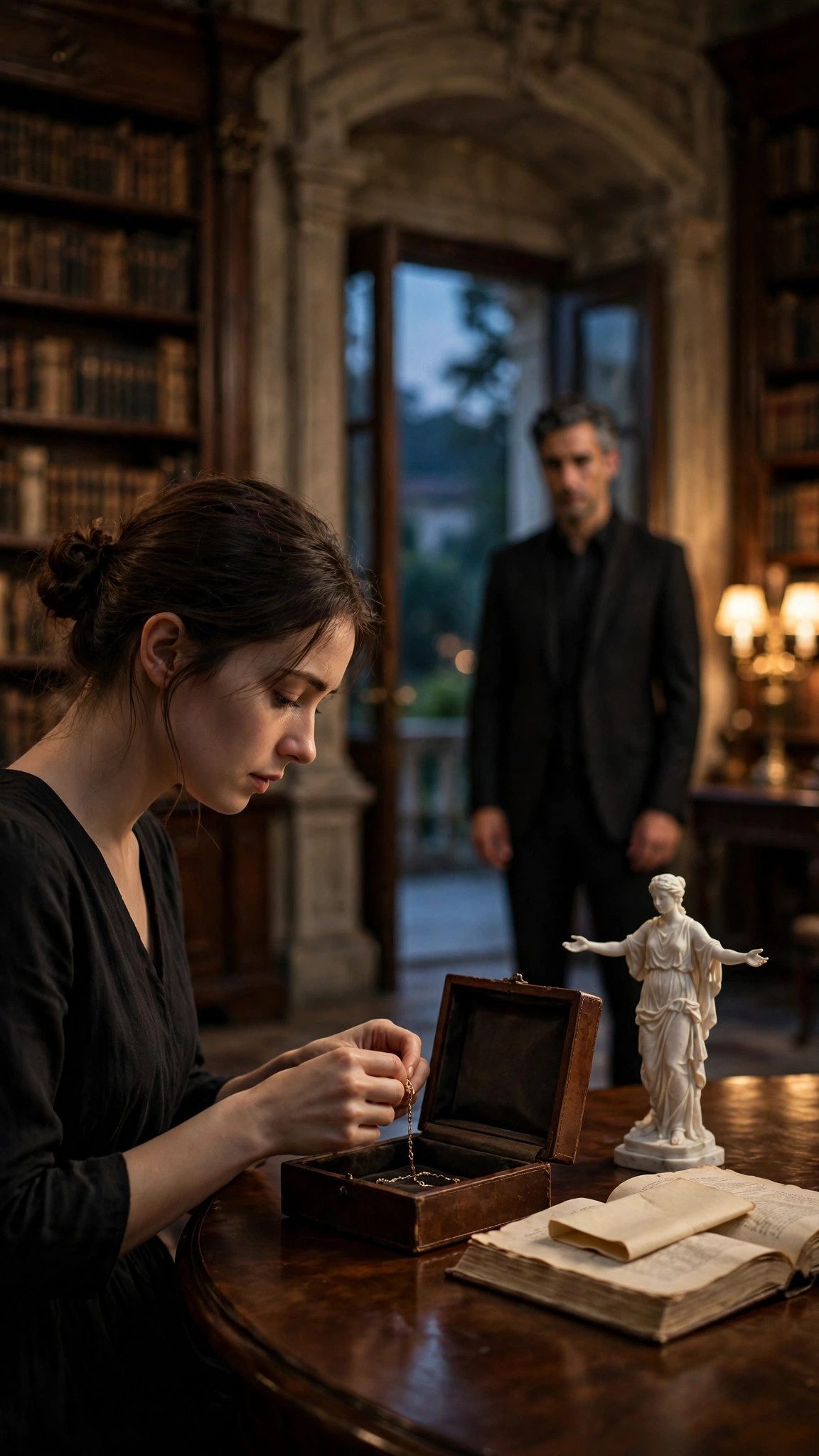
After Marta left, Giulia sat alone in the library for a long time, with the marble statue on the table beside her, and she thought about the gifts. The necklace. The earrings. The shawl. The dresses. The statue. Each one beautiful. Each one chosen with care. Each one a word he could not say.
And she thought about what Marta had said, and about what she had seen at the ball, and about the restaurant man who had owed forty thousand dollars, and about the way the whole house stood up when Raphael walked into a room, and about the way his own men lowered their eyes when they spoke to him, and she understood, finally, what the gifts were.
They were not gratitude. They were not love. They were the price of fear. He gave things to the people he valued because he did not know how to give them safety. He gave things because giving was the only way he knew to say: you are mine, and because you are mine, no one will hurt you. But the gifts did not make anyone safe. They only marked the people who belonged to him, the way a brand marks cattle.
She thought about her own life in the villa. She thought about the room on the second floor, and the keys that opened every door except the study, and the dresses that were not hers, and the necklace that was worth three months of her wages, and she asked herself a question she had never dared to ask before: if she left tomorrow, what would she take with her?
The answer frightened her. She would take the bracelet, because Elena had given it to her, and Elena had loved her. Everything else — the necklace, the earrings, the shawl, the dresses, the statue — belonged to him. They had always belonged to him. They were not gifts. They were chains, beautiful and golden and soft, but chains all the same.
The next morning, she went to Raphael's study. It was the first time she had ever knocked on that door without being called, and the sound of her own knuckles on the wood surprised her.
"Come in," he said.
He was sitting at his desk, a letter in his hand, and he looked up when she entered, and his face did what it always did when he saw her: it softened, just a little, around the eyes.
"Giulia," he said. "Is something wrong?"
She stood in front of his desk, and she looked at him, and she tried to find the words. She had practiced them all night, lying awake in her room, staring at the ceiling, but now that she was here, the words would not come in the order she had planned.
"Do you know what your name does to people?" she asked.
He frowned. "What do you mean?"
"At the ball last night," she said, "I watched the room when you walked in. Everyone stopped laughing. Everyone lowered their voice. My friend Marta was frightened, and she had never even met you. She was frightened of your name."
"That is respect," he said.
"No," Giulia said, and her voice was steady, because she had decided that if she was going to say this, she was going to say it plainly, the way she had always spoken to him. "That is fear. Respect is when people stand taller because you are in the room. Fear is when they make themselves smaller. I watched them make themselves smaller, Raphael. All of them. Even your own men."
He was very still. The letter in his hand did not move.
"Antonio the baker," she said. "Marta's cousin. He borrowed money from your men, and he was two weeks late, and three men came to his shop at night and told him they would break his hands. He has not slept since. Is that respect?"
"I did not send those men," Raphael said, and his voice was cold now, the voice of the boss.
"But they came in your name," Giulia said. "They used your fear. And you let them, because fear is how this family has always worked. Fear is the currency, Raphael. You taught them that. You taught all of them that."
He stood up then, slowly, and he came around the desk, and he stood in front of her, and for a moment she thought he was going to be angry. She had seen him angry once, at a man who had lied to him, and it had been a terrible thing to see, the way a storm is terrible to see from a window.
But he was not angry. He was something worse. He was confused, the way a man is confused when someone tells him that the ground he has been standing on his whole life is not ground at all, but a floor someone else built.
"I protect my people," he said.
"You frighten your people," Giulia said. "And you frighten the people who love you most of all. You frighten me, sometimes. Not because you would ever hurt me. But because I look at the life you have built, and I see a man standing alone in the middle of it, holding gifts in his hands, and wondering why no one will come close enough to take them."
She turned then, and she walked to the door, and she stopped with her hand on the handle, and she said the last thing she had practiced all night, the thing she had been most afraid to say.
"If respect only stays while you stand still and hold a gun in your hand, then it is not respect at all. And if I stay here, and I keep taking your gifts, and I keep telling myself that they mean love, then one day I will wake up and I will be afraid too. And I do not want to be afraid. Not of you. Not of anyone. Not ever again."
She left the study, and she closed the door behind her, softly, the way you close the door of a room where someone is sleeping. And she went to her room, and she opened the drawer where she kept the gifts, and she looked at them for a long time: the necklace, the earrings, the shawl, the dresses, the statue.
The next morning, before the sun was fully up, Giulia walked down the hill from the villa to Antonio's bakery on Via Roma, because she needed to see with her own eyes what fear had done to a man who had done nothing wrong.
The bakery was small and warm, and it smelled of yeast and sugar, and Antonio was behind the counter in his flour-dusted apron, shaping loaves with hands that shook, just slightly, every time the bell over the door rang. He smiled when he saw her, because he was a man who smiled even when he was afraid, but the smile did not reach his eyes, and his eyes kept going to the door, and to the window, and to the street outside, as if he were waiting for something to come through it.
"Antonio," Giulia said gently, "Marta told me what happened. About the men. About your hands."
Antonio's hands stopped moving. He looked down at them, at the flour on his knuckles, at the small scar on his thumb from a burn he had gotten twenty years ago.
"I am not angry," he said. "I know it was not the boss himself. But it does not matter whose hands held the knife, Giulia. It matters that the knife was there. My daughter asks me why I check the locks three times every night. What do I tell her? That the men who came to our shop were only being polite?"
Giulia bought a loaf of bread she did not need, and she paid him, and she walked back up the hill to the villa with the bread warm against her chest, and she thought about his hands, and about the way they shook, and about the way he smiled while he was afraid. And she understood, finally and completely, that fear does not stay where it is put. It spreads, the way water spreads through a house when a pipe breaks, quietly, in the dark, until everything is wet.
She did not pack them that night. She was not ready yet. But she knew, as she stood there in the dark, that the decision had already been made, the way a seed is already a tree before it ever breaks the ground.
She was going to return every gift he had ever given her. And then she was going to leave. And he was going to have to decide, for the first time in his life, what a man does when fear stops working.
On Sunday, her mother called, as she did every Sunday, and asked if Giulia was eating enough, and if she was sleeping enough, and if the people in the big house were treating her kindly. Giulia held the telephone to her ear, and she looked out of her small window at the garden below, and she almost told her mother the truth. She almost said, "Mama, I am in love with a man whose name frightens people, and I am going to leave him, and I do not know if I am brave or foolish." But she did not say it, because she was not ready to hear her mother's answer, and because some truths have to be lived before they can be spoken. "I am eating enough, Mama," she said instead. "And I am sleeping enough. And I am going to be all right. I promise you that."