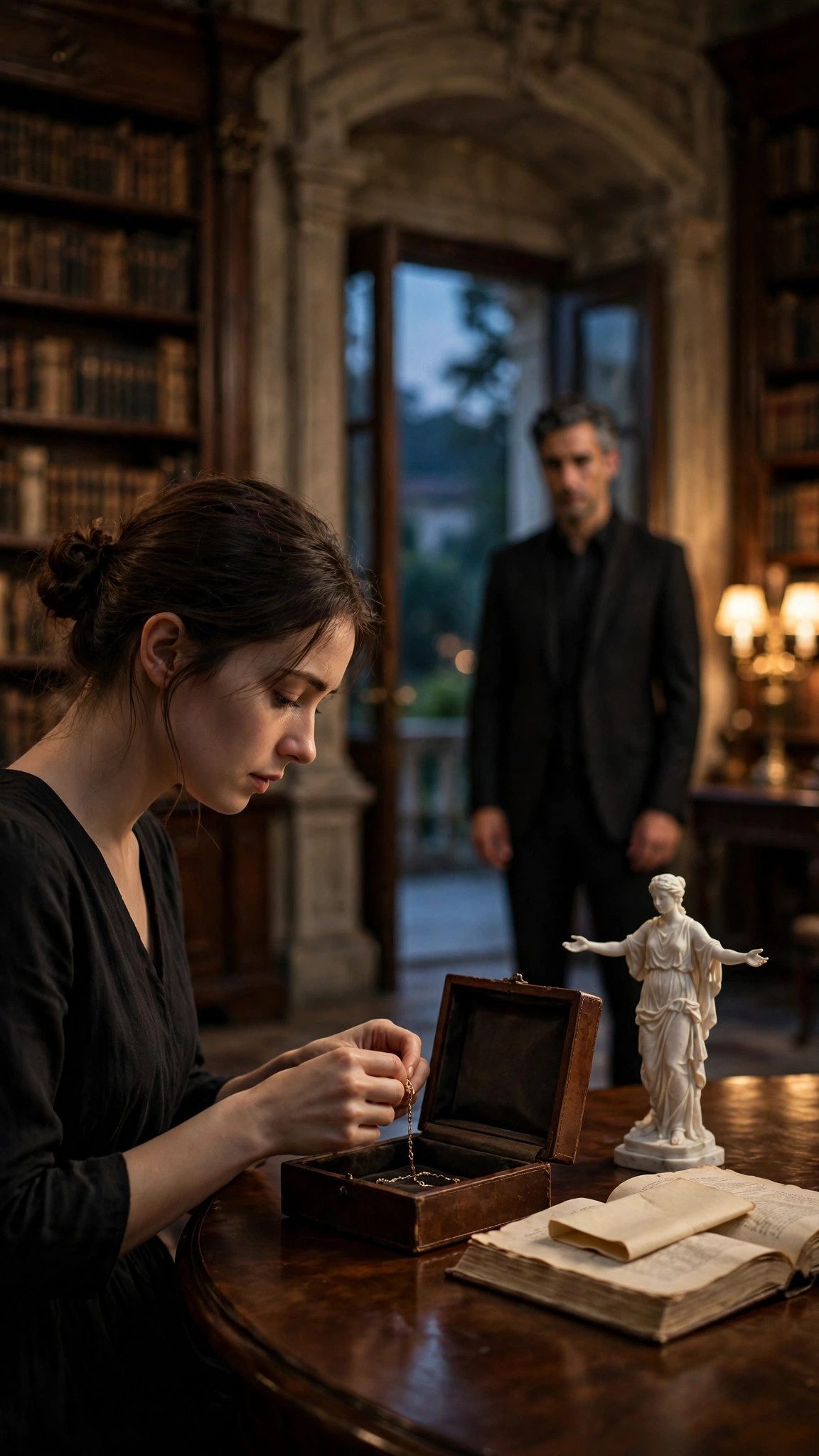
Vincent Castellano had been waiting for a weakness in Raphael Carbone for fifteen years, and when Giulia left the villa, he thought he had finally found one.
Castellano was sixty years old, with silver hair and a smile that never reached his eyes, and he ran the north side of the city the way a spider runs a web: quietly, patiently, and always from the center. He had watched Raphael's father, and then Raphael, and he had learned everything there was to learn about the Carbone family except one thing: how to break it. He had tried money. He had tried threats. He had tried taking their docks and their trucks and their men. Nothing had worked, because Raphael Carbone had never once shown fear, and a man who shows no fear is very hard to break.
But now Raphael was standing outside a woman's door every day, alone, without guards, knocking softly like a boy asking for a dance. And Castellano smiled his smile that never reached his eyes, and he said to his lieutenant, Dominic Voss, "The boss has gone soft. Let us see how soft."
It started small. A car with dark windows began parking on Giulia's street at night, its engine running, its headlights off. The men inside did not get out. They did not have to. Their presence was the message, and the message was simple: we know where she lives, and we know she is alone.
Then the whispers began. In the restaurants and the bars and the clubs where the city's important people gathered, men began to say, very quietly, that Raphael Carbone had lost his woman, and that a man who cannot keep his own woman cannot keep his family. They said it the way men always say such things: as a joke, with a laugh, and then they watched to see who laughed with them.
Then the threats began. Marta's cousin Antonio, the baker, found a note on his shop door one morning: a single sheet of paper, with one sentence written on it in block letters. "TELL YOUR COUSIN TO COME HOME." Antonio brought the note to Marta, and Marta brought it to Giulia, and Giulia brought it to Raphael, and Raphael read it, and his hands, which had been learning how to be still, closed into fists.
"He is using her," Charles said, when Raphael showed him the note. "He is using the girl to get to you. He wants you to do something foolish. He wants you to send your men to his territory and start a war."
"Then what do I do?" Raphael asked. "Do I stand here and let him frighten her? Do I let him frighten Antonio? Do I let him frighten Marta?"
Charles was quiet for a moment. Then he said, "Boss, I have served this family for thirty years, and I have never once told you what to do. But I will tell you this. If you send your men to Castellano's territory tonight, with guns, then you will win the night, and you will lose everything your letter was about. Because the moment you answer fear with fear, you prove that fear is the only language you speak. And the girl will hear it, wherever she is, and she will know that nothing has changed."
Raphael looked at the note for a long time. Then he folded it, and he put it in his jacket pocket, next to Giulia's letter, and he said, "Then we will answer him in a different language."
That night, Raphael Carbone went to the Meridian Club, the most public place in the city, the place where every important man in the city drank and talked and watched each other. He went alone, without guards, without men, without a gun. He walked through the doors in his black suit, and the room went quiet, the way rooms always went quiet when he walked into them, and he crossed the floor to the table where Vincent Castellano sat with his lieutenant and his men, drinking whiskey and smiling his smile.
Castellano looked up, and his smile widened.
"Raphael," he said. "To what do I owe this pleasure?"
"You sent a car to Giulia Ferraro's street," Raphael said, and his voice was calm, and it carried across the room, and every man in the club stopped talking to listen. "You sent a note to a baker. You have been telling men in this city that I have gone soft."
Castellano spread his hands. "I have no idea what you are talking about."
"Then let me make it clear," Raphael said, and he leaned forward, and he put both hands on the table, and he looked Castellano in the eyes. "Giulia Ferraro is under my protection. Not because she belongs to me. She does not belong to me. She belongs to herself. She is under my protection because she is a good woman, and good women are not to be frightened in my city. If any man in this room frightens her, or frightens her friends, or frightens a baker who has done nothing wrong, then that man will answer to me. Not with a gun. Not in the dark. Here. In the open. In front of everyone. Because I am done with fear, Vincent. I am done with the dark. From now on, everything I do, I do in the light, where everyone can see it."
The room was silent. Castellano's smile did not move, but something behind it did, the way a wall shifts when the ground underneath it moves.
"You have gone soft, Raphael," Castellano said softly. "A boss who talks about the light is a boss who has forgotten the dark."
"Then I have forgotten it," Raphael said. "And I am better for it."
He turned then, and he walked out of the club, alone, and the room stayed silent behind him, and every man in that room watched him go, and every man in that room understood, whether he wanted to or not, that something had changed. The most feared man in the city had just walked into the most public room in the city, unarmed and alone, and he had not threatened anyone. He had protected someone. And protection, offered openly, without fear behind it, was a thing none of them had ever seen before.
The car disappeared from Giulia's street that night. The whispers stopped. Antonio the baker slept through the night for the first time in two years, and in the morning he opened his shop and he baked his bread, and he did not jump when the door opened.
And Giulia, sitting at her table with her cup of tea, heard about what had happened at the Meridian Club, because Marta told her, and Marta had heard it from Antonio, and Antonio had heard it from a man who had been in the room. And Giulia sat very still, and she thought about the man who had walked into a room full of his enemies, alone and unarmed, and who had spoken about the light.
That evening, when Raphael came to her door, and he knocked softly, she opened it before he could knock a second time.
"I heard what you did," she said.
"I did it for you," he said. "But I also did it for me. Because your letter was right. I had taught people to fear me, not to trust me. And if respect only stays while I stand still and hold a gun in my hand, then it is not respect at all. I am learning that now. Slowly. But I am learning."
Giulia looked at him, and she saw the man who had stood in the Meridian Club, and she saw the boy who had picked dandelions, and she saw, for the first time, that they might be the same person after all.
"Come in," she said. "Just for tea. Just for tonight."
He came in. He sat at her small table. He drank her tea. He did not bring guards. He did not bring gifts. He brought only himself. And for the first time since she had left the villa, Giulia felt the quiet in the room change, the way a room changes when the winter is ending and the light is coming back through the window.
But the night at the Meridian Club had not come easily, and it had not come without a fight inside his own house first.
The day after the note appeared on Antonio's door, Raphael called his men into the study, and the study filled with the smell of leather and cigar smoke and old anger. Enzo stood by the window, his arms crossed. Frankie, the youngest of the capos, paced by the fireplace. Dominic Voss's name was spoken like a curse. Castellano's name was spoken like a war drum.
"We go tonight," Frankie said. "We go to Castellano's territory, and we burn his cars, and we break his lieutenant's hands, and we send a message that no one touches the boss's woman."
"She is not the boss's woman," Raphael said quietly, and the room went still. "She is a woman. She is her own woman. And she left me because I treated her like something I owned. I will not win her back by proving to the whole city that I own her."
"Boss, with respect," Enzo said, and his voice was rough, "if we do nothing, they will think we are weak. And weak men in this city do not live long."
Raphael looked at Enzo for a long moment. He thought about the rainy afternoon in the courtyard, about the delivery boy, about Enzo's face when Giulia had stopped him, about the way Enzo had said that for the first time in twelve years he had gone home feeling like a man instead of a weapon.
"Enzo," Raphael said, "when Giulia stopped you in the courtyard, did you feel weak?"
Enzo frowned. "No, Boss. I felt… I felt like I had been given something. I do not know what it was."
"It was a choice," Raphael said. "She gave you a choice, and you chose to be a man instead of a weapon. I am giving you all the same choice tonight. We can answer Castellano with fear, and we can win the night, and we can lose everything. Or we can answer him in the open, in the light, where everyone can see, and we can win something that lasts longer than a night."
The room was silent. Frankie stopped pacing. Enzo uncrossed his arms. And one by one, the men in that room looked at their boss, and they saw something they had never seen before: a man who was not asking them to be afraid, but asking them to be brave in a different way.
The morning after the Meridian Club, Raphael did one more thing, alone, before he went to Giulia's door. He walked down the hill to Antonio's bakery on Via Roma, and he went inside, and the bell over the door rang, and Antonio looked up from his dough, and his hands went still.
Raphael took off his coat, and he hung it on the hook by the door, and he walked to the counter, and he stood there, in his shirtsleeves, in the warm smell of bread, and he said, "Antonio. My name is Raphael Carbone. Men who work for my family frightened you, and threatened your hands, and stole your sleep. I did not send them. But they came in my name, and that makes it my fault. I have come to apologize, and to tell you that it will not happen again. And I have come to ask you something."
Antonio stared at him. His mouth opened, and no sound came out.
"Will you teach me how to make bread?" Raphael asked. "My mother used to say that a man who knows how to make bread will never go hungry, and a man who knows how to wait for it to rise will never be in a hurry to hurt anyone. I would like to learn."
Antonio laughed then, a real laugh, the first real laugh Giulia had ever heard from him, and he wiped his hands on his apron, and he said, "You are a strange man, Signor Carbone. But yes. I will teach you. Come on Saturday, early, before the sun is up. That is when the bread is best."
Raphael came on Saturday, early, before the sun was up. He learned to knead, and to wait, and to listen for the sound the dough makes when it is ready. And Antonio watched him, and his hands stopped shaking, and that night, for the first time in two years, Antonio slept through the night, and he dreamed of nothing at all, which was the most peaceful dream he had ever had.
Word of the Meridian Club spread through the city the way news always spreads through the city: quickly, and in whispers, and with every retelling growing a little larger. Dominic Voss, Castellano's lieutenant, heard it in a bar on the north side, and he laughed, and he said the boss had gone soft, and that a soft boss was a dead boss. But the men at the bar did not laugh with him. One of them, an old soldier who had served Castellano's father, shook his head and said, "You do not understand, boy. Any man can walk into a room with a gun. It takes a different kind of man to walk into a room full of his enemies with nothing in his hands and tell them the truth. I have been in this life for forty years, and I have never once seen a boss do that. Mark my words. That man is not soft. That man is more dangerous than he has ever been, because now he has nothing left to lose, and a man with nothing to lose is the most dangerous man of all."
Dominic Voss did not laugh again. He finished his drink in silence, and he went home, and he told Castellano what the old soldier had said, and Castellano sat very still for a long time, staring at the wall, and then he poured himself another whiskey, and he said, very quietly, "Then we wait. We wait and we watch. And we do not touch the girl. Not now. Not ever. Because a man who will walk into my club alone to protect a woman will do anything, and I am not yet ready to find out what anything means."