Giulia left the apartment on the final night of November, and she boarded a train, and she did not tell Raphael where she was going.
It was not cruelty. She had told him the truth in her letter, and she had told him the truth at her door, and she had told him the truth over tea, and the truth had not changed: she loved him, but she could not come home to a life built on fear, even a life that was learning to change. She needed to know that the change was real, and that it would last, and that it was not only something he was doing to win her back. And the only way to know that was to step away from it, and to let him prove it without her watching.
She took the train north, to a small town she had never seen before, a town with a university and a river and streets lined with trees that had lost their leaves. She rented a small room above a bookshop, and she found work at the university, at the customer service desk in the main hall, answering questions for students who had lost their keys and their schedules and their way. It was simple work, and it was honest work, and no one in that town knew her name, and no one flinched when they heard it, and for the first time in five years, Giulia Ferraro was only herself.
She sat by the window of her small room at night, and she watched the cars pass on the street below, and she thought about the villa, and about the garden, and about the man who had stood outside her door and knocked softly, and she waited to see what he would do.
For two weeks, nothing happened. No cars. No men. No messages. No gifts. The silence was complete, and it frightened her more than any noise ever had, because she had told him to come himself, and he had come himself, and now she had left without telling him where she had gone, and she wondered if she had asked too much of him, and if she had lost him by asking for the one thing he could not give her: a life without fear.
Then, one cold morning in January, she looked up from her desk at the university, and she saw him.
He was standing in the doorway of the main hall, alone, in his black suit, with snow on his shoulders, and he looked out of place in a way that almost made her laugh: a man built for ballrooms and boardrooms, standing in a hallway full of students with backpacks and wet boots. He saw her, and he stopped, and for a moment neither of them moved.
Then he walked toward her, slowly, the way a man walks when he is afraid of frightening someone, and he stopped on the other side of the desk, and he stood there, and he waited.
"How did you find me?" Giulia asked.
"Charles found you," Raphael said. "I did not send him. He found you on his own, because he was worried about me, and he told me where you were, and he told me not to come. He said that if I came, I would ruin it. He said that a boss does not chase a woman across the country."
"And yet here you are," Giulia said.
"And yet here I am," he said. "I sat alone in the villa for two weeks, and I waited, and I thought about your letter, and about the Meridian Club, and about Antonio the baker, and about everything you said to me in the study that night. And I realized that I had been waiting for you to come back to my world. But my world was the problem. So I came to yours."
He looked around the hall, at the students, at the notice boards, at the rain on the windows, and he smiled, a small, uncertain smile, the smile of a man who is far from home.
"It is a good world," he said. "It is quiet. No one is afraid here. I can see why you like it."
Giulia felt her throat close. She had imagined this moment a hundred times, lying awake in her room above the bookshop, and in every imagining she had been strong and certain. But now that he was standing in front of her, in his black suit with snow on his shoulders, looking at her the way a man looks at the only good thing he has ever known, she was not strong and certain at all. She was a woman looking at a man she loved, and wondering whether love was enough.
"I am not coming back to the villa," she said quietly. "Not to the villa as it was. Not to the gifts, and not to the fear, and not to the name that makes rooms go quiet."
"I know," he said. "I am not asking you to. I am asking you to let me stay here, in your world, for a while. I am asking you to let me sit with you, and drink tea with you, and walk with you, and learn how to be a man who does not frighten people. I am asking you to let me be Victor, here, where no one knows the Boss at all."
She looked at him for a long time. Then she stood up from her desk, and she came around to his side, and she took his hand, and his hand was cold from the snow, and she held it between both of hers to warm it, the way she had once held his mother's hand.
"There is a small café on the corner," she said. "They make good soup. Come with me."
They walked to the café together, through the snow, and they sat by the window, and they ate soup, and they talked. He told her about the villa, about the garden, about Rosa, who sent her love and a jar of her almond biscuits. He told her about the family, about the men who had been frightened at first when he told them that things were going to change, and who had slowly, one by one, begun to believe him. He told her about the restaurant man, who had paid back his debt in full, and who had sent a letter thanking him, and who had invited him to dinner. He told her about Antonio the baker, who had started sleeping through the night, and who had named a new loaf of bread after her, though he did not know her name.
And Giulia told him about the university, and about the students, and about the bookshop below her room, and about the river, and about the way the light came through her window in the morning. And as they talked, the snow fell outside, and the café grew warm, and the space between them, which had been full of fear and gifts and names, grew smaller and smaller, until it was only the space between two people sitting at a table, drinking soup, and telling each other the truth.
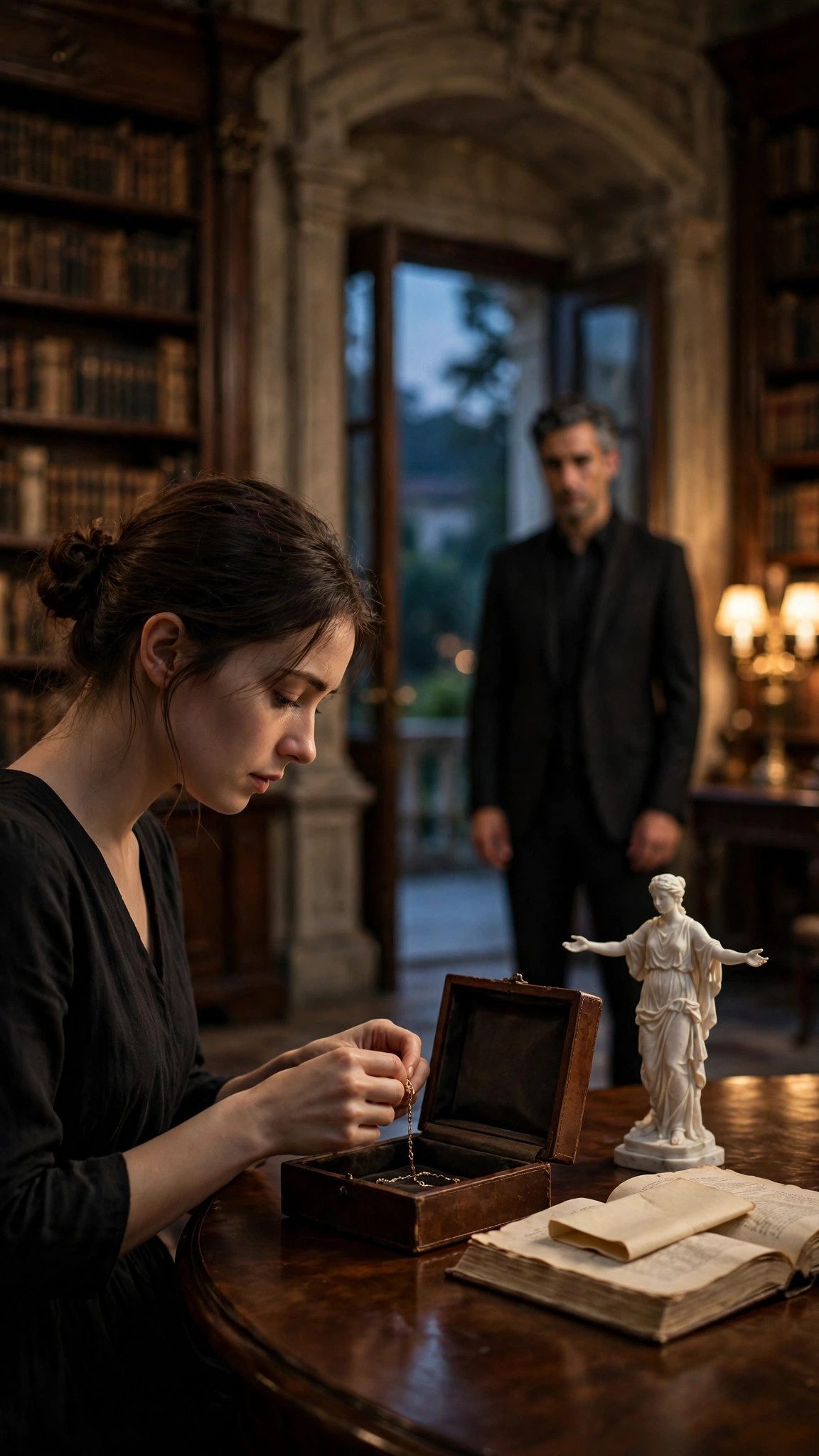
That night, back in her small room above the bookshop, Giulia opened the drawer where she kept her few belongings, and she took out the two small bracelets she had bought in the town market the week before. They were simple things, thin bands of silver, nothing like the gold bracelet Elena had given her, nothing like the gifts he had given her. They were plain, and they were cheap, and they were hers.
She laid out a table, and she placed the two small bracelets on it. One for him, and one for her.
She sat looking at them for a long time, and she thought about what they meant. They were not gifts. A gift is something one person gives to another, and it carries the weight of the giver. These were something else. They were a promise, made by two people at the same time, in the same place, with the same words. They said: I choose you, and you choose me, and neither of us is afraid, and neither of us owes the other anything at all.
She picked up one of the bracelets, and she held it in her hand, and she knew what she was going to do in the morning. She was going to lay the table, and she was going to place the two bracelets on it, and she was going to ask him to sit down, and she was going to tell him the last truth she had left to tell him.
She was going to tell him that she would come home, if he would come home with her. Not to the villa as it was. To a new house, in a new life, where the name on the door was Victor, and where the only gifts were the ones they gave each other freely, with open hands, and without fear.
But the weeks before that morning had been quiet ones, and they had taught her things she had not expected to learn.
Her room above the bookshop belonged to a widow named Mrs. Alden, seventy years old, with silver hair and a sharp tongue and a heart as soft as the bread Antonio made. On Giulia's first evening, Mrs. Alden brought her a bowl of soup and sat on the edge of the bed, and said, "You are running from something, child. I can always tell. But this is a good town for running to, not just running from. The river is kind. The people are kind. Stay as long as you need."
Giulia stayed. She learned the town the way you learn a new language: slowly, one word at a time. She learned the name of the man who sold flowers on the corner, and the name of the girl who worked in the bakery, and the name of the old professor who came into the bookshop every Tuesday to argue about poetry. She learned the way the light fell across the river in the morning, and the way the snow sounded when it fell on the roof at night, and the way it felt to walk down a street where no one knew her name, and where no one was afraid of it.
At the university desk, she found a different kind of purpose. The students came to her with small disasters: lost keys, lost schedules, lost courage before examinations. A girl named Sofia came in one morning in tears because she had lost her grandmother's ring, and Giulia helped her search the lost-and-found box, drawer by drawer, until they found it, tangled in a scarf at the very bottom, and Sofia cried with relief, and Giulia thought about how much of her life had been spent finding things that were lost, and how good it felt to find them.
A letter came from Rosa, two weeks after Giulia arrived, written in Rosa's careful handwriting on lined paper. "The villa is quiet without you," Rosa wrote. "The garden misses you. The roses are confused. The boss walks the halls at night, and he does not sleep, and he reads your letter every evening in the library, and I think he is learning something, though I do not know what it is yet. Come home when you are ready, child. Not before. The house will wait for you. Houses are patient. Men are not, but houses are."
Giulia read the letter three times, and she put it in the drawer with the two silver bracelets, and she thought about the villa, and about the garden, and about the man who walked the halls at night reading her letter, and she wondered if he was learning, and if the learning would last, and if it was enough.
And in the villa, on the other side of the country, Raphael was sitting in the library on the fourteenth night after she left, reading her letter for the hundredth time, when Charles came in without knocking, which Charles had never done in thirty years.
"I found her," Charles said.
Raphael looked up, and his hands went still on the paper.
"Where?"
"A small town, north, with a university," Charles said. "She works at the customer service desk. She has a room above a bookshop. She is well. She is safe. No one there knows who she is, and no one is afraid of her. She is happy, Boss. Or as happy as a woman can be when she is waiting for something."
"Waiting for what?" Raphael asked.
"For you to decide what kind of man you are going to be," Charles said. "And I told you not to go, because a boss does not chase a woman across the country. But I am going to tell you something else now, and I want you to listen. I have served this family for thirty years, and I have never once seen the boss do the brave thing when the easy thing was standing right there. Going to her is the brave thing. Staying here is the easy thing. And I think you already know that."
Raphael stood up, and he put the letter in his pocket, and he went upstairs, and he packed a small bag, the way an ordinary man packs a bag, with a change of clothes and a book and nothing else. He did not call for his car. He did not call for his men. He walked to the station in the dark, and he bought a ticket north, and he boarded a train, and he sat by the window, and he watched the city fall away behind him, and he thought about the woman waiting in a small town with a university and a river, and about the two silver bracelets he did not yet know she had bought, and about the question he was going to ask her when he found her.
He was going to ask her if he could stay. Not as the Boss. As Victor. As a man who had finally learned how to knock.