The law moved slowly, the way the law always moves, but it moved.
On Tuesday morning, Alessandro took his father's ledger to the chief of police, a man named Commissioner Ricci — no relation to Paolo — who had been waiting for twenty years for someone in the DeLuca family to walk through his door with evidence instead of a bribe. Marco testified. The two men from my bedroom testified. The accountant produced his second set of books. And within a week, Dominic Voss was arrested at the airport, trying to board a plane to Dubai with a suitcase full of cash. Within a month, Vincent Castellano was arrested at his villa on Lake Como, in his dressing gown, shouting that the DeLucas had no right, that no one had the right, that this was a war and wars did not end in courtrooms.
He was wrong. The trial lasted four months. I testified, in three languages, about the telephone calls I had overheard, and the mistranslations in the boardroom, and the night the men came to my room. Marco testified about the warehouse, and the man from Naples, and the threats against his wife and his son. The ledger testified loudest of all, in Vittorio DeLuca's careful handwriting, page after page of payments and dates and names, a record of betrayal so complete that even Castellano's lawyers could not explain it away.
Castellano was sentenced to life in prison. Voss was sentenced to thirty years. The two men from my bedroom were sentenced to eight years each, and they wept in the courtroom, and I felt nothing for them except a distant pity, the way you pity a storm that has passed.
Paolo's death was investigated too. The police found the men who had killed him at the station in Naples, and they were arrested, and they were sentenced, and I went to Paolo's grave one cold morning in November, and I stood there for a long time, and I thought about a nervous man who gambled, and who owed money, and who had been given no choice, and who had paid for it with his life. I left flowers. I did not forgive him, exactly. But I understood him. And understanding, I have learned, is the beginning of mercy.
The port venture flourished. Volkov's cranes arrived before winter, and Ferrante's ships filled the docks, and the Genoa port became the busiest on the Mediterranean. The deal that had nearly died in the boardroom became the foundation of something larger: a legitimate shipping company, owned jointly by the DeLucas, the Ferrantes, and the Volkovs, run by accountants and engineers instead of capos, paying taxes, hiring hundreds of people. Alessandro called it the new empire. I called it the honest one.
And the empire kept changing. Alessandro closed the businesses that could not survive in daylight. He sold the warehouses that had no purpose except to hide things. He ended the arrangements with the men who had profited from fear. Some of the old capos left, angry, calling him soft, calling him weak. He let them go. "An empire built on fear," he told me once, late at night in the library, "is an empire waiting to fall. An empire built on trust is an empire that lasts." He was right. The men who stayed were the loyal ones, and the loyal ones worked harder than the frightened ones ever had.
In the spring, we opened the school.
It was my idea, and Alessandro made it happen the way he made everything happen: quickly, completely, and without asking permission from anyone. We bought a building near the university, a beautiful old palazzo with tall windows and a garden, and we filled it with classrooms and books, and we named it the Marchetti School of Languages, after my father and my mother. It teaches seven languages — Italian, Russian, English, French, Spanish, German, and Arabic — to anyone who wants to learn, for free. The first students were the children of the dockworkers, and the daughters of the maids, and the sons of the drivers, children who had grown up the way I had grown up, believing that the world was closed to them. On the first day, I stood in front of a classroom of twenty children, and I wrote on the blackboard in seven languages, "The river is wide," and I watched their faces light up, and I thought about my father, testing me at the kitchen table, and my mother, laughing on the telephone in Russian, and I knew they would have been proud.
Rosa came to the opening. She wore her best coat, and she cried, and she told everyone who would listen that she had known me since I was a girl with a suitcase, and that she had always known I would do something extraordinary. She still works in the house, because she refuses to retire, but now she is the head of the household, and the maids call her Signora Rosa, and she pretends not to like it, and she likes it very much.
Marco Bellini's wife and son came to Milan, as Alessandro had promised. They live in a small house near the garden, and his son, whose name is also Marco, goes to the Marchetti School, and he is learning Russian, because he says he wants to speak to the woman who saved his father. Marco himself works in the shipping company now, counting cargo honestly, and he is a good man, and he will be a good man for the rest of his life, because mercy, once given, is a debt that can never be repaid, only passed on.
Enzo, my guard, is still my guard, though now he guards me as a friend, and he comes to Sunday dinner, and he tells terrible jokes, and Alessandro pretends to hate them, and laughs anyway.
And Alessandro — Alessandro is no longer just the Don. He is still the head of the family, still the man the city fears and respects, but he is also the man who comes home at night and takes off his jacket and sits in the library with me, reading, while the fire burns low. He is the man who learned Russian for me, one sentence at a time, and who is now learning Arabic, because he says a man should know all seven of his wife's languages, and I tell him he will never manage the pronunciation, and he tells me to wait and see.
We were married in June, in the garden of the DeLuca house, under the olive tree where Alessandro had once told me to keep talking. Rosa cried. Volkov came from Moscow, and he danced with Rosa, and he drank too much vodka, and he told everyone that I was the best negotiator he had ever met, and that he had once tried to hire me away from Alessandro, and that Alessandro had refused, and that he had never seen Alessandro so happy. Ferrante came from Genoa, and he brought his wife, and his wife told me that Ferrante had not smiled like that in years. My mother's sister came from Moscow, the aunt I had not seen since I was a child, and she wept, and she told me I had my mother's eyes, and my father's stubbornness, and that they would have loved Alessandro, because he was a man who had learned to listen.
I wore a white dress. Not a uniform. A white dress, simple and beautiful, with no apron, and no tray, and no one to serve but myself. And when Alessandro took my hand, and the priest asked if I would take this man, I answered in seven languages, one after another, because I could, and because it made everyone laugh, and because it was the truest thing I had ever said.
"Yes," I said, in Italian. "Da." In Russian. "Oui." In French. "Sí." In Spanish. "Ja." In German. "Na'am." In Arabic. "Yes." In English.
And then, because it was our wedding, and because I could not resist, I added one more, in the Neapolitan dialect my father had taught me, the dialect of the docks, the dialect of men who curse in their mother tongue: "Sì, pe' sempre." Yes, forever.
The garden erupted. Rosa wept. Volkov roared. Alessandro kissed me, and the olive tree shook in the summer wind, and the bells of the church down the hill began to ring, thin and golden, the way they had rung on the evening I first stepped into the boardroom.
The wedding preparations took a month, and Rosa supervised every detail with the iron hand of a general and the tenderness of a grandmother. She chose the flowers. She chose the music. She chose the dress, a simple white dress with no apron and no uniform, and when I tried it on, she wept, and she said, "Your mother would have loved this. She would have loved him, too. A man who learns Russian for love is a man worth marrying."
Volkov returned for the wedding, and he brought his wife, a formidable woman named Irina, who took one look at me and said, in Russian, "So you are the maid who saved my husband's money. I have heard a great deal about you. I approve." She became, over the course of the evening, one of my favorite people in the world.
In the first month of the school, we had two hundred students. By the third month, we had five hundred. The children of the dockworkers sat next to the children of the bankers, and they learned Italian and Russian and Arabic together, and they taught each other the way children always do, without fear and without prejudice. One afternoon, I walked into a classroom and found a boy of eight, the son of one of our drivers, teaching a girl of seven, the daughter of a judge, how to count to ten in Arabic, and I had to turn away, because my eyes were full of tears, and I did not want them to see their teacher cry.
Alessandro's Arabic lessons became the great comedy of our household. He practiced every morning, in the library, with a tutor I had hired, a patient woman from Cairo named Layla, and his pronunciation was, in the beginning, terrible. Rosa would stand in the doorway, listening, and she would shake her head, and she would say, "The Don can negotiate a two-billion-euro deal, but he cannot say 'good morning' in Arabic." Alessandro would laugh, and he would try again, and slowly, word by word, he got better, until one morning he greeted me in perfect Arabic, and I laughed, and I kissed him, and I told him he was the most stubborn student I had ever met.
In the autumn, the foundation gave its first scholarship, to a girl of seventeen whose parents had died, a girl with a suitcase full of books and no one to take her in. We brought her to the school, and we gave her a room, and a job, and a future, and when I looked at her, I saw myself, nine years earlier, arriving at the station with nothing, and I understood, finally, what my mother had meant when she wrote that one day the world would need me. The world had needed me. And now I was the world, for someone else.
On the first anniversary of the school, we held a celebration in the garden, and the children performed a play in seven languages, each child speaking a different tongue, telling the same story seven different ways, and the parents wept, and Volkov, who had flown in from Moscow for the occasion, stood up and said, in Russian, "I have built ships, and I have built companies, and I have never built anything as good as this." Alessandro took my hand, and he squeezed it, and he whispered, in Arabic, the language he was still learning, "You did this." And I whispered back, in Italian, "We did this."
That night, after the guests had gone, Alessandro and I sat in the garden, under the stars, and he held my hand, and he said, "Do you remember what you said to me, in the boardroom, on the first night?"
"I said I was a woman who could change everything," I said.
"And you did," he said. "You changed the deal. You changed the family. You changed the empire. You changed me."
I leaned my head against his shoulder. The garden smelled of jasmine. The house was quiet. The city spread out below us, gold and dark, and somewhere in it, in a building near the university, twenty children were dreaming in seven languages.
"I didn't change everything," I said. "I just finally spoke. The words were always there. I was just waiting for the right moment."
"Then I'm glad you waited," he said. "And I'm glad you spoke."
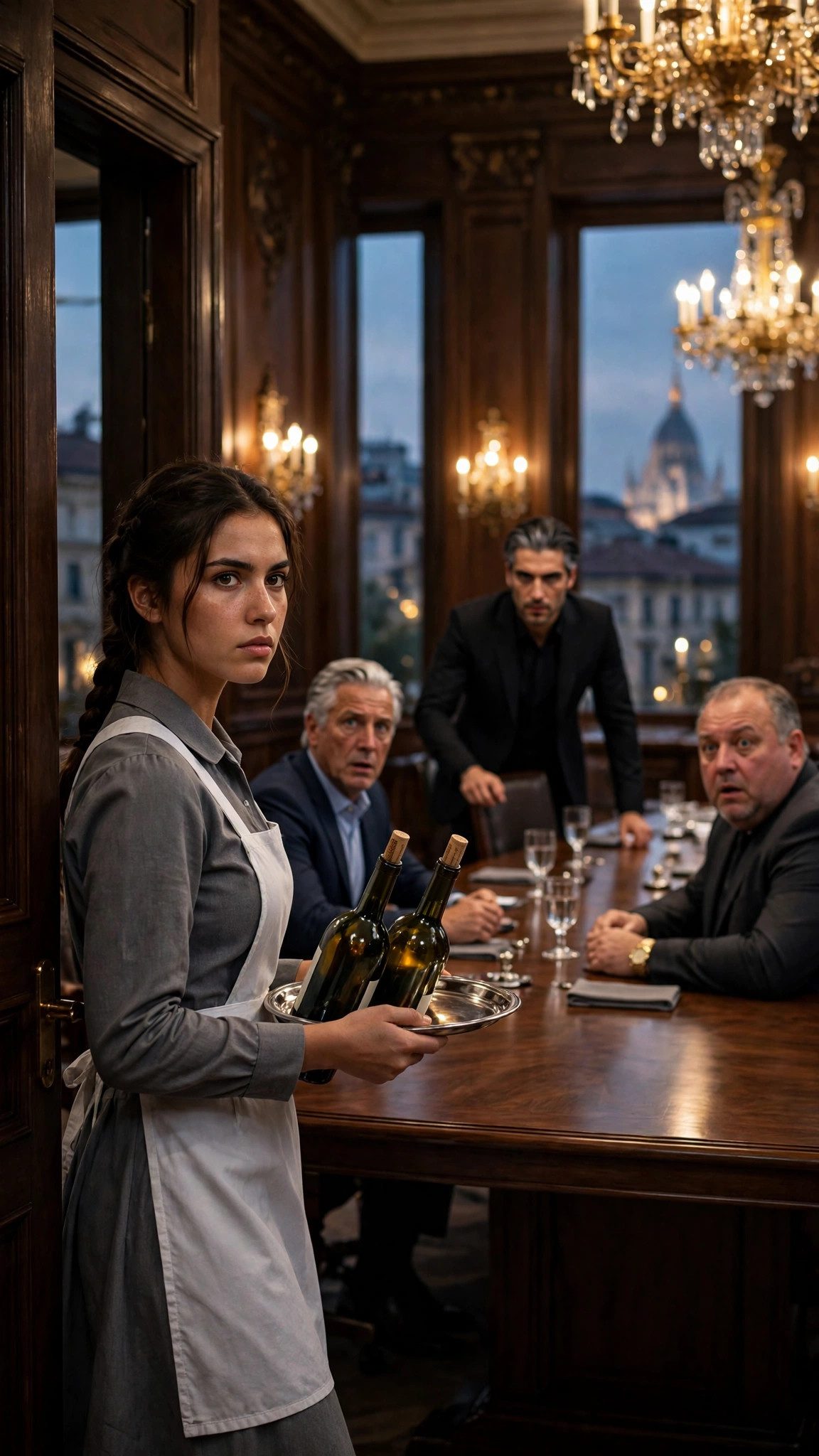
So am I. I am glad I spoke, and I am glad he listened, and I am glad that a maid who carried a tray of wine into a room full of the most feared men in Milan was brave enough to say, in a voice barely above a whisper, "I can help."
Because I could. And I did. And the empire will never be the same.
Sometimes, late at night, when the house is quiet and Alessandro is asleep beside me, I lie awake and think about the seven languages, and how each one of them saved me in a different way. Italian gave me a home. Russian gave me my mother. English gave me the world. French gave me diplomacy. Spanish gave me warmth. German gave me precision. Arabic gave me poetry. And together, they gave me a life I never dared to dream of, in a house I once cleaned in silence, beside a man I once feared, in a city that once felt like a door closing. Now the door is open. Now the words are mine. And now, finally, I am exactly who I was always meant to be.
The End.
THE END