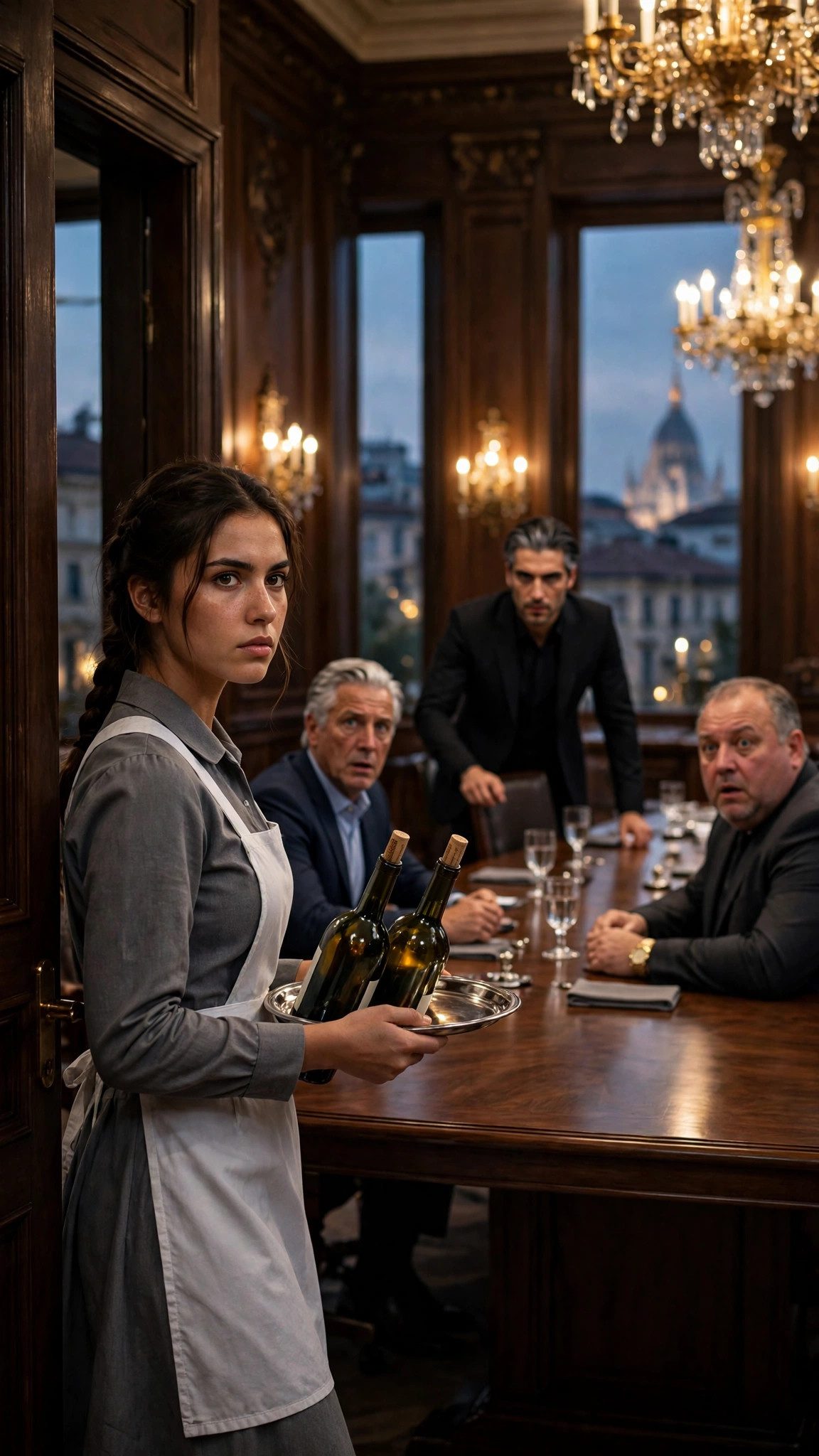
On Monday morning, the deal was signed.
The boardroom was full again, but it was a different room than it had been a week before. Volkov was there, in a new suit, smiling. Ferrante was there, relaxed, his hands open on the table. The lawyers were there, with their papers and their pens. And I was there, sitting at Alessandro's right hand, in the gray suit Rosa had chosen for me, translating the final terms, watching the numbers line up the way my father had once taught me numbers should line up: honestly, and in everyone's favor.
When it was done, when the pens had been put down and the hands had been shaken, Volkov stood up, and he came around the table, and he took my hand, and he kissed it, in the old Russian way, and he said, in Russian, "You are a remarkable woman, Lucia Marchetti. My father built his first ship with his hands. You built this deal with your tongue. I will remember your name."
Ferrante kissed my hand too, and he said, in Italian, "My grandmother always said that the smartest person in the room is the one nobody notices. She was right. Thank you, Lucia."
They left. The room emptied. And Alessandro and I were alone, in the boardroom where it had all begun, with the sun coming through the tall windows and the city spread out below us like a map.
"Two billion euros," he said. "The largest deal this family has ever made. And it happened because a maid walked into a room with a tray of wine."
"And because you listened to her," I said.
He smiled. It was a real smile this time, not the almost-smile from the garden, but a full smile, and it transformed his face, and I understood, suddenly, what he must have looked like as a boy, before the empire and the weight and the brother in Naples.
"Lucia," he said, "there is something I have to tell you. About the ledger."
"The ledger?" I asked.
He went to the sideboard and opened a drawer, and he took out a leather book, old and worn, its pages full of handwriting I recognized, even upside down, as the careful script of a man who had kept accounts for a very long time.
"This belonged to my father," he said. "Vittorio DeLuca kept a ledger of everything. Every deal, every payment, every debt, every favor. When he died, I inherited it, and I have kept it locked in that drawer for eight years, because I was afraid of what it would tell me."
He opened the book. He turned the pages, slowly, until he found the one he was looking for, and he laid it on the table in front of me.
"Read it," he said.
I read it. It was a page from two years ago, the month Enzo died. There were entries for payments to a man in Naples, a man named Dominic Voss. There were entries for a car, and a restaurant, and a bomb. And there, at the bottom of the page, in my father's — no, in Vittorio's — handwriting, were the words: "Voss is Castellano's man. He has been in my house for six years. I do not know how to remove him without starting a war. God forgive me."
I looked up. Alessandro's face was pale.
"My father knew," he said. "He knew Voss was a traitor, and he did nothing, because he was afraid of the war. And Voss killed my brother. And then Voss stayed, for two more years, in my house, eating my food, smiling at my table, while I looked for a killer I could not find."
"I'm sorry," I said. It was all I could think to say.
"Don't be sorry," he said. "Be angry. I was angry, for two years, and anger did not help me. But you — you found him in a week. You found him by listening. And now I have a choice to make, and I want you to help me make it."
"What choice?" I asked.
"The old choice," he said. "The choice every Don makes. Revenge, or the law. My father chose to do nothing, and my brother died. I could choose revenge. I could have Voss killed tonight, and Castellano too, and no one would ever know. It would be easy. It would be justice, in the old way."
He paused. He looked at the ledger, and then he looked at me.
"Or I could choose the law," he said. "I could give this ledger to the police, and Marco's testimony, and the two men from your bedroom, and let the law do what the law does. It would be slower. It would be harder. And it would mean that the DeLuca family admits, in public, that it was betrayed from the inside, and that it needs the police to save it."
I thought about Marco, kneeling in the council room, weeping with gratitude because I had chosen mercy. I thought about my mother, who had believed that books were stronger than bullets. I thought about my father, who had believed that a bridge could stop a war.
"The law," I said. "Choose the law. Revenge makes the empire smaller. The law makes it bigger. If you kill Voss, you are a Don who kills his enemies, and everyone will fear you, and fear is not the same as respect. But if you hand him to the police, with evidence, and the Castellanos fall with him, then you are a man who cleaned his own house, and everyone will respect you, and respect lasts longer than fear."
He was quiet for a long time. Then he closed the ledger, gently, the way a man closes a book he has finally finished reading.
"Then the law," he said. "Tomorrow morning, I will take this ledger to the chief of police myself. And Marco will testify. And the two men from your bedroom will testify. And Vincent Castellano will answer for my brother, and for Paolo, and for everything else he has done."
The meeting with Commissioner Ricci took place on a Tuesday morning, in an office with tall windows and a view of the cathedral. The commissioner was a man in his sixties, with white hair and tired eyes, and he listened to Alessandro without interrupting, his hands folded on his desk, while the ledger lay open between them like an accusation.
When Alessandro finished, the commissioner was quiet for a long time. Then he said, "Don Alessandro, I have been chief of police in this city for eleven years. In eleven years, no member of your family has ever walked through my door with evidence. They have walked through my door with lawyers, and with money, and with threats. But never with evidence. Do you know what this means?"
"It means my brother's killer will go to prison," Alessandro said.
"It means more than that," the commissioner said. "It means the DeLuca family is changing. And a family that changes is a family that survives. I will take your evidence, and I will act on it, and I will protect your people while I do. You have my word."
On the way home, Alessandro was quiet. He stared out of the car window at the streets of Milan, and I knew he was thinking about his father, and his brother, and the eight years he had spent carrying a ledger he was afraid to open.
"My father would have called me a traitor," he said at last.
"Your father was afraid of a war," I said. "You ended one. That is not treason. That is courage."
On the drive home, we passed the port, and I saw the cranes standing against the sky, and the ships lined up at the docks, and I thought about how a week ago this had all been falling apart, and how now it was coming together, and how strange it was that the difference between ruin and triumph had been a maid with a tray of wine who decided, for once, to speak. Alessandro must have been thinking the same thing, because he said, quietly, almost to himself, "My father kept a ledger of everything he owned. He never kept a ledger of what he owed. I think that was his mistake. I will not make it."
He took my hand, there in the back of the car, and he held it all the way home.
When we reached the house, Rosa was waiting in the doorway, her arms folded, her face stern, and when she saw us, her expression softened, and she said, "Well? Did the law listen?" Alessandro nodded, and Rosa closed her eyes for a moment, and she said, "Good. Your mother would have been proud, Don Alessandro. And Lucia — your mother would have been proud of you most of all."
That afternoon, I sat with Petrov, Volkov's lawyer, for three hours, going over the final terms of the port contract in Russian and English, clause by clause, until every number was exact and every obligation was clear. Petrov was a careful man, and a suspicious one, and by the end of the afternoon he was smiling, and he said, in Russian, "You are wasted as an interpreter, Lucia Marchetti. You should have been a lawyer."
"I am not wasted," I said. "I am exactly where I belong."
When I told Rosa about the commissioner that evening, she put down her spoon, and she looked at me, and she said, "Your father used to say that the law is a bridge, too. A bridge between what is and what should be. He would have been proud of you today, Lucia. They both would have."
That evening, after the commissioner, Alessandro took me to dinner at a small restaurant on the Navigli, a place with candles on the tables and a waiter who had known Alessandro since he was a boy. Volkov and Ferrante joined us, and for the first time since I had met them, they were not negotiating. They were celebrating. Volkov told stories about his father and his first ship, and Ferrante told stories about the storms he had sailed through, and Alessandro listened, and laughed, and I translated the jokes, and the laughter, and the toasts, and I thought about how strange it was that three men who had nearly destroyed each other a week ago were now sharing bread and wine like old friends. "This," Alessandro said quietly, as the candles burned low, "is what the deal was for. Not the money. This." And I knew he meant it.
He stood up. He walked to the window, and he stood there, looking out at Milan, and I stood beside him, and for a while neither of us spoke.
"There is one more thing," he said at last, and his voice was different now, softer, and I could hear the man underneath the Don, the man I had first glimpsed in the garden. "After the signing, I said I wanted to talk to you about something important. This is it."
He turned to face me. He took my hands in his.
"Lucia Marchetti," he said, "three years ago, you came to my house with a suitcase and a secret, and you cleaned my floors, and you carried my wine, and you listened to my enemies plotting in my own corridors, and you said nothing, because you were afraid. And then, one night, you walked into my boardroom, and you saved my empire, and you changed everything. You changed the deal. You changed the family. You changed me."
My heart was beating so hard I was sure he could hear it.
"I am a Don," he said. "I have spent eight years being a Don, and I am good at it, and I am tired of it. I am tired of the silence, and the fear, and the men who smile at my table and sell me to my enemies. I want something else. I want a partner. Not a maid. Not an interpreter. A partner. Someone who sees what I cannot see, and hears what I cannot hear, and tells me the truth when everyone else is lying."
He paused, and his eyes held mine, and the whole city seemed to go quiet.
"Stay," he said. "Stay in this house, not as my interpreter, but as my equal. Help me change this empire into something my father would not recognize and my brother would be proud of. Help me make it honest. Help me make it last. And Lucia —" His voice dropped, and he spoke slowly, carefully, in Russian, my mother's language, the language of the lullabies she had sung to me when I was small. "Ya lyublyu tebya." I love you.
I stared at him. He had learned Russian. He, the Don of the DeLuca family, the man who had never needed anyone, had learned a sentence in my mother's language, and he had said it to me, in the boardroom, with the sun coming through the windows.
And I answered him in Italian, because Italian was the language of the house, and the language of the life I had built here, and the language I wanted to build the rest of my life in.
"Anch'io ti amo," I said. I love you too.
He kissed me then, in the boardroom, with the city spread out below us, and it was the first time anyone had kissed me in three years, and it felt like coming home.
When we finally pulled apart, he was smiling, and I was smiling, and the ledger was closed on the table, and the deal was signed, and the empire was already changing, and I understood, with a clarity that made my breath catch, that the girl who had arrived at the station with a suitcase and a secret was gone forever, and that the woman standing in her place was exactly who she had always been meant to be.