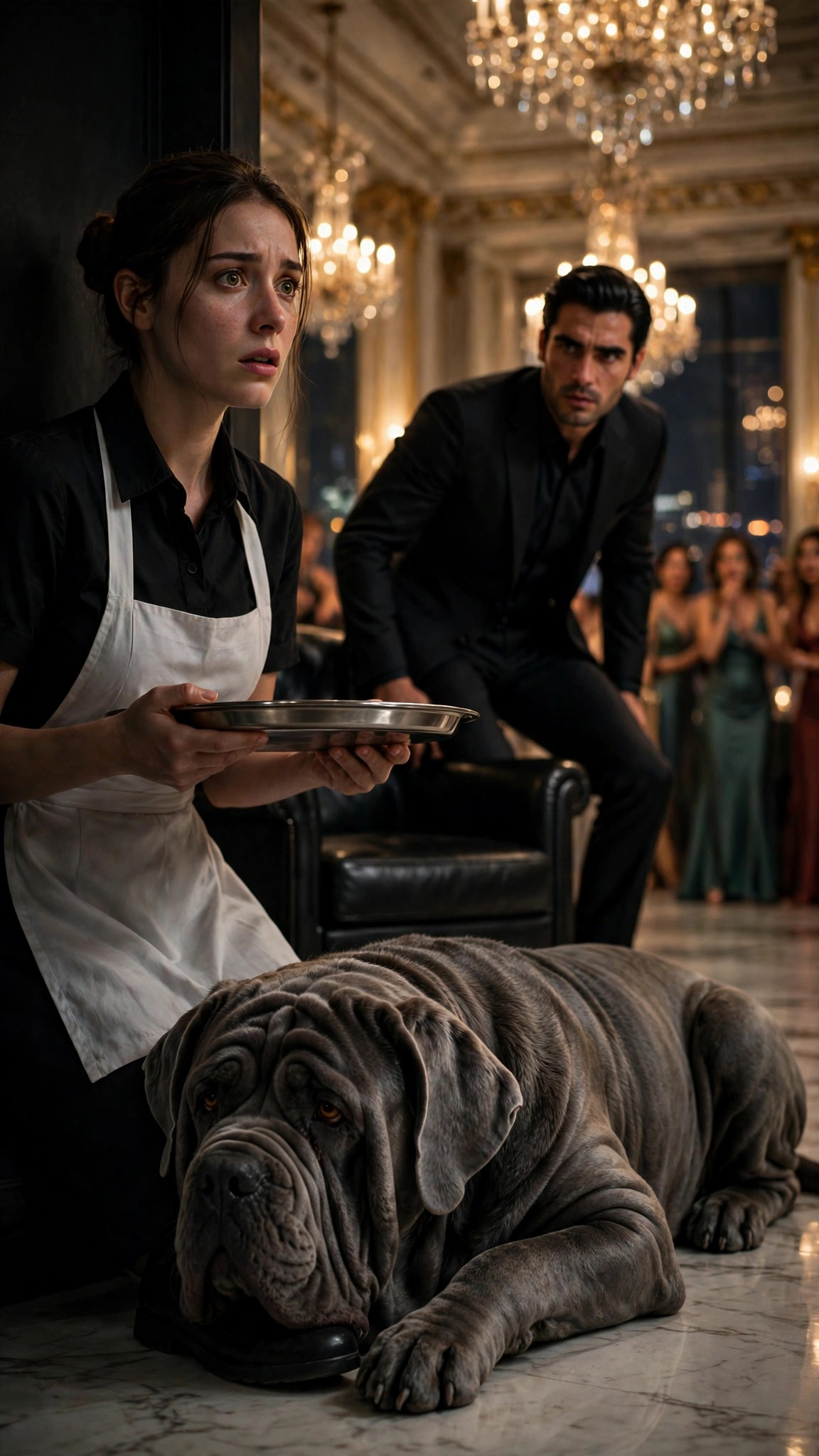
Kendrick Ashford did not believe in fate. He believed in ledgers, and in loyalty, and in the weight of a gun in his hand. He had run the East Coast syndicate for twelve years on those three things, and they had never failed him.
But that morning, standing in the library of his own tower with a waitress and a five-year-old girl and a one-hundred-fifty-pound dog, he felt something shift inside him — something he had not felt since he was fifteen years old, skipping stones in a garden fountain with a girl who laughed too loudly.
"Show me," he said to Rosa.
Rosa led them to the third shelf of the library, to the row of leather-bound books his father had kept there for as long as Kendrick could remember: law books, mostly, and a few old histories, the kind of books a man keeps to impress visitors and never reads. Rosa ran her old fingers along the spines until she found the one she wanted — a heavy volume on maritime law, its leather cracked with age — and she pulled it out, and behind it, in the hollow space between the books and the wall, was a small tin box.
It was the kind of tin box that had once held tea. It was rusted at the corners. Elena Kendrick had wrapped it in a dish towel, and the dish towel was still there, faded blue, with a strawberry embroidered in one corner.
Kendrick opened the box with hands that did not shake, because Kendrick Ashford's hands never shook, and inside he found three things.
The first was a letter, written in his mother's handwriting. His mother, Sofia Ashford, had died when he was nineteen, of a illness that took her slowly and quietly, and he had not seen her handwriting in nineteen years. The letter was addressed to Elena, and it was dated three days before Marcus Ashford was killed.
"My dearest Elena," it began, "if you are reading this, then I am gone, and Marcus is gone, and the house is in danger. I have known for some time that Barrett is not what he seems. He has been taking money from the family accounts for years. I have the records. They are in the blue folder in my desk. Marcus does not believe me. He says Barrett is his brother's son, his blood, and blood does not steal. But I have seen the numbers, Elena, and numbers do not lie. Watch over my boy. Watch over Kendrick. And if the day comes when he needs the truth, give him this."
The second thing in the box was a small notebook, Elena's own handwriting, neat and careful. It was a record of every conversation she had overheard in the kitchen in the last month of Marcus Ashford's life: Barrett on the telephone, late at night, speaking in a low voice about "the docks" and "the Castellanos" and "when Marcus is gone." Barrett arguing with Marcus in the library, three nights before the ambush, about a marriage — about Kendrick marrying Vivian Castellano, about the alliance, about the future. Barrett's voice, cold and clear, saying, "The old man is in the way, Vincent. The old man has to go."
The third thing in the box was a photograph. It showed a young Marcus Ashford, laughing, with his arm around a younger Thomas Kendrick, both of them in work shirts, standing in front of a car with the hood up. On the back, in Marcus's handwriting, were the words: "My brother in all but blood. — M."
Kendrick stood in the library for a long time, holding his mother's letter, and he did not speak. Penny watched him, and she saw the stone in his face crack — just a little, just enough for a man to show through underneath.
"My mother knew," he said at last. His voice was very quiet. "My mother knew, and she told your mother, and my mother died, and your mother died, and Barrett has been stealing from this family for twelve years, and I never saw it. I never saw it because he is my blood, and blood does not steal."
He looked at Penny.
"Your mother saved this," he said. "She hid it in my father's library, in a tea tin, wrapped in a dish towel, and she never told anyone, and she died with it inside her. Why?"
"Because she was afraid," Penny said. "She was afraid for me. Barrett knew she had heard something. After my father died, Barrett came to the kitchen, and he told my mother that if she ever spoke about what she had heard, something would happen to me. She was fifteen, sir. I was fifteen. She kept her mouth shut to keep me alive."
"And the dog?" Kendrick asked. "Why did Titan remember you?"
Penny told him then. She told him about the night her father died, about the puppy under the kitchen table, about the bread from her mother's apron pocket, about the way the small gray puppy had pressed his head against her chest and fallen asleep while the house fell apart. She told him about the morning after, when the puppy was gone, and about the twelve years since, when she had thought about him only in the dark, when she could not sleep.
"He was my father's dog," Kendrick said slowly. "My father brought him home the week before he died. He said the puppy would grow into a guardian. He said a man should have a dog who knows the difference between a friend and a thief."
He looked down at Titan, who had followed them into the library and was lying at Penny's feet again, his great head on her shoe.
"He knew," Kendrick said. "He knew you were a friend. He has known for twelve years."
That afternoon, Kendrick did something he had not done in twelve years. He opened his father's ledgers — the real ledgers, not the clean ones his accountants kept, but the old leather books in the safe behind his desk — and he went through them line by line, with his mother's letter beside him and Elena's notebook open on the desk.
What he found made his hands go still.
Barrett Ashford had been stealing from the syndicate for fourteen years. Not small amounts. Not the kind of skimming a consigliere takes as his due. Millions. Money moved through shell companies, through the docks, through a construction firm in New Jersey that existed only on paper. And in the last three years, the money had been moving in only one direction: toward Vincent Castellano.
The marriage was the final piece. If Kendrick married Vivian Castellano, the Castellano family would gain a seat at the table. And once they had a seat, with Barrett's help, they would take the table. The docks. The routes. The East Coast. All of it.
Barrett had not organized the bride parade to find Kendrick a wife. He had organized it to hand the syndicate to Vincent Castellano, gift-wrapped, with a red silk bow.
Kendrick closed the ledger. He sat in his father's chair, in his father's library, with his mother's letter in his hand, and he thought about the boy he had been at fifteen, skipping stones in a garden fountain with a girl who laughed too loudly. He thought about the man he had become: cold, careful, alone. He thought about the twelve years he had spent trusting the wrong man and forgetting the right girl.
And then he stood up, and he walked to the window, and he looked out over the city that was his, and he made a decision.
"Rosa," he said, "I want you to stay with Penny and Mia. Don't let them out of your sight. Titan stays with them too."
"And Barrett?" Rosa asked.
"Barrett," Kendrick said, "is going to have a very interesting week."
He turned to Penny.
"I need you to understand something," he said. "What happens next is not going to be quiet. Barrett has spent fourteen years building this. He is not going to give it up because I found a tea tin in a library. He will fight. And Vincent Castellano will fight with him. And Vivian—"
"Vivian hates me," Penny said.
"Vivian," Kendrick said, "is a twenty-six-year-old girl who was raised to believe she would be the queen of the East Coast, and a dog just told her she would not be. She is dangerous. Her father is dangerous. But they are not the ones I am worried about."
"Who are you worried about?" Penny asked.
"You," Kendrick said. "I am worried about you. Because Barrett knows you were in that ballroom. He knows Titan chose you. He knows you are the one thing in this house he did not plan for. And men like Barrett do not leave unplanned things alone."
He was right. He did not know how right he was. But by the end of the week, Penny Kendrick would learn exactly how far Barrett Ashford was willing to go to remove a waitress from his nephew's house — and exactly how far Kendrick Ashford was willing to go to protect her.
The next morning, before the sun was fully up, Kendrick went to his mother's old desk.
It stood in a small sitting room off the library, a beautiful old desk of dark wood, and it had been locked for nineteen years, since the day his mother died. Kendrick had never opened it. He had never wanted to. His mother's things were inside, and grief had taught him that some doors were better left closed.
Now he unlocked it with a key he had carried on his ring for nineteen years and never used.
Inside, in the top drawer, beneath a stack of old letters and a dried rose, was a blue folder. His mother's handwriting was on the tab: "For Kendrick. When you are ready."
He was ready now.
The folder held bank statements, transfer records, and a list of companies — neat columns in his mother's careful hand, each one annotated with a date and a note. Seventeen shell companies. Fourteen years of transfers. Millions of dollars. And at the bottom of every page, the same name, written over and over in his mother's hand: Barrett. Barrett. Barrett.
Kendrick sat at his mother's desk for two hours, going through the folder page by page, and with every page, the cold inside him grew deeper and harder, until it felt like a stone in his chest.
He called his accountant then — a quiet man named O'Brien, who had worked for the family for thirty years and had never once asked a question he was not paid to ask — and he laid the folder on the desk between them.
"Is this real?" Kendrick asked.
O'Brien went through the pages slowly, his face growing paler with every one. When he finished, he took off his glasses and wiped them with a handkerchief, and his hands were shaking.
"It's real," he said. "Every transfer is real. The construction firm in New Jersey — it doesn't exist. It never existed. The money went through it and came out the other side, into accounts in the Caymans, and from there to Vincent Castellano. Fourteen years, Mr. Ashford. I'm sorry. I should have seen it. I looked at these numbers for fourteen years, and I never saw it, because your uncle signed every authorization himself, and I trusted his signature."
"You trusted his blood," Kendrick said.
"Yes," O'Brien said quietly. "I did."
Kendrick sent him away with instructions to copy everything, twice, and to tell no one. Then he went to the roof garden, where he could think, and he stood there for a long time, looking out over the city, remembering his father.
Marcus Ashford had been a good man. Kendrick knew that now, in a way he had not known it when he was fifteen and his father was simply the large, laughing man who came home late and smelled of cigars and car leather. Marcus had loved his family. He had loved his dog. He had loved his driver, Thomas Kendrick, like a brother — the photograph in the tea tin proved it, the two of them laughing in front of a car with the hood up, "My brother in all but blood."
And Barrett — Barrett had been there too, all those years, smiling, loyal, the dutiful nephew, the trusted consigliere. Kendrick remembered Barrett teaching him to shoot, when he was sixteen. He remembered Barrett sitting with him the night his mother died, pouring him a glass of whiskey he was too young to drink, telling him that a Don does not cry in front of his men. He remembered Barrett standing beside him at his father's funeral, his hand heavy on Kendrick's shoulder, his voice low and steady: "I will help you carry this, nephew. You will not carry it alone."
Fourteen years of help. Fourteen years of theft.
Kendrick stood on the roof garden until the sun was high, and then he went back inside, and he found Penny and Mia in the kitchen of the guest suite, where Rosa had set them up with a small stove and a pot, and Penny was teaching Mia to make her grandmother's bread.
"Like this, baby," Penny was saying, her hands covered in flour, guiding Mia's small hands through the dough. "Push, and fold, and push, and fold. Grandma Elena said the bread knows if you're angry. You have to be gentle with it."
Mia was laughing, flour on her nose, and Titan was lying on the kitchen floor with his head on his paws, watching them, and Rosa was standing by the door with her arms crossed, smiling the way only a woman who has waited twelve years for a thing can smile.
Kendrick stood in the doorway and watched them, and he felt the stone in his chest crack a little more.
"Mr. Ashford," Rosa said, spotting him. "Would you like some bread? It's not ready yet, but Penny will make you a slice with butter when it is."
"I would like that very much," Kendrick said, and he came into the kitchen, and he sat down at the small table, and Mia climbed onto his lap without being asked, as if it were the most natural thing in the world, and she put her floury hands on his cheeks, and she said, "You have to be gentle with the bread, Mr. Kendrick. Grandma said so."
"I will be gentle," Kendrick promised, and he meant it, and he looked at Penny across the table, with flour on her hands and sunlight in her hair, and he thought about the girl she had been at fifteen, hiding a puppy under a kitchen table, and the woman she was now, teaching her daughter to make bread in his tower, and he understood, suddenly and completely, what his father had meant when he wrote "My brother in all but blood" on the back of a photograph.
Family was not blood. Family was the people who stayed. The people who hid the puppy. The people who kept the recipe book. The people who taught their daughters to be gentle with the bread.
Barrett had blood. Penny had family.
And Kendrick Ashford, who had spent twelve years trusting the wrong one, had finally learned the difference.