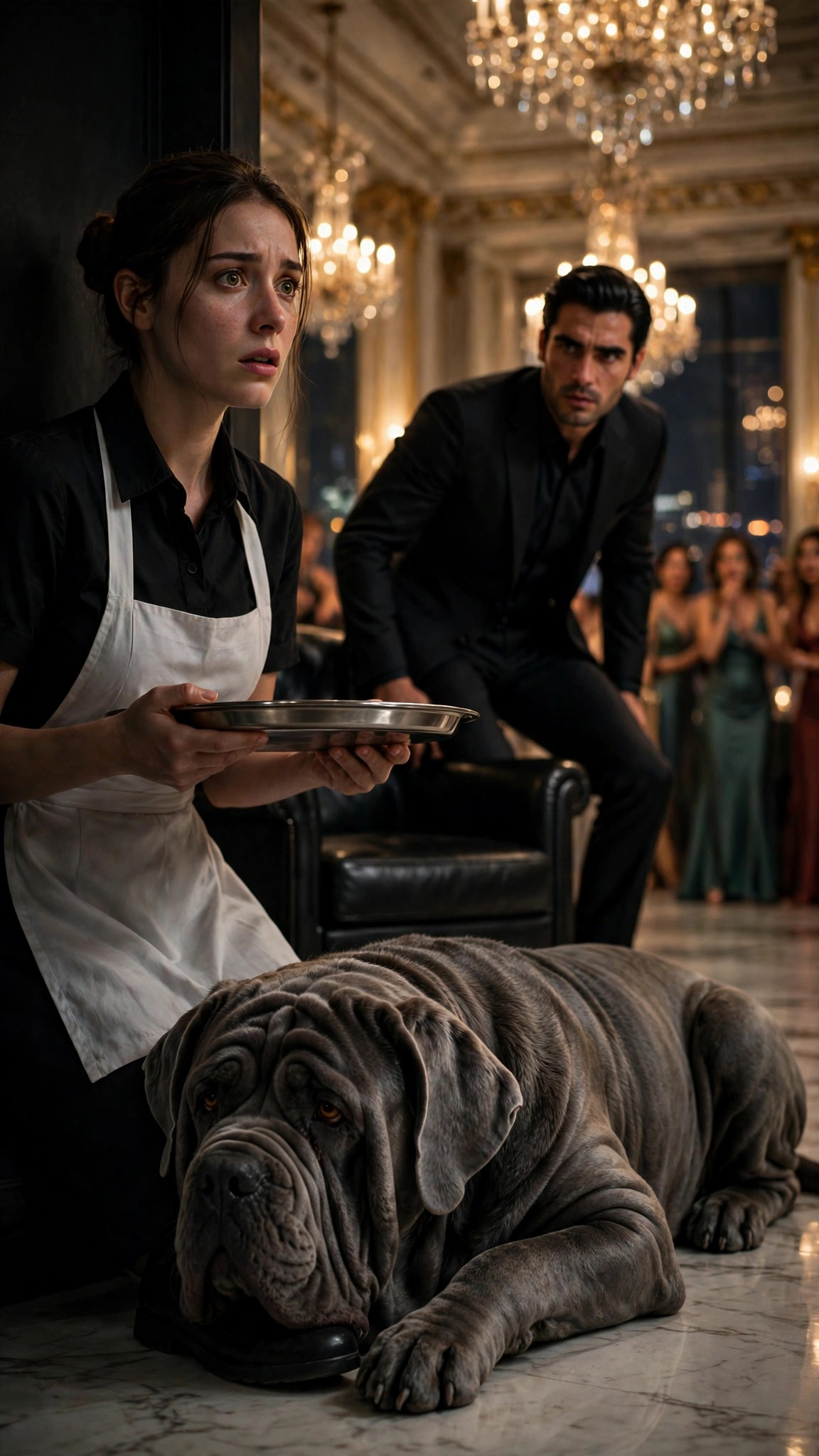
The ballroom did not erupt. That was the strangest thing about it. Penny had expected shouting, chaos, the capos reaching for their guns. Instead, the room went still in the way a forest goes still before a storm — every living thing holding its breath, waiting to see which way the lightning would fall.
Titan lay at Penny's feet with his chin on her shoe, and his amber eyes were closed, and his great body rose and fell with slow, deep breaths, as if he had been waiting twelve years to sleep and had finally found the one place in the world where he felt safe.
Mia stood beside her mother, her small hand resting on Titan's enormous head, and she was not afraid at all. Five-year-old children have not yet learned to be afraid of the right things.
"Mommy," Mia whispered, "he likes me."
"I know, baby," Penny whispered back. "Be very still."
Kendrick Ashford was still standing in the middle of the marble floor, still looking at her, and Penny could not read his face at all. It was the face of a man doing arithmetic in his head, adding up numbers that did not fit.
"Barrett," Kendrick said at last, without taking his eyes off Penny. "Clear the room."
"Clear the—" Barrett's voice rose, sharp and disbelieving. "Kendrick, the families are here. Vivian's father is downstairs. You cannot—"
"Clear the room," Kendrick said again, and his voice was very quiet, and very cold, and Barrett, who had known him for thirty-eight years, heard something in that quiet that made him stop arguing.
It took ten minutes. Ten minutes of murmuring, of silk rustling, of diamonds catching the light as fifteen furious heiresses filed out of the ballroom with their mothers and their chaperones and their wounded pride. Vivian Castellano was the last to leave, and she paused in the doorway, and she looked back at Penny with eyes full of poison.
"This is not over," she said.
Then she was gone, and the great doors closed, and the ballroom was empty except for Kendrick, and Barrett, and Penny, and Mia, and Titan.
"Who are you?" Kendrick asked.
Penny swallowed. Her mouth was dry. Her hands were shaking so hard the silver tray rattled against her apron.
"Penny Kendrick," she said. "I'm with the catering agency. Elegant Occasions. I was assigned to this event. I didn't—I didn't do anything. I swear. I was only standing there."
"Kendrick," he repeated slowly, as if tasting the name. "Your name is Kendrick."
"Yes, sir."
"And the child?"
"My daughter, Mia. She's five. I'm sorry she came in — the agency said I could bring her to the staff room, Mrs. Alvarez was supposed to—"
"Stop apologizing," Kendrick said. It was not unkind. It was the voice of a man who had heard too many apologies in his life and was tired of all of them. "My dog has never done that. Not once. Not to my mother. Not to my sister. Not to anyone. Titan does not kneel. Do you understand? In twelve years, that dog has never knelt to a living soul."
Penny looked down at Titan, still asleep on her shoe, and she felt tears sting the backs of her eyes, and she fought them down, because she did not cry in front of strangers, and she especially did not cry in front of men like Kendrick Ashford.
"I don't know why he did it, sir," she said. "I don't know anything about your dog."
"Yes," Kendrick said, very quietly. "You do."
And then he did something Penny did not expect. He knelt down — Kendrick Ashford, the ruler of the East Coast syndicate, in his impeccable black suit, on the marble floor of his own ballroom — and he put his hand on Titan's great gray head, and he looked up at Penny from below, and his gray eyes were no longer cold.
"Twelve years ago," he said, "on the night my father was killed, there was a puppy in the kitchen of our townhouse. A gray puppy, no bigger than a breadbox. When the house was searched that night — when men with guns came through every room looking for my father's papers — the puppy was gone. My mother told me later that the cook's daughter had hidden him. A fifteen-year-old girl had crawled under the kitchen table and held him in her lap until the men left."
He paused. Titan lifted his head and looked at him, and then looked at Penny, and then laid his head back down on her shoe.
"The cook's daughter," Kendrick said. "Her name was Penny."
Penny's breath caught in her throat. The ballroom tilted. The chandeliers blurred.
"You remember," she whispered.
"I remember that my mother cried when she told me," Kendrick said. "I remember that she said the girl had saved the only living thing my father had loved in that house besides his family. I remember that I asked her the girl's name, and she told me, and I forgot it — because I was twenty-six years old and my father was dead and I had a syndicate to hold together, and I forgot it."
He stood up slowly, brushing the marble dust from his knee, and he looked at her for a long moment.
"I did not forget her face," he said. "I have been looking at it for the last ten minutes, trying to understand why it felt familiar. You were twelve years old the last time I saw you, Penny Kendrick. You taught me to skip stones in the garden fountain. I showed you a drawer full of peppermints."
Penny's knees went weak. She set the silver tray down on the floor very carefully, because she was afraid she was going to drop it, and she pressed her hands against her apron to stop them shaking.
"I remember," she whispered. "I remember the peppermints."
Barrett made a sound then — a short, sharp sound, like a man who has just watched his careful plans fall off a cliff.
"Kendrick," Barrett said, "this is a waitress. A catering girl. Whatever she was twelve years ago, she is nothing now. The families are downstairs. Vivian's father is downstairs. Vincent Castellano does not wait."
"Vincent Castellano can wait," Kendrick said, and his voice was like ice cracking on a winter river. "My dog has waited twelve years. Vincent can wait one night."
He turned back to Penny.
"You will stay," he said. "You and Mia. Tonight. There are rooms in this tower. Titan clearly has opinions about where you should sleep, and I have learned, over twelve years, that Titan's opinions are worth more than most men's."
"I can't," Penny said. "I have a job. I have an apartment. Mia has daycare tomorrow. I can't just—"
"You can," Kendrick said. "And you will. Because I have questions, Penny Kendrick, and you are the only person alive who can answer them. And because—" He stopped, and for a moment, something moved behind his eyes, something old and tired and almost human. "Because my father loved that dog. And that dog loves you. And I would very much like to understand why."
That night, Penny slept in a guest suite on the eighty-sixth floor, in a bed softer than any bed she had ever slept in, with Mia curled against her side and Titan lying across the doorway like a mountain that had decided to guard the pass.
She did not sleep well. She kept thinking about the night her father died. She kept thinking about the puppy under the kitchen table. She kept thinking about the boy who had shown her a drawer full of peppermints, and the man he had become, and the way he had looked at her in the ballroom — like a man who had found something he had lost a very long time ago and did not know what to do with it.
In the morning, she woke to a knock on the door, and an old woman standing in the hallway with a breakfast tray, and a face Penny knew better than her own.
Rosa Benedetti had been the housekeeper of the Ashford townhouse for thirty years. She had taught Penny to fold napkins. She had bandaged Penny's scraped knees. She had been there on the night Penny's father died, and on the day Penny's mother died, and she had cried at both funerals, and Penny had not seen her in twelve years.
"Penny," Rosa said, and her old face broke into a smile, and she set the tray down and pulled Penny into her arms, and Penny, who did not cry in front of strangers, cried in front of Rosa, because Rosa was not a stranger.
"Rosa," Penny whispered. "What are you doing here?"
"I never left," Rosa said. "When they sold the townhouse, Mr. Kendrick brought me here. I keep his house now. I have kept it for twelve years, waiting." She pulled back and held Penny's face in her hands. "Waiting for what, I did not know. Now I know. I was waiting for you."
"Rosa," Penny said, "the dog. Titan. He remembered me."
"Of course he remembered you," Rosa said simply. "Dogs remember love, Penny. Men forget it. Dogs never do."
She sat down on the edge of the bed, and she took Penny's hands, and she told her the story of the night Marcus Ashford died — the story as Rosa had lived it, from inside the house, while Penny had been hiding a puppy under the kitchen table.
"The men who killed your father and Mr. Marcus," Rosa said, "they were not strangers. They were sent by someone inside the family. Someone who wanted the docks. Someone who wanted Mr. Marcus gone so the syndicate would fall to a man they could control."
"Who?" Penny whispered.
Rosa looked toward the door, where Titan lay sleeping, and she lowered her voice.
"Your mother knew," Rosa said. "Elena knew. She heard them talking, the night before, in the library. She told me, and she made me promise never to tell, because she was afraid for you. But Elena is gone now, and you are here, and Mr. Kendrick is asking questions, and I am an old woman, and I am tired of carrying this alone."
She squeezed Penny's hands.
"Ask Mr. Kendrick to look at the library," Rosa said. "Ask him to look behind the books his father kept on the third shelf. Elena hid something there, the night Mr. Marcus died. She said, 'If anything happens to me, Rosa, the truth is in the library.' I never looked. I was too afraid. But you are not afraid, Penny. You never were."
Penny sat very still, with Mia still asleep beside her and Titan snoring softly in the doorway, and she felt the past settle around her shoulders like a coat she had outgrown and never stopped wearing.
Twelve years ago, she had hidden a puppy under a kitchen table.
Now, the puppy had brought her back. And the truth her mother had hidden in a library was waiting, twelve years later, for someone brave enough to find it.
That night, after Rosa left with the breakfast tray promise for the morning, Penny sat on the edge of the great soft bed in the guest suite and watched her daughter sleep. Mia was curled on her side, one small hand tucked under her cheek, her dark hair spread across the white pillow, and she looked so small in that enormous bed that Penny's heart ached.
"Mommy," Mia had whispered, just before she fell asleep, "is Titan going to stay?"
"I think so, baby," Penny had said.
"Good," Mia had said, already drifting. "I like him. He's big, but he's gentle. Like a mountain that loves you."
Penny had smiled at that, and she had kissed her daughter's forehead, and she had whispered the bedtime story — the one about the brave little mouse — even though Mia was already asleep, because the story was as much for Penny as it was for Mia.
When she was done, she went to the window. The suite was on the eighty-sixth floor, and the city spread out below her like a field of fallen stars, and Penny stood there for a long time, looking at the lights, thinking about how strange it was to be standing in a tower owned by a man she had known as a boy, in a room softer than any room she had ever slept in, with a one-hundred-fifty-pound dog asleep across her doorway.
Titan had not left the doorway all evening. He had followed them from the ballroom to the suite, step by heavy step, and he had lain down across the threshold, and he had not moved since. Rosa had brought him a bowl of water and a plate of leftover roast beef, and he had eaten it politely, and then he had gone back to his post, his great head on his paws, his amber eyes half closed, guarding the door.
Penny went to him, very quietly, so as not to wake Mia, and she knelt down beside him, and she put her hand on his great gray head, and Titan sighed — a deep, contented sound, like a man settling into his favorite chair — and he leaned into her hand.
"Do you remember me?" she whispered. "Really? After all this time?"
Titan's tail thumped once against the marble floor. Just once. But it was enough.
Down the hall, behind a door that was not quite closed, Kendrick Ashford stood in the dark and watched. He had come to check on them — to make sure the suite was comfortable, to make sure Mia had what she needed, to make sure Rosa had everything — and he had found Penny kneeling beside his dog in the doorway, whispering to him in the dark, and he had stopped, and he had not gone in.
He had stood there for a long time, watching the waitress and the dog, and he had thought about the boy he had been at fifteen, and the girl who had taught him to skip stones, and the twelve years he had spent being cold and careful and alone, and he had felt something inside him shift — something old and rusted moving for the first time in years.
He did not knock. He did not speak. He turned, very quietly, and he walked back down the hall to his own rooms, and he sat in his father's chair, in his father's library, and he looked at the third shelf, at the row of leather-bound books his father had kept there, and he thought about what Rosa had said.
"The truth is in the library."
Tomorrow, he would look. Tomorrow, he would open the books and find the tin box, and read his mother's letter, and learn what his family had done. But tonight, he sat in the dark, and he listened to the silence of his tower, and for the first time in twelve years, the silence did not feel empty.
It felt like the beginning of something.