It began with a bracelet.
Vivian Castellano wore a diamond bracelet to the ballroom that night — a thin band of white gold with seven diamonds, each one the size of a pea, a gift from her father on her twenty-first birthday. She wore it on her left wrist, and she made sure everyone saw it, and when she lunged at Penny, Kendrick had caught her wrist, and the bracelet had been there, glittering in the light.
Three days later, the bracelet was gone. And Vivian Castellano stood in the middle of Kendrick's ballroom, in front of six capos and two of her father's men, and pointed one perfect finger at Penny Kendrick.
"She stole it," Vivian said. "The waitress. She was the only one near me when it happened. Search her room."
Penny stood in the doorway of the guest suite in her black uniform, with Mia hiding behind her legs, and she felt the floor drop away beneath her feet.
"I didn't steal anything," she said. "I swear on my daughter's life, I didn't steal anything."
"Then you won't mind if we search," Barrett said. He was standing behind Vivian, his silver hair perfect, his charcoal suit perfect, his face full of sorrow that did not reach his eyes. "If she is innocent, the search will prove it. If she is not—" He spread his hands. "Well. We all know what happens to thieves in this house."
Kendrick was not there. He was downtown, in a meeting with his lawyers about the ledgers, and Barrett had chosen his moment with the precision of a man who had spent fourteen years choosing moments.
They searched the suite. They searched the closet. They searched the dresser. They searched Mia's little backpack, and Mia cried, and Penny held her and whispered, "It's all right, baby, it's all right," even though it was not all right at all.
And then one of Vivian's men opened the locker in the staff room downstairs — Penny's locker, the one she had used for three days — and he reached inside, and he pulled out the diamond bracelet, wrapped in a white handkerchief, tucked behind Penny's spare apron.
The room went silent.
"I didn't put it there," Penny said. Her voice was shaking. "I never even touched it. Someone planted it. Please. You have to believe me."
"I believe the evidence," Barrett said quietly. "And the evidence says you are a thief."
He turned to the two men by the door.
"Take her to the holding room," he said. "Call the police. And the child—"
"Don't touch my daughter," Penny said, and her voice changed then, from fear to something harder, something her mother had given her. "Don't you dare touch my daughter."
"Relax," Barrett said, smiling the thin smile of a man who has already won. "No one is going to hurt the child. The child will go to a very nice place. A very safe place. While her mother explains to the police how a waitress came to own a diamond bracelet worth eighty thousand dollars."
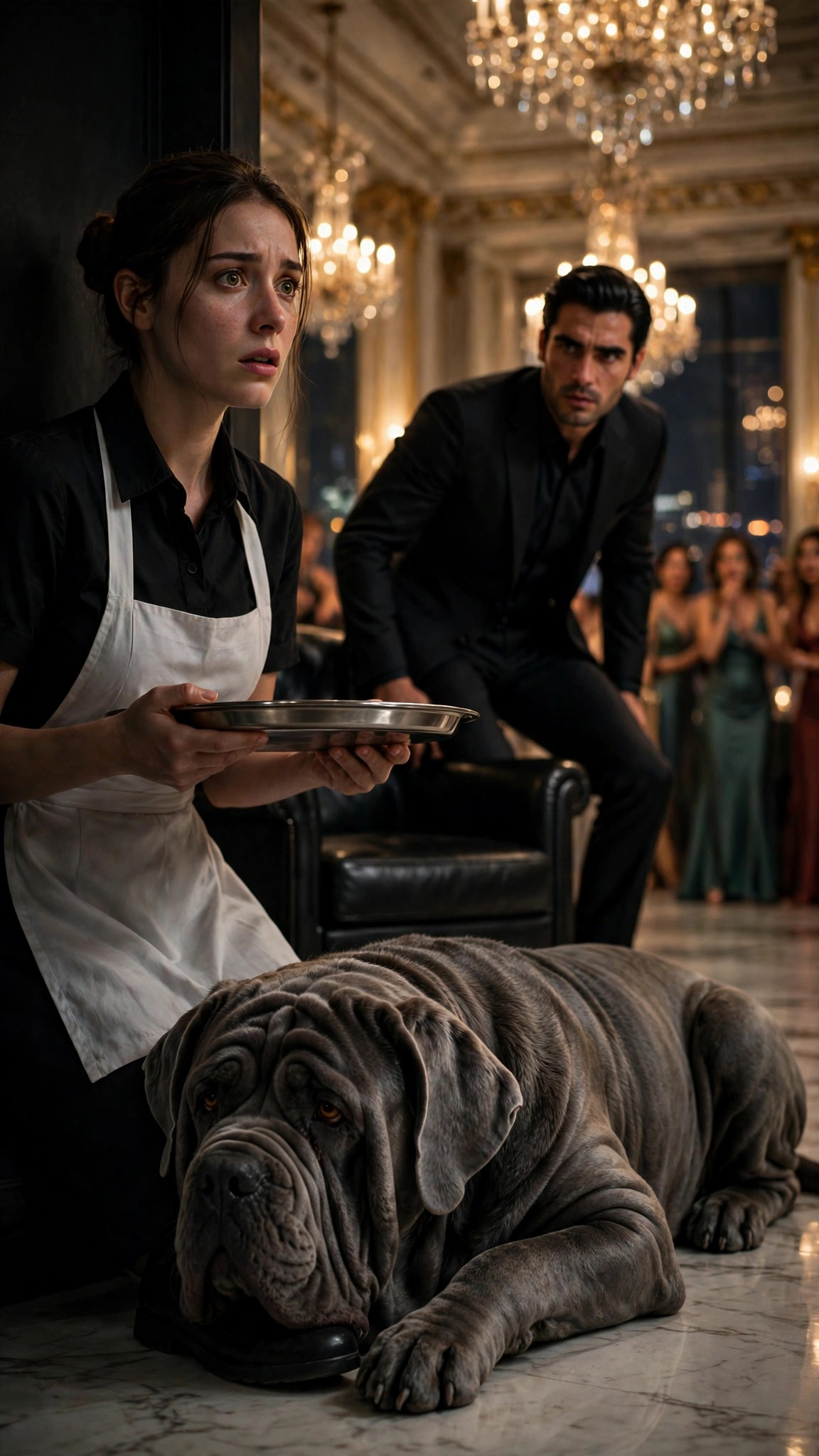
That was when Titan arrived.
Penny had not heard him come. None of them had. But suddenly the one-hundred-fifty-pound dog was standing in the doorway of the staff room, and his amber eyes were fixed on Barrett, and his great gray body was very still, and the low sound coming from his chest was not a growl. It was something older than a growl. It was the sound a mountain makes before it falls.
"Titan," Barrett said, taking a step back. "Titan, heel. Heel, boy."
Titan did not heel. Titan walked forward, step by heavy step, until he was standing between Penny and the two men, and then he lay down across the doorway, his enormous body blocking the only way out, and he looked at Barrett with eyes that said, very clearly: you will not take her. You will not take the child. You will have to go through me.
And then Kendrick arrived.
He came through the service entrance at a run, his suit jacket off, his tie loose, his face dark with fury, and behind him came three of his own men, and Rosa, and Mrs. Alvarez, who had brought Mia's daycare bag and was shouting in Spanish at anyone who would listen.
"What is happening here?" Kendrick demanded.
Barrett turned, smooth as oil. "Your waitress stole Vivian's bracelet. We found it in her locker. I was handling it."
"You were handling it," Kendrick said. He walked to the locker, and he looked at the bracelet, and he looked at the white handkerchief it was wrapped in, and he picked up the handkerchief, and he held it up to the light.
"This handkerchief," he said, very quietly, "has your monogram on it, Uncle."
The silence in the staff room was so complete that Penny could hear the hum of the lights.
Barrett's face did not change. It was the face of a man who had been caught and had decided, in a single second, to stop pretending.
"Yes," Barrett said. "It does."
"Why?" Kendrick asked.
"Because she had to go," Barrett said. "Because a dog does not choose a Don's bride, Kendrick. Because this family cannot be ruled by a man who lets a waitress and her bastard child sleep in his tower. Because Vincent Castellano is the future, and Vivian is the price, and you were too sentimental to pay it. So I paid it for you. I would have paid it a hundred times."
Kendrick looked at him for a long moment. Then he looked at Vivian, who was standing very still by the door, her face white.
"Did you know?" he asked her.
Vivian's mouth opened. No sound came out.
"Did you know," Kendrick said, "that your father has been buying my uncle for three years? Did you know that the marriage your father arranged was not an alliance, but a purchase? Did you know that the bracelet you accused this woman of stealing was planted by the man standing next to you?"
Vivian's eyes filled with tears. For the first time since Penny had seen her, she did not look like a queen. She looked like a girl.
"I didn't know about the bracelet," she whispered. "I swear I didn't know about the bracelet. But the rest—" She looked at her father, who was not there, and at Barrett, who was, and at Kendrick, who was waiting. "The rest, I knew. My father told me. He said it was the only way. He said the Castellanos would finally have what they deserved."
Kendrick nodded slowly. Then he turned to his men.
"Take Barrett to the holding room," he said. "Take Vivian to her father's people. And get me Agent Reyes on the telephone. Tell him I have something he has been waiting three years to hear."
He turned to Penny then, and his face softened, and he knelt down in front of Mia, who was still hiding behind her mother's legs, and he held out his hand, very slowly, the way a man holds out his hand to a frightened animal.
"Mia," he said gently. "I'm sorry. I'm sorry men came into your home and frightened you. That will not happen again. Do you understand? That will never happen again."
Mia looked at him for a long moment. Then she took his hand.
"Okay," she said. "Titan scared them."
"Titan did," Kendrick agreed, and he looked up at Penny, and his gray eyes were warm for the first time since she had known him as a man. "Titan always does."
That night, after Barrett was locked in the holding room and Vivian was gone and the tower was quiet, Penny found Kendrick on the roof garden, standing alone in the dark, looking out over the city. Titan lay at his feet, as always.
"Thank you," Penny said. "For believing me."
"I didn't believe you," Kendrick said honestly. "I believed the handkerchief. And I believed the dog. The dog has never been wrong, Penny. Not once, in twelve years."
He was quiet for a moment. Then he said, "Tomorrow, there will be a council. The families will come. Barrett will answer for what he has done. Vincent Castellano will answer for what he has done. And I will answer for what I am about to do."
"What are you about to do?" Penny asked.
Kendrick turned to look at her, and the city lights were behind him, and his face was in shadow, and she could not read his expression at all.
"I am about to choose," he said.
But before that night on the roof garden — before Kendrick arrived at a run through the service entrance, before Titan blocked the doorway with his enormous body, before the handkerchief with Barrett's monogram was held up to the light — there had been an hour in the holding room, and that hour had been the longest hour of Penny Kendrick's life.
The holding room was small and windowless, with a single bare bulb and a table and two chairs, and it smelled of disinfectant and old fear. Penny sat in one of the chairs with her hands folded in her lap, and she tried to keep them still, and she could not. They shook, and shook, and would not stop shaking.
She had been in a room like this once before. Not this room, but a room like it — a small room in a police station in Queens, three years ago, on the night Daniel died, when a kind officer had sat across from her and told her, very gently, that her husband was not coming home. She had sat in that room with her hands folded in her lap, and they had shaken then, too, and she had thought, I cannot do this. I cannot survive this. And then she had survived it, because Mia had needed her to, and she had gone home, and she had gone back to work on Monday, because the rent did not stop for grief.
Now she sat in another small room, and the charge was theft, and the bracelet was worth eighty thousand dollars, and she thought about Mia, downstairs with Mrs. Alvarez, crying into the old woman's shawl, and she thought about the rent notice on the refrigerator, and the jar on top of the refrigerator, and the five dollars a week, and she thought, I cannot survive this either. And then she thought, I have to. Mia needs me to.
The door opened, and Rosa came in with a tray — tea, and bread, and a small bowl of soup — and she set it down on the table, and she sat down across from Penny, and she took Penny's shaking hands in her own old hands, and she held them still.
"Eat," Rosa said. "You will need your strength. Mr. Kendrick is coming. He is downtown, but my grandson works in his office, and I have telephoned, and he is coming. He will be here within the hour."
"Rosa," Penny whispered, "they found the bracelet in my locker. I didn't put it there. I swear on Mia's life, I didn't put it there."
"I know," Rosa said. "I know you didn't. Do you know how I know? Because I have known you since you were a baby, and you have never taken anything that was not yours. Not even a peppermint, without asking." She smiled, a little. "And because I saw the man who put it there."
Penny stared at her. "You saw him?"
"I saw him on the security camera," Rosa said. "This tower has cameras in every hallway, Penny. Did you think Mr. Kendrick would not watch his own house? I went to the security room when they took you away, and I asked the young man there to show me the staff hallway, and there he was — one of Barrett's men, with a white handkerchief in his hand, opening your locker at half past two, when you were upstairs serving champagne. I have the recording. It is on my telephone now. I sent it to Mr. Kendrick's lawyer before I came down here."
Penny put her hands over her face, and she cried — not the quiet, controlled crying of a woman trying to be brave, but the great, shaking sobs of a woman who has been holding herself together for three days and cannot hold herself together for one more minute.
Rosa held her, and the soup went cold, and the tea went cold, and outside the door, Titan lay across the hallway with his great head on his paws, guarding the room, and no one — not Barrett's men, not Vivian's men, not anyone — dared to walk past him.
Meanwhile, downtown, Kendrick's men found the deliveryman.
His name was Eddie, and he was twenty-three years old, and he delivered flowers to the tower three times a week, and he had been in the service elevator at half past two that afternoon, and he had seen Barrett's man go into the staff room with something white in his hand, and he had seen him come out again with empty hands, and Eddie had thought nothing of it at the time, because Barrett's men went everywhere in the tower, and it was not a deliveryman's business to ask questions.
But when Kendrick's men asked him, very politely, if he had seen anything unusual that afternoon, Eddie remembered, and he told them, and he signed a statement, and he gave them his telephone number, and he went home to his mother in the Bronx and told her that the Don himself had shaken his hand.
And in another part of the city, in a penthouse in Brooklyn, Vivian Castellano sat on the edge of her father's great bed, and she telephoned him, and she told him what had happened — the bracelet, the locker, the dog, the handkerchief — and Vincent Castellano listened in silence, and when she finished, he said only, "Come home, Vivian. Come home now. It is over."
"It is not over," Vivian said, and her voice shook. "Father, I want to marry him. I have wanted to marry him since I was seventeen years old. You promised me."
"I promised you a kingdom," Vincent said. "I did not promise you a man who loves a waitress. Come home."
Vivian sat on the edge of the bed for a long time after her father hung up, looking at her hands — at the empty wrist where the diamond bracelet had been — and she thought about the ballroom, and the dog, and the waitress with the silver tray, and the way Kendrick had looked at that waitress, and she understood, for the first time in her life, what it felt like to want something with your whole heart and watch someone else receive it.
She did not cry. Vivian Castellano had been raised not to cry. But she took off her diamonds, one by one, and she laid them on the bedside table, and she went to the window, and she looked out at the city, and she wondered what it would be like to be a woman who was chosen — not for her name, not for her father's money, not for an alliance, but for herself, for who she was, for the way a dog looked at her when she walked into a room.
She would not learn the answer for a long time. But she would learn it, eventually, in California, in a flower shop, a long way from red silk gowns and diamond bracelets. That is a story for another day.
This story belongs to Penny. And to the dog. And to the man who finally learned to choose.